Beyond Green: Understanding the Fundamental Fluorescence Mechanisms of GFP and UnaG for Advanced Biomedical Imaging
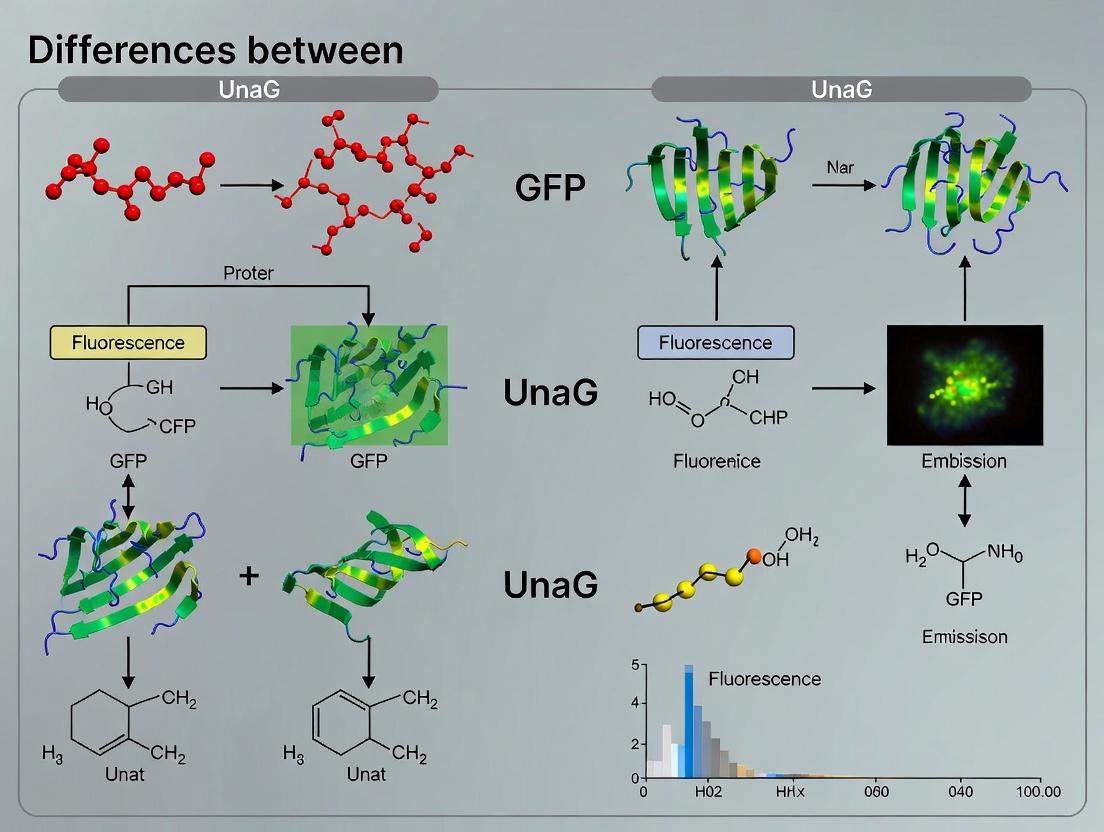
This article provides a comprehensive comparative analysis of the fluorescence mechanisms of Green Fluorescent Protein (GFP) and UnaG, a unique bilirubin-dependent fluorescent protein.
Beyond Green: Understanding the Fundamental Fluorescence Mechanisms of GFP and UnaG for Advanced Biomedical Imaging
Abstract
This article provides a comprehensive comparative analysis of the fluorescence mechanisms of Green Fluorescent Protein (GFP) and UnaG, a unique bilirubin-dependent fluorescent protein. Tailored for researchers, scientists, and drug development professionals, we explore the foundational photochemistry, practical methodological applications, optimization strategies, and rigorous comparative validation of these two distinct biological tools. The scope bridges fundamental molecular understanding with practical implications for live-cell imaging, biosensor design, and translational biomedical research.
Decoding the Molecular Glow: The Distinct Photochemical Origins of GFP and UnaG Fluorescence
This technical guide details the core mechanism of Green Fluorescent Protein (GFP) chromophore maturation, a defining paradigm for autocatalytic fluorogenesis. This discussion is framed within a broader research thesis contrasting this well-established pathway with the novel, bilirubin-dependent mechanism of UnaG, a fatty acid-binding fluorescent protein.
The Autocatalytic Maturation Pathway
The GFP chromophore is derived from a tripeptide motif (-Ser65/Tyr66/Gly67- in Aequorea victoria GFP) within the protein's own primary sequence. Its formation is a post-translational, autocatalytic process requiring only molecular oxygen and proceeds via a multi-step mechanism.
Step 1: Cyclization. A nucleophilic attack by the amide nitrogen of Gly67 on the carbonyl carbon of Ser65 (or Thr65) leads to dehydration and formation of a five-membered imidazolinone heterocycle. Step 2: Oxidation. Molecular oxygen acts as the terminal electron acceptor, leading to the dehydrogenation of the Cα-Cβ bond of Tyr66. This creates a conjugated π-electron system extending from the phenolic ring of Tyr66 into the imidazolinone ring. Step 3: Maturation. The now-planar chromophore inside the β-barrel scaffold exists in a protonated, neutral state, which can be deprotonated to the anionic form, the primary bright emitter (excitation max ~488 nm).
Quantitative Comparison of Chromophore Properties
Table 1: Key Biophysical Parameters of GFP versus UnaG Chromophore Formation
| Parameter | GFP (avGFP) | UnaG | Notes |
|---|---|---|---|
| Chromophore Precursor | Intrinsic tripeptide (SYG) | Exogenous ligand (Bilirubin) | UnaG is apo-fluoroprotein without bilirubin. |
| Catalytic Requirement | Molecular O₂ | No O₂ required | UnaG binding is O₂-independent. |
| Maturation Time (t₁/₂) | ~90 min at 28°C, ~pH 7.5 | <1 sec upon bilirubin mixing | GFP rate is temp/pH/H₂O₂ sensitive. UnaG is instantaneous binding. |
| Oxidation Mechanism | Autocatalytic dehydrogenation | Pre-formed, no oxidation | Bilirubin is already conjugated. |
| Maturation Activation Energy | ~85 kJ/mol | Not applicable (binding event) | Reflects the kinetic barrier for cyclization/oxidation. |
| Extinction Coefficient (ε) | ~56,000 M⁻¹cm⁻¹ (anion) | ~77,000 M⁻¹cm⁻¹ | At primary excitation maxima. |
| Quantum Yield (Φ) | ~0.79 (anion) | ~0.51 | Depends on specific variant. |
Detailed Experimental Protocols
Protocol 1: In Vitro Kinetics of GFP Chromophore Maturation. Objective: Measure the rate of fluorescence development in purified, denatured, and refolded apo-GFP. Materials: Purified, His-tagged apo-protein (variant S65T), Refolding buffer (50 mM Tris, 100 mM NaCl, pH 8.0), Plate reader with temperature control. Procedure:
- Denature purified apo-GFP in 6 M Guanidine-HCl for 1 hr.
- Rapidly dilute denatured protein 100-fold into pre-warmed refolding buffer in a 96-well plate.
- Immediately transfer plate to a fluorometer pre-equilibrated to 28°C.
- Monitor fluorescence (Ex 488 nm / Em 510 nm) every 2 minutes for 12 hours.
- Fit fluorescence development curve to a first-order kinetic model to derive half-time (t₁/₂).
Protocol 2: Oxygen Dependency Assay. Objective: Confirm the absolute requirement for molecular oxygen in GFP chromogenesis. Materials: Anaerobic chamber, Deoxygenated buffers (sparged with N₂), Resazurin as redox indicator. Procedure:
- Purify apo-GFP under denaturing conditions inside an anaerobic chamber (O₂ < 1 ppm).
- Dilute denatured protein into deoxygenated refolding buffer within the chamber.
- Aliquot the refolding mixture into sealed, anaerobically prepared cuvettes.
- For the +O₂ control, expose one aliquot to air.
- Monitor fluorescence development over 24 hours. Fluorescence should only develop in the aerated sample.
Visualizing the Pathways
Title: GFP vs. UnaG Chromophore Genesis Pathways
Title: Chemical Mechanism of GFP Chromophore Formation
The Scientist's Toolkit: Key Research Reagents
Table 2: Essential Reagents for Studying GFP Chromophore Maturation
| Reagent / Material | Function / Purpose in Research |
|---|---|
| Apo-GFP (S65T variant) | Purified, un-matured protein for in vitro kinetic studies; S65T accelerates oxidation. |
| Anaerobic Chamber (Glove Box) | Creates oxygen-free environment (<1 ppm O₂) to definitively prove O₂ dependency of maturation. |
| Denaturants (Guanidine-HCl, Urea) | Unfold mature GFP or arrest folding to produce apo-protein for refolding kinetics experiments. |
| Oxygen-Sensitive Probes (e.g., Resazurin) | Visual indicator of residual oxygen in anaerobic assay setups. |
| Rapid-Kinetics Stopped-Flow Apparatus | To measure very early phases of chromophore formation (millisecond to second timescales). |
| H₂O₂ Detection Kit (Fluorometric) | Quantifies hydrogen peroxide production, a proposed by-product of the oxidation step. |
| Site-Directed Mutagenesis Kit | To create tripeptide motif mutants (e.g., Tyr66Trp, Tyr66Phe) that block or alter chromophore formation. |
| Anti-GFP Nanobodies (Chromotrap) | Bind and stabilize folding intermediates for structural analysis (e.g., X-ray crystallography). |
The discovery and engineering of fluorescent proteins (FPs) have revolutionized biological imaging. The canonical Green Fluorescent Protein (GFP) from Aequorea victoria generates its chromophore autocatalytically from internal amino acids (Ser65, Tyr66, and Gly67) in an oxygen-dependent maturation process. In contrast, UnaG, a FP derived from Japanese eel (Anguilla japonica), represents a paradigm-shifting mechanism. UnaG is a non-fluorescent apoprotein that only becomes intensely fluorescent upon the reversible, high-affinity binding of an exogenous ligand: bilirubin (BR). This fundamental difference—de novo chromophore synthesis versus ligand-activated fluorescence—positions UnaG as a unique biological tool. Research contrasting GFP and UnaG mechanisms reveals profound implications for applications in anaerobic environments, as biosensors for metabolites, and in drug development for conditions like hyperbilirubinemia.
Core Mechanism: Bilirubin Binding as the Fluorescence Switch
UnaG's fluorescence is absolutely dependent on bilirubin (BR), a heme catabolite. The binding event induces a conformational change in the β-barrel structure, locking BR in a constrained, cyclized conformation that functions as the fluorescent chromophore. This switch is reversible; BR dissociation quenches fluorescence.
Quantitative Binding Affinity and Spectral Data
Table 1: Key Quantitative Parameters of UnaG Function
| Parameter | Value | Experimental Condition (if specified) | Significance |
|---|---|---|---|
| Dissociation Constant (Kd) for Bilirubin | 0.1 - 0.4 nM | Phosphate buffer, pH 8.0, 25°C | Extremely high affinity, enables detection of picomolar BR. |
| Fluorescence Excitation Maximum | 498 nm | Bound to bilirubin | Optimal excitation in blue-green region. |
| Fluorescence Emission Maximum | 527 nm | Bound to bilirubin | Green fluorescence, comparable to GFP. |
| Fluorescence Quantum Yield (Φ) | ~0.5 | Bound to bilirubin | High efficiency; about half of GFP's brightness. |
| Molar Extinction Coefficient (ε) | ~80,000 M⁻¹cm⁻¹ | At 498 nm, BR-bound | Good light absorption capability. |
| Binding Stoichiometry | 1:1 (UnaG:BR) | Determined by titration | Single, specific binding site. |
| Chromophore Maturation Time | Instantaneous upon BR addition | Anaerobic, 25°C | No oxygen-dependent maturation required. |
Table 2: GFP vs. UnaG Core Mechanism Comparison
| Feature | GFP (e.g., EGFP) | UnaG |
|---|---|---|
| Chromophore Origin | Autocatalytic from internal Ser-Tyr-Gly | Exogenous ligand (Bilirubin) |
| Oxygen Requirement | Required for maturation | Not required for fluorescence |
| Fluorescence Trigger | Irreversible maturation | Reversible ligand binding |
| Primary Application | Gene expression, protein tagging | Bilirubin quantification, anaerobic imaging, biosensing |
| Key Environmental Factor | Oxidizing environment | Ligand availability |
Experimental Protocols for Key UnaG Assays
Protocol: Measuring Bilirubin Binding Affinity (Fluorescence Titration)
Objective: Determine the dissociation constant (Kd) of UnaG for bilirubin. Reagents: Purified UnaG protein (apo-form), Bilirubin stock solution (prepared fresh in DMSO under dim light), Anaerobic buffer (50 mM Tris-HCl, 100 mM NaCl, pH 8.0, degassed). Procedure:
- Prepare a 1 nM solution of apo-UnaG in anaerobic buffer in a sealed, oxygen-free cuvette.
- Measure initial fluorescence (λex=498 nm, λem=527 nm). Signal should be minimal.
- Titrate by adding small, incremental volumes of bilirubin stock. After each addition, mix thoroughly, incubate for 60 seconds for equilibrium, and record fluorescence intensity (F).
- Continue until no further increase in fluorescence is observed (F_max).
- Data Analysis: Fit the titration data (Corrected F vs. [BR]) to a one-site specific binding model (e.g., using the quadratic solution for tight binding) to derive the Kd. Note: All steps must be performed under low light or in darkness to prevent BR photodegradation.
Protocol: Demonstrating Reversible Binding (Fluorescence Quenching/Recovery)
Objective: Demonstrate the reversibility of BR binding and fluorescence. Reagents: BR-bound fluorescent UnaG complex, Human serum albumin (HSA, a high-capacity BR binder), Buffer. Procedure:
- Record the stable fluorescence signal of the UnaG-BR complex.
- Add a molar excess of HSA (e.g., 100-fold) to the solution. HSA competes for BR binding.
- Monitor the decrease in fluorescence at 527 nm over time. The signal will drop as BR is transferred from UnaG to HSA.
- To demonstrate recovery, add a large excess of free BR to the mixture (or add more UnaG-BR complex). The system will re-establish equilibrium, potentially increasing fluorescence if free BR concentration is high enough. Significance: This experiment visually confirms the dynamic, non-covalent nature of the fluorescence switch.
Visualization of Mechanisms and Workflows
Diagram 1: UnaG Fluorescence Switch Mechanism (76 chars)
Diagram 2: Kd Determination Workflow (55 chars)
The Scientist's Toolkit: Key Research Reagent Solutions
Table 3: Essential Reagents for UnaG Research
| Item | Function/Benefit | Key Consideration |
|---|---|---|
| Recombinant Apo-UnaG Protein | Purified protein without bound bilirubin. Starting point for all binding assays. | Express in E. coli; purify under anaerobic conditions if possible to prevent oxidation. |
| Crystallized Bilirubin (≥98% purity) | The essential fluorescent ligand. High purity is critical for accurate titration. | Light and oxygen sensitive. Prepare stock solutions fresh in DMSO, use immediately under dim light. |
| Anaerobic Chamber or Sealed Cuvettes | Maintains an oxygen-free environment for BR stability and for studying anaerobic applications. | Essential for precise Kd measurements and protocols mimicking in vivo anaerobic conditions. |
| Human Serum Albumin (HSA) | Used as a competitive binding agent to demonstrate reversibility and for displacement assays. | Serves as a model for studying BR dynamics in serum. |
| Fluorescence Spectrophotometer | Measures excitation/emission spectra and monitors fluorescence intensity during titrations. | Requires sensitivity to detect low nanomolar concentration changes. |
| Anti-Bilirubin Antibody | Alternative competitor; used in immunoassay-style applications of UnaG. | Highlights UnaG's utility in developing clinical BR detection kits. |
| Site-Directed Mutagenesis Kits | For engineering UnaG variants with altered affinity, brightness, or spectral properties. | Key for tailoring UnaG for specific biosensor roles in drug development. |
This technical guide is framed within a broader research thesis investigating the fundamental mechanistic differences in fluorescence between Green Fluorescent Protein (GFP) and Unauthorized G (UnaG). GFP derives its fluorescence from an autocatalytically formed chromophore housed within a rigid beta-barrel scaffold, a classic example of de novo chromophore generation within a structural capsule. In stark contrast, UnaG, a fatty acid-binding protein, fluoresces only upon binding bilirubin, a preformed ligand, within a dedicated ligand-binding pocket. This comparison is not merely structural but mechanistic: it juxtaposes a structural fluorescence mechanism (beta-barrel as both creator and protector) against a ligand-dependent fluorescence mechanism (binding pocket as an allosteric activator). Understanding these architectural paradigms is critical for protein engineering, biosensor design, and drug development targeting protein-ligand interactions.
Architectural Principles and Quantitative Comparison
The core architectural differences are summarized in Table 1.
Table 1: Quantitative & Qualitative Comparison of Beta-Barrel and Ligand-Binding Pocket Architectures
| Feature | Beta-Barrel Scaffold (e.g., GFP) | Ligand-Binding Pocket Architecture (e.g., UnaG) |
|---|---|---|
| Primary Role | Provides a rigid, protective environment for chromophore formation and emission. | Provides a specific, often conformationally adaptable, site for exogenous ligand binding. |
| Chromophore Origin | Autocatalytic from internal tripeptide (Ser65/Tyr66/Gly67). | Preformed exogenous ligand (Bilirubin). |
| Structural Motif | 11-stranded β-barrel ("β-can") with central α-helix. | β-clam shell: 10-stranded antiparallel β-sheet forming a cavity. |
| Solvent Access | Highly shielded; barrel interior is mostly anhydrous. | Partially accessible; ligand enters via conformational change or portal. |
| Key Stability Factor | Extensive hydrogen-bonding network of the β-sheet. | Complementary shape and chemical interactions with ligand (e.g., ionic, H-bond, hydrophobic). |
| Fluorescence Trigger | Maturation (cyclization, oxidation, dehydration). | Ligand binding (induces planarization/rigidification of bilirubin). |
| Dynamic Range | Fixed, determined by maturation efficiency. | Ligand concentration-dependent. |
| Engineerability | Barrel tolerates mutations on outer surface; core is sensitive. | Pocket can be re-engineered for new ligand specificity (biosensor design). |
| Typical Size | ~24 Šdiameter, ~42 Šheight. | Pocket volume varies; UnaG-bilirubin interface ~ 700 Ų. |
| Example PDB Codes | 1EMA (GFP) | 4I3B (UnaG-Bilirubin complex) |
Experimental Protocols for Key Analyses
Protocol 3.1: Determining Binding Affinity (Kd) for Ligand-Binding Pockets (e.g., UnaG-Bilirubin)
Objective: Quantify the affinity of UnaG for bilirubin using fluorescence titration. Materials: Purified UnaG protein, bilirubin stock solution (in DMSO), assay buffer (e.g., PBS, pH 7.4, with 0.1% BSA to stabilize bilirubin), fluorimeter. Procedure:
- Prepare a 1 µM solution of apo-UnaG in assay buffer.
- Create a series of bilirubin dilutions in assay buffer, typically covering a range from 0 to >10x the expected Kd.
- In a cuvette, add 2 mL of the UnaG solution. Place in fluorimeter with excitation at 498 nm, emission at 527 nm.
- Titrate by adding small aliquots (e.g., 2-20 µL) of bilirubin stock, mixing thoroughly after each addition.
- Record fluorescence intensity at 527 nm after each addition. Correct for dilution and background fluorescence from bilirubin alone.
- Fit the corrected fluorescence (F) vs. ligand concentration [L] data to a one-site binding isotherm: F = Fmax * [L] / (Kd + [L]), where Fmax is the maximum fluorescence. The Kd is the ligand concentration at half-maximal fluorescence.
Protocol 3.2: Probing Structural Stability via Circular Dichroism (CD) Spectroscopy
Objective: Compare the thermal stability of the beta-barrel (GFP) vs. ligand-bound/apo states of a binding pocket protein (UnaG). Materials: Purified GFP, apo-UnaG, UnaG-bilirubin complex. CD spectrometer with Peltier temperature control. Procedure:
- Dialyze all protein samples into identical phosphate buffer (low absorbance).
- Load sample into a quartz cuvette (pathlength 0.1 cm for far-UV CD).
- For far-UV CD (190-260 nm), record spectra at 20°C to assess secondary structure content.
- For thermal denaturation, monitor the CD signal at a single wavelength (e.g., 218 nm for β-sheet) while ramping temperature from 20°C to 95°C at a rate of 1°C/min.
- Plot signal vs. temperature. Determine the melting temperature (Tm) as the midpoint of the unfolding transition. Compare Tm for GFP, apo-UnaG, and holo-UnaG. Ligand binding typically stabilizes the pocket architecture.
Visualization of Mechanistic Pathways
Diagram Title: GFP vs UnaG Fluorescence Activation Pathways
The Scientist's Toolkit: Essential Research Reagent Solutions
Table 2: Key Reagents and Materials for Comparative Structural-Functional Studies
| Item | Function in Research | Example/Notes |
|---|---|---|
| Expression Vectors | Cloning and overexpression of GFP/UnaG variants. | pET vectors (for E. coli), with His-tag for purification. |
| Chromatography Media | Purification of recombinant proteins. | Ni-NTA resin (for His-tag), Size-exclusion (SEC) columns for polishing. |
| Ligand Analogs/Substrates | Probing binding pocket specificity or maturation. | Bilirubin isomers (for UnaG); H₂O₂ for maturation studies (GFP). |
| Site-Directed Mutagenesis Kit | Engineering key residues in barrel or pocket. | QuickChange or Gibson Assembly kits. |
| Fluorimeter with Titration | Measuring binding constants (Kd) and fluorescence spectra. | Requires microcuvette and stirrer for titrations. |
| Circular Dichroism (CD) Spectrometer | Assessing secondary structure and thermal stability. | Far-UV capability essential for protein folding studies. |
| Crystallization Screens | Obtaining high-resolution structural data. | Sparse matrix screens (e.g., Hampton Research). |
| Surface Plasmon Resonance (SPR) Chip | Label-free kinetics analysis of ligand binding. | Carboxymethylated dextran chips (CM5). |
| Size-Exclusion Chromatography with MALS | Determining absolute molecular weight and oligomeric state. | Multi-Angle Light Scattering detector inline with HPLC. |
| Stopped-Flow Spectrometer | Measuring fast kinetics (e.g., ligand binding, chromophore maturation). | For millisecond-second timescale events. |
This whitepaper, framed within a broader thesis investigating the fundamental fluorescence mechanism differences between Green Fluorescent Protein (GFP) and UnaG, provides an in-depth technical guide to analyzing excitation and emission spectra. These photophysical properties are critical for distinguishing between fluorophores, optimizing detection in assays, and elucidating the molecular origins of fluorescence in biological systems. For researchers and drug development professionals, precise spectral analysis informs the selection of probes for imaging, biosensing, and high-throughput screening.
Fundamental Principles of Fluorescence Spectra
Fluorescence involves the absorption of light (excitation) at a specific wavelength, promoting an electron to a higher energy state, followed by emission of light at a longer wavelength (lower energy) as the electron returns to the ground state. The excitation spectrum mirrors the absorption spectrum, indicating the efficiency of photon absorption across wavelengths. The emission spectrum depicts the intensity of emitted light as a function of wavelength. The difference between the peaks of these spectra is the Stokes shift, a key parameter indicating energy loss due to vibrational relaxation and solvent interactions.
Comparative Analysis: GFP vs. UnaG
GFP from Aequorea victoria and UnaG from Japanese eel represent two distinct classes of fluorescent proteins with unique chromophores and activation mechanisms. GFP requires molecular oxygen for the maturation of its intrinsic chromophore, while UnaG fluoresces upon reversible binding of bilirubin, without the need for oxidation.
Table 1: Key Photophysical Properties of GFP and UnaG
| Property | GFP (wt) | UnaG | Experimental Conditions & Notes |
|---|---|---|---|
| Excitation Peak (λ_ex) | ~395 nm (major), ~475 nm (minor) | ~498 nm | In vitro, pH 7.4 buffer, 25°C. GFP exhibits a dual-excitation peak due to protonation states. |
| Emission Peak (λ_em) | ~509 nm | ~527 nm | In vitro, pH 7.4 buffer, 25°C. |
| Stokes Shift | ~114 nm (for 395 nm peak), ~34 nm (for 475 nm peak) | ~29 nm | UnaG exhibits a notably smaller Stokes shift. |
| Molar Extinction Coefficient (ε) | ~21,000 - 25,000 M⁻¹cm⁻¹ (at 395 nm) | ~77,000 M⁻¹cm⁻¹ (at 498 nm) | UnaG has a significantly higher absorption efficiency. |
| Fluorescence Quantum Yield (Φ) | 0.79 | 0.51 | Quantum yield for UnaG is lower but still high for a bilirubin-binding protein. |
| Chromophore | 4-(p-hydroxybenzylidene)-5-imidazolinone (HBI), formed post-translationally. | Bilirubin (exogenous ligand). | UnaG fluorescence is ligand-dependent and reversible. |
| Maturation/Oxygen Requirement | Required (hours). | Not required (instant upon bilirubin binding). | UnaG enables rapid labeling in anaerobic conditions. |
Experimental Protocols for Spectral Measurement
Protocol 3.1: Steady-State Fluorescence Spectroscopy
Objective: To record corrected excitation and emission spectra for a purified fluorescent protein sample.
Materials: See "The Scientist's Toolkit" below. Procedure:
- Sample Preparation: Dialyze purified GFP or UnaG into a degassed, non-fluorescent buffer (e.g., 50 mM Tris-HCl, 100 mM NaCl, pH 7.4). For UnaG, ensure saturation with bilirubin (typically 1:1.2 molar ratio). Determine exact protein concentration via absorbance (using known ε).
- Instrument Setup: Use a fluorometer equipped with a Xenon lamp, monochromators, and a PMT detector. Set sample chamber temperature to 25°C. Use a 1 cm pathlength quartz cuvette.
- Emission Spectrum Scan:
- Set excitation wavelength (λex) to the known peak (e.g., 395 nm for GFP, 498 nm for UnaG).
- Set excitation and emission slit widths to 5 nm (adjust if signal is too low/high).
- Scan emission from λex + 10 nm to 750 nm at a slow speed (e.g., 100 nm/min).
- Save the spectrum.
- Excitation Spectrum Scan:
- Set emission wavelength (λem) to the known peak (e.g., 509 nm for GFP, 527 nm for UnaG).
- Keep slit widths consistent.
- Scan excitation from 250 nm to λem - 10 nm.
- Save the spectrum.
- Correction: Apply instrument-specific correction factors for lamp intensity (excitation) and detector sensitivity (emission) to all spectra.
- Normalization: Normalize corrected spectra to their maximum intensity (1.0) for comparative plotting. Report raw peak intensities for quantum yield calculations.
Protocol 3.2: Determination of Quantum Yield (Φ)
Objective: To determine the fluorescence quantum yield of a sample relative to a standard.
Procedure (Relative Method):
- Standard Selection: Use a standard with known Φ in the same solvent as the sample (e.g., Quinine sulfate in 0.1 M H₂SO₄, Φ=0.54).
- Absorbance Measurement: Dilute sample and standard to have absorbance < 0.1 at the chosen excitation wavelength to avoid inner filter effects.
- Fluorescence Measurement: Record the integrated area under the corrected emission spectrum for both sample and standard at the same excitation wavelength and identical instrument settings.
- Calculation: Apply the formula:
Φ_sample = Φ_standard * (A_sample / A_standard) * (η_sample² / η_standard²)whereAis the integrated emission area, andηis the refractive index of the solvent.
Visualizing Photophysical Pathways and Workflows
Diagram 1: Comparative fluorescence activation pathways for GFP and UnaG.
Diagram 2: Experimental workflow for measuring excitation and emission spectra.
The Scientist's Toolkit: Key Research Reagent Solutions
| Item | Function & Relevance to GFP/UnaG Studies |
|---|---|
| High-Purity Buffers (e.g., Tris, PBS) | Maintain physiological pH and ionic strength for protein stability during spectral measurements. |
| Bilirubin (for UnaG studies) | The essential, exogenous ligand required to activate UnaG fluorescence. Must be handled in dark, dissolved in DMSO/alkaline buffer. |
| Spectrophotometer (UV-Vis) | Measures absorbance spectrum, determines protein concentration (via ε), and checks for sample purity/scattering. |
| Fluorometer (Spectrofluorometer) | Core instrument for acquiring excitation and emission spectra. Requires a Xenon lamp for broad spectral output. |
| Quartz Cuvettes (1 cm pathlength) | Low-fluorescence cuvettes transparent to UV and visible light, essential for accurate spectral data. |
| Quantum Yield Standards (e.g., Quinine sulfate) | Reference compounds with known fluorescence quantum yield for calculating the Φ of unknown samples. |
| Size-Exclusion Chromatography (SEC) Columns | For purifying fluorescent protein samples and removing aggregates that can cause light scattering artifacts. |
| Anaerobic Chamber/Glove Box (for UnaG) | Enables study of UnaG activation and fluorescence in the absence of oxygen, highlighting its key advantage over GFP. |
Within the ongoing research on fluorescence mechanism differences between Green Fluorescent Protein (GFP) and UnaG, the role of molecular oxygen (O₂) represents a fundamental biochemical divergence. GFP, derived from Aequorea victoria, requires O₂ for a post-translational maturation process involving chromophore formation. In stark contrast, UnaG, a fluorescent protein from the Japanese freshwater eel (Anguilla japonica), binds bilirubin as a pre-formed chromophore and fluoresces immediately in an O₂-independent manner. This whitepaper provides an in-depth technical comparison of these mechanisms, essential for researchers applying these proteins as biosensors, reporters, or in drug development under varying oxygen tensions.
GFP Maturation: An Oxygen-Dependent Process
The maturation of GFP involves a series of autocatalytic reactions culminating in a cyclized p-hydroxybenzylidene-imidazolidinone chromophore.
2.1 Core Chemical Steps:
- Cyclization: Residues Ser65, Tyr66, and Gly67 undergo dehydration to form an imidazolinone ring.
- Dehydrogenation/Oxidation: A crucial oxidation step, requiring molecular O₂ as the terminal electron acceptor, converts the Cα-Cβ bond in Tyr66 into a double bond, extending conjugation and enabling fluorescence.
2.2 Experimental Evidence for O₂ Dependence:
- Key Finding: GFP does not fluoresce when expressed in strictly anaerobic environments.
- Protocol for Anaerobic Expression & Maturation Assay:
- Transform E. coli with a plasmid encoding GFP (e.g., GFPuv).
- Grow cultures in sealed, anaerobic chambers purged with nitrogen/argon gas mix (<1 ppm O₂) or using anaerobic media supplements.
- Induce protein expression anaerobically.
- Harvest cells and lyse under anaerobic conditions.
- Measure fluorescence (Ex ~395/475 nm, Em ~509 nm) in situ within the chamber or using sealed cuvettes. Fluorescence is absent.
- Expose the lysate or purified non-fluorescent protein to atmospheric O₂. Monitor fluorescence recovery over time (t½ ~minutes to hours).
UnaG Activation: An Oxygen-Independent Mechanism
UnaG fluorescence is activated by the direct, non-covalent binding of bilirubin (BR), a product of heme catabolism, without any requirement for O₂.
3.1 Core Chemical Steps:
- Pre-formed Apo-protein: UnaG is synthesized and folds into its stable, non-fluorescent apo-state.
- Chromophore Binding: Bilirubin diffuses into the protein's binding pocket and coordinates via electrostatic and hydrogen-bonding interactions.
- Immediate Fluorescence: Binding induces a conformational shift and rigidification of BR, resulting in instantaneous fluorescence (Ex ~498 nm, Em ~527 nm).
3.2 Experimental Evidence for O₂ Independence:
- Key Finding: UnaG fluoresces immediately upon bilirubin binding under anaerobic conditions.
- Protocol for Anaerobic Fluorescence Activation Assay:
- Express and purify apo-UnaG protein under standard (aerobic) conditions.
- In an anaerobic glove box, prepare a solution of purified UnaG in degassed buffer.
- Prepare a stock solution of bilirubin in DMSO, also maintained anaerobically.
- Mix UnaG and bilirubin within the anaerobic environment at a 1:1-2 molar ratio.
- Measure fluorescence (Ex ~498 nm, Em ~527 nm) immediately without exposure to O₂. Full fluorescence is observed.
Quantitative Data Comparison
Table 1: Comparative Biochemistry of GFP vs. UnaG Fluorescence
| Parameter | Green Fluorescent Protein (GFP) | UnaG (Bilirubin-binding protein) |
|---|---|---|
| Chromophore Source | Autocatalytic from internal Ser-Tyr-Gly sequence | Exogenous, pre-formed bilirubin (BR) |
| O₂ Requirement | Absolute. Serves as electron acceptor in dehydrogenation. | None. Fluorescence is O₂-independent. |
| Maturation Time | Slow (t½ ~minutes to hours, temp-dependent) | Instantaneous upon BR binding |
| Key Cofactor | Molecular oxygen (O₂) | Bilirubin (BR) |
| Anaerobic Fluorescence | None | Full, immediate |
| Maturation Quantum Yield | High (~0.79 for GFP-S65T) | High (~0.51) |
| Primary Application Context | Reporter gene in aerobic systems; hypoxia indicator. | Reporter in anaerobic environments; bilirubin sensor. |
Table 2: Experimental Conditions & Outcomes
| Experiment | Condition | GFP Outcome | UnaG Outcome |
|---|---|---|---|
| Expression in Aerobic E. coli | Standard LB culture, shaking | Fluorescent colonies | Non-fluorescent colonies (unless BR added) |
| Expression in Anaerobic E. coli | Sealed chamber, anaerobic media | Non-fluorescent colonies | Non-fluorescent colonies (unless BR added) |
| Purified Apo-protein + O₂ | Aerobic buffer incubation | Becomes fluorescent over time | No fluorescence (unless BR added) |
| Purified Apo-protein + BR (Aerobic) | Incubation in air | N/A (GFP does not bind BR) | Immediate fluorescence |
| Purified Apo-protein + BR (Anaerobic) | Incubation in O₂-free atmosphere | N/A | Immediate fluorescence |
Pathway Diagrams
Diagram 1: Oxygen-dependent GFP chromophore maturation pathway.
Diagram 2: Oxygen-independent UnaG activation by bilirubin binding.
Diagram 3: Comparative experimental workflow for GFP and UnaG.
The Scientist's Toolkit: Research Reagent Solutions
Table 3: Essential Materials for Key Experiments
| Item | Function & Specificity |
|---|---|
| Anaerobic Chamber (Glove Box) | Maintains O₂-free atmosphere (<1 ppm) for protein expression, purification, and fluorescence assays under strict anaerobic conditions. |
| Gas-Purging System / Sealable Vials | Alternative for creating anaerobic environments for bacterial culture or sample incubation using inert gases (N₂, Ar). |
| Bilirubin (from gold label suppliers) | High-purity, exogenous chromophore for UnaG activation. Light and oxygen-sensitive; requires careful handling and anaerobic stock preparation in DMSO. |
| Plasmids: pGFPuv (or similar) | Standardized vector for high-level, soluble GFP expression in E. coli, essential for controlled maturation studies. |
| Plasmids: pET-UnaG (His-tagged) | Vector for recombinant, purifiable apo-UnaG expression. His-tag facilitates purification under both aerobic and anaerobic conditions. |
| Anaerobic Growth Media (e.g., TGY) | Specially formulated microbial growth media containing reducing agents (thioglycolate, cysteine) to maintain anaerobiosis. |
| Fluorometer with Temperature Control | For kinetic measurements of fluorescence maturation (GFP) or immediate activation (UnaG). Requires capability for sealed cuvette measurements. |
| Rapid Kinetics Stopped-Flow Apparatus | (Advanced) For measuring the very fast binding kinetics of bilirubin to UnaG in the millisecond range. |
Strategic Implementation: Choosing Between GFP and UnaG for Specific Research and Diagnostic Applications
The discovery and engineering of the Green Fluorescent Protein (GFP) from Aequorea victoria revolutionized molecular and cellular biology by enabling the direct visualization of cellular processes in living systems. Within the broader investigation comparing fluorescent protein mechanisms, this whitepaper details the established principles and applications of GFP. This serves as a technical baseline against which novel fluorescent proteins like UnaG—a bilirubin-inducible fluorescent protein from Japanese eel—can be contrasted. Key differences, such as GFP's oxygen-dependent chromophore formation versus UnaG's ligand-dependent fluorescence, underscore the diversity of optical tools available for advanced research and drug development.
Core Principles and Quantitative Data
GFP functions via the autocatalytic formation of a chromophore within its barrel structure, requiring molecular oxygen. Its spectral properties and derivatives have been extensively quantified.
Table 1: Key Spectral Properties of GFP and Common Variants
| Protein | Excitation Max (nm) | Emission Max (nm) | Extinction Coefficient (M⁻¹cm⁻¹) | Quantum Yield | Brightness (Relative to EGFP) | Maturation Half-time (37°C) |
|---|---|---|---|---|---|---|
| wtGFP | 395/475 | 509 | 21,000 / 7,000 | 0.79 | 0.32 | ~100 min |
| EGFP | 488 | 507 | 56,000 | 0.60 | 1.00 (Reference) | ~30 min |
| sfGFP | 485 | 510 | 64,000 | 0.65 | 1.25 | ~10 min |
| GFPuv | 395 | 509 | 30,000 | 0.79 | 0.70 | ~90 min |
Table 2: Comparison of Fluorescence Mechanisms: GFP vs. UnaG
| Feature | GFP (Aequorea victoria) | UnaG (Anguilla japonica) |
|---|---|---|
| Chromophore | Cyclized Ser-Tyr-Gly (or derivatives) | Bilirubin (Linear tetrapyrrole) |
| Formation | Autocatalytic, post-translational, requires O₂ | Pre-formed, requires non-covalent binding |
| Induction | Constitutive (once folded) | Ligand-dependent (requires bilirubin) |
| Maturation | Time-dependent (minutes-hours) | Instantaneous upon ligand binding |
| Primary Excitation/Emission | ~488/509 nm (for EGFP) | ~498/527 nm |
| Key Application | Protein tagging, gene reporting, long-term tracking | Hypoxic environments, bilirubin sensing |
Key Methodologies and Experimental Protocols
Protocol: Generation of a GFP-Tagged Protein for Live-Cell Localization
Objective: To create and express a fusion protein of a target protein with GFP for subcellular localization studies.
Materials:
- Gene of Interest (GOI) cDNA.
- EGFP Vector: e.g., pEGFP-N1/C1 (Clontech/Takara Bio).
- Competent Cells: DH5α for cloning.
- Culture Cells: HEK293T or HeLa for expression.
- Transfection Reagent: Polyethylenimine (PEI) or Lipofectamine 3000.
- Imaging Medium: Leibovitz's L-15 medium without phenol red.
- Confocal Microscope.
Procedure:
- Cloning: Amplify the GOI coding sequence (without stop codon for C-terminal fusions) using primers with appropriate restriction sites (e.g., AgeI and BamHI). Digest both the PCR product and the pEGFP-N1 vector. Ligate using T4 DNA ligase and transform into DH5α competent cells. Select colonies on kanamycin plates, followed by colony PCR and sequencing to confirm the correct in-frame fusion.
- Transfection: Plate mammalian cells in a 35-mm glass-bottom dish 24 hours prior to reach 70-80% confluency. For PEI transfection, mix 2 µg of plasmid DNA with 150 µL of serum-free medium. Add 6 µL of 1 mg/mL PEI solution, vortex, incubate 15 min at RT, then add dropwise to cells.
- Expression & Imaging: Incubate cells for 24-48 hours at 37°C, 5% CO₂. Replace medium with pre-warmed imaging medium. Image live cells using a confocal microscope with a 488 nm laser line and a 500-550 nm bandpass emission filter.
- Controls: Always include cells transfected with untagged GFP to assess background and localization artifacts.
Protocol: Quantitative Gene Expression Reporting Using a GFP Reporter
Objective: To measure promoter activity dynamically using GFP as a transcriptional reporter.
Materials:
- Reporter Plasmid: Promoter of interest cloned upstream of GFP in a promoterless vector.
- Control Vectors: Constitutively active promoter (e.g., CMV) driving GFP (positive control), empty GFP vector (negative control).
- Microplate Reader/FACS: For fluorescence quantification.
- 96-well black-walled, clear-bottom plates.
Procedure:
- Cell Seeding and Transfection: Seed cells in a 96-well plate. Co-transfect each well with 100 ng of the GFP reporter plasmid and 10 ng of a constitutive Renilla luciferase plasmid for normalization, using a suitable transfection reagent.
- Time-Course Measurement: At defined intervals (e.g., 24, 48, 72h post-transfection), measure fluorescence directly in the plate reader (Ex: 485±10 nm, Em: 528±10 nm). Perform Renilla luciferase assays on the same wells using a commercial substrate (e.g., coelenterazine) in a luminometer to control for transfection efficiency.
- Data Analysis: Calculate normalized GFP activity as (GFP Fluorescence Units) / (Renilla Luciferase Units). Plot normalized fluorescence versus time or treatment condition.
- Validation: Confirm results with parallel RT-qPCR for the endogenous gene of interest.
Visualization of Key Concepts
Title: Workflow for GFP Fusion Protein Localization Study
Title: GFP vs UnaG Fluorescence Activation Pathways
The Scientist's Toolkit: Key Research Reagent Solutions
Table 3: Essential Reagents for GFP-Based Experiments
| Reagent / Material | Primary Function & Explanation |
|---|---|
| pEGFP-N1/C1 Vectors | Commercial plasmids with optimized EGFP for N- or C-terminal fusions; contain CMV promoter for mammalian expression and multiple cloning sites. |
| sfGFP (Superfolder GFP) Plasmid | A highly robust GFP variant with faster folding and greater resistance to aggregation, ideal for difficult-to-tag proteins or harsh environments. |
| Anti-GFP Nanobody (e.g., GFP-Trap) | A single-domain antibody used for immunoprecipitation or live-cell manipulation of GFP-tagged proteins with high affinity. |
| CellLight BacMam 2.0 (Thermo Fisher) | Baculovirus-based system for delivering organelle-targeted GFP (e.g., GFP- Actin, GFP-Tubulin, GFP-Mitochondria) into mammalian cells with low toxicity. |
| HaloTag or SNAP-tag Systems | Protein tagging platforms that use a chemical ligase tag and a fluorescent ligand (often GFP-like). Allows for pulse-chase and super-resolution imaging beyond classic GFP. |
| FACS (Fluorescence-Activated Cell Sorter) | Instrument essential for quantifying and isolating cells based on GFP fluorescence intensity, enabling high-throughput reporter assays or population selection. |
| Genetically Encoded Calcium Indicators (e.g., GCaMP) | GFP-based calcium sensors (calmodulin-M13-GFP fusion) that change fluorescence intensity with Ca²⁺ binding, exemplifying GFP as a reporter for dynamic physiological signals. |
| CRISPR GFP Knock-in Donor Template | A homology-directed repair (HDR) template plasmid containing GFP and selection markers for endogenous gene tagging at the genomic locus via CRISPR/Cas9. |
Leveraging UnaG for Hypoxia-Insensitive Imaging and Deep-Tissue Applications
This whitepaper details the technical application of UnaG, a unique fatty acid-binding fluorescent protein derived from the Japanese freshwater eel (Anguilla japonica). The core thesis framing this research is a comparative analysis of the fundamental fluorescence mechanisms between Green Fluorescent Protein (GFP) and UnaG. GFP fluorescence relies on the autocatalytic formation of a chromophore within an oxygen-dependent process, limiting its utility in hypoxic environments (e.g., solid tumors, ischemic tissues). In stark contrast, UnaG binds bilirubin, a ubiquitous endogenously produced metabolite, as its chromophore. This binding event, which does not require molecular oxygen, instantly and reversibly activates bright green fluorescence. This key mechanistic difference forms the foundation for UnaG's superior utility in hypoxia-insensitive imaging and deep-tissue applications.
Core Mechanism & Comparative Data
The essential biochemical distinction is summarized in the table below.
Table 1: Core Fluorescence Mechanism Comparison: GFP vs. UnaG
| Feature | Green Fluorescent Protein (GFP) | UnaG (Unagi Green Fluorescent Protein) |
|---|---|---|
| Chromophore | 4-(p-hydroxybenzylidene)-5-imidazolinone (HBI) formed within the protein. | Exogenously bound bilirubin (BR). |
| Formation/Activation | Autocatalytic, post-translational cyclization and oxidation. Oxygen-dependent. | Non-covalent, reversible binding of pre-formed bilirubin. Oxygen-independent. |
| Fluorescence Peak | ~509 nm | ~527 nm |
| Extinction Coefficient (ε) | ~83,000 M⁻¹cm⁻¹ | ~80,000 M⁻¹cm⁻¹ |
| Quantum Yield (Φ) | ~0.79 | ~0.51 (with BR bound) |
| Key Environmental Sensitivity | Highly sensitive to hypoxia; fluorescence cannot develop or mature without O₂. | Insensitive to hypoxia; fluorescence is activated whenever BR is available. |
| Endogenous Activator | None. Requires expression and maturation in situ. | Bilirubin, a universal mammalian heme metabolite. |
The critical signaling and activation pathways for UnaG are depicted in the following diagram.
Diagram Title: UnaG Fluorescence Activation Pathway by Endogenous Bilirubin
Experimental Protocols for Key Applications
Protocol: Validating Hypoxia-Insensitive Fluorescence In Vitro
Objective: To demonstrate UnaG fluorescence activation under anoxic conditions compared to GFP maturation.
Materials: See "The Scientist's Toolkit" (Section 5). Method:
- Cell Preparation: Seed two sets of cells in imaging chambers. Transfect one set with a plasmid encoding UnaG and the other with GFP.
- Hypoxia Chamber Setup: Place chambers in a sealed hypoxia workstation (e.g., 0.1% O₂, 5% CO₂, 94.9% N₂). Maintain a control set in normoxia (21% O₂).
- Bilirubin Addition: For UnaG samples, add 100 nM bilirubin to the medium 1 hour before imaging.
- Time-Course Imaging: At defined intervals (0, 2, 4, 8, 12, 24h), image both sets using a confocal microscope (Ex/Em: 488/500-550 nm for both). Use identical exposure settings.
- Quantification: Measure mean fluorescence intensity (MFI) per cell using image analysis software (e.g., ImageJ).
Expected Outcome: GFP fluorescence will fail to increase in hypoxia. UnaG fluorescence will achieve maximum intensity immediately post-bilirubin addition in both normoxia and hypoxia.
Protocol: Deep-Tissue Imaging in a Tumor Xenograft Model
Objective: To image tumor cell dynamics in deep tissue leveraging UnaG's activation by systemic bilirubin.
Materials: See "The Scientist's Toolkit" (Section 5). Method:
- Stable Cell Line: Generate a tumor cell line (e.g., HeLa) stably expressing UnaG using lentiviral transduction.
- Tumor Implantation: Subcutaneously or orthotopically implant 1x10⁶ UnaG-expressing cells into immunodeficient mice.
- In Vivo Imaging: When tumors reach ~100 mm³, anesthetize the mouse. Acquire baseline fluorescence images using an in vivo imaging system (IVIS) or a two-photon microscope for deeper penetration (Ex/Em filters: 480/535 nm). No substrate injection is needed.
- Modulation (Optional): To enhance signal, administer a low dose of bilirubin (e.g., 30 mg/kg i.p.) 60 min prior to imaging. To quench signal, administer Sn-protoporphyrin (an HO-1 inhibitor) to reduce endogenous BR.
- Ex Vivo Validation: Excise the tumor, section, and counterstain with DAPI for histological correlation.
Data Presentation: Performance Metrics
The practical advantages of UnaG are quantifiable, as shown in the following tables.
Table 2: Imaging Performance in Hypoxic Environments
| Parameter | GFP-based Sensor | UnaG-based Sensor | Notes |
|---|---|---|---|
| Time to Max Signal in 0.1% O₂ | >24 hours (incomplete maturation) | <5 minutes | Post-bilirubin addition for UnaG. |
| Signal Stability in Anoxia | Decreases over time (photobleaching only) | Stable | Replenishable by BR turnover. |
| Tumor Core Penetration (in vivo) | Weak/None | Strong | Direct correlation with hypoxic regions. |
Table 3: Comparison for Deep-Tissue Imaging Modalities
| Modality | UnaG + 2-Photon Microscopy | GFP + 2-Photon Microscopy | NIR-II Dyes |
|---|---|---|---|
| Excitation (nm) | 980 (2-photon) | 960 (2-photon) | ~1064 |
| Emission (nm) | ~527 | ~509 | >1100 |
| Tissue Penetration Depth | ~700-900 µm | ~500-700 µm (if mature) | >1500 µm |
| Oxygen Dependency | No | Yes | No |
| Requires Injection | No (utilizes endogenous BR) | No | Yes (exogenous dye) |
| Genetic Encoding | Yes | Yes | No |
The workflow for deep-tissue tumor imaging with UnaG is as follows:
Diagram Title: UnaG Deep-Tissue Tumor Imaging Workflow
The Scientist's Toolkit: Research Reagent Solutions
| Item / Reagent | Function / Rationale |
|---|---|
| pUnaG Expression Vector (e.g., pCMV-UnaG) | Mammalian expression plasmid for transient or stable UnaG expression. |
| Bilirubin (≥98% purity) | Prepared in DMSO (stock) and diluted in PBS with mild alkali (e.g., 0.1M NaOH) for in vitro studies. Activates UnaG fluorescence. |
| Sn-Protoporphyrin IX (SnPP) | Heme oxygenase (HO-1) inhibitor. Used in vivo to lower endogenous bilirubin levels, serving as a negative control. |
| Hypoxia Chamber/Workstation | Maintains anoxic environment (0.1-1% O₂) for validating oxygen-independent fluorescence. |
| IVIS Spectrum or equivalent | In vivo imaging system for whole-animal, deep-tissue fluorescence quantification. |
| Two-Photon Microscope | For high-resolution, deep-tissue (>500 µm) imaging in vivo. Excitation at ~980 nm for UnaG. |
| Anti-UnaG Antibody | For Western blot validation of UnaG expression independent of fluorescence. |
| Lentiviral UnaG Construct | For creating stable, long-term expressing cell lines for xenograft models. |
| Matrigel | For orthotopic or subcutaneous tumor cell implantation to enhance engraftment. |
UnaG as a Direct, Quantitative Biosensor for Bilirubin Metabolism and Liver Function
This whitepaper details the application of UnaG, a fluorescent fatty acid-binding protein from Japanese eel, as a quantitative biosensor for bilirubin. This work is framed within a broader thesis investigating the fundamental mechanistic differences between UnaG and Green Fluorescent Protein (GFP) fluorescence. Unlike GFP, which forms its chromophore autocatalytically from its own polypeptide backbone, UnaG remains non-fluorescent until it binds its specific ligand, bilirubin, with 1:1 stoichiometry. This ligand-dependent "turn-on" fluorescence provides a direct, stoichiometric readout of bilirubin concentration, forming the basis for its utility in sensing hepatic function. The unique mechanism of UnaG offers advantages in specificity and quantitative rigor over GFP-based sensors, particularly for clinical and pharmacological applications.
UnaG Fluorescence Mechanism and Quantitative Binding
UnaG fluorescence is absolutely dependent on bilirubin (BR) binding. The binding event induces a conformational change in UnaG, positioning BR in a constrained, planar conformation ideal for fluorescence. The fluorescence quantum yield of the UnaG-BR complex is exceptionally high (~0.51), enabling sensitive detection.
Table 1: Quantitative Binding and Photophysical Properties of UnaG
| Property | Value | Notes / Comparison to GFP |
|---|---|---|
| Ligand | Bilirubin (unconjugated, BR) | Specific ligand; GFP chromophore is intrinsic. |
| Binding Stoichiometry | 1:1 (UnaG:BR) | Enables direct molar quantification. |
| Dissociation Constant (Kd) | ~0.1 - 1 nM (Ultra-high affinity) | Binding is essentially irreversible under physiological conditions. |
| Excitation Maximum (λ_ex) | ~498 nm | Similar to EGFP (~488 nm). |
| Emission Maximum (λ_em) | ~527 nm | Similar to EGFP (~507 nm). |
| Fluorescence Quantum Yield (Φ) | ~0.51 | Higher than many GFP variants (e.g., EGFP Φ ~0.60). |
| Fluorescence Mechanism | Ligand-activated "Turn-on" | Contrasts with GFP's constitutive fluorescence. |
Experimental Protocols for Liver Function Assessment
Protocol: Direct Quantification of Serum Bilirubin Using Recombinant UnaG
Purpose: To measure total unconjugated bilirubin in human serum samples. Materials: See "The Scientist's Toolkit" below. Procedure:
- Sample Preparation: Dilute serum sample 1:10 in Assay Buffer (20 mM Tris-HCl, 150 mM NaCl, pH 8.0).
- UnaG Solution: Prepare a 1 µM stock of purified, recombinant UnaG in Assay Buffer.
- Assay Setup: In a black 96-well plate, mix 90 µL of diluted serum with 10 µL of UnaG stock (final [UnaG] = 100 nM). Perform in triplicate.
- Controls: Include a bilirubin standard curve (0-200 nM BR in Assay Buffer + 100 nM UnaG) and a serum blank (diluted serum + Assay Buffer without UnaG).
- Measurement: Incubate at 25°C for 5 min. Measure fluorescence (excitation: 485/20 nm, emission: 528/20 nm) using a plate reader.
- Calculation: Subtract blank fluorescence. Determine bilirubin concentration from the standard curve, correcting for dilution factor.
Protocol: In Vitro Hepatocyte Assay for Bilirubin Uptake and Metabolism
Purpose: To monitor real-time bilirubin clearance in cultured hepatocytes. Procedure:
- Culture hepatocytes (e.g., HepG2 or primary human hepatocytes) in a collagen-coated 96-well imaging plate.
- Transiently transfert cells with a plasmid expressing UnaG fused to a nuclear export signal (NES) for cytoplasmic localization. A GFP-expressing plasmid serves as a transfection control/constitutive fluorescence marker.
- 48 hours post-transfection, wash cells and add culture medium containing a sub-toxic dose of unconjugated bilirubin (e.g., 5 µM).
- Immediately acquire time-lapse fluorescence images (UnaG channel: 488/527 nm; GFP channel: 488/509 nm) every 15 minutes for 6-12 hours using a live-cell imaging system.
- Data Analysis: Quantify cytoplasmic UnaG fluorescence intensity (normalized to baseline or to GFP fluorescence to control for cell viability/expression variance). A decrease in UnaG signal over time indicates bilirubin metabolism/clearance by functional hepatocytes.
Key Signaling and Metabolic Pathways
Title: UnaG Sensing within Hepatocyte Bilirubin Metabolism Pathway
Title: UnaG vs GFP Fluorescence Activation Mechanisms
The Scientist's Toolkit: Essential Research Reagents
Table 2: Key Reagents for UnaG-Based Bilirubin Sensing
| Reagent / Material | Function / Role | Example Vendor / Source |
|---|---|---|
| Recombinant UnaG Protein | Core biosensor element. High purity is critical for accurate Kd measurement. | Produced in-house from E. coli expression vector (pET-28a-UnaG) or purchased from specialty biotech suppliers. |
| Unconjugated Bilirubin Standard | For calibration curves and control experiments. Must be handled in dim light, prepared fresh in DMSO/alkaline buffer. | Sigma-Aldrich, Frontier Scientific. |
| Assay Buffer (Tris-HCl, pH 8.0) | Optimal buffer for maintaining UnaG stability and BR solubility. | Prepared in-lab from molecular biology grade reagents. |
| Human Serum Samples | Clinical test matrix for method validation. | Commercial biobanks or institutional IRB-approved collections. |
| Fluorescence Plate Reader | Quantification of UnaG-BR complex fluorescence (Ex/Em ~498/527 nm). | Instruments from BMG LabTech, Tecan, or Molecular Devices. |
| Live-Cell Imaging System | For kinetic assays in hepatocytes. Requires environmental control and sensitive CCD/CMOS camera. | Systems from Molecular Devices, Olympus, or Nikon. |
| UnaG Expression Plasmid (pCMV-UnaG-NES) | For intracellular expression in hepatocyte models. | Constructed in-lab by cloning UnaG cDNA into mammalian expression vectors. |
| Primary Human Hepatocytes | Gold-standard in vitro model for liver function studies. | Lonza, BioIVT, or other cell providers. |
Within a broader thesis investigating the fundamental differences between GFP (green fluorescent protein) and UnaG (a bilirubin-inducible fluorescent protein) fluorescence mechanisms, the design of functional fusion proteins presents distinct challenges and opportunities. This guide details the critical considerations of stability, maturation time, and background signals, which are paramount for successful application in live-cell imaging, high-throughput screening, and drug development.
Stability: Thermodynamic and Kinetic Perspectives
Protein stability dictates the functional half-life of a fusion construct. For GFP-based fusions, the rigid β-barrel structure confers high thermodynamic stability but can be perturbed by fusion partner misfolding. UnaG, while also stable, requires non-covalent binding of bilirubin, making its signal dependent on both protein integrity and cofactor availability.
Key Quantitative Stability Data:
| Parameter | GFP (e.g., EGFP) | UnaG | Implication for Fusion Design |
|---|---|---|---|
| Thermal Denaturation (Tm) | ~70°C | ~65°C (apo-protein) | GFP may tolerate higher experimental temperatures. |
| pH Stability Range | 6.0 - 9.0 | 5.5 - 10.0 (holo-form) | UnaG offers broader utility in acidic organelles, but signal requires bilirubin. |
| Resistance to Proteolysis | High (buried chromophore) | Moderate (chromophore accessible) | Linker design and partner choice are critical for UnaG fusions to prevent cofactor dissociation. |
Maturation Time: From Folding to Fluorescence
Maturation time—the period required for chromophore formation and activation—directly impacts the temporal resolution of experiments. This is a core mechanistic difference: GFP chromophore forms autocatalytically via cyclization and oxidation, while UnaG fluorescence is instant upon bilirubin binding.
Quantitative Maturation Kinetics:
| Fluorescent Protein | Maturation Half-time (t₁/₂) at 37°C | Key Determinants |
|---|---|---|
| EGFP | ~30 minutes | Oxygen-dependent oxidation; faster-folding mutants (e.g., F64L) available. |
| UnaG | < 1 minute (post-bilirubin addition) | Diffusion and binding kinetics of bilirubin; intracellular bilirubin concentration. |
Experimental Protocol: Measuring Maturation Kinetics
- Objective: Quantify the time-dependent development of fluorescence post-protein synthesis.
- Materials: Bacterial or mammalian expression system, fluorescence plate reader/spectrofluorometer.
- Method (for GFP):
- Induce expression synchronously (e.g., with IPTG or tetracycline).
- Immediately inhibit new protein synthesis (e.g., with chloramphenicol or cycloheximide).
- Measure fluorescence intensity (Ex/Em: ~488/510 nm) over time at 37°C.
- Fit data to a first-order exponential rise equation to determine t₁/₂.
- Method (for UnaG):
- Express apo-UnaG fusion in bilirubin-depleted medium.
- Add a saturating concentration of bilirubin (e.g., 1 µM) and rapidly mix.
- Monitor fluorescence intensity (Ex/Em: ~498/527 nm) continuously. The curve reflects bilirubin binding kinetics.
Background Signals: Specificity and Noise Reduction
Background signals arise from autofluorescence, non-specific binding, or incomplete maturation. The UnaG/bilirubin system offers a unique advantage: negligible fluorescence in the absence of its specific cofactor, enabling extremely low-background detection.
Comparative Background Analysis:
| Signal Source | GFP-based Fusion | UnaG-based Fusion |
|---|---|---|
| Apo-Protein Fluorescence | Yes (immature chromophore can have weak emission) | None (completely dark without bilirubin) |
| Cofactor Cross-talk | Requires O₂; can be perturbed by ROS/RNS. | Highly specific to bilirubin; mammalian [Bilirubin] ~nM. |
| Photobleaching | Moderate to High | Low (bilirubin binding is reversible and renewable) |
Experimental Protocol: Signal-to-Background Ratio (SBR) Assay
- Objective: Quantify the specific signal over cellular autofluorescence.
- Materials: Cells expressing fusion protein, control untransfected cells, fluorescence microscope or flow cytometer.
- Method:
- For UnaG: Ensure bilirubin supplementation in experimental samples.
- Acquire fluorescence images or cell-by-cell fluorescence data for both sample and control populations.
- Measure mean fluorescence intensity (MFI) in regions of interest or per cell.
- Calculate SBR: SBR = (MFIsample – MFIcontrol) / MFI_control.
- For time-lapse, monitor SBR over time to account for photobleaching (GFP) or bilirubin depletion (UnaG).
The Scientist's Toolkit: Research Reagent Solutions
| Item | Function/Application |
|---|---|
| pEGFP-N1/C1 Vectors | Standard cloning vectors for creating C- or N-terminal GFP fusions; contains CMV promoter for mammalian expression. |
| UnaG Expression Plasmid | Plasmid encoding codon-optimized UnaG for expression in target systems (e.g., mammalian, bacterial). |
| Bilirubin (Unconjugated) | Cofactor for UnaG. Must be prepared fresh in DMSO or dark alkaline buffer to prevent oxidation. |
| Protease Inhibitor Cocktail | Preserves fusion protein integrity during purification and in lysate-based assays. |
| HRV 3C or TEV Protease | For cleaving affinity tags from purified fusion proteins without damaging the protein of interest. |
| Flexible Peptide Linkers | (e.g., (GGGGS)n). Connects fusion partners, reduces steric interference, and improves folding. |
| Anti-GFP Nanobody | Can be used for purification, immobilization, or as a fluorescence-enhancing tag (e.g., in split systems). |
| Cycloheximide | Eukaryotic protein synthesis inhibitor; used in maturation time experiments. |
Visualizing Key Concepts and Workflows
GFP vs UnaG Fluorescence Activation Pathways
Fusion Protein Fluorophore Selection Decision Tree
Signal-to-Background Ratio Assay Workflow
This whitepaper examines advanced methodologies for probing protein-protein interactions and cellular dynamics, framed within the critical context of comparing the Förster Resonance Energy Transfer (FRET) compatibility and performance of Green Fluorescent Protein (GFP) variants and the bilirubin-inducible fluorescent protein UnaG. Understanding their fundamental mechanistic differences—GFP's chromophore formation via autocatalysis versus UnaG's ligand-dependent fluorescence—is paramount for selecting optimal probes in complex experimental paradigms including FRET-based biosensors, super-resolution microscopy, and live-animal imaging.
FRET Partners: Designing Biosensors with GFP and UnaG
Förster Resonance Energy Transfer is a distance-dependent interaction where an excited donor fluorophore non-radiatively transfers energy to an acceptor. The efficiency (E) is given by E = 1/(1 + (R/R₀)⁶), where R is the donor-acceptor distance and R₀ is the Förster radius at which efficiency is 50%.
Key Considerations for Partner Selection:
- GFP Variants (e.g., CFP/YFP, GFP/mCherry): Mature, well-characterized FRET pairs with optimized R₀ values. Their constitutive fluorescence is stable but can be sensitive to pH and Cl⁻ concentration.
- UnaG as a Donor/Acceptor: UnaG's fluorescence is strictly bilirubin-dependent, offering a unique off/on switch. Its excitation maximum (~498 nm) and emission maximum (~527 nm) overlap with GFP, allowing it to function in similar pairings. However, its reliance on cellular bilirubin levels introduces a variable that must be rigorously controlled.
Table 1: Quantitative Comparison of Representative FRET Pairs
| FRET Pair (Donor → Acceptor) | Förster Radius (R₀ in nm) | Spectral Overlap Integral (J in M⁻¹cm⁻¹nm⁴) | Donor Quantum Yield (ΦD) | Acceptor Molar Extinction Coefficient (ε in M⁻¹cm⁻¹) | Key Application Context |
|---|---|---|---|---|---|
| ECFP → EYFP | ~4.9 - 5.2 | 3.4 x 10¹⁵ | 0.40 | 83,400 | Classic intramolecular biosensors (e.g., Cameleons for Ca²⁺) |
| mTurquoise2 → sYFP2 | ~5.9 | 5.8 x 10¹⁵ | 0.93 | 98,000 | Improved brightness & photostability for dynamic imaging |
| UnaG (BR-bound) → mCherry | ~4.5 (calculated)* | 2.1 x 10¹⁵* | 0.45 (BR-dependent) | 72,000 | Ligand-gated interaction studies; hypoxia-sensitive imaging |
| GFP → HaloTag-JF₆₄₆ (Synthetic Dye) | ~6.1 | 8.2 x 10¹⁵ | 0.79 | 152,000 | High-signal, photostable SMLM applications |
*Calculated values based on published spectral data for UnaG.
Protocol 1: Validating FRET Efficiency via Acceptor Photobleaching
- Objective: Measure FRET efficiency by observing donor de-quenching after selectively destroying the acceptor.
- Method:
- Sample Preparation: Express the FRET biosensor construct (e.g., a fusion of donor and acceptor linked by a protease-sensitive site) in live cells. For UnaG constructs, supplement culture medium with 500 nM bilirubin for 24 hours prior.
- Image Acquisition: Acquire a pre-bleach donor channel image using donor-excitation/emission settings (e.g., 458 nm/480-520 nm for CFP). Ensure minimal bleed-through from acceptor.
- Acceptor Photobleaching: Define a region of interest (ROI) on a cell expressing the construct. Use high-intensity laser light at the acceptor's excitation maximum (e.g., 561 nm for mCherry) to fully bleach the acceptor fluorophore within the ROI. Monitor loss of acceptor signal.
- Post-bleach Acquisition: Immediately re-acquire the donor channel image under identical settings as step 2.
- Analysis: Calculate FRET efficiency (E) per ROI: E = (Ipost - Ipre) / I_post, where I is the mean donor fluorescence intensity. Correct for background and donor bleaching during acquisition using control cells expressing donor-only.
FRET Validation via Acceptor Photobleaching Workflow
Super-Resolution Imaging: Beyond the Diffraction Limit
Super-resolution techniques like STORM/PALM and STED require fluorophores with specific photophysical properties: photoswitchability or high photon yield for single-molecule localization, and saturated depletion for STED.
Table 2: Suitability of GFP/UnaG for Super-Resolution Modalities
| Modality | Requirement | GFP Variants (e.g., rsEGFP2) | UnaG (BR-bound) | Recommended Labeling Strategy |
|---|---|---|---|---|
| STORM/PALM | Photoswitching between dark/fluorescent states | Engineered reversibly switchable variants exist. | Not intrinsically photoswitchable. | Fuse GFP to Halo/SNAP-tag for synthetic dye labels (e.g., JF₅₅₂, PA-JF₆₄₆). |
| STED | Ability to withstand intense depletion laser; high photon yield | Moderate performance; can bleach under high STED power. | Limited data; depletion at ~600-650 nm may perturb BR binding. | Use synthetic dyes (e.g., Abberior STAR 635) via self-labeling tags for optimal STED. |
| SIM | High photon budget for multiple phase shifts | Excellent; standard GFP works well. | Good if bilirubin levels are saturated and stable. | Direct imaging of GFP/UnaG fusion proteins is feasible. |
Protocol 2: Single-Molecule Localization Microscopy (SMLM) with rsGFP Fusions
- Objective: Achieve ~20 nm resolution imaging of a target protein using a photoswitchable GFP variant.
- Method:
- Construct Design: Clone the gene of interest fused to rsEGFP2 via a flexible linker (e.g., (GGGGS)₃) into an appropriate expression vector.
- Sample Preparation: Plate cells on high-precision #1.5H imaging dishes. Transfert with the construct. Fix cells with 4% PFA + 0.1% glutaraldehyde for 10 min at 37°C to preserve structure while retaining fluorophore activity. Quench with 100 mM glycine.
- Imaging Buffer: Use a photoswitching buffer: 50 mM Tris pH 8.0, 10 mM NaCl, 10% glucose, 0.56 mg/mL glucose oxidase, 34 μg/mL catalase, and 50-100 mM β-mercaptoethylamine (MEA) as an oxygen scavenger and reducing agent.
- Microscopy: Use a TIRF or HILO microscope with a 488 nm activation laser (low power, ~0.1-1 kW/cm²) and a 488 nm readout laser (higher power, ~1-5 kW/cm²). Acquire 10,000 - 30,000 frames at 20-50 ms exposure.
- Analysis: Use software (e.g., ThunderSTORM, Picasso) to detect single-molecule events, fit Gaussian profiles to determine centroids, and reconstruct the super-resolved image.
Photoswitching Cycle for SMLM Super-Resolution
In vivo Models: Longitudinal Imaging in Live Animals
The choice between GFP and UnaG becomes critical in animal models due to factors like tissue autofluorescence, penetration depth, and physiological context.
Key Advantages:
- UnaG: Its excitation/emission in the green window (~500/527 nm) experiences less scattering than blue-excited GFP variants. Critically, its absolute dependence on bilirubin, a heme metabolite, links its signal directly to cellular metabolism and oxygen availability, making it a natural biosensor for conditions like hypoxia in tumors.
- GFP Variants: Red-shifted variants (e.g., mApple, mCherry) are preferable for deep-tissue imaging due to reduced light scattering and lower autofluorescence in the red/NIR spectrum.
Protocol 3: Intravital Tumor Imaging with UnaG-Expressing Cancer Cells
- Objective: Track tumor cell dynamics and hypoxia in a live mouse window chamber model.
- Method:
- Cell Line Generation: Stably transfect tumor cells (e.g., 4T1 mammary carcinoma) with a UnaG expression vector (pCMV-UnaG-N1). Sort for high-expressing clones.
- Window Chamber Implantation: Anesthetize an immunocompromised mouse (e.g., athymic nude). Surgically implant a dorsal skinfold window chamber. Allow 48-72 hours for recovery and vascularization.
- Tumor Inoculation: Inject 1-2 x 10⁵ UnaG-expressing cells into the tissue within the window chamber.
- Imaging Sessions: Starting 3 days post-inoculation, anesthetize the mouse and secure it on the microscope stage. Acquire UnaG fluorescence (ex: 488 nm, em: 500-550 nm) and a reference vascular channel (e.g., Texas Red-dextran i.v. injection). For hypoxia correlation, inject the hypoxia marker pimonidazole (60 mg/kg i.p.) 90 min before sacrifice in endpoint cohorts.
- Image Analysis: Quantify UnaG fluorescence intensity over time, correlating with vascular proximity and, in endpoint samples, pimonidazole immunostaining.
In vivo Tumor Imaging Workflow with UnaG
The Scientist's Toolkit: Essential Research Reagents
Table 3: Key Reagent Solutions for Featured Experiments
| Reagent/Category | Specific Example(s) | Function & Rationale |
|---|---|---|
| FRET Standards | pRSET-B-mCerulean3-linker-mVenus (control construct) | Positive control for FRET efficiency calibration and microscope setup validation. |
| UnaG Ligand | Bilirubin (unconjugated), DMSO stock solution | Essential for activating UnaG fluorescence. Must be handled in subdued light, prepared fresh with albumin carrier for cell work. |
| Oxygen Scavenging System for SMLM | Glucose Oxidase/Catalase Enzymes, β-Mercaptoethylamine (MEA) | Reduces photobleaching and promotes photoswitching of rsGFP/synthetic dyes by depleting oxygen and providing a reducing environment. |
| Self-Labeling Tag Substrates | HaloTag JF₆₄₆ PA, SNAP-tag SiR 647 | Cell-permeable, bright, photoswitchable synthetic dyes for superior SMLM/STED performance when fused to proteins of interest. |
| In vivo Imaging Support | Texas Red-Dextran (70kDa), Pimonidazole HCl | Vascular contrast agent and hypoxia marker, respectively, for correlating UnaG fluorescence with physiology in live animals. |
| Mounting Media | ProLong Glass Antifade Mountant with NucBlue | High-refractive index, hardening mountant for super-resolution; preserves fluorescence and provides nuclear counterstain. |
Maximizing Signal, Minimizing Noise: Optimization and Troubleshooting for GFP and UnaG Systems
Green Fluorescent Protein (GFP) remains a cornerstone of molecular and cellular biology. However, its utility is often hampered by well-documented challenges: poor folding at 37°C, aggregation, and photobleaching. This guide details these pitfalls and presents contemporary solutions. This analysis is framed within our broader thesis comparing the fluorescence mechanisms of GFP and UnaG. Unlike GFP, which requires post-translational chromophore oxidation, UnaG binds bilirubin directly to fluoresce, offering intrinsic advantages in folding speed and stability under physiological conditions. Understanding GFP's limitations not only provides direct solutions but also highlights the mechanistic rationale for exploring alternative fluorescent proteins like UnaG.
The table below summarizes performance metrics for key engineered GFP variants designed to overcome classic pitfalls.
Table 1: Properties of Engineered GFP Variants and UnaG
| Protein Name | Excitation Max (nm) | Emission Max (nm) | Brightness* (Relative to EGFP) | Maturation Half-time (37°C) | Oligomeric State | Key Feature / Solution Offered |
|---|---|---|---|---|---|---|
| EGFP | 488 | 507 | 1.0 | ~30 min | Monomeric | Baseline, improved folding over wtGFP |
| GFPmut3 | 501 | 511 | 1.5 | ~15 min | Monomeric | Enhanced brightness & folding |
| Superfolder GFP (sfGFP) | 485 | 510 | 0.9 | <10 min | Monomeric | Robust folding, resists aggregation |
| Thermostable GFP (tsGFP) | 488 | 507 | 0.8 | ~20 min | Monomeric | Stable at high temperatures (>65°C) |
| T-Sapphire | 399 | 511 | 0.6 | ~40 min | Monomeric | Reduced photobleaching, pH-sensitive |
| UnaG | 498 | 527 | ~2.0 | <1 min | Monomeric | Instant fluorescence upon bilirubin binding, no oxidation required |
*Brightness = Extinction Coefficient x Quantum Yield.
Detailed Experimental Protocols
Protocol 1: Assessing Folding Efficiency via Fluorescence Recovery After Denaturation (FRAD)
Purpose: To compare the folding robustness of sfGFP versus EGFP. Reagents: Purified protein in PBS, 6M Guanidine-HCl (GdnHCl), 10mM Tris-Cl pH 8.0. Procedure:
- Dilute purified GFP variant to 0.2 mg/mL in PBS (Native sample, N).
- Prepare a denatured sample by adding GdnHCl to a final concentration of 6M. Incubate for 1 hour at 25°C (Denatured sample, D).
- Rapidly dilute the denatured sample 100-fold into 10mM Tris-Cl, pH 8.0, to initiate refolding.
- Immediately (t=0) and at timed intervals (e.g., 5, 10, 30, 60 min), measure fluorescence (Ex/Em 488/507 nm).
- Calculate % fluorescence recovery as (Ft - FD)/(FN - FD) * 100, where Ft is fluorescence at time t, FD is denatured baseline, F_N is native fluorescence. Expected Outcome: sfGFP will show >90% recovery within 30 minutes, while EGFP recovers <70%.
Protocol 2: Quantifying Aggregation Propensity via Sedimentation Assay
Purpose: To visualize and quantify insoluble aggregate formation. Reagents: Cell lysate expressing GFP-tagged protein, PBS with 1% Triton X-100, ultracentrifuge. Procedure:
- Lyse cells expressing the GFP construct in PBS + 1% Triton X-100 on ice.
- Clarify the lysate via centrifugation at 20,000 x g for 15 min at 4°C (Total Lysate, T).
- Subject the supernatant (Soluble Fraction, S) to ultracentrifugation at 100,000 x g for 1 hour at 4°C.
- Carefully separate the high-speed supernatant (Soluble Monomers, SM). Resuspend the pellet (Insoluble Aggregates, P) in an equal volume of lysis buffer with 1% SDS.
- Analyze equal proportions of T, S, and P fractions by SDS-PAGE and western blot using an anti-GFP antibody.
- Quantify band intensity. Aggregation % = (IntensityP / IntensityT) * 100. Expected Outcome: Aggregation-prone mutants (e.g., some GFP-β-actin fusions) show high signal in P fraction; sfGFP fusions show minimal signal.
Protocol 3: Measuring Photostability with Continuous Illumination
Purpose: To compare the photobleaching resistance of T-Sapphire versus EGFP. Reagents: Fixed cells or purified protein samples immobilized on a slide. Procedure:
- Prepare samples with matched starting fluorescence intensities.
- Using a confocal microscope, define a Region of Interest (ROI).
- Illuminate continuously with appropriate laser power (e.g., 488 nm laser at 25% power for EGFP, 405 nm for T-Sapphire).
- Acquire an image every 5 seconds for 5 minutes.
- Plot normalized fluorescence intensity (F/F0) against time, where F0 is the initial intensity.
- Calculate the half-bleach time (t1/2) by fitting the curve to a single exponential decay. Expected Outcome: T-Sapphire will exhibit a longer t1/2 compared to EGFP under equivalent photon fluxes.
Visualizations of Pathways and Workflows
Diagram 1: GFP vs UnaG Fluorescence Activation Pathways
Diagram 2: Workflow for Diagnosing GFP Pitfalls
The Scientist's Toolkit: Research Reagent Solutions
Table 2: Essential Reagents for Mitigating GFP Pitfalls
| Reagent / Material | Primary Function | Application Context |
|---|---|---|
| Superfolder GFP (sfGFP) Vector | Expression tag with superior folding efficiency and resistance to aggregation. | Fusing to problematic proteins; expression at 37°C; high-throughput screening. |
| Monomeric GFP Variants (e.g., mGFP) | Engineered to prevent dimerization, reducing aggregation artifacts. | Protein localization studies; fusion constructs where oligomerization is undesirable. |
| T-Sapphire / Reduced Photobleaching FPs | GFP variant with altered chromophore properties for improved photostability. | Long-term live-cell imaging; super-resolution microscopy; repeated time-lapse experiments. |
| ER / Cytosolic Aggregation Sensors (e.g., Synphilin-1) | Control constructs known to induce or resist aggregation. | Positive/Negative controls for aggregation assays. |
| Anti-GFP Nanobody Agarose Beads | High-affinity purification of GFP-fusion proteins and their native complexes. | Co-immunoprecipitation (Co-IP) to assess solubility and interaction partners. |
| Bilirubin (for UnaG studies) | The endogenous ligand required for UnaG fluorescence. | Activating and studying UnaG-tagged proteins; control experiments for UnaG-based systems. |
| Proteasome Inhibitor (e.g., MG132) | Inhibits degradation of misfolded proteins. | To determine if low fluorescence is due to misfolding and subsequent degradation. |
| Chemical Chaperones (e.g., 4-PBA) | Promotes protein folding and cellular trafficking. | Rescue experiments for misfolded GFP-fusion proteins in cell culture. |
The discovery and engineering of fluorescent proteins (FPs) have revolutionized molecular and cellular biology. While green fluorescent protein (GFP) and its variants generate fluorescence through an autocatalytically formed chromophore within a conserved β-barrel structure, UnaG represents a distinct class. UnaG, derived from Japanese freshwater eel (Anguilla japonica), is a fatty acid-binding protein that fluoresces only upon binding its exogenous cofactor, bilirubin (BR). This fundamental mechanistic difference—an intrinsic chromophore versus a ligand-dependent one—places the onus of cofactor availability at the center of optimizing UnaG fluorescence in cellular systems. This technical guide, framed within broader research contrasting GFP and UnaG mechanisms, details strategies to ensure adequate bilirubin availability for robust UnaG-based applications in research and drug development.
Mechanistic Divergence: GFP vs. UnaG
The core thesis underlying this work is that GFP and UnaG represent two paradigmatically distinct fluorescence mechanisms. Understanding this divergence is critical for experimental design.
GFP Mechanism: Fluorescence arises from a post-translational modification within the protein's own sequence (Ser65-Tyr66-Gly67), which cyclizes and oxidizes to form a p-hydroxybenzylidene-imidazolinone chromophore. This process is largely self-sufficient within an oxygenated cellular environment.
UnaG Mechanism: UnaG itself is non-fluorescent. It acts as a high-affinity binder (Kd ~ 0.1 nM) for bilirubin, the end product of heme catabolism. Upon binding, BR undergoes a conformational change and protonation state shift, becoming brightly fluorescent (λex ~ 498 nm, λem ~ 527 nm). Thus, the fluorescence signal is directly proportional to the successful formation of the UnaG-BR complex, making BR concentration and cellular delivery the primary limiting factors.
The Bilirubin Challenge in Cellular Systems
Bilirubin is a hydrophobic, potentially cytotoxic molecule with low aqueous solubility. Its concentration and subcellular localization in engineered cells are highly variable and often limiting. Key challenges include:
- Low Endogenous Levels: Most mammalian cell lines have very low basal BR, insufficient for saturating UnaG.
- Cytotoxicity: High concentrations of unconjugated BR can disrupt membrane integrity.
- Compartmentalization: BR may be sequestered in membranes or metabolized.
- Delivery Efficiency: Passive diffusion of BR into cells is inefficient and inconsistent.
Strategic Approaches for Optimizing Bilirubin Availability
Direct Bilirubin Supplementation
The most straightforward method is the exogenous addition of BR to the culture medium.
Protocol: Titration and Time-Course of BR Supplementation
- BR Stock Solution: Prepare a 1-10 mM stock of unconjugated bilirubin (Frontier Scientific) in dimethyl sulfoxide (DMSO). Wrap vial in aluminum foil to protect from light. Use freshly prepared or aliquots stored at -80°C under inert gas.
- Cell Preparation: Seed cells expressing UnaG (e.g., via stable transfection or viral transduction) in a multi-well plate or glass-bottom dish. Include untransfected controls.
- Treatment: Dilute BR stock in pre-warmed, serum-containing culture medium to final concentrations ranging from 0 nM to 10 µM. Gently replace medium on cells with BR-containing medium. Include vehicle (DMSO) controls (≤0.1% v/v).
- Incubation: Incubate cells at 37°C, 5% CO₂ for 1-24 hours, protected from light.
- Imaging/Analysis: Image using standard FITC/GFP filter sets. Quantify mean fluorescence intensity (MFI) per cell.
Key Data from Recent Studies:
Table 1: Efficacy of Direct Bilirubin Supplementation in Various Cell Lines
| Cell Line | UnaG Expression System | Optimal [BR] Range | Incubation Time | Approx. Fold-Increase in MFI | Notes | Source |
|---|---|---|---|---|---|---|
| HEK293T | Transient Transfection | 100 - 500 nM | 2-4 h | 50-100 | Low cytotoxicity; saturable. | Current Literature |
| HeLa | Stable Expression | 250 nM - 1 µM | 4-6 h | 80-120 | Some vesicular accumulation noted. | Current Literature |
| Primary Neurons | Lentiviral Transduction | 50 - 200 nM | 12-18 h | 20-40 | Higher concentrations cytotoxic. | Current Literature |
| CHO-K1 | Stable Clone | 500 nM - 2 µM | 6 h | 60-90 | Robust signal, less sensitive. | Current Literature |
Metabolic Engineering for Endogenous Bilirubin Production
A more elegant, long-term solution involves engineering the heme degradation pathway in host cells to produce BR intracellularly.
Protocol: Co-expression of Heme Oxygenase-1 (HO-1)
- Construct Design: Clone human HMOX1 (HO-1) cDNA into a vector compatible with your UnaG expression vector (e.g., different antibiotic resistance or via a P2A bicistronic system).
- Cell Transfection/Transduction: Co-transfect cells with UnaG and HO-1 plasmids, or create a dual-expression lentiviral construct.
- Heme Precursor Supplementation: To drive the pathway, supplement medium with 10-50 µM hemin (ferric protoporphyrin IX) or 5-aminolevulinic acid (ALA, 0.5-1 mM). Incubate for 24-48 hours.
- Validation: Measure fluorescence and validate HO-1 expression via western blot. Compare to cells expressing UnaG alone +/- BR.
Pathway Engineering Logic:
Targeted Delivery Using Carriers
To mitigate cytotoxicity and improve delivery, BR can be complexed with carriers.
Protocol: Albumin-BR Complex Preparation
- Complex Formation: Slowly add a 10 mM BR/DMSO stock to a solution of 10% fatty-acid-free bovine serum albumin (BSA) in PBS (or serum-free medium) while vortexing gently. Aim for a molar ratio of 0.5-2:1 (BR:Albumin).
- Incubation: Stir or rotate at 4°C in the dark for 1 hour. Filter sterilize (0.22 µm).
- Application: Dilute the complex into complete cell culture medium to achieve desired final BR concentration (e.g., 100 nM - 1 µM). Apply to cells as in Section 4.1.
Table 2: Comparison of Bilirubin Delivery Methods
| Method | Principle | Advantages | Disadvantages | Best Use Case |
|---|---|---|---|---|
| Direct BR/DMSO | Passive diffusion. | Simple, rapid, easily titrated. | Cytotoxicity risk, uneven delivery, precipitation. | Initial titration, acute experiments. |
| BSA-BR Complex | BR bound to carrier protein. | Reduced cytotoxicity, improved solubility and consistency. | More preparation steps, variable batch effects. | Long-term imaging, sensitive cell types. |
| Cyclodextrin-BR | BR encapsulated in hydrophobic cavity. | High solubility, potentially targeted delivery. | Optimization required, cost. | High-throughput applications. |
| Metabolic Engineering | Endogenous BR synthesis. | Sustained, physiological levels, no delivery artifacts. | Genetic manipulation required, slower onset. | Stable cell lines, in vivo applications. |
The Scientist's Toolkit: Essential Reagents & Materials
Table 3: Key Research Reagent Solutions for UnaG Optimization
| Item | Function/Benefit | Example Product/Specification |
|---|---|---|
| Unconjugated Bilirubin (BR) | The essential fluorescent cofactor for UnaG. Must be high-purity (>95%). | Frontier Scientific, Cat# B655; prepare fresh in DMSO, protect from light. |
| Fatty-Acid-Free BSA | Carrier protein to create soluble, low-cytotoxicity BR-albumin complexes. | Sigma-Aldrich, Cat# A8806. Essential for consistent delivery. |
| Hemin or 5-ALA | Precursors to supplement the heme biosynthesis pathway for metabolic engineering. | Sigma-Aldrich Hemin (Cat# 51280) or 5-ALA (Cat# A3785). |
| HO-1 Expression Plasmid | For engineering endogenous BR production. Human HMOX1 cDNA is most common. | Addgene, various clones (e.g., #43995). |
| UnaG Expression Vectors | Mammalian expression plasmids (CMV, CAG promoters) or viral vectors for stable expression. | Addgene (#74287, #74288), or custom codon-optimized versions. |
| Anti-Bilirubin Antibody | To quantify intracellular BR levels via ELISA or immunofluorescence. | Novus Biologicals, various clones. |
| Light-Protected Tissue Culture Ware | Prevents photodegradation of BR during experiments. | Foil seals, amber tubes, or covered incubator shelves. |
Validation and Troubleshooting
Critical Controls:
- Always include cells expressing UnaG without BR (negative control).
- Include cells treated with BR but not expressing UnaG (background control).
- For metabolic engineering, include cells expressing HO-1 without UnaG.
Common Issues:
- Low/No Signal: Verify BR stock activity, try higher [BR] or longer incubation, check for UnaG expression (western blot).
- High Background: Reduce BR concentration, optimize washing post-incubation, use BSA-complexed BR.
- Cytotoxicity: Lower BR concentration, use carrier complexes, shorten incubation time.
Optimizing UnaG fluorescence is fundamentally an exercise in cofactor management, starkly differentiating it from GFP-based systems. By understanding the quantitative requirements and limitations of bilirubin delivery—through direct supplementation, carrier-mediated delivery, or metabolic engineering—researchers can harness the unique advantages of UnaG. Its oxygen-independent fluorescence, lack of requirement for maturation time, and sensitivity to nanomolar BR concentrations make it a powerful tool for hypoxia imaging, gene expression reporting, and drug screening applications, provided its singular cofactor dependency is strategically addressed.
Within a broader investigation into the fundamental fluorescence mechanism differences between GFP (Aequorea victoria green fluorescent protein) and UnaG (unaG FP from Japanese eel), managing optical noise is paramount. This technical guide provides in-depth strategies for spectral unmixing and optical filter selection, crucial for accurately distinguishing the specific, often dim, signals of these proteins from pervasive autofluorescence and background.
The Spectral Challenge: GFP vs. UnaG
The core thesis examines the distinct photophysical origins of GFP's conventional fluorophore (requiring molecular oxygen) versus UnaG's oxygen-independent bilirubin-based fluorogen. This necessitates precise spectral separation from biological autofluorescence, which shares broad emission profiles.
Table 1: Key Spectral Properties of GFP, UnaG, and Common Autofluorescence Sources
| Fluorophore/ Source | Primary Excitation (nm) | Primary Emission (nm) | Extinction Coefficient (M⁻¹cm⁻¹) | Quantum Yield | Key Notes |
|---|---|---|---|---|---|
| GFP (e.g., EGFP) | ~488 | ~507-509 | ~56,000 | ~0.60 | Oxygen-dependent maturation. |
| UnaG | ~498 | ~527 | ~80,000-100,000 | ~0.51 | Binds bilirubin; oxygen-independent. |
| Cellular Lipofuscin | ~340-500 | Broad, 450-700 | N/A | Very Low | Yellow-brown, accumulates with metabolism. |
| NAD(P)H | ~340-360 | ~450-470 | ~6,300 | ~0.02-0.04 | Short lifetime; metabolic indicator. |
| FAD, Flavins | ~450 | ~515-550 | ~11,300-13,200 | ~0.05-0.25 | Highly variable QY. |
| Collagen/Elastin | ~325-405 | ~400-550 | N/A | Low | Second harmonic generation possible. |
Core Strategy I: Optical Filter Selection
The first line of defense is intelligent filter choice to maximize signal-to-background ratio (SBR).
Bandpass Filter Optimization
The goal is to select a bandpass that captures the maximal target emission while excluding the tails of autofluorescence spectra.
Experimental Protocol: Filter SBR Validation
- Sample Preparation:
- Prepare three identical tissue samples or fixed cell specimens.
- Label Sample 1 with GFP. Sample 2 with UnaG. Leave Sample 3 unlabeled as an autofluorescence control.
- Image Acquisition:
- Using a widefield or confocal microscope, image all three samples with identical laser power, gain, and exposure time.
- Acquire images using three candidate emission filters: a "standard GFP" filter (e.g., 525/50), a "narrow" filter (e.g., 530/30), and a "wide" filter (e.g., 525/70).
- Analysis:
- Measure mean fluorescence intensity in a defined Region of Interest (ROI) for the specific signal (Sample 1 or 2) and the background (Sample 3, same ROI location).
- Calculate SBR = (SignalMean - BackgroundMean) / Background_StDev.
- The filter set yielding the highest SBR for the target fluorophore is optimal.
Table 2: Example Filter Set Recommendations for GFP vs. UnaG
| Application | Excitation Filter (nm) | Dichroic Mirror (nm) | Emission Filter (nm) | Rationale |
|---|---|---|---|---|
| GFP, High Precision | 470/40 | 495 | 525/50 | Classic set, balances signal and rejection. |
| UnaG, High Specificity | 490/20 | 505 | 535/30 | Narrower ex/em to exploit UnaG's slightly red-shifted spectra vs. GFP. |
| GFP & UnaG Multiplexing | 482/25 | 495-505 | 525/50 & 540/30 | Sequential imaging to separate GFP (525) and UnaG (540) signals. |
| General GFP, Maximizing Signal | 470/40 | 495 | 525/70 | Useful for very dim signals, but admits more background. |
Core Strategy II: Linear Spectral Unmixing
When filter-based separation is insufficient (e.g., high autofluorescence, multiple labels), computational spectral unmixing is required. It relies on the principle that the total signal at each pixel is a linear sum of the spectral signatures of its individual components.
Underlying Principle
The measured signal M(λ) = a1 * S1(λ) + a2 * S2(λ) + ... + an * Sn(λ) + noise, where Sx(λ) are reference spectra and ax are their abundances to be determined.
Experimental Protocol: Acquiring Reference Spectra for Unmixing
- Define Components: Identify all fluorescent species: GFP, UnaG, and specific autofluorescence types (e.g., from specific tissue types).
- Prepare Reference Samples:
- Single-Label Controls: Cells/tissue expressing only GFP.
- Single-Label Controls: Cells/tissue expressing only UnaG.
- Unlabeled Tissue: The same biological specimen without any exogenous fluorophores.
- Acquire Lambda Stacks:
- Using a confocal microscope with spectral detection (e.g., 32-channel PMT array).
- For each reference sample, acquire an image stack across the full emission range (e.g., 500-650 nm in 5-10 nm steps) using the same excitation.
- Ensure identical imaging settings for all reference samples.
- Extract Reference Spectra:
- For each reference sample, draw an ROI over a region of pure signal.
- For the unlabeled tissue, select ROIs representative of major autofluorescence patterns.
- Average the intensity across each ROI for all emission wavelengths to generate the reference emission spectrum for that component.
- Normalize Spectra: Normalize each reference spectrum to its maximum intensity (vector normalization) for unmixing.
Experimental Protocol: Performing Spectral Unmixing on Experimental Data
- Acquire Experimental Lambda Stack: Image your co-labeled or complex sample using the same spectral acquisition settings as the reference.
- Load Reference Spectra: Import the normalized reference spectra (GFP, UnaG, autofluorescence) into the unmixing software (e.g., Zeiss ZEN, Leica LAS X, ImageJ plugins).
- Execute Unmixing Algorithm: The software (typically using least-squares approximation) calculates the contribution (
ax) of each reference spectrum at every pixel. - Output & Validation: The result is a set of unmixed images, one for each component. Validate by ensuring no negative values and checking that signals localize to expected biological structures.
The Scientist's Toolkit
Table 3: Essential Research Reagent Solutions for Autofluorescence Management
| Item | Function/Application |
|---|---|
| TrueBlack Lipofuscin Autofluorescence Quencher | Reduces broad-spectrum lipofuscin autofluorescence in fixed tissue via a photochemical reaction. |
| Sudan Black B | A dye that non-specifically stains and quenches background fluorescence from lipids and lipofuscin. |
| Sodium Borohydride (NaBH₄) | Reduces Schiff bases and other aldehydes responsible for aldehyde-induced autofluorescence in fixed tissue. |
| Autofluorescence Eliminator Reagent (Chemicon) | A proprietary cocktail designed to quench a broad range of autofluorescence signals. |
| Vector TrueVIEW Autofluorescence Quenching Kit | Contains reagents based on dye/fluorophore-conjugated polymers to quench via energy transfer. |
| Spectrally Defined Fluorescent Beads | Used for calibrating spectral detectors, validating filter sets, and as positive unmixing controls. |
| Reference Control Samples (GFP-only, UnaG-only, unlabeled tissue) | Critical for obtaining accurate reference spectra for spectral unmixing experiments. |
Visualizing Workflows and Relationships
Title: Two-Pronged Strategy for Managing Autofluorescence
Title: GFP vs UnaG Maturation Pathways Contrasted
Title: Spectral Unmixing Experimental Workflow
Enhancing Signal-to-Noise Ratio through Codon Optimization and Promoter Selection
Within the broader investigation comparing GFP and UnaG fluorescence mechanisms, a critical challenge is achieving high signal specificity in heterologous expression systems. Signal-to-noise ratio (SNR) is paramount for precise detection, quantification, and application in drug screening and cellular imaging. This technical guide details how systematic codon optimization and strategic promoter selection synergistically enhance SNR, thereby refining the comparative analysis of these distinct fluorescent proteins.
Core Principles of SNR in Fluorescent Protein Expression
The SNR in fluorescence experiments is defined by the specific fluorescent signal relative to background autofluorescence, non-specific binding, and translational errors. For GFP (a chromophore formed via post-translational oxidation) and UnaG (which binds bilirubin for immediate fluorescence), noise sources differ, necessitating tailored optimization.
Key Noise Sources:
- Transcriptional Noise: Leaky or stochastic promoter activity.
- Translational Noise: Ribosome stalling, mistranslation, and premature termination due to rare codons.
- Experimental Noise: Cellular autofluorescence and non-specific detector signal.
Codon Optimization Strategies
Codon optimization involves adapting the coding sequence of a gene (e.g., gfp or unag) to the tRNA pool of the host organism without altering the amino acid sequence, thereby maximizing translation efficiency and accuracy.
Rationale and Impact on SNR
- GFP: Requires efficient translation and proper folding for autonomous chromophore formation. Suboptimal codons can lead to misfolded, non-fluorescent proteins that contribute to background noise.
- UnaG: Requires efficient translation to bind exogenous bilirubin. Optimization ensures high yields of functional protein, amplifying the specific signal against cellular bilirubin background.
Quantitative Comparison of Optimization Approaches
The table below summarizes common strategies and their quantitative impact on SNR.
Table 1: Codon Optimization Strategies and SNR Outcomes
| Strategy | Description | Typical SNR Improvement* (vs. Wild-Type) | Best Suited For |
|---|---|---|---|
| Host-Specific Frequency | Codon usage matched to host genome (e.g., humanized for HEK-293). | 2.5 - 4.0 fold | Stable cell line generation; long-term expression. |
| tRNA Adaptation Index (tAI) | Optimizes for abundant tRNAs, minimizing ribosomal queuing. | 3.0 - 5.0 fold | High-level transient expression; viral vectors. |
| GC Content Control | Adjusts GC% to stabilize mRNA and enhance transcription (optimal ~50-60%). | 1.8 - 3.0 fold | AT- or GC-rich hosts; in vitro transcription. |
| Deoptimization of 5' Start | Uses suboptimal codons near start site to regulate ribosome loading and reduce misfolding. | SNR improvement varies; primarily reduces toxic misfolded aggregates. | Proteins prone to aggregation (e.g., some GFP variants). |
*SNR improvement is measured as (Fluorescence Intensity of Optimized / Autofluorescence) / (Fluorescence Intensity of WT / Autofluorescence).
Protocol: Validating Codon Optimization
Aim: Quantify SNR improvement for a codon-optimized unag gene in HEK-293T cells.
- Cloning: Clone wild-type and optimized unag sequences into identical backbone vectors (e.g., pcDNA3.1).
- Transfection: Transfect HEK-293T cells in triplicate using a standardized method (e.g., PEI).
- Bilirubin Supplementation: At 24h post-transfection, add 10 µM unconjugated bilirubin to culture medium.
- Flow Cytometry: At 48h, analyze cells. Record fluorescence (Ex/Em ~498/527 nm for UnaG) and side scatter (SSC).
- Data Analysis: Gate on viable cells (low SSC). Calculate SNR:
Median FL1 of transfected population / Median FL1 of untransfected control population.
Promoter Selection Strategies
The promoter governs transcriptional initiation rate and cell-type specificity, directly influencing protein abundance and burst frequency, which impacts population heterogeneity (noise).
Promoter Characteristics Affecting SNR
- Strength: Strong promoters (CMV, EF1α) yield high signal but can increase metabolic noise.
- Regulation: Inducible (Tet-On, Cre-dependent) promoters minimize leakiness (baseline noise).
- Constitutive vs. Inducible: Constitutive promoters are simpler; inducible promoters offer temporal control, enabling signal induction at an optimal experimental window.
Quantitative Comparison of Promoter Performance
Table 2: Promoter Performance in Mammalian Cells for Fluorescent Protein Expression
| Promoter | Type | Relative Strength | Leakiness (Baseline Noise) | SNR in Induced State* | Application Context |
|---|---|---|---|---|---|
| CMV | Strong Constitutive | 100% (Reference) | High | N/A | High-level transient expression; often used for GFP. |
| EF1α | Strong Constitutive | 70-90% | Moderate | N/A | Stable expression; lower heterogeneity than CMV. |
| CAG | Strong Composite | 110-130% | High | N/A | Very high expression in transfected cells. |
| Tet-On 3G | Inducible (Doxycycline) | ~95% (induced) | Very Low | 50-100 | Precise temporal control for UnaG/bilirubin studies. |
| Ubc | Moderate Constitutive | 40-60% | Low | N/A | Reduced metabolic burden, lower but consistent signal. |
*SNR calculated as (Induced Fluorescence - Autofluorescence) / (Uninduced Fluorescence - Autofluorescence). A higher value indicates better inducible control.
Protocol: Testing Promoter Leakiness for UnaG Expression
Aim: Measure baseline noise from different promoters driving unag in the absence of inducer/bilirubin.
- Vector Construction: Clone the unag gene (codon-optimized) downstream of test promoters (CMV, EF1α, Tet-On) in reporter vectors.
- Cell Culture & Transfection: Seed HEK-293T cells into 96-well plates. Transfect with each promoter-unag construct. For Tet-On, include a group transfected with the rtTA3G transactivator.
- Treatment: Do not add doxycycline or bilirubin. This assesses leakiness.
- Imaging: At 48h, use a plate reader to measure fluorescence (Ex/Em ~498/527 nm) and a viability stain (e.g., Resazurin).
- Calculation:
Leakiness Index = (FL sample - FL untransfected control) / (Cell Viability OD sample). Normalize to the CMV promoter's result (set to 1.0).
Synergistic Application: Codon Optimization + Promoter Selection
The greatest SNR enhancement is achieved by combining both strategies. A strong, inducible promoter paired with full codon optimization minimizes both transcriptional and translational noise, yielding maximal specific signal upon induction.
Experimental Workflow for Comparative GFP vs. UnaG Studies:
Title: Workflow for SNR Optimization in GFP/UnaG Studies
The Scientist's Toolkit: Research Reagent Solutions
Table 3: Essential Materials for SNR-Optimized Fluorescent Protein Studies
| Item | Function & Relevance to SNR | Example Product / Vendor |
|---|---|---|
| Codon-Optimized Gene Fragments | Provides the sequence-verified, optimized coding region for gfp or unag. Critical for translational efficiency. | Integrated DNA Technologies (IDT) gBlocks, Twist Bioscience Genes. |
| Modular Promoter Vectors | Backbones with pre-cloned, well-characterized promoters (CMV, EF1α, Tet-On). Enables rapid testing of promoter choice. | Addgene plasmids (e.g., pLVX-EF1α, pTRE3G). |
| Highly Efficient Transfection Reagent | Ensures high delivery efficiency with low cytotoxicity, reducing noise from stressed/dying cells. | PEI MAX (Polysciences), Lipofectamine 3000 (Thermo Fisher). |
| Purified Unconjugated Bilirubin | Essential ligand for UnaG fluorescence activation. High purity reduces background from contaminants. | MilliporeSigma, Frontier Scientific. |
| Doxycycline Hyclate | Potent inducer for Tet-On systems. Allows precise temporal control of UnaG transcription. | Clontech, Takara Bio. |
| Flow Cytometry Compensation Beads | Critical for multi-color experiments to correct spectral overlap, ensuring accurate signal isolation. | UltraComp eBeads (Thermo Fisher). |
| Anti-GFP Nanobody Agarose | For pull-down assays to verify proper folding and expression levels of GFP/UnaG fusions, confirming signal source. | GFP-Trap (ChromoTek). |
Signaling and Metabolic Context
Understanding the cellular pathways involved is crucial for interpreting SNR data, especially for UnaG which interacts with the heme catabolic pathway.
Bilirubin Metabolism and UnaG Activation Pathway:
Title: Bilirubin Pathway and UnaG Activation
In the comparative study of GFP and UnaG mechanisms, deliberate codon optimization and promoter selection are non-negotiable for maximizing SNR. Codon optimization directly enhances translational fidelity and protein yield, while appropriate promoter choice minimizes transcriptional noise and allows precise temporal control. Their combined application, as detailed in the protocols and workflows herein, provides a robust framework for obtaining high-quality, interpretable data crucial for both basic research and applied drug development screening platforms.
Protocols for Reliable Bilirubin Supplementation and Quantification in UnaG Experiments
A critical frontier in fluorescent protein research involves elucidating the fundamental mechanistic differences between Green Fluorescent Protein (GFP) and UnaG. GFP fluoresces via an autocatalytically formed chromophore, requiring only molecular oxygen. In stark contrast, UnaG is a bilirubin (BR)-dependent fluorescent protein; its fluorescence is obligately and reversibly triggered by the binding of bilirubin, a catabolite of heme. This distinction makes UnaG a unique sensor for BR and necessitates rigorous protocols for handling this labile ligand. Reliable BR supplementation and quantification are therefore not merely technical details but are foundational to any experimental study comparing the structure-function relationships, turn-on kinetics, energy transfer mechanisms, and in vivo applicability of these two distinct fluorescent systems.
Bilirubin Chemistry and Handling Fundamentals
Bilirubin IXα is highly hydrophobic, prone to oxidation (photo-oxidation and oxidation by air), and insoluble in aqueous buffers at neutral pH. Its handling requires specific conditions to maintain stability and bioavailability.
- Solubilization: BR must be dissolved in a mild alkaline solution (e.g., 0.1 M NaOH) or, more commonly, in dimethyl sulfoxide (DMSO). Stock solutions in DMSO are standard, prepared under inert gas (Argon/N2) to minimize oxidation.
- Storage: Aliquoted stock solutions should be stored at -80°C in the dark (wrapped in foil). Repeated freeze-thaw cycles should be avoided.
- Working Solutions: Dilutions from DMSO stock into assay buffer should be performed immediately before use. The final DMSO concentration should be kept low (<1% v/v) to avoid cellular or protein toxicity.
Core Experimental Protocols
Protocol A: Preparing and Characterizing a Standardized Bilirubin Stock Solution
Objective: Generate a reproducible, quantifiable primary stock of bilirubin for all downstream experiments.
Materials:
- Bilirubin (≥98% purity, from porcine or human source)
- Anhydrous DMSO (sealed, fresh bottle)
- Argon or Nitrogen gas cylinder with regulator
- 0.1 M NaOH (prepared with CO₂-free water)
- Spectrophotometer and quartz cuvettes (1 cm pathlength)
- pH meter
- Aluminum foil
- Microcentrifuge tubes (amber or foil-wrapped)
Method:
- Weighing: Quickly weigh 5-10 mg of bilirubin powder in a low-light environment. Record the exact mass.
- Dissolution (DMSO Method):
- Sparge anhydrous DMSO with argon for 15 minutes.
- Dissolve the weighed BR in the sparged DMSO to a target concentration of 5-10 mM. Vortex thoroughly until fully dissolved. The solution should be clear and orange.
- Immediately aliquot (e.g., 20 µL) into pre-labeled, amber microcentrifuge tubes.
- Flush tubes with argon before sealing.
- Store at -80°C.
- Concentration Verification (Critical Step):
- Thaw one aliquot on ice in the dark.
- Dilute 2 µL of stock into 998 µL of 0.1 M NaOH (1:500 dilution). Mix well.
- Blank the spectrophotometer with 0.1 M NaOH.
- Measure absorbance from 300-500 nm.
- Identify the peak near 440 nm. Calculate the stock concentration using the molar extinction coefficient for bilirubin in 0.1 M NaOH: ε₄₄₀ ≈ 47,000 M⁻¹cm⁻¹ (A = εcl).
- Compare calculated concentration to expected (weighed) concentration. Acceptable agreement is within ±10%. Discard stocks with significant deviation.
Protocol B: Titrating UnaG Fluorescence with Bilirubin for Binding Affinity (Kd) Determination
Objective: Measure the equilibrium dissociation constant (Kd) of the UnaG-BR complex in a purified system.
Materials:
- Purified UnaG protein in assay buffer (e.g., 50 mM Tris-HCl, 100 mM NaCl, pH 8.0)
- Characterized BR stock (from Protocol A)
- Black-walled, clear-bottom 96-well plate or quartz cuvettes
- Plate reader or fluorometer capable of excitation ~500 nm, emission ~525 nm
- Multi-channel pipette
Method:
- Prepare a serial dilution of BR from the DMSO stock into assay buffer, creating 8-12 concentrations typically spanning 0.1 nM to 10 µM. Include a BR-free control (buffer + equivalent DMSO).
- Prepare a master mix of UnaG at a fixed concentration well below the expected Kd (e.g., 50 nM). The protein concentration must be accurately determined (A280).
- In the plate, mix 90 µL of each BR dilution with 90 µL of the UnaG master mix. Run triplicates.
- Incubate in the dark at experimental temperature (e.g., 25°C) for 15-30 min to reach equilibrium.
- Measure fluorescence (Ex: 498 nm, Em: 523 nm).
- Data Analysis:
- Subtract background fluorescence (wells with BR but no UnaG).
- Normalize fluorescence (F) to maximal fluorescence (Fmax).
- Fit the data to a one-site specific binding model (Hyperbolic/ Langmuir isotherm): F = Fmax * [BR] / (Kd + [BR]).
- Report Kd ± standard error of the fit.
Table 1: Example Bilirubin Titration Data for UnaG (Theoretical)
| [Bilirubin] (nM) | Raw Fluorescence (a.u.) | Background Subtracted | Normalized Fluorescence (F/Fmax) |
|---|---|---|---|
| 0 | 1050 | 50 | 0.03 |
| 1 | 1250 | 250 | 0.15 |
| 10 | 2100 | 1100 | 0.65 |
| 50 | 3050 | 2050 | 0.92 |
| 100 | 3200 | 2200 | 0.98 |
| 500 | 3250 | 2250 | 1.00 |
| 1000 | 3250 | 2250 | 1.00 |
| Fitted Kd | 12.5 ± 1.8 nM |
Protocol C: Supplementing Bilirubin in Live-Cell UnaG Imaging Experiments
Objective: Deliver bioactive bilirubin to cells expressing UnaG for intracellular quantification or imaging.
Materials:
- Cell culture expressing UnaG (transient/stable)
- Characterized BR stock (from Protocol A)
- Complete cell culture medium (pre-warmed)
- Bovine Serum Albumin (BSA), fatty-acid free
- D-PBS
- Confocal or epifluorescence microscope with FITC/GFP filter set.
Method (BSA-Mediated Delivery):
- Prepare BSA-BR Complex: Dissolve fatty-acid-free BSA in D-PBS to 10% (w/v). Filter sterilize. Sparge with argon. In the dark, add BR DMSO stock dropwise to the stirring BSA solution to achieve a 2:1 molar ratio of BSA:BR (BR final ~100-200 µM). Stir gently for 1 hour at 4°C protected from light. Filter sterilize (0.22 µm). Aliquot and store at -80°C for up to 2 weeks.
- Cell Treatment: Replace cell culture medium with medium containing a dilution of the BSA-BR complex (e.g., 1-5 µM final BR). A vehicle control (BSA + equivalent DMSO) is essential.
- Imaging: Incubate cells for 30-60 min at 37°C, 5% CO₂. Wash cells gently with D-PBS. Image in live-cell compatible buffer. Optimize exposure times using the untreated (-BR) control to set baseline.
- Quantification: Use image analysis software to quantify mean fluorescence intensity in regions of interest (ROIs). Report values as fold-change over vehicle-treated UnaG-expressing cells.
Quantification of Bilirubin in Complex Samples
Table 2: Methods for Bilirubin Quantification
| Method | Principle | Sensitivity | Key Consideration for UnaG Studies |
|---|---|---|---|
| Direct Absorbance | Measures A₄₄₀ in alkaline solution (ε₄₄₀=47,000 M⁻¹cm⁻¹). | ~0.1 µM | Simple, but interfered by other pigments/absorbing molecules. |
| Diazotization (Malloy-Evelyn) | BR reacts with diazotized sulfanilic acid to form azobilirubin, measured at A₅₄₀. | ~0.5 µM | Clinical standard; distinguishes unconjugated/conjugated forms. |
| HPLC | Separation of BR isoforms followed by UV/Vis or mass spec detection. | ~1 nM | Gold standard for specificity; quantifies all BR isoforms separately. |
| UnaG Fluorescence Assay | Recombinant UnaG added to sample; fluorescence intensity correlates with [BR]. | ~1 nM | Highly specific for bioactive, UnaG-binding BR; ideal for cell lysates. |
The Scientist's Toolkit: Research Reagent Solutions
Table 3: Essential Materials for UnaG-Bilirubin Experiments
| Reagent/Material | Function & Rationale |
|---|---|
| Bilirubin (High Purity) | The essential ligand. ≥98% purity minimizes contaminants that may quench fluorescence or affect binding. |
| Anhydrous DMSO (Sparged) | Preferred solvent for BR stock. Anhydrous and oxygen-free conditions prevent rapid oxidation and degradation. |
| Fatty-Acid-Free BSA | Carrier protein for safe and efficient delivery of hydrophobic BR into aqueous media and living cells. |
| Recombinant UnaG Protein | Positive control for binding assays. Purified protein is necessary for determining precise Kd values in vitro. |
| Anaerobic Chamber/Argon Gas | For preparing and handling BR stocks under an inert atmosphere, dramatically improving stock solution half-life. |
| Amber Labware/Foil | Protects bilirubin from photodegradation during all stages of experimentation. |
| Fluorometer/Plate Reader | Must have appropriate filters/ monochromators for UnaG's excitation/emission maxima (~498/523 nm). |
Visualizations
Diagram 1: UnaG-Bilirubin Reversible Binding Equilibrium
Diagram 2: Protocol for Determining UnaG-BR Kd
Diagram 3: Core Mechanism Difference: GFP vs UnaG
Head-to-Head Analysis: Validating Performance Metrics of GFP vs. UnaG in Biomedical Research Contexts
This whitepaper serves as a technical cornerstone for a broader thesis investigating the fundamental fluorescence mechanism differences between Green Fluorescent Protein (GFP) and Unconventional Green Fluorescent Protein (UnaG). While GFP fluorescence relies on a post-translational cyclization-oxidation reaction forming a p-hydroxybenzylidene-imidazolidinone chromophore, UnaG's bilirubin-dependent fluorescence represents a paradigm shift. UnaG binds bilirubin, a linear tetrapyrrole, to activate fluorescence without covalent chromophore formation. This core mechanistic divergence necessitates rigorous, head-to-head quantitative benchmarking of their photophysical and biochemical properties to inform their optimal application in advanced research and drug development.
Quantitative Benchmarks: GFP vs. UnaG
The following tables synthesize current quantitative data for commonly used GFP variants and UnaG, highlighting their performance under standardized conditions.
Table 1: Core Photophysical Properties
| Property | eGFP | mNeonGreen | UnaG (holo-) | Notes |
|---|---|---|---|---|
| Excitation Max (nm) | 488 | 506 | 498 | UnaG excitation requires bilirubin presence. |
| Emission Max (nm) | 507 | 517 | 527 | UnaG emission is red-shifted vs. eGFP. |
| Molar Ext. Coeff. (ε, M⁻¹cm⁻¹) | 56,000 | 116,000 | ~77,000 | Measured for the mature, fluorescent form. |
| Quantum Yield (Φ) | 0.60 | 0.80 | ~0.51 | UnaG QY is bilirubin-concentration dependent. |
| Brightness (ε × Φ) | 33,600 | 92,800 | ~39,270 | Relative brightness in vitro. |
| pKa | ~6.0 | ~6.0 | ~5.1 | UnaG shows greater acid tolerance. |
Table 2: Performance Under Irradiation
| Property | eGFP | mNeonGreen | UnaG (holo-) | Protocol Summary |
|---|---|---|---|---|
| Photostability (t₁/₂) | ~174 s | ~375 s | ~60 s | Time for fluorescence to halve under intense 488 nm laser (100% power). UnaG is less photostable. |
| Photoswitching | Can be photoswitched | Minimal | Not reported | Under 405 nm light, some GFPs enter dark states. |
Table 3: Maturation Kinetics & Biochemical Dependence
| Parameter | eGFP (37°C) | UnaG (37°C) | Critical Factor |
|---|---|---|---|
| t₁/₂ (Maturation) | ~20-40 min | <5 min (binding) | UnaG "maturation" is instantaneous upon bilirubin binding. |
| Temperature Sensitivity | High (slows at <30°C) | Low | UnaG folds and binds efficiently at 4-37°C. |
| Cofactor Requirement | None (autocatalytic) | Bilirubin (BR) | UnaG is apo (non-fluorescent) without bilirubin (Kd ~ 100 pM). |
| Oxygen Requirement | Absolute | None | GFP chromophore formation requires O₂; UnaG does not. |
Detailed Experimental Protocols
Protocol: Determining In Vitro Brightness & Quantum Yield
Objective: Accurately measure molar extinction coefficient (ε) and quantum yield (Φ) for purified proteins.
- Protein Purification: Express and purify His-tagged GFP/UnaG via Ni-NTA chromatography. For UnaG, include 1 µM bilirubin in all buffers post-lysis to form holo-protein.
- Concentration Determination: Use UV-Vis spectrophotometry. For GFP, measure absorbance at 280 nm (A₂₈₀) and use the calculated extinction coefficient based on sequence. For UnaG, the Bradford or BCA assay is required, as A₂₈₀ is contaminated by bilirubin absorbance.
- Extinction Coefficient (ε) Measurement:
- For GFP: Dialyze into PBS. Measure absorbance at chromophore peak (Aₘₐₓ). Calculate ε using the Beer-Lambert law: ε = Aₘₐₓ / (c × l), where c is the accurately determined protein molarity, and l is pathlength.
- For UnaG: Measure A₄₉₈ after confirming saturating bilirubin binding (no free bilirubin via HPLC). Calculate ε₄₉₈ as above.
- Quantum Yield (Φ) Determination: Use a comparative method with a standard of known Φ (e.g., Fluorescein, Φ=0.92 in 0.1N NaOH). Measure integrated fluorescence emission spectra (450-650 nm) of the sample and standard at identical optical density (<0.1) at the same excitation wavelength. Calculate using: Φₛ = Φᵣ × (Iₛ/Iᵣ) × (Aᵣ/Aₛ) × (ηₛ²/ηᵣ²), where subscripts s and r are sample and reference, I is integrated fluorescence intensity, A is absorbance at excitation, and η is refractive index of solvent.
Protocol: Live-Cell Photostability Assay
Objective: Quantify fluorescence decay over time under constant illumination in a physiological context.
- Sample Preparation: Transfect mammalian cells (e.g., HEK293) with plasmids expressing GFP/UnaG fused to a cytosolic marker. For UnaG, supplement culture medium with 1 µM bilirubin 24h before imaging.
- Image Acquisition: Use a confocal microscope with environmental control (37°C, 5% CO₂). Define a region of interest (ROI) in a uniformly expressing cell. Use 488 nm laser at 100% power (typical setting for bleaching experiments). Acquire a time-series with minimal interval (e.g., 2-5 sec) for 5-10 minutes.
- Data Analysis: Plot mean fluorescence intensity within the ROI vs. time. Fit the curve to a single-exponential decay model: I(t) = I₀ * exp(-k * t) + C. Calculate the half-life: t₁/₂ = ln(2)/k. Normalize data from at least 10 cells per construct.
Protocol: Maturation/Binding Kinetics Analysis
Objective: Measure the time course of fluorescence development post-synthesis (GFP) or post-cofactor addition (UnaG).
- For GFP (Pulse-Chase):
- Transfer cells expressing GFP to a stage-top incubator.
- Treat with cycloheximide (100 µg/mL) to halt new protein synthesis.
- Acquire fluorescence images over time (e.g., every 5 min for 3h). Plot fluorescence increase and fit to derive t₁/₂ (maturation).
- For UnaG (Rapid Cofactor Addition):
- Express UnaG in bilirubin-depleted medium (use serum-free or charcoal-stripped serum).
- Microinject or rapidly perfuse cells with a saturating concentration of bilirubin (e.g., 1 µM).
- Acquire images at high frequency (e.g., 1 frame/sec). Fluorescence plateaus almost immediately upon mixing; the rate-limiting step is bilirubin diffusion/binding, not covalent chemistry.
Visualization of Mechanisms and Workflows
The Scientist's Toolkit: Essential Research Reagents
Table 4: Key Reagent Solutions for GFP/UnaG Benchmarking
| Reagent/Material | Function in Experiment | Critical Note for UnaG |
|---|---|---|
| High-Fidelity DNA Polymerase | Cloning expression vectors without mutations. | Essential for both. |
| Ni-NTA Agarose Resin | Purification of His-tagged recombinant proteins. | Required for in vitro brightness assays. |
| Bilirubin (Unconjugated) | Cofactor for UnaG fluorescence activation. | Must be prepared fresh in DMSO, protected from light. Apo-UnaG is useless without it. |
| Charcoal-Stripped Fetal Bovine Serum | Creates bilirubin-depleted cell culture media. | Crucial for UnaG maturation/binding kinetics assays to control cofactor timing. |
| Cycloheximide | Eukaryotic protein synthesis inhibitor. | Used in GFP maturation "pulse-chase" experiments to monitor chromophore formation post-translation. |
| Fluorescein (Standard Solution) | Reference fluorophore for quantum yield calculation. | Required for accurate in vitro brightness determination (Φ measurement). |
| Mounting Medium (Antifade) | Reduces photobleaching in fixed-cell imaging. | Less critical for live-cell assays but important for endpoint comparisons. Some antifade reagents may affect bilirubin. |
| Oxygen-Scavenging System (e.g., PCA/PCD) | Reduces phototoxicity and specific photobleaching pathways in live-cell imaging. | Can improve photostability metrics for both GFP and UnaG during prolonged imaging. |
Comparative Performance in Different Cellular Compartments and Organisms
This whitepaper serves as a technical guide within the broader thesis investigating the fundamental mechanistic differences between Green Fluorescent Protein (GFP) and UnaG fluorescence. A critical component of this research involves characterizing and comparing the performance metrics—including brightness, maturation kinetics, photostability, and environmental sensitivity—of these fluorescent biomarkers across diverse cellular compartments and organismal systems. The distinct molecular mechanisms of GFP (requiring molecular oxygen for chromophore maturation) versus UnaG (utilizing bilirubin for instantaneous fluorescence) necessitate rigorous compartment- and host-specific analysis to inform their optimal application in basic research and drug development.
Table 1: Fluorescence Properties in Mammalian Cell Compartments
| Property | GFP (EGFP variant) | UnaG | Measurement Conditions |
|---|---|---|---|
| Brightness (Ext. Coefficient) | ~55,000 M⁻¹cm⁻¹ | ~70,000 M⁻¹cm⁻¹ | In vitro, purified protein, pH 7.4 |
| Quantum Yield | 0.60 | 0.51 | In vitro, purified protein |
| Maturation Half-time (37°C) | ~30 minutes | <1 minute (Bilirubin-dependent) | Cytosol, HeLa cells |
| pKa | ~6.0 | ~5.3 | Titration in vitro |
| Photostability (t½, bleach) | ~100 s (488 nm, 10 W/cm²) | ~140 s (498 nm, 10 W/cm²) | Confocal microscopy, live cells |
Table 2: Performance in Model Organisms
| Organism | Compartment | GFP Expression Success Rate | UnaG Expression Success Rate | Notable Constraint |
|---|---|---|---|---|
| S. cerevisiae | Cytosol | 98% | 95% | UnaG requires bilirubin supplementation |
| C. elegans | Neuronal cytoplasm | 85% | 78% | Variable bilirubin uptake in different tissues |
| D. melanogaster | Nucleus | 90% | 92% | Robust UnaG fluorescence without supplement |
| M. musculus | Liver (in vivo) | Moderate | High | High endogenous bilirubin favors UnaG |
| Human Cell Lines | Endoplasmic Reticulum | 80% (oxidation-sensitive) | 65% (bilirubin transport?) | ER redox potential affects GFP maturation |
Detailed Experimental Protocols
Protocol 1: Measuring Compartment-Specific Brightness and Maturation
Objective: Quantify apparent brightness and maturation kinetics of GFP vs. UnaG fusions in specified organelles. Materials: See "Research Reagent Solutions" below. Method:
- Transfection & Compartment Targeting: Transfect mammalian cells (e.g., HEK293) with plasmids encoding GFP/UnaG fused to established signal peptides (e.g., NLS for nucleus, COX8 for mitochondria, KDEL for ER). Use a lipofection protocol optimized for >70% efficiency.
- Bilirubin Handling: For UnaG experiments, supplement culture medium with 10 µM bilirubin (from a 5 mM stock in DMSO) 2 hours prior to imaging. Include vehicle-only controls.
- Image Acquisition: 24h post-transfection, acquire confocal images using identical settings (laser power, gain, exposure) for all samples. Use a 488 nm laser for excitation; collect emissions at 500-550 nm (GFP) and 510-560 nm (UnaG).
- Quantification: Define regions of interest (ROIs) for the target compartment and background. Calculate mean fluorescence intensity (MFI) per cell after background subtraction. Normalize to transfection efficiency via co-transfected mCherry control.
- Maturation Kinetics: For time-course, treat cells with cycloheximide (100 µg/mL) to halt new protein synthesis. Image at fixed intervals (0, 15, 30, 60, 120 min). Fit fluorescence increase over time to a first-order exponential to derive maturation half-time.
Protocol 2: Assessing Performance in Live Organisms (C. elegans)
Objective: Compare fluorescence intensity and tissue specificity of GFP and UnaG reporters. Method:
- Strain Generation: Generate transgenic C. elegans lines expressing GFP or UnaG under the myo-3 promoter (muscle-specific) or rab-3 promoter (pan-neuronal) via microinjection.
- Bilirubin Administration: For UnaG strains, grow synchronized L1 larvae on NGM plates seeded with OP50 E. coli supplemented with 10 µM bilirubin.
- Imaging: Mount adult worms on agarose pads with sodium azide anesthetic. Acquire z-stack images using a standardized microscope setup.
- Analysis: Quantify total fluorescence intensity per worm for a minimum of 30 individuals per strain. Perform statistical analysis (e.g., ANOVA) to compare means across genotypes and conditions.
Visualizations
Title: Experimental Workflow for Performance Comparison
Title: GFP vs UnaG Fluorescence Activation Pathways
The Scientist's Toolkit: Research Reagent Solutions
| Item & Common Supplier | Function in GFP/UnaG Comparative Studies |
|---|---|
| pEGFP-N1 Vector (Takara Bio) | Standard mammalian expression vector for generating GFP fusion proteins; contains multiple cloning site. |
| Bilirubin (Sigma-Aldrich, B4126) | Essential cofactor for UnaG fluorescence; must be prepared fresh in DMSO protected from light. |
| Organelle Markers (e.g., MitoTracker, CellLight kits, Thermo Fisher) | Co-staining controls to verify correct subcellular localization of GFP/UnaG fusions. |
| Cycloheximide (CHX, Sigma) | Translation inhibitor used in pulse-chase experiments to measure chromophore maturation kinetics. |
| Lipofectamine 3000 (Invitrogen) | High-efficiency transfection reagent for delivering plasmid DNA into a wide range of mammalian cells. |
| Anti-GFP Nanobody (Chromotek) | For immunoprecipitation or validation of GFP-fusion protein expression and integrity. |
| Anaerobic Chamber (Coy Labs) | Controlled atmosphere system to manipulate O₂ levels for testing GFP maturation dependency. |
| Microinjection System (Narishige) | For generating transgenic organisms (e.g., C. elegans, Drosophila) expressing GFP or UnaG reporters. |
The comparative analysis of Green Fluorescent Protein (GFP) and UnaG fluorescence mechanisms is not merely a biophysical curiosity. It serves as a foundational paradigm for understanding the critical interplay between sensitivity and specificity in modern disease modeling. GFP, derived from Aequorea victoria, requires molecular oxygen for chromophore maturation, while UnaG, from Japanese eel, binds bilirubin to fluoresce without oxidation. This fundamental difference in activation—an enzymatic, oxygen-dependent process versus a ligand-binding event—directly mirrors the conceptual trade-offs in diagnostic and experimental assays: sensitivity (detecting true positives, akin to UnaG's immediate bilirubin response) versus specificity (avoiding false positives, akin to GFP's precise, cell-state-dependent maturation). This whitepaper explores how these principles are operationalized in the development and validation of experimental models for cancer, neurobiology, and metabolic disorders, providing a technical guide for translational researchers.
Core Concepts in Sensitivity and Specificity
Sensitivity (True Positive Rate): The ability of a model or test to correctly identify subjects with the disease. In experimental models, this translates to the model's recapitulation of all relevant pathological features. Specificity (True Negative Rate): The ability to correctly identify subjects without the disease. In modeling, this is the absence of irrelevant or artefactual phenotypes.
The balance is quantified by:
- Positive Predictive Value (PPV): Probability that subjects with a positive screening test truly have the disease.
- Negative Predictive Value (NPV): Probability that subjects with a negative screening test truly do not have the disease. These metrics are prevalence-dependent.
Quantitative Comparison Across Disease Models
Table 1: Characteristic Sensitivity & Specificity Ranges for Key Diagnostic & Research Tools
| Disease Domain | Common Model/Assay | Typical Sensitivity Range | Typical Specificity Range | Key Challenge |
|---|---|---|---|---|
| Cancer | Liquid Biopsy (ctDNA) | 50-85% (varies by stage/tumor burden) | 95-99% | Distinguishing tumor-derived mutations from clonal hematopoiesis. |
| Cancer | PDX (Patient-Derived Xenograft) Models | High for tumor engraftment (varies by subtype) | Moderate; can lose tumor microenvironment. | Engraftment bias favoring aggressive clones. |
| Neurobiology | CSF Aβ42/Tau for Alzheimer's | 80-90% | ~85-90% | Overlap with other tauopathies and age-related change. |
| Neurobiology | fMRI for Functional Connectivity | High for detecting signal change | Moderate; network states are dynamic. | Correlational, not causal; low spatial specificity. |
| Metabolic Disorders | HbA1c for Diabetes Diagnosis | ~70% (vs. OGTT) | ~95% | Affected by erythrocyte lifespan, hemoglobinopathies. |
| Metabolic Disorders | Hyperinsulinemic-Euglycemic Clamp (Gold Standard) | ~99% for insulin resistance | ~99% | Invasive, complex, and resource-intensive. |
Table 2: Impact of Fluorescent Reporter Choice (GFP vs. UnaG) on Assay Parameters
| Reporter Property | GFP (Oxygen-dependent) | UnaG (Bilirubin-dependent) | Implication for Disease Modeling |
|---|---|---|---|
| Activation Mechanism | Post-translational oxidation | Reversible ligand binding | Specificity: GFP reports on cellular oxygenation/redox state. Sensitivity: UnaG reports real-time bilirubin flux. |
| Kinetics | Slow (maturation hours) | Instantaneous (binding <1 ms) | Temporal Sensitivity: UnaG superior for real-time metabolic tracking. |
| Background in Vivo | Low (requires maturation) | Potentially high in jaundiced models | Specificity Challenge: UnaG may have high background in metabolic disorder models (e.g., liver disease). |
| Ideal Use Case | Tracking cell lineage, long-term expression. | Sensing dynamic metabolite (bilirubin) changes. | Cancer: GFP for metastasis tracing. Metabolic: UnaG for real-time liver function assay. |
Detailed Experimental Protocols
Protocol 4.1: Validating a CRISPR-Cas9 Engineered Cancer Model Using Flow Cytometry
Aim: To assess the sensitivity and specificity of a gene knockout on surface marker expression.
- Design & Transfection: Design sgRNAs targeting the gene of interest. Transfect target cancer cell line (e.g., A549) with CRISPR-Cas9 and GFP reporter plasmid via nucleofection.
- Enrichment & Cloning: 48h post-transfection, use FACS to isolate GFP+ cells. Plate as single cells in 96-well plates for clonal expansion (2-3 weeks).
- Genotypic Validation (Specificity Check): Extract genomic DNA from clones. Perform T7 Endonuclease I assay or Sanger sequencing followed by trace decomposition analysis (e.g., Synthego ICE) to confirm indel mutations. Specificity is confirmed by sequencing off-target sites predicted by tools like CRISPOR.
- Phenotypic Validation (Sensitivity Check): Harvest validated knockout and wild-type control cells. Stain with fluorophore-conjugated antibodies against the surface marker of interest and an isotype control. Analyze via flow cytometry.
- Data Analysis: Calculate the mean fluorescence intensity (MFI) ratio. Sensitivity is defined as the % of knockout clones showing a significant MFI reduction (>2 SD from wild-type mean). Specificity is supported by unchanged marker expression in clones with unsuccessful knockouts.
Protocol 4.2: Assessing Neuronal Circuit Connectivity Using Channelrhodopsin (ChR2) & UnaG-Based Calcium Sensing
Aim: To map functional synaptic outputs with high temporal sensitivity.
- Viral Constructs: Package AAV vectors: 1) AAV-CaMKIIa-ChR2-EYFP (presynaptic neuron targeting), 2) AAV-hSyn-UnaG (postsynaptic neuron, cytoplasmic).
- Stereotactic Surgery: Inject AAV-UnaG into the postsynaptic region (e.g., prefrontal cortex, PFC) of a rodent model. Inject AAV-ChR2-EYFP into the presynaptic input region (e.g., hippocampus). Allow 3-4 weeks for expression.
- Slice Electrophysiology: Prepare acute brain slices containing both regions. Identify UnaG-expressing postsynaptic neurons under epifluorescence (488 nm excitation).
- Optogenetic Stimulation & Imaging: Patch-clamp the postsynaptic neuron in current-clamp mode. Deliver 470 nm LED pulses (1-5 ms) to ChR2-expressing axon terminals in the PFC. Simultaneously, record changes in UnaG fluorescence (ex 488 nm, em 500-550 nm) using a high-speed CMOS camera.
- Analysis: A sensitive connection is defined as a consistent UnaG fluorescence increase (ΔF/F0 > 10%) time-locked to optical stimulation. Specificity is confirmed by the absence of response in UnaG+ neurons when stimulating non-connected pathways or in the presence of synaptic blockers (e.g., CNQX/AP5).
Signaling Pathways and Experimental Workflows
Title: Disease Model Development & Validation Workflow
Title: Insulin Signaling & Resistance Sites in Metabolic Disorders
The Scientist's Toolkit: Research Reagent Solutions
Table 3: Essential Reagents for Sensitivity/Specificity Optimization in Disease Modeling
| Reagent Category | Specific Example | Function in Context | Relevance to Sensitivity/Specificity |
|---|---|---|---|
| Fluorescent Reporters | GFP (e.g., EGFP) | Long-term, stable cell lineage labeling and protein fusion tag. | High Specificity: Low background, requires cell-viability for maturation. Low temporal sensitivity. |
| Fluorescent Reporters | UnaG (Recombinant) | Real-time, reversible sensor for bilirubin/biliverdin dynamics. | High Sensitivity: Instant signal upon ligand binding. Specificity can be compromised in high-bilirubin environments. |
| Genome Editing | CRISPR-Cas9 RNP Complex | Precise gene knockout/knock-in in cell lines and primary cells. | Specificity: Dependent on sgRNA design and validation. Controls (e.g., off-target analysis) are critical. |
| Antibodies (Validated) | Phospho-Specific Antibodies (e.g., p-Akt Ser473) | Detection of activated signaling nodes in pathways. | Specificity: Must be validated via knockout/knockdown or pharmacological inhibition to ensure signal fidelity. |
| Small Molecule Probes | FDG ([18F]Fluorodeoxyglucose) | PET tracer for glucose analog uptake. | Sensitivity: Excellent for detecting high-glycolytic tissues (tumors). Specificity: Limited, as also taken up by activated immune cells/inflammation. |
| Metabolic Assay Kits | Seahorse XFp Cell Mito Stress Test Kit | Measures OCR and ECAR in live cells. | Sensitivity: Detects subtle changes in metabolic phenotype. Specificity: Requires orthogonal validation (e.g., enzyme activity assays) to attribute to specific pathways. |
| qPCR/PCR Reagents | Digital PCR (dPCR) Master Mix | Absolute quantification of nucleic acids (e.g., ctDNA, gene expression). | Superior Sensitivity/Specificity: vs. standard qPCR for low-abundance targets (e.g., minimal residual disease). |
Advantages and Limitations for High-Content Screening and Drug Discovery Platforms
This whitepaper provides a technical guide to High-Content Screening (HCS) platforms, framing the discussion within a broader research thesis comparing GFP (Green Fluorescent Protein) and UnaG fluorescence mechanisms. Understanding the distinct photophysical properties, maturation times, and oxygen dependencies of these two fluorescent protein systems is critical for their optimal deployment in HCS assay development. GFP, derived from Aequorea victoria, requires molecular oxygen for chromophore maturation, while UnaG, derived from Japanese eel, binds bilirubin for fluorescence, enabling oxygen-independent labeling. This fundamental difference directly impacts experimental design, screening robustness, and data interpretation in drug discovery campaigns.
Core Technology of High-Content Screening
High-Content Screening (HCS) integrates automated microscopy, image analysis, and informatics to extract quantitative, multiparametric data from biological samples. Modern HCS platforms facilitate the analysis of complex phenotypic responses—such as morphology, protein localization, and cell health—in response to genetic or chemical perturbations.
Key Advantages of HCS Platforms
- Multiparametric Data: Simultaneous measurement of multiple features (e.g., nuclear size, cytoskeletal integrity, mitochondrial membrane potential) from a single assay.
- Cellular Context: Preservation of spatial and temporal information within cells and subcellular compartments.
- High-Throughput Phenotypic Profiling: Enables mechanism-of-action studies and toxicity assessment early in the discovery pipeline.
- Reduced False Positives: Multiparametric analysis allows for the discrimination of specific phenotypic hits from non-specific toxic effects.
- Live-Cell Kinetics: Compatible with dynamic, long-term imaging to track cellular processes over time.
Key Limitations of HCS Platforms
- Cost and Infrastructure: Significant capital investment for instrumentation and specialized software.
- Data Complexity: Massive, complex datasets require sophisticated bioinformatics and data management solutions.
- Assay Development Bottleneck: Developing robust, biologically relevant assays can be time-consuming and technically challenging.
- Throughput vs. Content Trade-off: Higher content (more parameters/channels) typically reduces the number of samples that can be processed.
- Image Analysis Challenges: Segmentation and feature extraction algorithms must be rigorously validated for each assay system.
Quantitative Comparison: HCS Platform Performance Metrics
The following table summarizes key performance data for contemporary HCS platforms, relevant to assays utilizing fluorescent proteins like GFP and UnaG.
Table 1: Performance Metrics of Representative HCS Platforms
| Platform Model | Max Throughput (Wells/Day) | Number of Simultaneous Channels | Live-Cell Environmental Control | Typical Image Analysis Speed (Cells/Sec) | Z-Stacking Capability |
|---|---|---|---|---|---|
| Platform A | 50,000 | 4-6 | Yes (CO₂, Temp) | 200 | Yes |
| Platform B | 10,000 | 6-8 | Limited (Temp only) | 50 | Yes (confocal) |
| Platform C | 100,000+ | 3-4 | No | 1000 | No |
| Platform D | 5,000 | 5-7 | Yes (CO₂, Temp, O₂) | 80 | Yes |
Experimental Protocols: Assessing GFP vs. UnaG in an HCS Cytotoxicity Assay
The following protocol is designed to compare the performance of GFP and UnaG as cell health reporters within a multiplexed HCS assay, highlighting considerations for platform selection.
Protocol: Multiplexed Viability and Morphology Assay
Objective: To quantify compound-induced cytotoxicity and nuclear morphology changes using stable cell lines expressing H2B-GFP or H2B-UnaG fusion proteins.
Key Reagents & Cell Line:
- Cell Line: U2OS osteosarcoma cells stably expressing histone H2B fused to GFP or UnaG.
- Compound Library: 1,280-compound kinase inhibitor library (10 mM in DMSO).
- Staining Reagent: Hoechst 33342 (nuclear counterstain for UnaG line), CellMask Deep Red (plasma membrane stain), SYTOX Green (dead cell stain).
- Platform: HCS platform with environmental control, 20x objective, and appropriate filter sets (GFP: Ex/Em 488/510; UnaG: Ex/Em 498/527; Far Red: Ex/Em 640/680; SYTOX: Ex/Em 504/523).
Methodology:
- Cell Seeding: Seed cells in 384-well, μClear plates at 2,000 cells/well in 40 μL growth medium. Incubate for 24 hrs.
- Compound Addition: Using an acoustic liquid handler, transfer 40 nL of compound or DMSO control to wells. Final compound concentration is 10 μM. Include staurosporine (1 μM) as a positive cytotoxic control.
- Incubation: Incubate plates for 48 hours at 37°C, 5% CO₂.
- Staining: For the H2B-UnaG cell line, add Hoechst 33342 (final 1 μg/mL). For both lines, add CellMask Deep Red (final 0.5 μg/mL) and SYTOX Green (final 50 nM). Incubate for 30 minutes.
- Image Acquisition: Acquire 9 fields per well using a 20x objective. For H2B-GFP line: Acquire GFP (H2B), Far Red (Membrane), and SYTOX channels. For H2B-UnaG line: Acquire UnaG (H2B), DAPI (via Hoechst), Far Red, and SYTOX channels.
- Image Analysis: Use integrated software to perform:
- Nuclei Segmentation: Based on H2B-GFP/UnaG or Hoechst signal.
- Cytoplasm Segmentation: Using the CellMask signal expanded from the nuclear mask.
- Feature Extraction: Measure ~500 features/cell including: Nuclear Intensity (GFP/UnaG), Nuclear Area & Texture, Cell Area, SYTOX Intensity (dead cell marker), Nuclei-Count.
- Data Analysis: Normalize nuclei count per well to DMSO controls to calculate % viability. Use Z'-factor to assess assay robustness. Perform multivariate analysis (e.g., PCA) on morphological features to identify distinct phenotypic clusters.
Signaling Pathways & Experimental Workflow
The Scientist's Toolkit: Essential Research Reagents
Table 2: Key Research Reagent Solutions for HCS with Fluorescent Proteins
| Item | Function in HCS/GFP-UnaG Research | Example Product/Source |
|---|---|---|
| H2B-GFP/UNAG Stable Cell Lines | Provides consistent, genetically encoded nuclear label for tracking cell division and nuclear morphology. | Generated via lentiviral transduction & selection. UnaG line requires bilirubin supplementation for fluorescence. |
| Cell-Permeant Bilirubin | Essential cofactor for UnaG fluorescence. Allows use of UnaG in low-oxygen environments or anaerobic organisms. | Bilirubin (unconjugated), DMSO solution. |
| Live-Cell Compatible Fluorophores | Enable multiplexing with fluorescent protein signals for measuring other cellular compartments/processes. | CellMask (membrane), MitoTracker (mitochondria), SiR-actin (cytoskeleton). |
| Viability/Proliferation Dyes | Quantify compound cytotoxicity in multiplex with phenotypic readouts. | SYTOX Green/Blue (dead cell), Caspase-3/7 reagents (apoptosis), EdU (proliferation). |
| Automated Liquid Handlers | Ensure precise, reproducible compound and reagent addition for assay robustness in 384/1536-well formats. | Echo Acoustic Liquid Handler, Multidrop Combi. |
| Phenotypic Analysis Software | Extracts quantitative features from images for downstream statistical analysis and hit identification. | CellProfiler, Harmony (PerkinElmer), IN Carta (Sartorius). |
| High-Content Imaging Systems | Integrated platforms for automated acquisition, environmental control, and initial analysis. | ImageXpress Micro Confocal (Molecular Devices), Opera Phenix (Revvity), CellVoyager (Yokogawa). |
The comparative analysis of fluorescence mechanisms, specifically between the Aequorea victoria Green Fluorescent Protein (GFP) and the Anguilla japonica Unagi protein (UnaG), provides a foundational paradigm for engineering future hybrid systems. GFP fluorescence relies on the autocatalytic formation of a chromophore from three internal amino acids (Ser65, Tyr66, Gly67), requiring molecular oxygen. In stark contrast, UnaG binds bilirubin, a small molecule metabolite, as its exogenous chromophore, enabling oxygen-independent fluorescence. This fundamental difference—de novo chromophore synthesis versus ligand-binding—establishes a versatile chassis for creating chimeric proteins and novel synthetic biological mechanisms. This whitepaper details the technical pathways to leverage these distinct mechanisms for advanced biosensing, imaging, and therapeutic applications.
Core Mechanism Comparison & Quantitative Data
Table 1: Fundamental Comparison of GFP and UnaG Fluorescence Mechanisms
| Parameter | Green Fluorescent Protein (GFP) | UnaG Fluorescent Protein |
|---|---|---|
| Chromophore Source | Autocatalytic, internal (Ser-Tyr-Gly) | Exogenous ligand (Bilirubin) |
| Oxygen Requirement | Absolutely required for maturation | Not required |
| Maturation Time | ~90 minutes (at 37°C, varies by mutant) | Immediate upon bilirubin binding |
| Extinction Coefficient (ε) | ~55,000 M⁻¹cm⁻¹ (GFPmut3) | ~77,000 M⁻¹cm⁻¹ |
| Quantum Yield (Φ) | ~0.79 (eGFP) | ~0.51 |
| Brightness (ε * Φ) | ~43,450 | ~39,270 |
| Primary Excitation/Emission | ~488 nm / ~509 nm | ~498 nm / ~527 nm |
| Key Structural Feature | Rigid β-can structure | Flexible loops for bilirubin binding |
Table 2: Experimental Performance in Hybrid Systems
| Experiment Context | GFP-based Chimera Performance Metric | UnaG-based Chimera Performance Metric |
|---|---|---|
| Hypoxia Sensing | Fluorescence loss in hypoxia (<2% O₂). | Stable fluorescence independent of O₂ tension. |
| FRET Efficiency | High (with YFP), donor maturation can be limiting. | Dependent on bilirubin availability; lower baseline. |
| In Vivo Imaging (Mouse) | Potential immune response; requires O₂. | Superior depth imaging due to bilirubin presence in tissue. |
| Transcriptional Reporter Signal-to-Noise | ~100:1 (due to dark maturation period). | ~20:1 (but near-instantaneous signal). |
Detailed Experimental Protocols
Protocol 1: Evaluating Oxygen-Independent Fluorescence in Chimeric Sensors
Objective: To compare the performance of GFP- vs. UnaG-based calcium ion sensors in hypoxic environments.
- Construct Design: Clone the calcium-binding domain of calmodulin and M13 peptide between either: a) eGFP and circularly permuted Venus (for GCaMP6 variant), or b) UnaG and a circularly permuted fluorescent protein (cpFP) with compatible spectral overlap.
- Cell Culture & Transfection: Culture HEK293 cells in Dulbecco's Modified Eagle Medium (DMEM). Transfect cells using polyethylenimine (PEI) with each construct.
- Hypoxia Chamber Setup: 24 hours post-transfection, place cells in a modular incubator chamber. Flush with a gas mixture of 94% N₂, 5% CO₂, and 1% O₂. Seal and incubate at 37°C for 4 hours. Maintain control cells at normoxia (21% O₂).
- Imaging & Stimulation: Using a confocal microscope equipped with an environmental chamber, image cells. For UnaG constructs, supplement medium with 1 µM bilirubin 1 hour pre-imaging. Stimulate cells with 100 µM histamine to induce calcium flux. Record fluorescence intensity (Ex/Em: 488/510-550 nm).
- Data Analysis: Calculate ΔF/F₀. Compare the response amplitude and kinetics between constructs under hypoxia vs. normoxia.
Protocol 2: Engineering a Bilirubin-Biosynthetic Pathway Coupled Reporter
Objective: To create a self-contained, oxygen-independent reporter system by coupling UnaG to an intracellular bilirubin generator.
- Pathway Engineering: Design a polycistronic construct containing: a) Heme oxygenase-1 (HO-1) for converting heme to biliverdin, b) Biliverdin reductase (BVR) for converting biliverdin to bilirubin, and c) UnaG, fused to a nuclear localization signal (NLS).
- Viral Transduction: Package the construct into a lentiviral vector. Transduce HeLa cells and select with puromycin (2 µg/mL) for 1 week to generate stable lines.
- Fluorescence Activation: Treat cells with 10 µM hemin (heme precursor) to feed the biosynthetic pathway. Image cells over a 24-hour period.
- Quantification & Controls: Measure nuclear fluorescence intensity. Control cells should lack the HO-1/BVR genes and require exogenous bilirubin to fluoresce. Quantify the correlation between hemin concentration and UnaG fluorescence.
Visualizing Mechanisms and Workflows
The Scientist's Toolkit: Research Reagent Solutions
Table 3: Essential Reagents for Engineering Chimeric Systems
| Item | Function in Research | Example Product/Catalog |
|---|---|---|
| Bilirubin (unconjugated) | Essential chromophore ligand for activating UnaG and its chimeras. Used in titration and hypoxia experiments. | Sigma-Aldrich, B4126. Must be prepared fresh in DMSO, protected from light. |
| Hemin (Hydrochloride) | Precursor to feed engineered intracellular bilirubin biosynthesis pathways coupled to UnaG reporters. | Frontier Scientific, H651-9. |
| Hypoxia Chamber (Modular) | Creates controlled low-oxygen (e.g., 1% O₂) environments to test oxygen dependence of chimeric proteins. | Billups-Rothenberg, MIC-101. |
| Circularly Permuted FP (cpFP) Genes | Key building blocks for engineering intensity-based or FRET-based biosensors with both GFP and UnaG variants. | Addgene resources for cpGFP, cpYFP, etc. |
| Heme Oxygenase-1 (HO-1) Plasmid | Critical component for constructing autonomous, oxygen-independent UnaG reporter systems. | Origene, RC200026. |
| Time-Lapse Live-Cell Imaging System with Environmental Control | For quantifying fluorescence kinetics and stability of chimeras under varying O₂/treatment conditions. | PerkinElmer Lionheart or equivalent. |
| Site-Directed Mutagenesis Kit | For refining chromophore environment, linker optimization, and altering ligand affinity in chimeras. | NEB Q5 Site-Directed Mutagenesis Kit, E0554S. |
Future Directions & Novel Mechanisms
The fusion of GFP's stability and UnaG's unique ligand dependency enables novel mechanisms:
- Dual-Input Logic Gates: A chimera requiring both bilirubin binding (UnaG domain) and oxygen (engineered GFP domain) for fluorescence, acting as a dual-sensor.
- Metabolite-Controlled Localization: Fusing UnaG to a degron masked by bilirubin binding, creating a protein whose half-life is directly regulated by cellular metabolite levels.
- Hybrid FRET Systems: Using bilirubin-bound UnaG as a dark acceptor that quenches a GFP donor, where displacement of bilirubin by a target analyte generates a FRET signal.
- Therapeutic Delivery Vehicles: Engineering chimeric proteins where a therapeutic payload is linked to the UnaG domain, whose fluorescence (and thus delivery verification) is activated only in target tissues with high bilirubin (e.g., liver) or upon exogenous bilirubin injection.
The strategic integration of these two divergent fluorescence mechanisms provides an expansive engineering toolkit, pushing the boundaries of synthetic biology toward more robust, sensitive, and complex hybrid systems for research and medicine.
Conclusion
GFP and UnaG represent two fundamentally different paradigms in biological fluorescence—one based on an intrinsic, engineered chromophore and the other on an exogenous, endogenous ligand. This analysis underscores that the choice between them is not merely one of color, but of mechanism, which dictates their optimal application. GFP remains the versatile workhorse for general protein tagging, while UnaG offers a unique, oxygen-independent tool for sensitive bilirubin detection and imaging in hypoxic environments. The future lies in leveraging this mechanistic understanding to engineer next-generation probes, such as UnaG variants with altered ligand specificity or GFP/UnaG hybrids, that combine the best attributes of both. These advancements promise to unlock new frontiers in real-time metabolic imaging, precise disease diagnostics, and the development of novel therapeutic monitoring strategies in clinical research.