Light Scattering in Biological Tissue: A Practical Guide to Mie Theory and Rayleigh Scattering for Biomedical Research
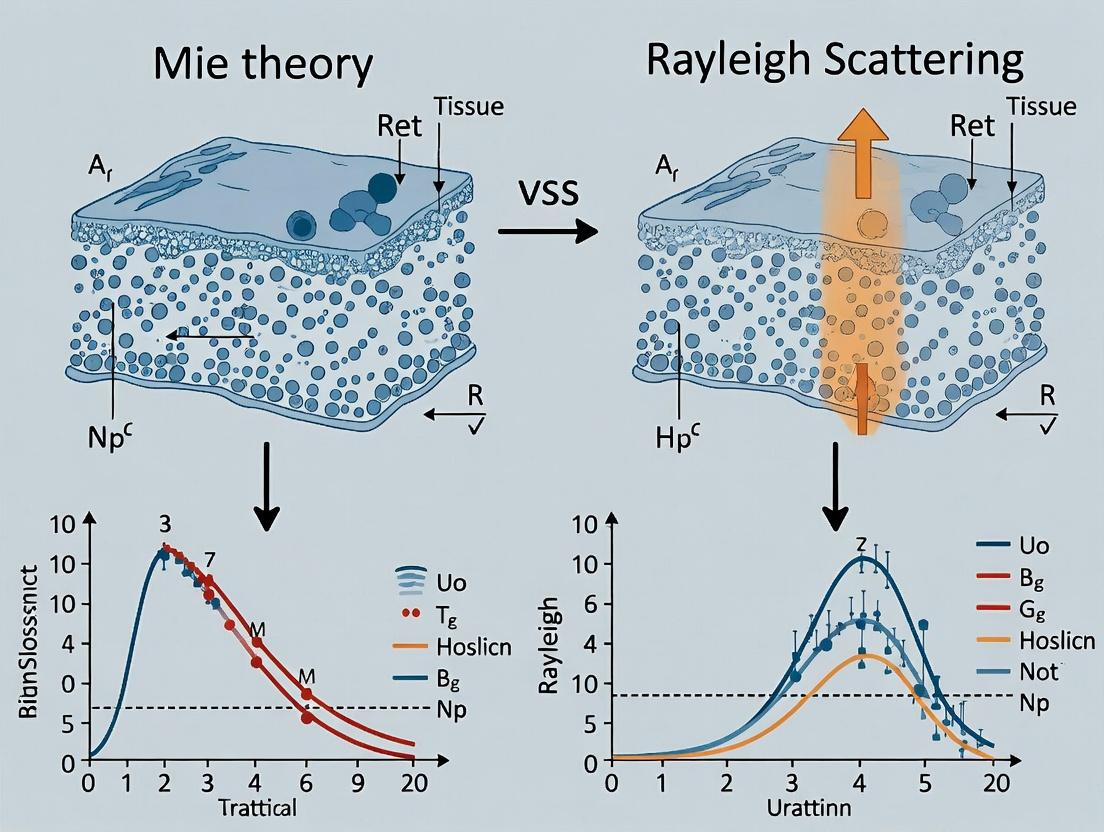
This article provides a comprehensive guide to Mie theory and Rayleigh scattering principles as applied to biological tissue analysis.
Light Scattering in Biological Tissue: A Practical Guide to Mie Theory and Rayleigh Scattering for Biomedical Research
Abstract
This article provides a comprehensive guide to Mie theory and Rayleigh scattering principles as applied to biological tissue analysis. Targeting researchers and drug development professionals, it covers foundational concepts, methodological applications in optical diagnostics and imaging, strategies for troubleshooting measurement artifacts, and a comparative validation of when to use each scattering model. The content synthesizes current research to enable accurate interpretation of light-tissue interactions for advancing biomedical technologies like optical coherence tomography, flow cytometry, and targeted therapeutic development.
Understanding the Physics: Core Principles of Mie and Rayleigh Scattering in Tissue
Light-tissue interaction is the cornerstone of numerous biomedical optics technologies, from microscopy to therapeutic applications. At its core, the interaction is governed by absorption and scattering. While absorption drives photothermal therapy and provides molecular contrast, scattering dictates the penetration depth, resolution, and ultimately the information yield of optical techniques. Understanding and modeling scattering is therefore not merely an academic exercise but a practical necessity for innovating diagnostics and treatments. This guide frames the critical role of scattering within the specific context of differentiating between Mie and Rayleigh scattering theories, which model the interaction of light with particles of different sizes relative to the wavelength. Accurate application of these models is essential for interpreting data from tissues—a complex, multi-scale scattering medium.
Theoretical Framework: Mie vs. Rayleigh Scattering in Tissue
Biological tissue is a heterogeneous medium containing scattering particles with sizes ranging from nanometers (proteins, cellular organelles) to micrometers (cells, collagen fibers). The choice of scattering model has profound implications for data interpretation.
- Rayleigh Scattering applies when the scattering particle radius (r) is significantly smaller than the wavelength of incident light (λ), typically r < λ/10. The scattering intensity (I) is proportional to 1/λ⁴ and is relatively isotropic. In tissue, this model approximates scattering from small structures like ribosomes or some extracellular matrix components.
- Mie Scattering is a general solution to Maxwell's equations for spherical particles of any size. It is necessary when particle size is comparable to or larger than the wavelength (r ≈ λ or r > λ). Mie scattering produces complex angular intensity distributions, often with strong forward directionality. In tissue, this models scattering from nuclei, mitochondria, and most collagen fibers.
The following table summarizes the key quantitative distinctions between these regimes in a biological context.
Table 1: Core Characteristics of Rayleigh vs. Mie Scattering in Tissue
| Parameter | Rayleigh Scattering | Mie Scattering |
|---|---|---|
| Particle Size Condition | r << λ (typically r < ~40 nm for visible light) | r ≈ λ or r > λ (typically r > ~40 nm) |
| Wavelength Dependence | I ∝ 1/λ⁴ (Strong) | I ∝ 1/λ^b, where 0 < b < 4 (Weak to Moderate) |
| Angular Distribution | Relatively symmetric (slightly more forward scatter) | Highly forward-directed, complex pattern |
| Primary Tissue Targets | Small proteins, nucleic acids, some lipids | Cell nuclei, mitochondria, collagen fibers |
| Typical Anisotropy (g) Factor | 0 ≤ g < 0.2 (Nearly isotropic) | 0.7 ≤ g < 0.99 (Highly anisotropic) |
| Dominant in Tissue Layer | Deep dermis (partial), cytoplasmic nanoscale | Epidermis, superficial dermis, cell membranes |
Experimental Protocols for Scattering Analysis
Quantifying scattering properties in tissue requires carefully designed experiments. Below are detailed protocols for two fundamental approaches.
Protocol 1: Integrating Sphere Measurement for Reduced Scattering Coefficient (μs')
Objective: To experimentally determine the reduced scattering coefficient (μs' = μs(1-g)) of a thin tissue sample.
- Sample Preparation: Fresh or optically cleared tissue is sliced to a known, uniform thickness (d = 100-500 μm) using a vibratome. The sample is mounted in a transparent, index-matched holder.
- Setup Configuration: A dual-beam integrating sphere system is used. A collimated light source (e.g., 660 nm diode laser) is directed at the sample. The sample is placed at the sphere's entrance port. A reflectance standard (e.g., Spectralon) is used at the exit port.
- Data Acquisition: Two measurements are taken:
- Total Transmittance (T): With sample at entrance port and detector at exit port.
- Total Reflectance (R): With sample at entrance port and detector at a side port.
- Inverse Adding-Doubling (IAD): The measured T and R values, along with sample thickness (d) and the sphere's geometry, are input into an IAD algorithm. This algorithm iteratively solves the radiative transport equation to output the absorption coefficient (μa) and the reduced scattering coefficient (μs').
Protocol 2: Goniometric Measurement of Scattering Phase Function
Objective: To directly measure the angular scattering distribution (phase function, p(θ)) of a tissue sample to derive the anisotropy factor (g).
- Sample Preparation: A highly diluted suspension of isolated, homogenized tissue (e.g., collagen fibers or isolated cell nuclei) is prepared in a clear, index-matched cuvette to ensure single-scattering events.
- Setup Configuration: A narrow, collimated beam from a laser (e.g., 532 nm) is passed through the sample cuvette, placed at the center of a rotation stage. A sensitive photodetector (e.g., photomultiplier tube) is mounted on a rotating arm that orbits the sample, collecting light from 0° (forward) to 180° (backward).
- Data Acquisition: The detector records scattered light intensity I(θ) at small angular increments (e.g., 1°). Background noise is subtracted. Data is normalized to the incident beam intensity.
- Analysis: The normalized intensity profile is fitted with a scattering model (e.g., Henyey-Greenstein or Mie theory-derived function). The anisotropy factor g is calculated as the average cosine of the scattering angle: g = ⟨cos θ⟩ = ∫ p(θ) cos θ dΩ.
Visualization of Scattering-Based Imaging Modalities
Scattering-Based Imaging Pathways
The Scientist's Toolkit: Research Reagent Solutions
Table 2: Essential Materials for Scattering Experiments in Tissue
| Item | Function | Example/Notes |
|---|---|---|
| Optical Clearing Agents | Reduce scattering by refractive index matching, enabling deeper imaging. | SeeDB, FocusClear, glycerol solutions. |
| Tissue Phantoms | Calibrate instruments with known μs' and μa values. | Polystyrene microspheres, TiO2, or SiO2 nanoparticles in a polymer matrix. |
| Integrating Sphere | Collects all light transmitted/reflected from a sample for accurate flux measurement. | Essential for inverse determination of optical properties. |
| Index-Matching Fluid/Gel | Minimizes surface reflections at sample-container interfaces. | Glycerol, ultrasound gel, or commercial optical gels. |
| Spectralon/Diffuse Reflectance Standards | Provide a reference with near-perfect Lambertian (diffuse) reflectance. | Critical for calibrating reflectance measurements. |
| Anisotropy Factor (g) Standards | Suspensions of monodisperse microspheres with precisely calculable g. | Used to validate goniometer setups and phase function models. |
| Collimated Light Sources | Provide a defined, narrow beam for transmission/goniometry experiments. | Diode lasers, supercontinuum lasers with monochromators. |
| Inverse Adding-Doubling (IAD) Software | Algorithm to compute μa and μs' from measured reflectance and transmittance. | Open-source or commercial implementations of the IAD method. |
Light scattering is a fundamental physical phenomenon critical to biomedical optics. In biological tissue research, the choice between Mie theory (for particles comparable to the wavelength) and Rayleigh scattering (for particles much smaller than the wavelength) dictates the interpretation of experimental data from techniques like Optical Coherence Tomography (OCT), diffuse reflectance spectroscopy, and flow cytometry. This whitepaper provides an in-depth technical guide to Rayleigh scattering, its governing laws, and its specific applications and limitations within the context of probing biological tissues and subcellular structures.
Theoretical Foundation of Rayleigh Scattering
Rayleigh scattering describes the elastic scattering of light by particles whose diameter (d) is significantly smaller than the incident wavelength (λ), typically satisfying d < λ/10. The scattering arises from the electromagnetic wave inducing a dipole moment in the particle. The oscillating dipole then radiates energy in all directions.
The key quantitative relationships are summarized in the following table:
Table 1: Core Quantitative Relationships of Rayleigh Scattering
| Parameter | Mathematical Expression | Dependence & Notes |
|---|---|---|
| Scattering Cross-Section (σ_sca) | σ_sca = (2π^5 / 3) * (d^6 / λ^4) * ((m^2 - 1)/(m^2 + 2))^2 | Proportional to d^6 and λ^-4. m is the relative refractive index (particle/medium). |
| Scattering Intensity (I) | I(θ) = I_0 * (1 + cos^2θ) / (R^2) * (π^4 d^6 / 8 λ^4) * ((m^2 -1)/(m^2+2))^2 | Angular dependence is isotropic for unpolarized light. θ is scattering angle, R is distance. |
| λ^-4 Dependence | I_sca ∝ 1 / λ^4 | Explains blue sky and red sunset. Dominates for very small particles. |
| Anisotropy Factor (g) | g ≈ 0 | Assumes isotropic scattering. For real biological particles, g is small but non-zero. |
The critical distinction from Mie theory is the lack of higher-order multipole contributions; only the dipole mode is significant. The λ^-4 dependence is a hallmark, making shorter wavelengths scatter orders of magnitude more strongly.
Rayleigh vs. Mie Scattering in Biological Tissue Context
The applicability of Rayleigh or Mie theory depends on the size parameter, x = πd/λ. Rayleigh regime is x << 1. Biological tissues present a complex hierarchy of scatterers.
Table 2: Scattering Regimes for Common Biological Structures
| Biological Scatterer | Typical Size Range | Wavelength (λ) Example | Size Parameter (x) | Applicable Theory |
|---|---|---|---|---|
| Intracellular organelles (mitochondria, vesicles) | 0.2 - 1 μm | 633 nm (He-Ne) | ~1 - 5 | Mie Theory (Transitional) |
| Ribosomes, proteins | 20 - 30 nm | 633 nm | ~0.1 - 0.15 | Rayleigh Scattering |
| Collagen fibrils (cross-section) | 50 - 200 nm | 800 nm (NIR) | ~0.2 - 0.8 | Rayleigh to Mie Transition |
| Cell nuclei in early apoptosis | 1 - 5 μm (condensed) | 500 nm | ~6 - 30 | Mie Theory |
A key research thesis involves deconvoluting the composite scattering signal from tissue. Rayleigh-type scattering from ultrafine structures contributes to background signal and spectral shaping, while Mie scattering from larger structures (cell nuclei, mitochondria) dominates angular anisotropy and is often linked to disease-state changes (e.g., nuclear morphology in dysplasia).
Diagram Title: Rayleigh Scattering Physical Mechanism
Experimental Protocols for Characterizing Rayleigh Scattering
Protocol: Dynamic Light Scattering (DLS) for Nanoparticle & Protein Size Distribution
Purpose: Determine hydrodynamic diameter of nanoparticles, vesicles, or proteins in suspension, confirming they are in the Rayleigh regime. Materials: See "The Scientist's Toolkit" below. Method:
- Prepare sample: Filter buffer (0.1 μm filter) and sample (if necessary) to remove dust.
- Load into clean, dust-free cuvette.
- Place in DLS instrument thermostatted to 25°C.
- Laser (λ = 633 nm) illuminates the sample.
- A single photon-counting detector at a fixed angle (often 90° or 173°) measures the time-dependent scattering intensity I(t).
- Autocorrelate intensity: G²(τ) =
- Analyze correlation decay using the Stokes-Einstein relation: D = k_BT / (3πηd_H), where decay rate relates to diffusion coefficient D, yielding hydrodynamic diameter d_H. Interpretation: A monomodal, fast-decaying correlation function indicates a population of small, rapidly diffusing particles consistent with Rayleigh scatterers.
Protocol: Wavelength-Dependent Reflectance Measurement
Purpose: Verify λ^-4 dependence in a tissue phantom or purified subcellular fraction. Method:
- Create phantom: Suspend known Rayleigh scatterers (e.g., 50 nm polystyrene nanospheres, n=1.59) in agarose gel (n=1.33).
- Use a broadband light source (e.g., halogen) and spectrometer.
- Measure diffuse reflectance R_d(λ) from phantom using a fiber-optic probe.
- Fit the spectral slope: R_d(λ) ∝ λ^(-γ)*.
- For pure Rayleigh scattering in the absence of absorption, γ ≈ 4. Deviation indicates Mie contributions or absorption.
Diagram Title: Wavelength-Dependent Reflectance Setup
The Scientist's Toolkit: Research Reagent Solutions
Table 3: Essential Materials for Rayleigh-Scattering Experiments
| Item | Function & Relevance |
|---|---|
| Polystyrene Nanospheres (d=20-100 nm) | Calibration standards for DLS and microscope scattering. Known size and refractive index model ideal Rayleigh scatterers. |
| Ultrafiltration Membranes (e.g., 100 kDa MWCO) | Purify protein/vesicle samples by size to ensure they meet d << λ criterion and remove aggregates. |
| Index-Matching Oils/Gels | Reduce large background scattering from interfaces when imaging/measuring soft tissue or hydrogels, allowing isolation of weak Rayleigh signal. |
| Low-Autofluorescence Cuvettes & Labware | Essential for sensitive light scattering measurements to minimize background signal from container. |
| Recombinant Proteins & Stabilization Buffers | Study Rayleigh scattering from specific biological macromolecules (e.g., fibrinogen, albumin) under controlled aggregation states. |
| Liposome/Nanovesicle Preparation Kits | Generate model membrane-bound Rayleigh scatterers to mimic extracellular vesicles or drug delivery vehicles. |
Applications and Current Research Frontiers
In drug development, Rayleigh scattering principles are used in:
- Characterization of nanotherapeutic formulations: Ensuring lipid nanoparticles or polymeric micelles are small and uniform (Rayleigh regime) for predictable biodistribution.
- High-Throughput Screening: Static light scattering in microplates to monitor protein aggregation in real-time, a critical quality attribute.
- Advanced Imaging: Techniques like interferometric scattering microscopy (iSCAT) detect single proteins (< 100 kDa) by their minute Rayleigh-scattered signal, enabling the study of biomolecular kinetics without labels.
The ongoing thesis in tissue optics emphasizes hybrid models. While pure Rayleigh scattering is rare in bulk tissue, it is a critical component of unified Mie-Rayleigh models (e.g., using T-matrix methods) that account for the full spectrum of scatterer sizes, from macromolecules to cell clusters.
The analysis of light scattering by particles is fundamental to a multitude of scientific and industrial applications, particularly in biomedical research. In the context of biological tissue characterization, two regimes are classically considered: Rayleigh scattering, valid for particles much smaller than the incident wavelength (diameter << λ), and Mie theory, which provides a general solution for spherical particles of any size. This whitepaper details Mie theory as the rigorous, analytical solution to Maxwell's equations for a plane wave incident upon a homogeneous, isotropic sphere embedded in a homogeneous, isotropic medium. Its precision is critical for advancing quantitative techniques in tissue diagnostics, nanoparticle drug delivery tracking, and cellular imaging, where scatterer sizes often span the transition between the Rayleigh and Mie regimes.
Theoretical Framework: From Maxwell's Equations to the Mie Solution
Mie theory begins with the time-harmonic form of Maxwell's equations. The key step is expressing the incident plane wave, the scattered field, and the internal field within the sphere in terms of vector spherical harmonic functions (Mie potentials). Boundary conditions for the tangential components of the E and H fields are enforced at the sphere's surface. The solution yields infinite series for the scattered field expansion coefficients, (an) and (bn), known as the Mie coefficients.
Core Equations: The Mie coefficients are functions of the size parameter (x = \pi d / \lambdam) (where (d) is particle diameter, (\lambdam) is the wavelength in the surrounding medium) and the relative complex refractive index (m = n{particle} / n{medium}).
[ an = \frac{m\psin(mx)\psi'n(x) - \psin(x)\psi'n(mx)}{m\psin(mx)\xi'n(x) - \xin(x)\psi'n(mx)} ] [ bn = \frac{\psin(mx)\psi'n(x) - m\psin(x)\psi'n(mx)}{\psin(mx)\xi'n(x) - m\xin(x)\psi'n(mx)} ]
where (\psin) and (\xin) are Riccati-Bessel functions.
The extinction, scattering, and absorption cross-sections ((C{ext}), (C{sca}), (C_{abs})) are then calculated:
[ C{sca} = \frac{2\pi}{k^2} \sum{n=1}^{\infty} (2n+1)(|an|^2 + |bn|^2) ] [ C{ext} = \frac{2\pi}{k^2} \sum{n=1}^{\infty} (2n+1)\text{Re}(an + bn) ] [ C{abs} = C{ext} - C_{sca} ]
Mie vs. Rayleigh Scattering in Biological Tissue Research: Quantitative Comparison
The choice between Mie and Rayleigh approximations has profound implications for data interpretation in tissue optics.
Table 1: Theoretical Comparison: Mie Theory vs. Rayleigh Scattering
| Feature | Rayleigh Scattering (d << λ) | Mie Theory (Any d/λ) |
|---|---|---|
| Governing Dependency | (\lambda^{-4}), (d^6) | Complex oscillatory function of (d/\lambda) |
| Angular Distribution | Symmetric (forward/backward ratio = 1) | Highly asymmetric, increasingly forward-directed with size |
| Polarization | Complete polarization at 90° | Complex polarization patterns |
| Validity Range | Typically (d/λ < 0.1) | Theoretically exact for all sizes (sphere) |
| Computational Cost | Simple analytical formulas | Requires summation of series (10-300 terms) |
| Application in Tissue | Intracellular organelles, thin collagen fibers | Cell nuclei, larger organelles, microcalcifications, drug carriers |
Table 2: Scattering Regimes for Common Biological Scatterers (λ = 633 nm in water, n=1.33)
| Scatterer Type | Approx. Diameter (nm) | Size Parameter (x) | Appropriate Theory |
|---|---|---|---|
| Proteins / Small Vesicles | 5 - 50 | 0.02 - 0.2 | Rayleigh |
| Mitochondria | 500 - 1000 | 3.3 - 6.6 | Mie |
| Cell Nuclei | 5000 - 15000 | 33 - 100 | Mie (Geometric limit) |
| Lipid Nanoparticles (Drug Delivery) | 80 - 200 | 0.5 - 1.3 | Mie (Transition Regime) |
| Collagen Fibrils (Cross-section) | 100 - 500 | 0.7 - 3.3 | Mie (or infinite cylinder models) |
Diagram 1: Scattering Regime Decision Logic (85 chars)
Experimental Protocols for Scattering Characterization in Tissue
Protocol 1: Goniometric Measurement of Scattering Phase Function Objective: To measure the angular distribution of scattered light (phase function) from a tissue sample or suspension of biological scatterers (e.g., cell nuclei, drug carriers).
- Sample Preparation: Thin tissue slice (<100 µm) mounted in index-matched medium or a dilute suspension of extracted nuclei/nanoparticles in buffer.
- Instrument Setup: A collimated laser source (e.g., He-Ne, 633 nm) is incident on the sample. A high-sensitivity detector (photomultiplier tube or avalanche photodiode) is mounted on a rotating arm to collect scattered light from 5° to 175°.
- Measurement: Record intensity I(θ) at each angle. For suspensions, perform ensemble averaging. Normalize data to obtain the phase function: (p(θ) = I(θ) / \int I(θ) dΩ).
- Fitting & Analysis: Use a nonlinear least-squares algorithm to fit the measured p(θ) to Mie theory predictions, with particle size distribution and refractive index contrast as fitting parameters.
Protocol 2: Inverse Spectroscopic Analysis for Particle Sizing Objective: To determine the size distribution of dominant scatterers in tissue from wavelength-dependent backscattering/reflectance measurements.
- Spectral Acquisition: Using a fiber-based reflectance spectrometer, measure diffuse reflectance spectra (R(λ)) from the tissue site over a broad range (e.g., 450-900 nm).
- Model Formulation: Assume a distribution of spherical scatterers (e.g., a log-normal distribution). Calculate μ_s'(λ), the reduced scattering coefficient, using Mie theory for each wavelength.
- Inverse Solution: Employ a Monte Carlo simulation or diffusion theory model that uses μ_s'(λ) as input to predict R(λ). Iteratively adjust the distribution parameters (mean size, dispersion) and density to minimize the difference between measured and simulated R(λ).
- Validation: Compare inferred size with histology (e.g., nuclear size from stained biopsy).
Diagram 2: Inverse Mie Scattering Analysis Workflow (96 chars)
The Scientist's Toolkit: Key Research Reagent Solutions
Table 3: Essential Materials for Mie-Based Scattering Experiments
| Item | Function & Relevance to Mie Theory |
|---|---|
| Index-Matching Fluids (e.g., Glycerol, Sucrose Solutions) | Adjusts the refractive index of the surrounding medium (nmedium). Critical for isolating single scattering by reducing inter-particle effects and for controlling the relative index (m = nparticle / n_medium) in validation experiments. |
| Monodisperse Silica or Polystyrene Microspheres (NIST-traceable) | Serve as calibration standards with known size and refractive index. Essential for validating the experimental setup and the implementation of Mie calculation codes. |
| Protease/RNase/DNase Enzymes (e.g., Trypsin, RNase A) | Selectively digest specific cellular components to isolate scatterers of interest (e.g., removing cytoplasmic proteins to study nuclear scattering). Allows for experimental decomposition of the composite tissue scattering signal. |
| Fluorescent-Labeled Nanoparticles (Polymeric, Liposomal) | Engineered drug carriers. Mie theory is used to model their pure scattering signal, separating it from tissue autofluorescence and the carrier's own fluorescence in tracking studies. |
| Optical Phantoms (e.g., Intralipid, TiO2 in Gelatin) | Tissue-simulating materials with tunable scattering properties. Mie theory is used to calculate the scattering properties of the phantom constituents, enabling the creation of standards with known μ_s and g (anisotropy factor). |
| Optical Clearing Agents (e.g., SeeDB, CLARITY reagents) | Temporarily reduce scattering in tissue by index matching. Allows researchers to probe deeper structures and validate Mie-based models of bulk tissue scattering by systematically altering n_medium. |
Mie theory's precision is indispensable for modern biophotonics. It enables the quantification of cellular morphology changes (e.g., nuclear enlargement in dysplastic tissue) via light scattering spectroscopy. In drug development, it facilitates the precise optical characterization of nanoparticle carriers, optimizing their size and coating for desired in vivo distribution and imaging detectability. While computational methods like Finite-Difference Time-Domain (FDTD) can handle arbitrary shapes, Mie theory remains the gold-standard, computationally efficient solution for spherical scatterers, providing the foundational framework against which other methods are calibrated and understood. Its correct application, as opposed to the misuse of the Rayleigh approximation for larger particles, is critical for accurate model-based diagnosis and therapeutic monitoring in biological tissue.
The quantitative analysis of light scattering in biological tissues is fundamental to advancements in optical imaging, diagnostics, and therapeutic monitoring. This technical guide elucidates the three pivotal parameters governing scattering phenomena: particle size, refractive index contrast, and the wavelength dependence of light. The interpretation of these parameters is critically framed within the context of Mie theory and Rayleigh scattering approximations—two foundational physical models whose applicability is determined by the size of the scattering particle relative to the incident wavelength. Accurately distinguishing between these regimes is essential for researchers and drug development professionals seeking to design contrast agents, interpret imaging data (e.g., OCT, confocal microscopy), or model light transport in tissue for photothermal therapy or biosensing applications.
Theoretical Foundation: Mie vs. Rayleigh Scattering
Rayleigh Scattering describes the elastic scattering of light by particles much smaller than the wavelength of light (typically diameter (d < \lambda/10)). The scattered intensity (I) exhibits a strong inverse quartic dependence on wavelength ((I \propto \lambda^{-4})), accounting for the blue sky. It is applicable to scattering from macromolecules, very small organelles, or nanoparticles in suspension.
Mie Scattering provides a general solution to Maxwell's equations for spherical particles of any size relative to the wavelength. It is essential for particles with diameters comparable to or larger than the wavelength ((d \approx \lambda) or (d > \lambda)). Its predictions are more complex, showing oscillatory behavior with size and wavelength, and forward-scattering dominance for larger particles.
In biological tissue, both regimes coexist: Rayleigh-like scattering from subcellular structures and Mie scattering from cell nuclei, mitochondria, and larger organelles or injected contrast agents.
Core Parameter Analysis
Particle Size (Radius,a)
The particle size, typically expressed as the dimensionless size parameter (x = 2\pi nm a / \lambda) (where (nm) is the refractive index of the medium), is the primary determinant of the scattering regime.
Table 1: Scattering Regime vs. Particle Size Parameter
| Size Parameter ((x)) | Approx. Particle Diameter | Scattering Regime | Characteristics in Tissue |
|---|---|---|---|
| (x << 1) (e.g., <0.3) | (d < \lambda/10) (~40 nm for 500 nm light) | Rayleigh | Isotropic scattering, strong (\lambda^{-4}) dependence. |
| (x \approx 1) | (d \approx \lambda/\pi) | Mie Transition Region | Anisotropy (g-factor) increases sharply. |
| (x > 1) | (d > \lambda) | Mie | Increasingly forward-peaked scattering, complex (\lambda) dependence. |
Refractive Index Contrast ((m = np / nm))
The relative refractive index, (m), between the particle ((np)) and the surrounding medium ((nm)) dictates the scattering strength or efficiency. The scattering cross-section scales with ((m-1)^2) in the Rayleigh limit. In biological tissue, typical contrasts are low (1.02 to 1.10), making scattering sensitive to small changes in local index, such as during drug-induced apoptosis or nanoparticle uptake.
Table 2: Typical Refractive Indices in Biological Systems
| Component | Refractive Index ((n)) | Medium Context |
|---|---|---|
| Cytoplasm | ~1.36 - 1.38 | Aqueous cytosol |
| Cell Nucleus | ~1.38 - 1.41 | Higher due to chromatin |
| Mitochondria | ~1.38 - 1.41 | Dense membranes |
| Collagen Fibrils | ~1.43 - 1.47 | Extracellular matrix |
| Lipid Droplets | ~1.44 - 1.48 | Hydrophobic organelles |
| Polystyrene Beads | ~1.59 | Common contrast agent |
| Gold Nanoparticles | Complex (e.g., 0.27+2.97i @600nm) | Plasmonic agent |
Wavelength Dependence
The wavelength ((\lambda)) of incident light interacts with the size parameter and material properties. The scattering coefficient (\mus) in tissue often follows a power-law: (\mus \propto \lambda^{-b}), where the scattering power (b) is ~0.2-4. For larger Mie scatterers, (b) is small (~0.5-2); for Rayleigh-dominated tissue, (b) approaches 4.
Table 3: Empirical Wavelength Dependence in Tissue Types
| Tissue Type | Typical Scattering Power ((b)) | Dominant Regime | Notes |
|---|---|---|---|
| Dense Connective Tissue | 0.5 - 1.5 | Mie (larger fibrils) | Forward scattering dominant. |
| Brain (Gray Matter) | 1.2 - 1.8 | Mixed Mie/Rayleigh | |
| Blood (erythrocytes) | ~1.0 - 1.3 | Mie (size ~7-8 µm) | Strong forward scattering. |
| Intracellular Fluid | ~2.0 - 4.0 | Rayleigh (small solutes) | Lower scattering magnitude. |
Experimental Protocols for Parameter Quantification
Protocol 1: Determining Scattering Regime via Angular Scattering Measurements
Objective: To distinguish Mie from Rayleigh scattering by measuring the angular dependence of scattered intensity.
- Sample Preparation: Prepare suspensions of known particles (e.g., 100 nm & 1000 nm polystyrene beads, n=1.59) in aqueous medium (n=1.33) at low concentration to avoid multiple scattering.
- Instrument Setup: Use a goniometer-based static light scattering system. A polarized laser source (e.g., 633 nm He-Ne) is collimated and directed onto a cuvette. A photodetector on a rotating arm collects scattered light from 20° to 160°.
- Data Acquisition: Measure intensity I(θ) at each angle. Normalize data to incident intensity and subtract background (medium alone).
- Analysis: Plot I(θ). Isotropic distribution indicates Rayleigh regime. Increasing forward asymmetry (higher intensity at low angles) indicates Mie regime. Fit data to Mie theory models to extract size and index contrast.
Protocol 2: Measuring Wavelength-Dependent Scattering Coefficient in Thin Tissue Sections
Objective: To derive the scattering power (b) for tissue characterization.
- Sample Preparation: Cryosection fresh or fixed tissue to 50-200 µm thickness. Mount on glass slide with index-matching medium if necessary for transmission measurement.
- Instrument Setup: Use a spectrophotometer with an integrating sphere attachment. Measure total transmission (Tt) and diffuse reflectance (Rd) across a spectral range (e.g., 400-900 nm).
- Data Acquisition: Collect Tt(λ) and Rd(λ). Perform a similar measurement with a non-scattering reference (e.g., blank slide with medium).
- Analysis: Apply Inverse Adding-Doubling (IAD) algorithm to Tt(λ) and Rd(λ) to extract the reduced scattering coefficient (\mus'(λ) = \mus(λ)(1 - g)). Fit (\mus'(λ)) to the power-law model: (\mus'(λ) = A \lambda^{-b}). The parameter (b) quantifies wavelength dependence.
Visualization of Concepts and Workflows
Title: Determining Scattering Regime from Core Parameters
Title: Protocol for Measuring Tissue Scattering Wavelength Dependence
The Scientist's Toolkit: Key Research Reagent Solutions
Table 4: Essential Materials for Scattering Experiments in Biophotonics
| Item | Function & Relevance to Key Parameters |
|---|---|
| Size-Calibrated Polystyrene Beads | Monodisperse spheres with known diameter (50 nm - 10 µm) and RI (~1.59). Used as standards to validate Mie theory calculations, calibrate instruments, and model specific particle sizes. |
| Index-Matching Oils/Fluids | Liquids with tunable refractive index (1.33-1.56). Used to manipulate refractive index contrast ((m)) in controlled experiments, or to render tissue transparent for deeper imaging. |
| Tunable Wavelength Light Sources | Supercontinuum lasers or monochromator-equipped lamps. Enable precise study of wavelength dependence across UV-VIS-NIR spectra. |
| Integrating Sphere | A hollow spherical device that collects all transmitted or reflected light. Essential for accurate measurement of total scattering coefficient ((\mu_s)) independent of anisotropy. |
| Goniometer-Based Scattering Setup | Allows angular-resolved intensity measurements (I(θ)). Critical for determining anisotropy factor (g) and distinguishing scattering regimes. |
| Silicon or Optical Phantoms | Solid or gel-based materials with precisely known scattering and absorption properties (µs', µa). Used as stable references for system validation and protocol calibration. |
| Computational Mie Solver Software (e.g., MATLAB Mie code, PyMieScatt) | Calculates scattering efficiency, anisotropy, and angular distribution for user-defined a, m, λ. Invaluable for experimental design and data fitting. |
In biophotonics, light-tissue interactions are governed by scattering and absorption. The choice between Mie theory and Rayleigh scattering approximations is dictated by the size parameter x = 2πr n_m / λ, where r is the scatterer radius, n_m is the refractive index of the surrounding medium, and λ is the incident wavelength. This whitepaper frames the analysis of biological scatterers within this core theoretical dichotomy, critical for interpreting optical biopsies, developing imaging modalities like OCT and confocal reflectance microscopy, and modeling light distribution for therapeutic applications.
Scattering Regimes: Mie vs. Rayleigh in Biological Context
Rayleigh Scattering applies when x << 1 (scatterer diameter << λ). Scattering intensity scales as ~1/λ⁴ and is relatively isotropic. Mie Scattering applies when x ≈ 1 or larger, requiring full Maxwell equation solutions. It exhibits strong forward scattering, complex angular dependence, and resonant behavior.
Table 1: Scattering Regimes of Key Biological Structures (λ = 633 nm, n_m ~1.35)
| Biological Scatterer | Approx. Diameter Range | Size Parameter (x) | Dominant Scattering Regime | Key Optical Impact |
|---|---|---|---|---|
| Mitochondria | 0.5 - 1.0 µm | 6.7 - 13.4 | Mie Theory | Strong forward lobe, contributes significantly to g (anisotropy factor) |
| Lysosomes/Peroxisomes | 0.2 - 0.5 µm | 2.7 - 6.7 | Transitional / Mie | Intermediate angular distribution |
| Cell Nuclei | 5 - 15 µm | 67 - 200 | Mie Theory (large particle) | Primary source of backscattering in epithelia, nuclear size correlates with scattering signal |
| Collagen Fibrils (cross-section) | 50 - 200 nm | 0.67 - 2.7 | Rayleigh to Mie Transition | Contributes to diffuse reflectance, birefringence |
| Ribosomes | ~20 nm | ~0.27 | Rayleigh Scattering | Weak, near-isotropic scatter, often overshadowed |
Quantitative Scattering Properties of Organelles
Recent studies using spectrophotometry with integrating spheres, angular scattering measurements, and inverse Monte Carlo methods have quantified scattering coefficients (µ_s) and anisotropy factors (g).
Table 2: Measured Scattering Properties of Subcellular Components
| Scatterer Type | Refractive Index Contrast (Δn vs. cytoplasm) | Scattering Cross-section (σ_s) | Anisotropy Factor (g) | Primary Measurement Method |
|---|---|---|---|---|
| Mitochondria (isolated) | 0.02 - 0.04 | 1.2 - 4.5 x 10⁻¹² cm² | 0.92 - 0.97 | Flow cytometry, angle-resolved low-coherence interferometry |
| Nuclei (in situ) | 0.04 - 0.06 | 8.0 - 45 x 10⁻¹² cm² | 0.95 - 0.99 | Confocal reflectance microscopy, OCT |
| Dense Collagen Bundle | 0.05 - 0.09 (vs. interstitial fluid) | Varies with bundle size | 0.85 - 0.94 | Polarized light scattering, second harmonic generation (SHG) correlation |
| Cytoplasmic Granules | 0.01 - 0.03 | 0.1 - 1.5 x 10⁻¹² cm² | 0.75 - 0.90 | Dark-field microscopy, electron microscopy correlation |
Experimental Protocols for Characterizing Biological Scatterers
Protocol: Angular-Dependent Light Scattering of Isolated Organelles
Objective: Measure scattering phase function to determine regime (Mie/Rayleigh) and calculate g. Materials: See "Scientist's Toolkit" below. Procedure:
- Isolate mitochondria or nuclei via differential centrifugation (e.g., kits from Abcam #ab206996) in isotonic buffer (e.g., 250 mM sucrose, 20 mM HEPES).
- Resuspend pellet in scattering buffer (refractive index matched to cytoplasm, n=1.36) at ~10⁶ particles/mL.
- Load sample into a goniometer-compatible cuvette. Use a λ=632.8 nm He-Ne laser with intensity stabilized to <1% fluctuation.
- Record scattered light intensity from 10° to 170° in 1° increments using a photomultiplier tube (PMT) on a rotating arm. Perform background subtraction with buffer alone.
- Fit data to Mie theory predictions (using known particle size distribution from TEM) or Henyey-Greenstein function to derive µ_s and g.
- Validate by comparing the ratio of forward (10-30°) to backward (150-170°) scatter. A high ratio (>10) confirms Mie-dominated behavior.
Protocol: Quantifying Nuclear Scattering in Tissue via OCT
Objective: Correlate OCT backscattering intensity (µ_b) with nuclear morphology in histopathology. Materials: Spectral-domain OCT system, formalin-fixed paraffin-embedded (FFPE) tissue sections, H&E staining. Procedure:
- Acquire OCT B-scans of unstained FFPE tissue block with axial resolution ≤5 µm.
- Register OCT data to subsequent histology section precisely using fiduciary markers.
- Manually segment nuclei borders on H&E image using ImageJ. Calculate nuclear density and average nuclear area.
- Extract the OCT backscattering coefficient (µ_b) from the registered region using a depth-resolved algorithm accounting for confocal function and signal roll-off.
- Perform multivariate linear regression: µb = A + B*(Nuclear Density) + C*(Avg. Nuclear Area). High C coefficient confirms nuclei as dominant Mie scatterers. This protocol is foundational for detecting dysplasia, where nuclear enlargement increases µb.
Title: OCT-Histology Correlation Workflow for Nuclear Scattering
Signaling Pathways Linking Cellular State to Scattering Changes
Cellular processes like apoptosis, fibrosis, and metabolic activation alter organelle morphology and thus scattering signatures. A key pathway is the mitochondrial permeability transition pore (mPTP)-mediated swelling.
Title: Apoptosis-Induced Mitochondrial Scattering Change Pathway
The Scientist's Toolkit: Key Reagent Solutions
Table 3: Essential Research Reagents for Scattering Experiments
| Reagent/Material | Supplier Example | Function in Scattering Studies |
|---|---|---|
| MitoTracker Deep Red FM | Thermo Fisher, M22426 | Live-cell mitochondrial staining for correlating fluorescence (location) with scattering signals. |
| Nuclei Isolation Kit: NST Buffer | BioVision, K-260 | Gentle detergent-based isolation of intact nuclei for in vitro scattering measurements. |
| Refractive Index Matching Solutions (e.g., Histodenz) | Sigma, D2158 | Adjust medium n to isolate scattering from specific structures by reducing contrast. |
| Collagenase Type I (for tissue dissociation) | Worthington, LS004196 | Digests extracellular matrix to liberate cells/organelles for flow cytometry scattering (FSC/SSC). |
| Agarose Phantoms with Polystyrene Microspheres | Bangs Laboratories | Calibration standards for validating Mie theory predictions and instrument response. |
| OCT Compound (Optimal Cutting Temperature) | Sakura, 4583 | For frozen tissue sections used in spatially-resolved scattering microscopy. |
Applications in Drug Development and Disease Research
Table 4: Scattering-Based Biomarkers in Disease Models
| Pathology | Key Altered Scatterer | Scattering Change | Detection Platform | Drug Development Utility |
|---|---|---|---|---|
| Hepatic Fibrosis | Collagen Fibers | ↑ µ_s, ↓ g (more diffuse) | Polarization-sensitive OCT | Quantify antifibrotic drug efficacy by reduced collagen deposition. |
| Early Apoptosis (in vitro) | Mitochondria | Initial swelling → ↑ forward scatter | Flow cytometry (FSC) | High-throughput screening of chemotherapeutic agents. |
| Epithelial Dysplasia | Cell Nuclei | ↑ µ_b (backscatter) due to enlargement & pleomorphism | Angle-resolved low-coherence interferometry (a/LCI) | Non-invasive monitoring of chemoprevention in Barrett's esophagus. |
| Steatosis (Fatty Liver) | Lipid Droplets in Cytoplasm | ↑ Scattering due to high Δn | Quantitative phase microscopy | Track lipid accumulation and resolution with therapy. |
The rigorous application of Mie theory versus Rayleigh approximations is not merely academic but foundational for accurate biophysical modeling. As shown, mitochondria and nuclei operate firmly in the Mie regime, dictating instrument design and data interpretation. The protocols and tools outlined enable researchers to decode the rich scattering signals inherent in biological tissue, transforming them into quantitative biomarkers for disease detection and therapeutic monitoring in preclinical and clinical drug development.
In biological tissue research, light scattering is a fundamental interaction that dictates the penetration depth, resolution, and contrast of optical techniques. The dominant scattering mechanism is determined by the size parameter, ( x = \frac{2\pi r nm}{\lambda} ), where ( r ) is the particle radius, ( nm ) is the refractive index of the medium, and ( \lambda ) is the wavelength of light. The core thesis framing this guide is that accurate identification of the scattering regime (Rayleigh vs. Mie) is not merely academic but is critical for interpreting imaging data, designing therapeutic protocols, and developing contrast agents.
- Rayleigh Scattering dominates when scatterers (e.g., small proteins, ribosomes) are much smaller than the wavelength (( x << 1 )). Scattering intensity follows a ( \lambda^{-4} ) dependence, making it highly sensitive to wavelength.
- Mie Scattering occurs when scatterer size is comparable to or larger than the wavelength (( x \approx 1 ) or ( x > 1 )), such as for cell nuclei, mitochondria, and lipid droplets. It exhibits complex angular dependence and a weaker relationship with wavelength.
Misidentifying the regime can lead to significant errors in extracting quantitative tissue properties, such as reduced scattering coefficient (( \mu_s' )) and anisotropy factor (( g )).
The Scattering Regime Map: Key Parameters and Quantitative Boundaries
The following table summarizes the critical parameters that define the scattering regime for biological tissues.
Table 1: Defining Characteristics of Rayleigh vs. Mie Scattering Regimes
| Parameter | Rayleigh Scattering Regime | Mie Scattering Regime | Typical Biological Scatterer |
|---|---|---|---|
| Size Parameter (x) | ( x \leq 0.1 ) | ( x \geq 0.1 ) | - |
| Scatterer Diameter | ( d < \lambda / 10 ) | ( d \geq \lambda / 10 ) | Rayleigh: Proteins (< 50 nm)Mie: Mitochondria (500-1000 nm), Nuclei (5-10 μm) |
| Wavelength Dependence | ( \mu_s \propto \lambda^{-4} ) | ( \mu_s \propto \lambda^{-b} ) ( ( 0 < b < 2 ) ) | b is the scattering power, ~0.5-2.0 for tissue |
| Angular Dependence | Isotropic or weakly anisotropic (( g \rightarrow 0 )) | Highly forward-peaked (( g \rightarrow 0.8 - 0.99 )) | g ~0.5-0.6 for cytoplasm, >0.9 for whole blood |
| Anisotropy Factor (g) | Low (0.0 - 0.2) | High (0.7 - 0.99) | - |
| Primary Influence on Tissue Optics | Limits penetration depth homogeneously. | Governs the effective transport of photons. | Determines ( \mus' = \mus (1-g) ) |
The transition between regimes is not abrupt. For ( x \approx 0.1-1 ), an intermediate or "Rayleigh-Gans" regime may apply, relevant for many organelles.
Experimental Protocols for Regime Identification
Protocol A: Determining Scattering Power via Spatially Resolved Reflectance
This protocol measures the wavelength dependence of the reduced scattering coefficient to estimate the scattering power ( b ), which indicates the dominant regime.
- Sample Preparation: Prepare fresh or fixed tissue sections (200-500 μm thick) on a non-reflective substrate. Ensure a flat surface.
- Instrument Setup: Use a fiber-optic probe with a single source fiber and multiple detector fibers at linearly increasing distances (e.g., 0.25-2.0 mm). Connect to a white light source and a spectrometer.
- Data Acquisition: Place the probe in gentle contact with the sample. Acquire diffuse reflectance spectra, ( R_d(\lambda, \rho) ), at each source-detector separation (( \rho )).
- Data Fitting & Analysis: For each wavelength, fit the ( Rd(\rho) ) profile to a diffusion theory model to extract ( \mus'(\lambda) ). Perform a power-law fit: ( \mu_s'(\lambda) = A \lambda^{-b} ).
- Regime Interpretation: A fitted ( b \approx 4 ) suggests Rayleigh-dominated scattering. A fitted ( b ) between 0.5 and 2 suggests Mie-dominated scattering.
Protocol B: Goniometric Measurement of Scattering Phase Function
This direct measurement of the angular scattering distribution yields the anisotropy factor ( g ).
- Sample Preparation: Create a dilute, homogeneous suspension of isolated tissue structures (e.g., cell nuclei, collagen fibers) or use a very thin (< 100 μm) tissue slice in a cuvette.
- Instrument Setup: Use a goniometer. A collimated laser source (e.g., 633 nm) is fixed. A detection fiber connected to a photomultiplier tube moves along a rotational stage around the sample.
- Data Acquisition: Record scattered light intensity ( I(\theta) ) at angles ( \theta ) from ( 0^\circ ) (forward) to ( 180^\circ ) (backward) at small increments (e.g., ( 1^\circ )).
- Data Analysis: Normalize ( I(\theta) ) to obtain the phase function, ( p(\theta) ). Calculate ( g = \langle \cos \theta \rangle = \int_{0}^{\pi} p(\theta) \cos \theta \, 2\pi \sin \theta \, d\theta ).
- Regime Interpretation: ( g < 0.2 ) indicates isotropic (Rayleigh-like) scattering. ( g > 0.7 ) confirms highly forward-peaked Mie scattering.
Visualizing the Decision Workflow
Diagram Title: Scattering Regime Identification Workflow
The Scientist's Toolkit: Essential Research Reagents & Materials
Table 2: Key Reagents and Materials for Scattering Experiments in Tissues
| Item | Function & Application |
|---|---|
| Optical Phantoms (e.g., Polystyrene Microspheres, TiO₂ in Silicone) | Provide calibrated scattering standards with known μs' and g for system validation and protocol calibration. |
| Index-Matching Fluids (e.g., Glycerol, DMSO) | Reduce surface scattering at tissue interfaces by minimizing refractive index mismatch, allowing clearer probing of bulk scattering. |
| Proteolytic Enzymes (e.g., Collagenase, Trypsin) | Used to dissociate tissue and isolate specific scatterers (like nuclei or mitochondria) for goniometric phase function measurements. |
| Optical Clearing Agents (e.g., SeeDB, CUBIC) | Render tissue transparent by reducing refractive index heterogeneity, allowing isolation of scattering from absorption effects. |
| Fixed Tissue Sections (Paraffin-embedded or Frozen) | Provide stable, reproducible samples for comparative studies between different tissue types or disease states. |
| Spectrophotometer with Integrating Sphere | The gold-standard instrument for measuring absolute transmission and reflection, enabling extraction of fundamental scattering coefficients. |
| Fiber-Optic Probes (Single-fiber or Multi-distance) | Enable in vivo or contact measurement of spatially resolved diffuse reflectance, the key data for inverse modeling of μs'. |
| Monte Carlo Simulation Software (e.g., MCX, TIM-OS) | Computational tool for modeling photon transport in complex tissues, essential for testing inverse models and interpreting data. |
From Theory to Bench: Applying Scattering Models in Biomedical Research & Diagnostics
Within biological tissue research, the interaction of light with cellular and extracellular structures is governed by scattering phenomena. The choice between Mie theory (for particles comparable to or larger than the wavelength of light) and Rayleigh scattering (for particles significantly smaller than the wavelength) forms a foundational thesis for instrument design. This guide details the optical engineering principles required to interrogate these distinct regimes, enabling precise measurement of morphological and compositional biomarkers critical for diagnostics and drug development.
Theoretical Framework: Mie vs. Rayleigh in Tissue
Biological tissues present a complex scattering landscape. The dominant scattering regime dictates the information depth, resolution, and contrast mechanism of an optical system.
| Scattering Regime | Particle Size Parameter (x = 2πr/λ) | Key Tissue Scatterers | Angular Scattering Profile | Wavelength Dependence |
|---|---|---|---|---|
| Rayleigh Scattering | x << 1 (typically r < λ/10) | Organelles (ribosomes), small protein complexes | Isotropic (relatively uniform) | Scattering coefficient ∝ λ⁻⁴ |
| Mie Scattering | x ≈ 1 to ≈ 20 (r ≈ λ) | Cell nuclei, mitochondria, collagen fibrils | Highly forward-directed, complex patterns | Weak, complex dependence on λ |
System Design Parameters by Regime
Optical components must be selected based on the targeted scattering physics. The following table outlines core design considerations.
| Design Parameter | Rayleigh-Dominant Systems (e.g., Confocal Fluorescence, DLS) | Mie-Dominant Systems (e.g., OCT, Diffuse Reflectance) |
|---|---|---|
| Light Source | Shorter wavelengths (e.g., 405 nm, 488 nm) to enhance weak scattering signal for small particles. | Longer NIR wavelengths (e.g., 800-1300 nm) for deeper penetration, minimizing Rayleigh scatter. |
| Detection Geometry | Wide-angle or integrating sphere collection to capture isotropic scattering. | Coherent detection (OCT) or specific angular collection (e.g., small separation source-detector fibers) for forward-scattered light. |
| Polarization | Critical; used to isolate scattering events from depolarizing fluorescence. | Often used to gate superficial, singly scattered photons from deeper, multiply scattered light. |
| Coherence Length | Long coherence length not required for intensity-based assays. | Short coherence length (broad bandwidth) essential for axial sectioning in time-domain OCT or spectral-domain OCT. |
| Modeling Basis | Rayleigh-Gans-Debye approximation often sufficient for refractive index contrasts. | Full Mie theory calculations required for accurate prediction of scattering cross-sections and phase functions. |
Experimental Protocols
Protocol 1: Validating Scattering Regime in a Tissue Phantom Objective: To characterize the dominant scattering regime of a novel tissue-mimicking phantom.
- Phantom Preparation: Prepare two sets of phantoms: (A) with sub-100 nm polystyrene nanospheres (Rayleigh scatterers), and (B) with 2 μm polystyrene microspheres (Mie scatterers), both embedded in a PDMS matrix.
- Goniometric Measurement: Mount phantom in a rotational stage. Illuminate with a polarized, narrow-beam 635 nm laser.
- Angular Scattering Data Collection: Use a photodetector on a movable arm to collect scattered intensity from 10° to 170° relative to the incident beam at 5° increments.
- Data Analysis: Plot normalized intensity vs. scattering angle. Compare to theoretical Mie and Rayleigh angular distribution models fitted for particle size and concentration.
Protocol 2: Depth-Resolved Backscattering Spectroscopy for Nuclei Sizing (Mie Regime) Objective: To extract mean nuclear diameter from epithelial tissue using Mie theory fitting.
- System Setup: Employ a fiber-optic reflectance probe with a single source fiber and multiple detector fibers at distances of 200, 400, and 800 μm.
- Spectral Acquisition: Illuminate tissue with broadband white light (450-700 nm). Collect spectrally resolved reflectance at each detector separation.
- Monte Carlo Modeling: Run a scalable Mie theory-based Monte Carlo model for a range of assumed nucleus sizes (5-15 μm) and densities.
- Inverse Fit: Fit the measured spatially resolved spectral data to the model library using a least-squares algorithm to extract the reduced scattering coefficient spectrum, derived from Mie theory.
Visualization of Design Logic and Workflows
Design Logic for Scattering-Based Instrumentation
Spectral-Domain OCT Workflow for Mie Scattering
The Scientist's Toolkit: Research Reagent & Material Solutions
| Item | Function in Scattering Experiments |
|---|---|
| Polystyrene Micro/Nano Spheres (50 nm - 10 μm) | Calibrated scatterers for phantom construction to validate system performance in specific regimes (Rayleigh vs. Mie). |
| Optical Phantoms with TiO₂ or Al₂O₃ | Provide controlled, stable scattering backgrounds (μs) for system calibration and validation of diffusion theory models. |
| Index-Matching Fluids (e.g., Glycerol) | Reduces surface scattering at tissue/coverglass interfaces, improving signal-to-noise for deep-tissue measurements. |
| Polarization-Preserving Optical Fibers | Maintains polarization state of light for systems relying on polarization gating to isolate scattering order. |
| Broadband Near-Infrared Superluminescent Diodes (SLDs) | Key light source for Mie-regime systems like OCT, providing short coherence length for high axial resolution. |
| Integrating Spheres | Essential for accurate measurement of total reflectance/transmittance, enabling extraction of absorption (μa) and reduced scattering (μs') coefficients. |
Within biophotonics, the selection of light scattering theory is fundamental. This whitepaper operates within the thesis that Mie theory is the indispensable framework for analyzing larger, structured particles in biological systems, whereas Rayleigh scattering is reserved for particles significantly smaller than the wavelength of light (typically < λ/10). In biological tissue research, this distinction is critical: Mie theory governs the interaction of light with cells, large organelles, and engineered nanoparticles, enabling precise quantification of size, concentration, and composition—parameters central to diagnostics and therapeutic development.
Core Principles: Mie Theory vs. Rayleigh in Biological Contexts
Mie theory provides an exact solution to Maxwell's equations for spherical particles of any size, accounting for diffraction, interference, and resonance effects. Its application is essential when particle diameter (d) is comparable to or larger than the incident wavelength (λ). In contrast, Rayleigh scattering, with its d⁶/λ⁴ dependence, describes the dipole scattering of sub-wavelength particles.
Key Differentiating Table:
| Scattering Regime | Particle Size Parameter (x = πd/λ) | Intensity Dependence | Angular Scattering Pattern | Primary Biological Applications |
|---|---|---|---|---|
| Rayleigh | x << 1 (typically d < 40 nm for visible light) | ∝ d⁶ / λ⁴ | Isotropic (uniform in all directions) | Molecular scattering, very small lipoprotein complexes. |
| Mie | x ≈ 1 to 100 (d ~ 100 nm to several μm) | Complex oscillatory function of size and refractive index | Highly anisotropic, forward-directed lobes | Cell sizing, nanoparticle tracking, oxygen saturation via RBCs. |
Application 1: Cell Sizing via Flow Cytometry and Static Light Scattering
Mie theory is the computational backbone for converting angular light scattering patterns into cell diameter and granularity (internal complexity) in flow cytometry. Forward Scatter (FSC) correlates with cell size, and Side Scatter (SSC) with internal complexity.
Experimental Protocol for Calibration and Sizing:
- Instrument Calibration: Use monodisperse polystyrene or silica microsphere standards (e.g., 2 μm, 5 μm, 10 μm) with known refractive index (RI).
- Sample Preparation: Suspend cells in an isotonic, clear buffer (e.g., PBS). Fix cells if necessary, noting that fixation alters the cytoplasmic RI.
- Data Acquisition: Pass single cells through a focused laser beam (e.g., 488 nm, 633 nm). Detect FSC at small angles (1-10°) and SSC at 90°.
- Mie-Based Analysis: Use an optical model (Mie theory) incorporating:
- Laser wavelength (λ)
- Assumed or measured cellular RI (e.g., nucleus: ~1.39, cytoplasm: ~1.36-1.38, membrane: ~1.33)
- Collection angles of detectors
- Inversion Algorithm: Apply an inversion algorithm to the scattering pattern to extract the best-fit particle size distribution.
Research Reagent Solutions for Cell Sizing:
| Reagent/Material | Function |
|---|---|
| Polystyrene Size Standard Beads | Provide a known scattering profile to calibrate instrument detectors and validate Mie model parameters. |
| Phosphate-Buffered Saline (PBS) | Isotonic suspension medium that maintains cell morphology and minimizes background scattering. |
| Cell Fixative (e.g., paraformaldehyde) | Preserves cell structure for analysis over time; alters cytoplasmic RI, requiring model adjustment. |
| Viability Dye (e.g., Propidium Iodide) | Distinguishes intact cells from debris, ensuring Mie analysis is performed only on whole cells. |
Diagram: Mie Theory Workflow for Cell Sizing in Flow Cytometry.
Application 2: Blood Oxygenation Monitoring via Pulse Oximetry
Pulse oximetry relies on the differential Mie scattering and absorption of red and infrared light by red blood cells (RBCs), whose effective optical properties change with oxygen saturation (SpO₂). Oxygenated hemoglobin (HbO₂) and deoxygenated hemoglobin (Hb) have distinct absorption coefficients, while the Mie scattering of the RBC itself remains dominant.
Experimental Protocol for In Vitro Oximetry Calibration:
- Setup: Use a controlled blood circuit with a variable oxygen mixer. Place optical probes for dual-wavelength light (typically 660 nm (red) and 940 nm (IR)) transmission.
- Reference Measurement: Simultaneously measure SpO₂ via a co-oximeter (gold standard).
- Light Propagation Modeling: Apply a modified Beer-Lambert law that accounts for intense Mie scattering by RBCs: A = ε * c * L * DPF + G, where A is attenuation, ε is extinction coefficient (absorption + scattering), L is path length, DPF is differential pathlength factor (due to scattering), and G is geometry-dependent loss.
- Ratio-of-Ratios Calculation: Compute R = (Ared / AIR) / (Ared / AIR) for pulsatile (AC) and baseline (DC) components. This ratio minimizes the influence of static scattering and geometry.
- Calibration Curve: Correlate R values with reference SpO₂ to establish an empirical calibration curve rooted in the Mie-based optical properties of RBCs.
Key Optical Parameters for Mie Calculation in Blood:
| Parameter | Value at 660 nm (Hb) | Value at 660 nm (HbO₂) | Value at 940 nm (Hb) | Value at 940 nm (HbO₂) | Notes |
|---|---|---|---|---|---|
| Absorption Coefficient (μₐ) | ~0.8 cm⁻¹ | ~0.2 cm⁻¹ | ~0.3 cm⁻¹ | ~0.8 cm⁻¹ | Drives primary SpO₂ contrast. |
| Reduced Scattering Coefficient (μₛ') | ~40 cm⁻¹ | ~40 cm⁻¹ | ~30 cm⁻¹ | ~30 cm⁻¹ | Dominated by Mie scattering of RBCs (~7 μm disks). Assumed similar for Hb/HbO₂. |
| Typical Arterial Pulsatility (AC/DC) | 0.1% - 2% | 0.1% - 2% | 0.1% - 2% | 0.1% - 2% | Enables isolation of arterial signal via "ratio of ratios". |
Diagram: Signal Pathway for Mie-Based Pulse Oximetry.
Application 3: Nanoparticle Tracking Analysis (NTA)
NTA leverages Mie theory to determine the size distribution of nanoparticles in suspension by relating the rate of Brownian motion to particle hydrodynamic diameter via the Stokes-Einstein equation, while using scattered light intensity for auxiliary sizing and concentration.
Experimental Protocol for NTA:
- Sample Preparation: Dilute nanoparticle suspension (e.g., liposomes, polymeric NPs, viral vectors) in filtered buffer to achieve ~10⁷-10⁹ particles/mL for optimal single-particle tracking.
- Illumination: Inject a laser beam (e.g., 405 nm, 532 nm) into the sample chamber. Mie scattering ensures particles act as point scatterers.
- Microscopy & Video Capture: Use a high-sensitivity CMOS/EMCCD camera mounted on a microscope to record videos (30-60 fps) of the scattering particles in Brownian motion.
- Particle Tracking: Software identifies and tracks the centroid of each particle's scattered light spot frame-by-frame.
- Size Calculation:
- From Motion: Mean Square Displacement (MSD) is calculated for each track. Hydrodynamic diameter is computed via: dH = (kB T) / (3 π η D), where D is diffusion coefficient from MSD, η is viscosity, T is temperature.
- From Intensity (Optional): Scattering intensity of each particle is compared to a standard curve from reference beads. Mie theory provides the model for intensity vs. size (and RI) at the given laser wavelength and collection angle.
Research Reagent Solutions for NTA:
| Reagent/Material | Function |
|---|---|
| Nanosphere Size Standards (e.g., 100 nm, 200 nm) | Calibrate particle tracking software and validate the intensity-based sizing model derived from Mie theory. |
| Syringe Filters (0.02 μm or 0.1 μm pore) | Purify dilution buffers to eliminate dust/background particles that create false positives. |
| Viscosity Standard Fluid | Precisely define medium viscosity (η) for accurate hydrodynamic diameter calculation. |
| NTA-specific Sample Chamber | Provides defined path length and optical quality for consistent laser illumination and imaging. |
Diagram: Nanoparticle Tracking Analysis (NTA) Experimental Workflow.
The rigorous application of Mie theory is paramount for advancing quantitative biophotonics in biological tissue research. As demonstrated in cell sizing, oximetry, and nanoparticle tracking, it provides the essential link between measurable optical signals and critical physical and physiological parameters. Moving beyond the limitations of Rayleigh scattering, Mie-based approaches enable researchers and drug development professionals to accurately characterize complex biological systems, from single nanoparticles to circulating cells, forming the foundation for next-generation diagnostic and therapeutic monitoring platforms.
The investigation of sub-cellular architectures and supramolecular assemblies requires optical techniques capable of probing structures significantly smaller than the wavelength of light. This necessitates a rigorous understanding of light-scattering regimes. Rayleigh scattering describes the elastic scattering of light by particles much smaller than the wavelength (diameter < λ/10), with scattering intensity (I) proportional to 1/λ⁴ and to the sixth power of the particle diameter (d⁶). In contrast, Mie theory provides a complete analytical solution for scattering by spherical particles of any size relative to the wavelength. In biological tissue research, the distinction is critical: Rayleigh scattering dominates for proteins, small vesicles, and molecular aggregates, while Mie scattering becomes relevant for larger organelles, nuclei, and lipid droplets. This guide details the application of Rayleigh scattering principles to monitor dynamic molecular and sub-cellular events.
Core Principles & Quantitative Comparison of Scattering Regimes
The choice between Rayleigh and Mie models hinges on the size parameter, x = π * d * nₘ / λ, where d is particle diameter, nₘ is the refractive index of the medium, and λ is the wavelength.
Table 1: Key Parameters Governing Rayleigh vs. Mie Scattering in Biological Systems
| Parameter | Rayleigh Scattering Regime | Mie Scattering Regime | Biological Relevance |
|---|---|---|---|
| Size Parameter (x) | x << 1 (typically < 0.1) | x ≈ 1 to > 50 | Determines applicable model. |
| Particle Diameter | < λ/10 (~40 nm for λ=400 nm) | Comparable to or larger than λ | Proteins (1-10 nm), small vesicles (<100 nm) vs. mitochondria (0.5-3 µm), nuclei (>5 µm). |
| Scattering Intensity | ∝ d⁶ / λ⁴ | Complex function of x and relative refractive index (m = nₚ/nₘ). | Explains why small aggregate formation leads to non-linear signal increase. |
| Angular Dependence | Isotropic (uniform in all directions) | Highly anisotropic (forward-directed). | Affects detection geometry in microscopes. |
| Polarization | Complete polarization at 90° scattering. | Partial, complex polarization. | Useful for differentiating scatterer size. |
| Relative Refractive Index (m) | m ≈ 1.1-1.2 (e.g., protein in cytosol) | m can vary widely (1.05-1.5). | Lipids, organelles have distinct nₚ. |
Table 2: Example Scattering Cross-Section Calculations for Biological Particles (λ = 488 nm, nₘ = 1.33)
| Scattering Particle | Approx. Diameter (nm) | Size Parameter (x) | Dominant Regime | Estimated σ_sca (cm²) |
|---|---|---|---|---|
| Single Protein (BSA) | 7 | 0.06 | Rayleigh | ~1.2 × 10⁻¹⁹ |
| Protein Dimer/Aggregate | 14 | 0.12 | Rayleigh | ~7.7 × 10⁻¹⁹ |
| Small Vesicle | 80 | 0.68 | Mie (Transition) | ~2.1 × 10⁻¹⁵ |
| Mitochondrion | 500 | 4.3 | Mie | ~3.4 × 10⁻¹¹ |
Experimental Protocols for Rayleigh-Based Monitoring
Protocol 1: Dynamic Light Scattering (DLS) for Aggregate Kinetics
Objective: Quantify the hydrodynamic radius (Rₕ) of proteins or nanoparticles in solution. Materials: Monodisperse protein sample, filtered buffer, temperature-controlled DLS instrument. Procedure:
- Filter all buffers and sample through 0.02 µm syringe filter.
- Equilibrate sample chamber at desired temperature (e.g., 37°C).
- Measure autocorrelation function of scattered light intensity at a fixed angle (often 90° or 173°).
- Analyze decay rate using the Stokes-Einstein equation: D = kT / (6πηRₕ), where D is diffusion coefficient, k is Boltzmann constant, T is temperature, η is viscosity.
- Monitor Rₕ over time to detect aggregation (increase in Rₕ).
Protocol 2: Angular Scattering Microscopy for Sub-cellular Structures
Objective: Map sub-resolution organelle distribution in live cells. Materials: Live cell culture, high-NA objective, dark-field or interferometric microscope, sCMOS camera. Procedure:
- Seed cells on glass-bottom dish. Maintain physiological conditions on microscope stage.
- Illuminate with monochromatic, collimated light (e.g., 405 nm or 488 nm laser).
- Collect scattered light images at multiple angles using spatial light modulation or specialized condensers.
- For each pixel, analyze the angular scattering pattern.
- Fit pattern to Rayleigh-Gans or discrete dipole approximation models to infer local particle size distribution and density.
- Track changes in organelle distribution upon drug treatment.
Protocol 3: Depolarized Scattering for Anisotropic Structure Detection
Objective: Detect formation of ordered molecular aggregates (e.g., amyloid fibrils, collagen fibers). Principle: Isotropic Rayleigh scatterers do not depolarize light. Anisotropic structures do. Procedure:
- Illuminate sample with linearly polarized light.
- Collect scattered light through a polarization analyzer oriented parallel (I∥) and perpendicular (I⟂) to the incident polarization.
- Calculate depolarization ratio: ρ = I_⟂ / I_∥.
- An increase in ρ over baseline indicates the formation of anisotropic structures.
Visualizing Workflows and Signaling Pathways
Diagram 1: Core Workflow for Scattering-Based Monitoring
Diagram 2: Drug Effect on Protein Aggregation & Scattering Readout
The Scientist's Toolkit: Research Reagent Solutions
Table 3: Essential Materials for Rayleigh Scattering Experiments in Biology
| Item | Function & Relevance | Example Product/Note |
|---|---|---|
| Size Exclusion Filters | Ensure particle-free buffers to reduce background scatter. Critical for DLS. | 0.02 µm Anotop or Millex syringe filters. |
| Monodisperse Protein Standards | Calibrate DLS instrument and validate size measurements. | NIST-traceable polystyrene nanospheres (e.g., 20 nm, 100 nm). |
| Optically Clear Cell Culture Substrate | Minimize scatter from dish for live-cell imaging. | #1.5 High-precision glass coverslips, µ-Dish. |
| Refractive Index Matching Oils/Media | Reduce scattering from cell membrane and dish interfaces. | Immersion oils matched to cytoplasm (n~1.38). |
| Live-Cell Incubation Chamber | Maintain physiological conditions (37°C, 5% CO₂) during imaging. | Stage-top incubator with temperature and gas control. |
| Monochromated Light Source | Provide specific λ to leverage λ⁻⁴ dependence in Rayleigh regime. | Lasers (405, 488, 532 nm) or monochromator-equipped lamp. |
| Polarizing Optics | Generate and analyze polarized light for depolarization assays. | Linear polarizers, λ/4 wave plates. |
| Silanized Cuvettes | Prevent protein adsorption to walls in DLS, which creates artifacts. | Disposable or reusable silanized glass cuvettes. |
| Viscosity Standard | Calibrate DLS temperature and viscosity parameters. | Certified glycerol/water solutions. |
Optical Coherence Tomography (OCT) is a pivotal, non-invasive imaging modality in biological and clinical research. Its contrast mechanism fundamentally relies on light scattering from tissue microstructures. The accurate interpretation of OCT signals—whether for quantifying tissue morphology, diagnosing pathology, or monitoring drug efficacy—hinges on the appropriate selection of a light scattering model. This whitepaper provides an in-depth technical analysis, framed within the critical thesis of Mie theory versus Rayleigh scattering in biological tissue research. We evaluate the applicability, limitations, and quantitative outcomes of each model, providing researchers and drug development professionals with a framework for model selection based on specific experimental objectives and tissue properties.
In biological tissue, light scattering is dominated by interactions with subcellular organelles, collagen fibrils, lipid membranes, and nuclear components. The choice between Rayleigh scattering (applicable to particles much smaller than the wavelength) and Mie theory (applicable to particles of comparable or larger size than the wavelength) is not merely academic. It directly impacts:
- The extraction of quantitative biomarkers (e.g., scattering coefficient, anisotropy factor).
- The interpretation of backscattering intensity for cell nuclear morphology.
- The development of algorithms for optical biopsy and disease classification.
This case study examines the theoretical foundations, provides experimental protocols for validation, and presents contemporary data to guide this essential choice.
Theoretical Framework & Quantitative Comparison
Core Principles
- Rayleigh Scattering: Describes scattering by particles with diameter (d \ll \lambda) (typically (d < \lambda/10)). The scattering cross-section (\sigma_s \propto d^6 / \lambda^4). It produces a strong wavelength dependence ((\sim \lambda^{-4})) and isotropic scattering patterns.
- Mie Theory: Provides an exact solution to Maxwell's equations for spherical particles of any size relative to the wavelength. It accounts for complex scattering patterns, including forward-directed lobes, and allows calculation of precise scattering efficiency (Q{sca}), absorption efficiency (Q{abs}), and anisotropy factor (g).
Model Applicability in Biological Tissue
Table 1: Applicability of Scattering Models to Common Tissue Components
| Tissue Component | Typical Size | Applicable Model | Rationale |
|---|---|---|---|
| Mitochondria | 0.5 - 1.0 µm | Mie Theory | Size is comparable to common OCT wavelengths (800-1300 nm). |
| Lysosomes | 0.5 - 1.2 µm | Mie Theory | Similar to mitochondria, in the Mie regime. |
| Collagen Fibrils | 50 - 200 nm diameter | Rayleigh or Mie | Diameter may be in Rayleigh regime; bundles act as Mie scatterers. |
| Cell Nucleus | 5 - 15 µm diameter | Mie Theory | Size parameter >>1. Dominant source of backscatter in epithelia. |
| Ribosomes | ~20 nm | Rayleigh Scattering | Significantly smaller than the wavelength. |
| Lipid Droplets | 0.5 - 10 µm | Mie Theory | Broad size range, typically within Mie domain. |
Quantitative Scattering Parameters
Table 2: Calculated Scattering Properties at λ = 1300 nm (nparticle = 1.40, nmedium = 1.35)
| Particle Diameter | Size Parameter (2πr/λ) | Scattering Regime | μs (cm⁻¹) per unit density | Anisotropy (g) |
|---|---|---|---|---|
| 50 nm | 0.12 | Rayleigh | 0.2 - 0.5 | ~0.0 (Isotropic) |
| 250 nm | 0.60 | Rayleigh-to-Mie Transition | 25 - 50 | 0.1 - 0.4 |
| 500 nm | 1.21 | Mie | 80 - 120 | 0.6 - 0.8 |
| 1.0 µm | 2.42 | Mie | 150 - 200 | 0.85 - 0.92 |
| 5.0 µm | 12.1 | Mie (Geometric) | Very High | >0.95 |
Experimental Protocols for Model Validation
Protocol: Measuring Wavelength-Dependent Attenuation
Objective: To determine the exponent (b) in (\mu_s \propto \lambda^{-b}) and distinguish Rayleigh ((b \approx 4)) from Mie-type scattering ((b < 4)).
- Sample Preparation: Prepare uniform tissue phantoms with calibrated polystyrene microspheres (e.g., 0.2 µm for Rayleigh, 1.0 µm for Mie) suspended in agarose.
- OCT Imaging: Acquire OCT A-scans using a swept-source OCT system with a broad wavelength sweep (e.g., 1050-1350 nm).
- Data Analysis: Fit the depth-dependent intensity decay in each spectral bin to extract (\mu_s(\lambda)).
- Model Fitting: Plot (\mu_s) vs. (\lambda) on a log-log scale and perform linear regression. The slope yields (-b).
Protocol: Angular-Dependent Scattering Measurement
Objective: To measure the scattering phase function (p(\theta)) and derive the anisotropy factor (g).
- Setup: Use a goniometer-based OCT or dark-field system. A collimated beam illuminates a dilute sample.
- Measurement: Record scattered intensity at angles ((\theta)) from (10^\circ) to (170^\circ) relative to the forward direction.
- Analysis: Normalize intensities to obtain (p(\theta)). Calculate (g = \langle \cos \theta \rangle = \int p(\theta) \cos \theta \, d\Omega).
- Validation: Compare the measured (p(\theta)) and (g) to Mie theory predictions for hypothesized particle sizes.
Visualization of Key Concepts
OCT Signal Path & Model Choice
Quantifying μs & Determining Scattering Regime
The Scientist's Toolkit: Research Reagent Solutions
Table 3: Essential Materials for OCT Scattering Experiments
| Item / Reagent | Function / Rationale | Example Use Case |
|---|---|---|
| Polystyrene Microspheres | Calibrated scatterers with known size & refractive index. Serve as gold-standard phantoms for model validation. | Creating tissue phantoms to test Rayleigh vs. Mie scattering predictions. |
| Intralipid | A standardized, biocompatible emulsion of lipid particles (~200-400 nm). A common reference for tissue-mimicking scattering. | Calibrating OCT system sensitivity; as a scattering standard in comparative studies. |
| Agarose or Gelatin Hydrogels | Transparent, solidifying matrices for suspending scatterers, creating stable 3D phantoms. | Fabricating tissue phantoms with defined scattering properties and geometry. |
| Index-Matching Fluids (e.g., Glycerol) | Adjusts the refractive index of the surrounding medium (nmedium), altering the relative index contrast (m = nparticle/nmedium). | Experimentally testing the impact of refractive index match/mismatch on μs and g. |
| Cell Nucleus Stains (DAPI, Hoechst) | Fluorescent dyes binding specifically to DNA. Enable correlation of OCT backscatter with nuclear morphology. | Validating that OCT signal variations originate from nuclear size/density changes (Mie scatterers). |
| Collagenase Enzymes | Enzymatically degrades collagen fibrils, a key structural scatterer in tissue. | Experimental manipulation to isolate the contribution of collagen to total tissue scattering. |
The application of light scattering for cell analysis is fundamentally grounded in electromagnetic scattering theory. The choice between Mie theory (for particles comparable to or larger than the wavelength of light) and Rayleigh scattering (for particles much smaller than the wavelength) is critical for interpreting flow cytometry data. In biological tissue research, this distinction dictates instrument design and data interpretation. While Rayleigh approximations simplify analysis for sub-wavelength structures like vesicles, Mie theory is essential for modeling scattering from whole cells (typically 5-20 μm) using visible lasers (488-640 nm), enabling the extraction of intrinsic morphological parameters such as size, granularity, and nuclear-to-cytoplasmic ratio.
Core Principles: From Theory to Measurable Signals
In a standard flow cytometer, a laser illuminates a hydrodynamically focused cell stream. The scattered light is collected at different angles:
- Forward Scatter (FSC): Detected at small angles (0.5-10°), primarily proportional to cell size (diameter²) and governed by diffraction-dominated Mie scattering.
- Side Scatter (SSC): Detected at approximately 90°, proportional to cellular granularity and internal complexity, influenced by refraction and reflection within the cell.
The following workflow details the process from cell preparation to data acquisition.
Flow Cytometry Light Scattering Workflow
Experimental Protocol for Differential Scattering Analysis
Objective: To classify a mixed population of peripheral blood mononuclear cells (PBMCs) based solely on differential light scattering.
Materials: See "Research Reagent Solutions" table below.
Method:
- Sample Preparation: Isolate PBMCs from whole blood via density gradient centrifugation (Ficoll-Paque). Wash twice in PBS and resuspend at 1x10⁶ cells/mL in PBS + 0.5% BSA.
- Instrument Calibration: Perform daily calibration using standardized silica beads (e.g., 3 μm). Adjust PMT voltages so bead population appears in consistent logarithmic channel on FSC and SSC plots.
- Data Acquisition:
- Use a 488 nm blue laser (standard for triggering Mie scattering).
- Set a threshold on FSC to exclude debris.
- Acquire events at a steady rate of < 1000 events/second.
- Collect a minimum of 50,000 events per sample.
- Data Analysis:
- Plot FSC-A (area) vs. SSC-A on a biexponential dot plot.
- Apply a live cell gate based on FSC-H vs. FSC-W to exclude doublets.
- Manually gate distinct populations based on scattering profiles.
Key Research Reagent Solutions
| Item | Function in Experiment |
|---|---|
| Ficoll-Paque Premium | Density gradient medium for gentle isolation of viable PBMCs from whole blood. |
| Phosphate-Buffered Saline (PBS) | Isotonic buffer for cell washing and resuspension to maintain viability. |
| Bovine Serum Albumin (BSA) | Reduces non-specific cell adherence to tubing and lowers background noise. |
| Polystyrene Alignment Beads | Standardized particles (e.g., 3μm) for daily instrument calibration and performance tracking. |
| Sheath Fluid (0.9% Saline) | Particle-free fluid for hydrodynamic focusing, creating a laminar flow stream. |
Quantitative Data: Scattering Signatures of Major PBMC Subsets
The table below summarizes typical relative scattering intensities for key immune cell types, enabling label-free identification.
Table: Differential Scattering Profiles of Human PBMCs
| Cell Type | Approx. Diameter (μm) | Relative FSC Signal (Size) | Relative SSC Signal (Complexity) | Primary Scattering Regime |
|---|---|---|---|---|
| Lymphocytes | 7-10 | Low | Very Low | Mie Theory (Homogeneous Sphere) |
| Monocytes | 12-20 | High | Medium | Mie Theory (Complex Internal Structure) |
| Granulocytes (Neutrophils) | 10-12 | Medium | Very High | Mie Theory (High Granular Refractivity) |
| Platelets (for reference) | 2-3 | Very Low | Low | Rayleigh-Mie Transition |
Mie vs. Rayleigh in Data Interpretation Pathway
The following diagram illustrates the logical decision process for applying scattering theory to interpret a flow cytometry event, linking raw signals to biological inference.
Theoretical Framework for Scattering Analysis
Advanced Applications in Drug Development
Differential light scattering provides a rapid, label-free readout for functional assays. For example, in compound screening, a shift in monocyte SSC can indicate drug-induced vacuolization or granule release. Furthermore, monitoring changes in the lymphocyte FSC/SSC profile is a cornerstone assay in immunotoxicology, indicating blast transformation or apoptosis. This physical measurement, rooted in Mie theory, offers a robust and cost-effective primary screen complementary to fluorescent biomarker detection.
The optical interrogation of biological tissue is fundamentally governed by light scattering phenomena. The choice between Mie theory (describing scattering by particles with diameters comparable to or larger than the wavelength of light) and Rayleigh scattering (describing scattering by particles much smaller than the wavelength) provides a critical theoretical framework for advancing photodynamic therapy (PDT) and drug delivery monitoring. In biological tissue, organelles and cell nuclei act as Mie scatterers, while subcellular structures and proteins often exhibit Rayleigh scattering. Precise characterization of these effects enables the rational design of light-based therapies and diagnostics. Mie-dominated scattering in the near-infrared (NIR) window allows for deeper tissue penetration, guiding PDT irradiation and enabling monitoring of drug carriers. Conversely, Rayleigh-based spectroscopic shifts are exploited for sensing micro-environmental changes during drug release. This whitepaper details how leveraging these distinct scattering regimes is revolutionizing therapeutic precision and pharmacokinetic analysis.
Core Principles and Quantitative Data
Scattering Regimes in Tissue: Key Parameters
Table 1: Comparison of Rayleigh and Mie Scattering in Biological Contexts
| Parameter | Rayleigh Scattering | Mie Scattering | Biological Analog/Application |
|---|---|---|---|
| Particle Size (d) | d << λ (≈ < λ/10) | d ≈ λ to d > λ | Proteins (Rayleigh) vs. Mitochondria/Nuclei (Mie) |
| Wavelength (λ) Dependence | Scattering Intensity ∝ 1/λ⁴ | Complex, weakly dependent on λ | NIR penetration relies on reduced Rayleigh scattering |
| Angular Distribution | Symmetric, forward/backward | Highly forward-directed | Determines light propagation depth in tissue |
| Primary Influence in Tissue | Ultraviolet/Visible light attenuation | NIR optical window formation (~650-1350 nm) | Enables deep-tissue PDT and imaging |
| Monitoring Application | Spectral shift sensing for micro-environment | Tracking of larger carrier particles (e.g., NPs) | Drug release sensing vs. carrier biodistribution |
Performance Metrics for Emerging Agents
Table 2: Representative Data for PDT Photosensitizers and Tracking Probes
| Agent / System | Type | Excitation λ (nm) | Monitoring Signal | Key Metric (Recent Data) | Scattering Regime Leveraged |
|---|---|---|---|---|---|
| Chlorin e6-loaded PLGA NPs | PDT Drug Carrier | 660 ± 10 nm | NIR Fluorescence / Photoacoustic | Encapsulation Efficiency: 92%; Tumor Accumulation: ~12% ID/g* | Mie (Carrier Tracking) |
| 5-ALA-induced PpIX | Metabolic PDT Agent | 635 nm | Fluorescence at 704 nm | Tumor-to-Skin Ratio: ~4.2:1* | Rayleigh (Micro-environment Sensing) |
| Upconversion Nanoparticles (UCNPs) | PDT & Tracking | 980 nm | Upconverted Emission (e.g., 540, 660 nm) | Singlet Oxygen Quantum Yield: ~0.48* | Mie (Deep-tissue Activation) |
| Gold Nanorods | Theranostic Agent | 780-850 nm (Tunable) | Surface Plasmon Resonance (SPR) Shift | Photothermal Conversion Efficiency: >75%* | Mie (Photothermal/Scattering Imaging) |
| ROS-Responsive Fluorophore | Release Sensor | 680 nm | Fluorescence Turn-On (690 nm) | >50-fold increase upon ROS* | Rayleigh (Micro-environment Sensing) |
Data synthesized from recent literature (2023-2024). ID/g = Injected Dose per gram of tissue.
Detailed Experimental Protocols
Protocol: Quantifying Nanoparticle Accumulation via Mie-Scattering Corrections in Fluorescence Imaging
Objective: To accurately measure the biodistribution of fluorescently-labeled drug carriers in vivo, correcting for tissue scattering and absorption. Materials: See "Scientist's Toolkit" (Section 5). Procedure:
- System Calibration: Prepare a series of phantom gels (e.g., Intralipid-ink) mimicking tissue scattering (μs') and absorption (μa) properties. Embed fluorescent NPs at known concentrations.
- In Vivo Imaging: Administer NPs intravenously to a tumor-bearing murine model. At designated time points (e.g., 1, 4, 24, 48h), acquire fluorescence images (Ex/Em per NP specs) using a pre-clinical imaging system.
- Diffuse Reflectance Measurement: Immediately following fluorescence acquisition, acquire a diffuse reflectance image using a non-absorbing, scattering-specific wavelength (e.g., 570 ± 10 nm, where tissue absorption is low).
- Data Processing: Use the modified Beer-Lambert law with diffusion theory corrections. Calculate the effective attenuation coefficient (μeff) from the diffuse reflectance image on a pixel-by-pixel basis.
- Fluorescence Correction: Apply a spatially mapped correction algorithm:
F_corrected = F_measured * exp(μeff * k), wherekis a geometry-dependent factor derived from the calibration phantoms. This corrects for wavelength-dependent Mie-dominated scattering and absorption. - Quantification: Convert corrected fluorescence intensities to nanoparticle concentration using the calibration curve from Step 1.
Protocol: Monitoring Drug Release via Rayleigh Scattering Spectral Shift Analysis
Objective: To sense the release of a drug from a nanocarrier using a micro-environment-sensitive dye whose emission exhibits Rayleigh-type spectral shifts. Materials: See "Scientist's Toolkit" (Section 5). Procedure:
- Nanocarrier Fabrication: Load a hydrophobically-quenched, environmentally-sensitive dye (e.g., Nile Red) and a hydrophobic drug (e.g., Doxorubicin) into a polymeric micelle.
- In Vitro Calibration: Measure the fluorescence emission spectrum (e.g., 550-750 nm, Ex 540 nm) of the intact NPs in buffer. Treat with a surfactant (e.g., Triton X-100) or change pH to trigger release, and measure the spectra of the released, unquenched dye in aqueous milieu.
- Spectral Parameterization: Calculate the centroid wavelength (λc) or spectral width (FWHM) for each state. The shift from a red-shifted (hydrophobic) to blue-shifted (hydrophilic) λc indicates release.
- In Vivo Monitoring: Inject NPs intravenously. Use a fluorescence spectroscopic imaging system to capture emission spectra (not just intensity) from the region of interest (e.g., tumor) over time.
- Rayleigh Shift Analysis: For each time point, fit the acquired spectrum to a linear combination of the "quenched/intact" and "released" reference spectra from Step 2. The increasing contribution of the "released" spectrum component quantifies the drug release kinetics in vivo, leveraging the Rayleigh scattering principles of spectral shift due to local dielectric constant changes.
Visualizations
Title: PDT Workflow Leveraging Mie Scattering
Title: Scattering Regime Decision Logic for Monitoring
The Scientist's Toolkit: Key Research Reagent Solutions
Table 3: Essential Materials for Featured Experiments
| Item | Function / Relevance | Example Product/Chemical |
|---|---|---|
| Intralipid 20% | Standardized scattering phantom component for calibrating imaging systems to model Mie scattering in tissue. | Fresenius Kabi Intralipid |
| ROS-Sensitive Probe | Fluorescent dye (e.g., SOSG) or turn-on probe to detect singlet oxygen (¹O₂) generation during PDT, exploiting micro-environment changes (Rayleigh regime). | Singlet Oxygen Sensor Green (SOSG) |
| Poly(lactic-co-glycolic acid) (PLGA) | Biodegradable polymer for constructing drug/PS carriers. Size tunability allows control over Mie scattering properties for tracking. | RESOMER RG 502H |
| Upconversion Nanoparticles (UCNPs) | Core-shell nanoparticles (e.g., NaYF₄:Yb,Tm@NaYF₄) that convert NIR light to visible emissions, enabling deep-tissue PDT activation with minimal background. | Custom synthesis (e.g., from Nanochemazone) |
| Tissue-Mimicking Phantom Kit | Solid or gel phantoms with calibrated μs' and μa for validating light propagation models and instrument performance across scattering regimes. | Biomimic Phantom Kit (INO) |
| Environment-Sensitive Dye | Dye whose fluorescence spectrum (λmax, I) shifts with polarity (Rayleigh scattering principle) to monitor drug release (e.g., Nile Red, DCVJ). | Nile Red |
| Near-Infrared Fluorophore | Fluorescent tag (e.g., ICG, Cy7) for labeling nanocarriers, with emission in the "NIR window" where Mie scattering dominates for deeper imaging. | Indocyanine Green (ICG) |
| Monte Carlo Simulation Software | Computational tool (e.g., MCML) to model photon transport in tissue, essential for separating the effects of Mie and Rayleigh scattering in complex geometries. | MCmatlab / TIM-OS |
Resolving Ambiguity: Troubleshooting Common Pitfalls in Scattering Analysis of Tissue
The optical analysis of biological tissues—crucial for drug delivery monitoring, optical biopsy, and biosensing—relies on accurate light scattering models. The central parameter distinguishing scattering regimes is the size parameter, x, defined as: x = (2π * nm * r) / λ where *r* is the particle radius, *nm* is the refractive index of the surrounding medium, and λ is the incident wavelength in vacuum.
Rayleigh scattering provides a simplified approximation valid for x << 1 (typically particles smaller than λ/10). In this regime, scattering cross-section scales as ~λ⁻⁴. Conversely, Mie theory provides an exact solution for spherical particles of any size relative to the wavelength. Biological systems often contain structures like cell nuclei, mitochondria, and lipid droplets with size parameters near or above 1, placing them firmly in the Mie or optical scattering domain. Misapplying Rayleigh approximations to these Mie-dominant systems leads to significant errors in quantifying particle concentration, size distribution, and refractive index.
Quantitative Comparison of Scattering Formulations
The critical differences between the two theories are summarized in the table below.
Table 1: Core Formulae & Applicability of Rayleigh vs. Mie Scattering
| Aspect | Rayleigh Scattering (Approximation) | Mie Scattering (Exact Theory) |
|---|---|---|
| Governing Equation | σ_scat = (8π/3) * x⁴ * r² * [(m² - 1)/(m² + 2)]² | σscat = (λ²/2π) * Σ{n=1}^{∞} (2n+1)(|an|² + |bn|²) |
| Size Parameter (x) Range | x < ~0.1 (Strict: r < λ/10) | All x (0 to ∞) |
| Angular Dependence | Isotropic (1 + cos²θ) | Complex, forward-peaked for x >> 1 |
| Wavelength Dependence | σ ∝ λ⁻⁴ | Complex, resonances possible; weaker λ dependence for large x |
| Key Assumptions | Particle as a point dipole; homogeneous field across particle. | Spherical, homogeneous particle; no size assumptions. |
| Typical Biological Targets | Very small proteins, neurotransmitters (< 40 nm at 600 nm). | Mitochondria (500-1000 nm), nuclei (5-10 μm), vesicles, lipid droplets. |
Table 2: Calculated Scattering Cross-Section for a 500 nm Diameter Particle (np=1.42, nm=1.35, λ=630 nm)
| Theory | Scattering Cross-Section (σ_scat) | Error Relative to Mie |
|---|---|---|
| Mie (Reference) | 2.47 × 10⁻¹² m² | 0% |
| Rayleigh Approximation | 1.05 × 10⁻¹³ m² | -95.7% |
This >95% underestimation demonstrates the severe quantitative pitfall of misapplication.
Experimental Protocols for Scattering Regime Validation
Before applying a scattering model, researchers must experimentally determine the dominant regime.
Protocol 3.1: Wavelength-Dependence Spectroscopy
Objective: To distinguish λ⁻⁴ dependence (Rayleigh) from weaker, complex dependence (Mie). Materials: Suspension of particles/tissue sample, spectrophotometer with integrating sphere, tunable laser source (e.g., Ti:Sapphire). Procedure:
- Prepare a dilute, homogeneous suspension of the scatterer of interest (e.g., isolated organelles, tissue phantom microspheres).
- Using the integrating sphere, measure the reduced scattering coefficient (μs') or total scattered intensity across a broad wavelength range (e.g., 400-900 nm).
- Fit the measured intensity data to a power law: I(λ) ∝ λ^(-sp).
- Analysis: A scattering power (sp) close to 4 suggests Rayleigh dominance. A value significantly less than 4 (often 0.5-2 for biological tissue) indicates Mie or fractal scattering from larger structures.
Protocol 3.2: Angular Scattering Profilometry
Objective: To identify isotropic vs. anisotropic angular scattering patterns. Materials: Goniometer setup, collimated laser (e.g., He-Ne, 632.8 nm), highly sensitive photodetector (PMT or APD), sample cuvette. Procedure:
- Mount the sample at the center of the rotational goniometer stage.
- Illuminate with a collimated, polarized beam.
- Rotate the detector from 0° (forward) to 180° (backward) in small increments (e.g., 1°), measuring scattered intensity at each angle.
- Plot normalized intensity vs. scattering angle.
- Analysis: A profile fitting (1 + cos²θ) confirms Rayleigh regime. Strong forward scattering (sharp peak near 0°) is definitive evidence of Mie-dominated scattering from particles comparable to or larger than the wavelength.
The Scientist's Toolkit: Essential Reagents & Materials
Table 3: Research Reagent Solutions for Scattering Experiments
| Item | Function & Rationale |
|---|---|
| Polystyrene Microspheres (NIST-traceable) | Calibration standards for Mie theory validation. Known size (50 nm – 20 μm) and refractive index provide ground truth for system calibration. |
| Intralipid 20% Fat Emulsion | Tissue-simulating phantom standard. A stable emulsion of Mie-scale lipid particles (~400 nm) used to mimic tissue scattering properties. |
| Index-Matching Fluids (e.g., Glycerol, Sucrose Solutions) | To control medium refractive index (nm). Allows experimental tuning of the relative index (m = np/n_m) and size parameter (x). |
| Protease/Collagenase Enzymes | For structural digestion in tissue. Selectively breaks down collagen networks (Mie scatterers) to study their contribution to total scattering. |
| Cell/Nucleus Isolation Kits | To isolate specific organelles (e.g., nuclei). Enables direct Mie analysis on purified biological scatterers to determine their optical properties. |
| FD&C Dyes (e.g., India Ink) | Absorption agents. Added to phantoms to independently control absorption coefficient (μa) without altering scattering properties, isolating μs'. |
| Agarose or Gelatin | Solid scattering phantom base. Provides a solid, stable matrix for embedding scatterers (microspheres, cells) for 3D measurements. |
Visualizing the Decision Pathway & Experimental Workflow
Title: Scattering Model Decision & Validation Workflow
Title: Angular Scattering Profilometry Protocol
Within biological tissue research and drug development—where particle sizing, concentration, and structural integrity are often inferred from optical measurements—the misapplication of Rayleigh approximations to Mie-dominant systems is a fundamental and costly pitfall. It systematically underestimates scattering coefficients, misrepresents angular distributions, and invalidates derived physical parameters. Rigorous validation via wavelength and angular scattering measurements, as outlined here, is non-negotiable. The correct application of Mie theory or its appropriate approximations is essential for accurate modeling of light transport in tissues, reliable interpretation of optical imaging data, and the development of robust optical-based diagnostics and therapies.
Within the context of applying classical scattering theories (Mie vs. Rayleigh) to biological tissue, a critical and often underestimated error arises from the assumption of monodisperse, spherical scatterers. Real tissue comprises a complex ensemble of structures—organelles, vesicles, protein aggregates—with heterogeneous size distributions (polydispersity) and irregular shapes (e.g., ellipsoids, rods). This whitepaper details the quantitative impact of this pitfall, provides protocols for its characterization, and offers a toolkit for more accurate modeling in biomedical research and drug development.
Theoretical Discrepancy: Ideal vs. Real Scattering Systems
Mie theory provides an exact solution for scattering from homogeneous, isotropic spheres, while Rayleigh scattering approximates particles much smaller than the wavelength. Tissue invalidates both core assumptions.
Table 1: Scattering Regime Comparison for Biological Constituents
| Scatterer Type | Approx. Size Range (nm) | Shape | Applicable Theory (Ideal) | Reality in Tissue |
|---|---|---|---|---|
| Mitochondria | 500 - 2000 | Ellipsoidal/Cylindrical | Mie (sphere) | Polydisperse, non-spherical |
| Lysosomes | 200 - 500 | Irregular/Spherical | Mie | Polydisperse, moderate shape variance |
| Exosomes | 50 - 150 | Cup-shaped/Spherical | Rayleigh-Mie transition | Polydisperse, often non-spherical |
| Protein Aggregates (e.g., Amyloid-β) | 10 - 200 | Fibrillar/Rod-like | Rayleigh (if small) | Highly anisotropic, polydisperse |
| Lipid Droplets | 500 - 5000 | Spheroidal | Mie | Broad polydispersity, near-spherical |
Quantitative Impact of Overlooking Reality
Ignoring polydispersity and non-sphericity introduces significant errors in derived parameters such as scattering coefficient (μs), anisotropy factor (g), and reduced scattering coefficient (μs').
Table 2: Error Magnitude from Spherical Monodisperse Assumption
| Tissue Phantom Study | Polydispersity Index (PDI) | Aspect Ratio (AR) of Scatterers | Error in μs' | Error in g |
|---|---|---|---|---|
| Simulated Mitochondria Ensemble (PDI=0.2, AR=1.8) | 0.2 | 1.8 | +34% | -18% |
| Measured Lipid Droplet Population (PDI=0.35, AR=1.1) | 0.35 | 1.1 | +55% | -5% |
| Fibrillar Collagen Network (PDI=0.5, AR=5.0) | 0.5 | 5.0 | +120% | -42% |
Data synthesized from recent simulations and experimental validations (2023-2024).
Experimental Protocols for Characterization
Protocol 3.1: Dynamic Light Scattering (DLS) with Multi-Angle Analysis for Polydispersity
Purpose: Determine the size distribution and polydispersity index (PDI) of isolated subcellular scatterers. Materials: See "Scientist's Toolkit" below. Procedure:
- Isolate organelles (e.g., mitochondria) via differential centrifugation.
- Suspend in isotonic, filtered buffer to prevent aggregation.
- Load sample into a quartz cuvette.
- Perform DLS measurements at three angles (e.g., 90°, 60°, 30°).
- Analyze correlation functions using a CONTIN algorithm or similar to extract size distribution.
- Calculate PDI: (σ / D)^2, where σ is standard deviation of distribution, D is mean hydrodynamic diameter.
- Compare distributions from different angles; significant variation suggests non-sphericity.
Protocol 3.2: Transmission Electron Microscopy (TEM) with Shape Factor Quantification
Purpose: Directly image and quantify shape anisotropy of tissue scatterers. Procedure:
- Fix tissue sample in glutaraldehyde (2.5%) and osmium tetroxide (1%).
- Dehydrate through ethanol series, embed in epoxy resin.
- Section to 70-90 nm thickness using an ultramicrotome.
- Stain with uranyl acetate and lead citrate.
- Acquire TEM images at 20,000-50,000x magnification.
- Use image analysis software (e.g., ImageJ/Fiji) to segment scatterers.
- For each particle, measure major (a) and minor (b) axes. Calculate Aspect Ratio (AR = a/b) and Circularity (4π*Area/Perimeter²).
- Generate distributions of AR and Circularity for the population.
Modeling and Correction Workflows
Diagram Title: Correcting the Scattering Modeling Workflow
The Scientist's Toolkit: Research Reagent Solutions
Table 3: Essential Materials for Accurate Scatterer Characterization
| Item | Function | Example Product/Catalog |
|---|---|---|
| Isotonic Organelle Isolation Buffer | Maintains organelle integrity and prevents osmotic lysis during extraction for DLS. | MilliporeSigma, MIB Buffer (S-2470) |
| Size Calibration Nanospheres | Essential for calibrating DLS and TEM instruments, providing a monodisperse reference. | Thermo Fisher, NIST Traceable Latex Beads (4009A) |
| Ultrapure, Filtered Buffers (0.02µm) | Minimizes dust/aggregate background noise in light scattering experiments. | Corning, Disposable Vacuum Filter Systems (431097) |
| Negative Stain for TEM (Uranyl Acetate) | Enhances contrast of biological nanostructures for shape analysis. | Electron Microscopy Sciences, 2% Uranyl Acetate (22400) |
| Software for T-Matrix/DDA Calculations | Enables scattering computation for non-spherical, polydisperse ensembles. | SCATMECH Library (NIST), ADDA (Discrete Dipole Approximation) |
| Tissue-Mimicking Phantoms with Controlled PDI | Validation standards with known polydispersity and anisotropy. | Biomimic Phantoms, INO (Poly-disperse series) |
Integrating rigorous characterization of polydispersity and shape anisotropy is no longer optional for quantitative tissue optics. Moving beyond the simplistic spherical Mie model to embrace T-Matrix or effective medium theories that incorporate real-world distributions is critical for advancing optical diagnostics, phototherapies, and drug delivery monitoring. The protocols and toolkit provided offer a path to correct this pervasive pitfall.
Within the field of biological tissue optics, the selection of an optimal illumination wavelength is a fundamental challenge. This choice is dictated by a trade-off governed by two primary light-tissue interactions: absorption and scattering. This guide frames the problem within the core theoretical dichotomy of elastic scattering regimes: Rayleigh scattering, relevant when the scatterer size is much smaller than the wavelength (d << λ), and Mie scattering, which provides a more general solution for particles of any size relative to λ. In biological tissues, subcellular organelles (e.g., mitochondria) may fall into the Rayleigh regime for near-infrared light, while cell nuclei and larger structures require Mie theory analysis.
The primary thesis is that for deep-tissue imaging and sensing, longer wavelengths (NIR-I: 650-950 nm; NIR-II: 1000-1700 nm) offer reduced scattering (approximately following λ^(-b), where b is the scattering power) and lower absorption from endogenous chromophores like hemoglobin and water, maximizing penetration depth. Conversely, shorter wavelengths (visible, 400-650 nm) experience stronger scattering, which can be leveraged to generate higher scattering contrast for highlighting microstructural variations.
Quantitative Analysis of Scattering and Absorption
The following tables summarize key quantitative relationships and data critical for wavelength selection.
Table 1: Scattering Regimes and Dependence in Biological Tissue
| Scattering Regime | Approximate Scatterer Size (d) vs. Wavelength (λ) | Scattering Cross-Section (σ_s) Proportionality | Typical Biological Scatterers | Relevance to Contrast |
|---|---|---|---|---|
| Rayleigh | d << λ (typically d < λ/10) | σ_s ∝ λ^(-4) / (d^6) | Mitochondria, small vesicles | Low, relatively uniform |
| Mie (Rayleigh-Gans approx.) | d ≈ λ | Complex function of size, λ, refractive index | Cell nuclei, collagen fibrils | High, structure-dependent |
| Mie (Large sphere) | d >> λ | σ_s → 2πa^2 (geometric limit) | Adipocytes, large aggregates | Very high, but limits depth |
Table 2: Optical Properties of Key Tissue Chromophores Across Wavelengths
| Chromophore | Peak Absorption Wavelength(s) [nm] | Absorption Coefficient (µ_a) Range [cm⁻¹] * | Minimum Absorption "Windows" [nm] | Primary Impact |
|---|---|---|---|---|
| Hemoglobin (Oxy) | 415, 542, 577 | ~10-100 at peaks, <<1 in NIR | 650-950, 1000-1350 | Limits visible depth |
| Hemoglobin (Deoxy) | 430, 555 | Similar to Oxy-Hb | 650-950, 1000-1350 | Limits visible depth |
| Water | ~980, >1400 | ~0.02 at 800nm, >1.0 after 1400nm | 650-950 | Limits long-NIR depth |
| Lipid | 930, 1210 | Moderate (~0.1-1) | 800-900, 1300-1400 | Confounds imaging |
*Representative values; tissue-specific.
Table 3: Approximate Penetration Depth vs. Wavelength in Soft Tissue
| Wavelength Band | Central λ [nm] | Estimated Effective Penetration Depth (1/µ_eff) [mm]* | Dominant Scattering Regime | Primary Limiting Factor |
|---|---|---|---|---|
| Visible (Blue) | 450 | 0.1 - 0.5 | Rayleigh / Mie | High absorption & scattering |
| Visible (Red) | 650 | 1 - 2 | Mie | High scattering |
| NIR-I Window | 800 | 2 - 5 | Mie | Scattering |
| NIR-IIa Window | 1300 | 3 - 8 | Mie | Water absorption onset |
| NIR-IIb Window | 1550 | 1 - 3 | Mie | Strong water absorption |
*µeff = sqrt(3µa(µa + µs')); µ_s' is reduced scattering coefficient. Depths are illustrative.
Experimental Protocols for Characterization
Protocol 1: Measuring Reduced Scattering Coefficient (µ_s') Using Integrating Sphere
Objective: To determine the wavelength-dependent reduced scattering coefficient of a thin tissue sample. Materials: See "The Scientist's Toolkit" below. Procedure:
- Sample Preparation: Slice fresh or fixed tissue to a known, uniform thickness (L = 0.5-1 mm) using a vibratome. Place sample in a quartz cuvette with index-matching fluid.
- System Calibration: Perform baseline measurements with the cuvette filled only with matching fluid (reference) and a standard reflectance target (e.g., Spectralon).
- Total Transmittance (Tt) Measurement: Illuminate the sample with a monochromated or tunable laser source. Use an integrating sphere to collect all forward-scattered light. Measure intensity (It). Calculate Tt = It / I_incident (reference).
- Total Reflectance (Rt) Measurement: Flip the sample/sphere assembly to collect all back-scattered light. Measure intensity (Ir). Calculate Rt = Ir / I_incident.
- Inverse Adding-Doubling (IAD): Input Tt, Rt, sample thickness (L), and the sample's absorption coefficient (µa, obtained from separate measurement or literature) into an IAD algorithm. The algorithm iteratively solves the Radiative Transport Equation to output µa and µ_s'.
- Spectral Analysis: Repeat steps 3-5 across a wavelength range (e.g., 500-1600 nm). Plot µs'(λ). The slope of µs'(λ) on a log-log plot gives the scattering power
b, indicating the dominant scattering regime (b ~ 4 suggests Rayleigh, b ~ 1-2 suggests Mie-type).
Protocol 2: Contrast-to-Noise Ratio (CNR) Assessment in Scattering-Contrast Microscopy
Objective: Quantify the trade-off between penetration and contrast by imaging a phantom with embedded scatterers of different sizes. Materials: Tissue-mimicking phantom (e.g., Intralipid, agarose), polystyrene microspheres of sizes 0.1µm (Rayleigh) and 1.0µm (Mie), tunable wavelength optical coherence tomography (OCT) or multiphoton microscope. Procedure:
- Phantom Fabrication: Create two layers in a phantom. Top layer: Uniform low scattering. Bottom layer: Embed distinct regions with 0.1µm and 1.0µm microspheres at known concentrations.
- Multi-Wavelength Imaging: Image the phantom at defined wavelengths (e.g., 680 nm, 800 nm, 1300 nm) using the same system (OCT is ideal for deep scanning). Maintain constant illumination power and detector settings.
- Region of Interest (ROI) Analysis: For each wavelength and each scatterer type, define an ROI within the embedded region and in the surrounding background.
- CNR Calculation: Calculate CNR = |µroi - µbackground| / σ_background, where µ is mean signal intensity and σ is standard deviation.
- Depth-Resolved Analysis: Repeat CNR calculation at increasing depths within the sample. Plot CNR vs. Depth for each wavelength and scatterer type. The optimal wavelength maximizes the area under the CNR-depth curve.
Visualizing the Wavelength Selection Logic and Workflows
Title: Wavelength Selection Logic Flow
Title: Mie vs Rayleigh Scattering Decision
Title: Integrating Sphere Measurement Workflow
The Scientist's Toolkit: Key Research Reagent Solutions
| Item Name | Function & Relevance to Wavelength Optimization |
|---|---|
| Intralipid 20% | A standardized lipid emulsion used as a tissue-mimicking phantom for scattering studies. Its µ_s'(λ) is well-characterized, allowing system calibration and validation of scattering models across wavelengths. |
| Polystyrene Microspheres (various sizes: 0.1µm, 0.5µm, 1.0µm) | Used to simulate Rayleigh (0.1µm) and Mie (0.5, 1.0µm) scatterers in controlled phantoms. Critical for experimentally validating contrast predictions at different wavelengths. |
| Index-Matching Fluids (e.g., Glycerol, D₂O-based solutions) | Reduces surface reflections and refraction artifacts at sample interfaces, especially important for quantitative measurements across broad wavelength ranges. D₂O extends the NIR window by reducing water absorption. |
| Spectralon Diffuse Reflectance Standards | Provides >99% Lambertian reflectance across a wide spectral range (250-2500 nm). Essential for calibrating reflectance measurements in integrating sphere setups. |
| Tunable Wavelength Laser Source (e.g., Ti:Sapphire OPO, Supercontinuum Laser) | Enables precise, high-power illumination at any wavelength within its range (often 400-2200 nm), allowing direct measurement of wavelength-dependent phenomena without system realignment. |
| InGaAs/NIR-Enhanced Detectors | Photodetectors sensitive in the NIR-II region (1000-1700 nm). Mandatory for exploiting the long-wavelength optical window for deep penetration studies. |
| Inverse Adding-Doubling (IAD) Software | Computational tool that solves the inverse problem using measured Tt and Rt to extract intrinsic optical properties (µa, µs'). The key to quantifying the scattering power b. |
In biological tissue optics, the choice between Mie theory and Rayleigh scattering frameworks hinges on the particle size relative to the incident wavelength. The single-scattering approximation, valid in dilute media, becomes invalid in dense, heterogeneous tissues like skin, tumors, or brain white matter, where photons scatter multiple times before detection. This breakdown fundamentally alters the interpretation of optical measurements for drug delivery monitoring, oximetry, and metabolic imaging. This guide details the theoretical transition, experimental protocols for quantification, and analytical corrections for the multiple scattering regime.
Theoretical Framework: From Single to Multiple Scattering
The scattering regime is defined by the scattering coefficient (μs), the absorption coefficient (μa), and the physical thickness (L) of the sample. The key parameter is the optical depth (τ).
τ = μs * L
When τ >> 1, multiple scattering dominates. In biological tissue, Mie scattering (from organelles, nuclei, collagen fibers) typically provides μs, while Rayleigh scattering (from smaller macromolecules) contributes to the total attenuation.
Table 1: Scattering Regimes in Tissue Optics
| Parameter | Single-Scattering Regime | Transition Regime | Multiple Scattering Regime |
|---|---|---|---|
| Optical Depth (τ) | τ < 0.1 | 0.1 < τ < 10 | τ > 10 |
| Mean Free Path (MFP=1/μs) | Sample size L ~ MFP | L > MFP | L >> MFP |
| Dominant Theory | Analytic Mie/Rayleigh | Radiative Transfer Equation | Diffusion Theory / Monte Carlo |
| Tissue Example | Dilute cell suspension | Thin tissue section (100-500 µm) | In vivo organ imaging (e.g., brain, muscle) |
| Angular Dependence | Strong, defined by phase function | Moderated | Isotropic (diffuse) |
Experimental Protocols for Characterizing Multiple Scattering
Protocol 1: Integrating Sphere Measurement of Bulk Optical Properties
Objective: Accurately measure μs and μa in thick tissue samples where multiple scattering is unavoidable.
- Sample Preparation: Fresh or fixed tissue is sliced to a known thickness (L) using a vibratome (0.5-2 mm). Ensure parallel surfaces.
- Setup Configuration: Use a double-integrating sphere system with matched detectors. A collimated light source (e.g., 660 nm laser diode) is used.
- Measurement: Place the sample against the entrance port of the first (reflection) sphere. Measure total reflectance (R) and total transmittance (T). Measure the collimated transmittance (Tc) using a detector with a small aperture in a separate setup.
- Inverse Adding-Doubling (IAD) Analysis: Input R, T, and sample thickness L into an IAD algorithm. The algorithm iteratively solves the Radiative Transfer Equation to output μs, μa, and the anisotropy factor (g). This method is valid for all scattering regimes.
Protocol 2: Spatial Frequency Domain Imaging (SFDI) for Depth-Resolved Mapping
Objective: Map optical properties and separate scattering from absorption in a turbid medium.
- Pattern Projection: Project sinusoidal light patterns of varying spatial frequencies (0 to 0.5 mm⁻¹) onto the tissue surface using a DLP projector.
- Demodulation: Capture the reflected diffuse light with a CCD camera. For each frequency, demodulate the image to extract the amplitude (AC) and direct current (DC) components.
- Model Fit: Use a Monte Carlo-based or diffusion theory look-up table to fit the measured AC and DC data at each pixel. This yields pixel-wise maps of μs and μa, providing a 2D map of scattering strength, which is sensitive to multiple scattering conditions.
The Scientist's Toolkit: Research Reagent Solutions
Table 2: Essential Materials for Multiple Scattering Experiments
| Item | Function & Relevance to Multiple Scattering |
|---|---|
| Intralipid 20% Suspension | A standardized scattering phantom with known Mie scattering properties; used for system calibration and protocol validation. |
| Spectralon Diffuse Reflectance Standards | Provides >99% Lambertian reflectance; critical for calibrating integrating sphere and SFDI measurements. |
| Optical Clearing Agents (e.g., SeeDB, FocusClear) | Temporarily reduce scattering (μs) by refractive index matching; allows probing of single-scattering signals in deep tissue layers. |
| Fiber-Optic Phantoms (e.g., TiO2 in silicone) | Stable, reproducible solid phantoms with tunable μs and μa for validating tomographic reconstruction algorithms. |
| Monte Carlo Simulation Software (e.g, MCML, TIM-OS) | Computationally models photon transport in multi-layered turbid media; essential for designing experiments and interpreting data in the multiple scattering regime. |
Analytical and Computational Pathways
Title: From Microphysics to Macroscopic Solution
Title: Model Selection Impact on Data Interpretation
Data Correction and Modeling Techniques
Table 3: Techniques for Managing Multiple Scattering Data
| Technique | Principle | Applicable Range (τ) | Output |
|---|---|---|---|
| Inverse Adding-Doubling | Numerical solution of RTE using measured R & T. | 0.1 to >100 | μs, μa, g |
| Monte Carlo Simulation | Stochastic simulation of photon packets. | All ranges (Gold Standard) | Simulated measurement for model fitting. |
| Diffusion Theory Approximation | Assumes scattering is isotropic (valid when μs' >> μa). | τ > 10, g > 0.9 | Analytic estimates of μs' and μa. |
| Optical Coherence Tomography (OCT) | Uses coherence gating to select minimally scattered photons. | Depends on depth | Depth-resolved μs map (shallow depths). |
The transition from single to multiple scattering is not a failure of Mie or Rayleigh theory, but a shift in the applicable macroscopic solution of the Radiative Transfer Equation. Effective management of multiple scattering is paramount for accurate in vivo biodistribution studies of fluorescent drug compounds, functional imaging, and translating laboratory spectroscopy to clinical diagnostics. The protocols and tools outlined here provide a pathway to robust quantification in this challenging regime.
The analysis of light scattering spectra is a cornerstone for determining size distributions of particles—from subcellular organelles to drug delivery nanoparticles—within biological tissues. The choice of scattering model fundamentally dictates the accuracy of extracted parameters. Rayleigh scattering applies when particles are significantly smaller than the incident wavelength (typically < λ/10), with scattering intensity proportional to d⁶/λ⁴, making it sensitive to minute size changes but limited to very small sizes (~<40 nm). In contrast, Mie theory provides an exact solution for spherical particles of any size relative to the wavelength, describing complex oscillatory patterns in scattering efficiency. In tissue research, the coexistence of diverse scatterers (mitochondria, vesicles, nuclei, lipid droplets) necessitates a hybrid or inverse modeling approach, where fitting scattering spectra to a model incorporating both regimes is paramount. The core challenge lies in the ill-posed inverse problem: distinctly different size distributions can produce remarkably similar scattering spectra, leading to significant fitting artifacts.
Core Data Fitting Challenges and Quantitative Comparisons
The table below summarizes primary challenges and their impact on size distribution accuracy.
Table 1: Key Challenges in Extracting Size Distributions from Scattering Spectra
| Challenge | Description | Impact on Extracted Size Distribution | Typical Error Magnitude |
|---|---|---|---|
| Ill-posedness of Inverse Problem | Multiple distributions produce nearly identical scattering curves. | Non-unique solutions, high sensitivity to noise. Can generate false peaks or smear true peaks. | Peak position errors can exceed 20% without regularization. |
| Model Selection Error | Incorrect choice between Rayleigh, Mie, or anomalous diffraction models. | Systematic bias in mean size and distribution width. | >50% error in mean size if model is grossly inappropriate. |
| Polydispersity & Shape Assumptions | Assuming monodisperse spheres when samples are polydisperse or non-spherical. | Over- or under-estimation of distribution width; inaccurate mean size. | Polydispersity index error can be >0.1. |
| Multiple Scattering | Significant in dense tissues (>~100 μm thickness); single-scattering models fail. | Apparent size distribution skewed towards larger sizes. | Mean size overestimation of 30-100% possible. |
| Index of Refraction Uncertainty | Imprecise knowledge of scatterer (ns) and medium (nm) refractive indices. | Direct scaling error in absolute size; ∆n = ns - nm is critical. | ~10% error in size per 0.01 error in ∆n. |
| Spectral Noise & Limited Range | Signal-to-noise ratio and limited wavelength range constrain information content. | Reduced resolution, inability to detect small populations or fine features. | Distribution width artificially increased. |
Experimental Protocols for Validating Size Extraction
Protocol 1: Combined Dynamic Light Scattering (DLS) and Static Light Scattering (SLS) Cross-Validation
- Objective: To benchmark size distributions extracted from angular/spectral static scattering data against an independent technique.
- Materials: Monodisperse polystyrene nanosphere standards (e.g., 50 nm, 100 nm, 200 nm), purified nanoparticle sample, multi-angle DLS/SLS instrument (or goniometer setup), cuvettes, index-matching bath.
- Method:
- Calibration: Measure SLS intensity vs. angle (or wavelength) for standard samples. Fit data using Mie theory with known refractive indices to verify instrument alignment and model.
- Sample Measurement: Perform DLS measurement on unknown sample to obtain a hydrodynamic size distribution (intensity-weighted).
- Static Scattering Acquisition: On the same sample, acquire full angular scattering profile (e.g., 30° to 150°) or wavelength spectrum (e.g., 400-800 nm).
- Inverse Fitting: Input scattering data into an inverse algorithm (e.g., Regularized Least Squares, CONTIN, Neural Network) constrained by Mie theory.
- Comparison & Regularization Tuning: Compare the volume-weighted distribution from SLS inversion to the DLS result. Adjust regularization parameters to achieve physically plausible agreement without over-smoothing.
Protocol 2: Extracting Subcellular Size Distributions from Tissue Reflectance Spectra
- Objective: To deconvolve the effective size distribution of dominant scatterers from measured tissue reflectance.
- Materials: Thin tissue section (e.g., liver, tumor biopsy) or tissue phantom, spectrophotometer with integrating sphere, known medium (saline, index-matched fluid), microscopy validation.
- Method:
- Sample Preparation: Place tissue in a transparent chamber with index-matched fluid to reduce surface reflections.
- Spectral Measurement: Acquire diffuse reflectance spectrum, R(λ), from 450-1000 nm. Apply inverse adding-doubling to extract the reduced scattering coefficient spectrum, μs'(λ).
- Model Formulation: Assume a power-law or modified Mie theory model: μs'(λ) = A λ^(-b). Relate the scattering power b to the size distribution of scatterers via Mie theory calculations.
- Inverse Mie Fitting: Assume a parameterized distribution (e.g., log-normal). Use a forward model to calculate μs'(λ) for a trial distribution and iteratively minimize difference from measured μs'(λ) using a Levenberg-Marquardt algorithm.
- Validation: Compare extracted mean size (e.g., ~0.2 - 2.0 μm for organelles) with histology (electron microscopy) or confocal reflectance microscopy size analyses.
Visualizing Workflows and Relationships
Title: Inverse Analysis Workflow for Scattering Spectra
Title: Scattering Regimes & Fitting Complexity
The Scientist's Toolkit: Research Reagent & Solution Guide
Table 2: Essential Materials for Scattering-Based Size Distribution Analysis
| Item | Function & Relevance | Example/Specification |
|---|---|---|
| Index-Matched Phantoms | Calibration standards with known scatterer size and concentration. Validate fitting algorithms. | Polystyrene or silica microspheres (NIST-traceable) in glycerol/water solutions. |
| Tissue Optical Clearing Agents | Reduce scattering in tissue to enable deeper photon penetration and mitigate multiple scattering artifacts. | Fructose-based solutions (e.g., SeeDB), FocusClear, or ethyl cinnamate. |
| Stable Reference Nanoparticles | Positive controls for instrument performance and model validation in drug delivery research. | Gold nanoparticles (20-150 nm), PEGylated liposomes of defined size. |
| High-Index Immersion Oils/Fluids | Match external medium index to tissue/particle to control scattering contrast (Δn) in experiments. | Cargille Labs immersion oils, series B. |
| Regularization Software/Code | Implement numerical stability in inverse problems to extract physically meaningful distributions. | MATLAB with lsqnonneg and Tikhonov routines; Python SciPy with scipy.optimize and custom regularization. |
| Mie Scattering Calculator | Core forward model engine. Must be accurate and computationally efficient for iterative fitting. | MATLAB Mie functions (e.g., MiePlot, Wiscombe's code), Python miepython package. |
Best Practices for Sample Preparation and Measurement to Minimize Artifacts
Within the analytical framework of light scattering in biological tissues, understanding the transition between Rayleigh and Mie scattering regimes is paramount. Mie theory describes scattering by particles with diameters comparable to or larger than the incident wavelength (e.g., cell nuclei, organelles), while Rayleigh scattering applies to smaller particles (e.g., proteins, small vesicles). Artifacts arising from poor sample preparation and measurement can obscure this distinction, leading to misinterpretation of scattering data critical for drug development and disease diagnostics. This guide details best practices to mitigate these artifacts.
Foundational Theory: Scattering Regimes in Tissue
Quantitative Comparison of Scattering Theories
Table 1: Key Parameters Differentiating Rayleigh and Mie Scattering in Biological Contexts
| Parameter | Rayleigh Scattering Regime | Mie Scattering Regime | Practical Implication for Sample Prep |
|---|---|---|---|
| Particle Size (d) | d << λ (Typically < λ/10) | d ≈ λ to > λ | Size homogenization is critical; polydispersity creates mixed signals. |
| Scattering Intensity | ∝ d⁶ / λ⁴ | ∝ d² (for larger particles) | Minute contaminants cause massive signal spikes in Rayleigh regime. |
| Angular Dependence | Isotropic | Strongly anisotropic (forward-directed) | Measurement angle must be controlled and documented precisely. |
| Wavelength (λ) Dependence | ∝ λ⁻⁴ | Complex, weaker dependence | Requires monochromatic or carefully characterized broad-spectrum sources. |
| Typical Biological Targets | Cytoplasmic vesicles, ribosomes, small protein aggregates | Cell nuclei, mitochondria, collagen fibers | Sample fixation and sectioning can alter apparent size distribution. |
Section 1: Sample Preparation Protocols
Protocol 1.1: Tissue Homogenization for Scattering Particle Analysis
Objective: Prepare a suspension of subcellular structures with minimal aggregation and size alteration.
- Fresh Tissue Dissociation: Mince 100 mg of tissue in 2 mL of ice-cold isotonic sucrose buffer (0.25 M sucrose, 10 mM HEPES, pH 7.4) containing protease inhibitors.
- Gentle Mechanical Disruption: Use a loose-fitting Dounce homogenizer (10-15 strokes). Avoid vortexing or blade homogenizers, which shear nuclei and create artificial fragments.
- Differential Centrifugation:
- Centrifuge at 800 x g for 10 min at 4°C to pellet nuclei and unbroken cells (Mie-relevant fraction).
- Centrifuge supernatant at 20,000 x g for 30 min to pellet mitochondria/lysosomes.
- The final supernatant contains microsomes and vesicles (Rayleigh-relevant fraction).
- Resuspension: Resuspend pellets gently in filtered (0.22 µm) buffer. Avoid freeze-thaw cycles.
Protocol 1.2: Optical Clearing for Intact Tissue Imaging
Objective: Reduce multiple scattering in thick samples to enable depth-resolved single-scattering measurements.
- Fixation: Perfuse tissue with 4% paraformaldehyde (PFA) for 24 hours.
- Dehydration: Immerse tissue sequentially in graded ethanol series (50%, 70%, 95%, 100%) for 2 hours each.
- Clearing Agent: Immerse in Ethyl Cinnamate (ECi) for ≥48 hours until optically transparent. ECi matches refractive index of lipid membranes, reducing Mie scattering from organelles.
Section 2: Measurement and Instrumentation Best Practices
Protocol 2.1: Dynamic Light Scattering (DLS) for Nanoparticle Sizing
Objective: Accurately measure size distribution of nanoparticles in suspension (Rayleigh regime).
- Sample Filtration: Filter all buffers and sample through 0.22 µm syringe filters immediately before use.
- Concentration Optimization: Dilute sample to achieve a scattering intensity within the instrument's linear range (typically 100-500 kcps). Too high a concentration induces multiple scattering.
- Temperature Equilibration: Allow sample to equilibrate in cuvette holder for 5 minutes. Perform measurement in triplicate, with each run consisting of 10-15 sub-runs.
- Data Interpretation: Use intensity-weighted distribution for primary peak. Always report polydispersity index (PDI). PDI > 0.7 indicates a highly polydisperse sample, invalidating simple Rayleigh analysis.
Protocol 2.2: Goniometer-Based Angular Scattering Measurements
Objective: Characterize angular scattering profile to distinguish Mie from Rayleigh behavior.
- Cuvette Selection: Use low-fluorescence, optical quartz cuvettes. Clean with filtered acetone and dust-free lens tissue.
- Background Subtraction: Measure scattering from filtered buffer at every angle. Subtract from sample signal.
- Alignment: Align laser beam to precisely intersect the cuvette center. Verify using a standard (e.g., monodisperse 100 nm polystyrene beads).
- Data Collection: Measure intensity from 20° to 150° in 1° increments. Integration time ≥ 5 seconds per point.
The Scientist's Toolkit: Research Reagent Solutions
Table 2: Essential Materials for Scattering Experiments in Biological Research
| Item | Function & Rationale |
|---|---|
| Isotonic Sucrose Buffer | Maintains organelle integrity during homogenization, preventing osmotic lysis and size artifacts. |
| Protease Inhibitor Cocktail | Prevents enzymatic degradation of scattering structures, preserving native size distribution. |
| 0.22 µm PES Syringe Filter | Removes dust and large aggregates which are potent sources of spurious Mie scattering. |
| Refractive Index Matching Fluids (e.g., ECi) | Reduces multiple scattering in tissue, allowing isolation of single-scattering events for analysis. |
| Monodisperse Silica/Polystyrene Nanospheres | Critical standards for instrument calibration and validation of Rayleigh vs. Mie models. |
| Low-Fluorescence Cuvettes | Minimizes background signal from container, crucial for weak scattering from Rayleigh targets. |
| HEPES Buffer | Maintains stable pH without significant absorbance in UV-Vis range, avoiding fluorescence artifacts. |
Visualizing Workflows and Relationships
Workflow for Scattering Analysis in Tissue Research
Artifact Sources & Their Impact on Scattering Theory
Mie vs. Rayleigh: A Head-to-Head Comparison for Validating Your Biomedical Assay
Within the field of biological tissue optics, particularly in applications such as optical diagnosis, imaging, and targeted drug delivery, the accurate modeling of light scattering is paramount. Two dominant theoretical frameworks are Mie theory, applicable to particles of any size, and Rayleigh scattering, a simplification valid for particles much smaller than the wavelength of incident light. This whitepaper provides a direct comparison of their mathematical formulations and computational complexity, framed within the practical context of biological research where the choice of model directly impacts the interpretation of experimental data and the design of light-based therapeutics.
Mathematical Formulations: A Side-by-Side Analysis
Foundational Assumptions and Domain of Validity
Rayleigh Scattering:
- Core Assumption: The scattering particle is a homogeneous sphere with a radius ( r ) much smaller than the wavelength ( \lambda ) of incident light (( 2\pi r / \lambda \ll 1 ), typically ( r < \lambda/10 )).
- Physical Model: The incident electromagnetic field is assumed to be uniform across the particle (quasi-static approximation). The particle behaves as a point dipole oscillating in phase with the incident field.
- Primary Domain in Biology: Scattering from very small subcellular structures, extracellular vesicles, or individual macromolecules in dilute solutions.
Mie Theory (Lorenz-Mie Theory):
- Core Assumption: The scattering particle is a homogeneous sphere of any size. No size restriction relative to wavelength.
- Physical Model: A rigorous solution to Maxwell's equations for a plane wave incident on a spherical scatterer with given complex refractive index. It accounts for phase shifts across the particle volume.
- Primary Domain in Biology: Scattering from cell nuclei, mitochondria, lipid droplets, synthetic drug delivery nanoparticles (e.g., polymeric or metallic NPs), and densely packed tissue structures.
Core Mathematical Equations
The quantitative comparison is summarized in Table 1.
Table 1: Core Mathematical Formulations
| Aspect | Rayleigh Scattering | Mie Theory | ||
|---|---|---|---|---|
| Scattering Cross Section (σ_sca) | ( \sigma_{\text{sca}} = \frac{8\pi}{3} k^4 r^6 \left | \frac{m^2 - 1}{m^2 + 2} \right | ^2 ) where ( k = 2\pi / \lambda ), ( m = np / nm ) (relative refractive index) | ( \sigma{\text{sca}} = \frac{\lambda^2}{2\pi} \sum{n=1}^{\infty} (2n+1)(|an|^2 + |bn|^2) ) where ( an, bn ) are complex Mie coefficients dependent on size parameter ( x = 2\pi r n_m / \lambda ) and ( m ). |
| Angular Dependence (Phase Function) | ( I(\theta) \propto (1 + \cos^2\theta) ) Symmetric, with equal forward and backward scattering. | Governed by intricate series: ( S1(\theta), S2(\theta) = \sum{n=1}^{\infty} \frac{2n+1}{n(n+1)} (an \pin(\cos\theta) + bn \tau_n(\cos\theta)) ) Highly asymmetric for larger particles, strongly favoring forward scattering. | ||
| Wavelength Dependence | ( \sigma_{\text{sca}} \propto \lambda^{-4} ) Strong blue preference (e.g., causes blue sky). | Complex, oscillatory dependence on ( \lambda ) and ( r ). Can exhibit resonances for absorbing particles (e.g., gold NPs). | ||
| Key Parameters | Particle volume (( r^3 )), relative refractive index ( m ), wavelength ( \lambda ). | Size parameter ( x ), relative refractive index ( m ), summation over multipole orders ( n ). |
Computational Complexity and Implementation
The computational demands of these models differ drastically, influencing their practical use in simulation-driven research.
Algorithmic Complexity Analysis
Rayleigh Scattering:
- Operations: Calculation involves a simple, closed-form analytic expression.
- Complexity: ( O(1) ) – constant time. Computationally trivial, suitable for real-time processing or integration into large-scale Monte Carlo simulations of tissue without significant overhead.
Mie Theory:
- Operations: Requires computation of Bessel functions (( Jn, Yn )) and Legendre polynomials for the angular functions. The infinite series must be truncated at an order ( n{\text{max}} ), commonly estimated by Wiscombe's criterion: ( n{\text{max}} = \lfloor x + 4x^{1/3} + 2 \rfloor ).
- Complexity: ( O(n{\text{max}}) ) for the series calculation. For large size parameters (( x > 100 )), ( n{\text{max}} ) can exceed 100, making single-point calculations significantly more expensive. The computation of special functions is non-trivial and requires stable numerical libraries.
Practical Computational Comparison
Table 2: Computational Requirements
| Feature | Rayleigh Scattering | Mie Theory |
|---|---|---|
| Implementation Difficulty | Low. Can be coded in a few lines. | High. Requires robust special function computation and series convergence management. |
| Single Evaluation Time | Microseconds. | Microseconds to milliseconds, scaling with ( n_{\text{max}} ). |
| Use in Volume Rendering / Monte Carlo | Highly efficient. Easily computed for millions of virtual scatterers. | Can be a bottleneck. Often pre-computed and stored in lookup tables for given ( x ) and ( m ). |
| Sensitivity to Parameters | Smooth, monotonic response to changes in ( r ) and ( \lambda ). | Highly oscillatory response. Small changes in ( r ) or ( \lambda ) can cause large changes in output, requiring dense sampling for accurate simulations. |
Experimental Protocols for Model Validation in Tissue
The choice between models is validated by comparing theoretical predictions with empirical light scattering measurements from biological samples.
Protocol: Goniometric Measurement of Angular Scattering
Objective: To measure the scattering phase function ( I(\theta) ) of a tissue sample or cell suspension and compare it to Rayleigh and Mie predictions.
- Sample Preparation: Prepare a thin slice (e.g., 10-20 µm) of fixed tissue or a dilute suspension of cells/spheroids in an index-matching medium to reduce multiple scattering.
- Instrumentation: Use a goniometer setup with a polarized, monochromatic laser source (e.g., He-Ne laser at 633 nm) and a photodetector mounted on a rotating arm.
- Data Acquisition: Record the scattered light intensity ( I(\theta) ) at angles from ( \theta = 0^\circ ) (forward) to ( 180^\circ ) (backward) in small increments (e.g., 1°).
- Model Fitting: Extract the size distribution and refractive index of dominant scatterers from electron microscopy or literature. Compute the theoretical ( I(\theta) ) using both Rayleigh and Mie formulations.
- Validation: Compare measured and theoretical phase functions. Rayleigh scattering will fail to capture strong forward scattering lobes observed from cell-sized structures, while Mie theory will show close agreement.
Protocol: Wavelength-Dependent Attenuation Measurement
Objective: To measure the scattering coefficient ( \mu_s(\lambda) ) across a spectrum and determine its functional dependence on ( \lambda ).
- Sample Preparation: Prepare homogeneous, optically thin tissue phantoms with known concentrations of scatterers (e.g., polystyrene microspheres of defined size).
- Instrumentation: Use a double-integrating sphere spectrophotometer coupled to a broadband light source.
- Data Acquisition: Measure total transmission and diffuse reflection spectra. Invert these measurements using an inverse adding-doubling algorithm to extract ( \mu_s(\lambda) ).
- Analysis: Plot ( \mus ) vs ( \lambda ) on a log-log scale. Fit a power law: ( \mus \propto \lambda^{-b} ). The scattering power ( b ) is indicative of scatterer size:
- ( b \approx 4 ) suggests Rayleigh-type scatterers (very small relative to ( \lambda )).
- ( b < 2 ) (typically 0.5 to 1.5 for tissue) indicates Mie-type scatterers, with the exact value related to the size distribution.
Visualization of Conceptual and Workflow Relationships
Title: Model Selection Workflow for Tissue Scattering
The Scientist's Toolkit: Essential Research Reagents & Materials
Table 3: Key Reagents and Materials for Scattering Experiments
| Item | Function in Experiment | Example Product / Specification |
|---|---|---|
| Index-Matching Fluids/Oils | Reduces surface scattering and refraction at sample interfaces, allowing clearer measurement of bulk scattering properties. | Glycerol (n=1.47), Immersion Oil (n=1.518). |
| Monodisperse Polystyrene Microspheres | Serve as calibrated Mie scatterers for validating instrumentation, creating tissue phantoms, or as drug delivery model systems. | ThermoFisher Scientific, 0.1 µm to 20 µm diameter, various refractive indices. |
| Tissue Optical Phantoms | Solid or liquid mimics of tissue with precisely tunable scattering (µs) and absorption (µa) coefficients for method calibration. | Liquid phantoms with Intralipid (scatterer) and India Ink (absorber). |
| Gold Nanoparticles (GNPs) | Strong Mie resonators (plasmonic scatterers and absorbers). Used in photothermal therapy and as contrast agents due to their tunable, wavelength-dependent cross-sections. | Cytodiagnostics, 10-100 nm GNPs, functionalized with PEG or antibodies. |
| Integrating Spheres | Essential accessories for measuring total diffuse reflectance and transmittance to derive intrinsic optical properties (µs, µa, g). | Labsphere, diameters 50-150mm, with Spectralon coating. |
| Polarizers & Waveplates | Control the polarization state of incident light and enable measurement of polarization-sensitive scattering, providing additional structural information. | Thorlabs, linear polarizers, quarter-wave plates for relevant wavelengths. |
The accurate determination of particle or cellular structure size in biological tissues—such as drug delivery carriers, extracellular vesicles, or organized protein aggregates—is a cornerstone of biomedical research and therapeutic development. The dominant optical methods rely on light scattering theory, primarily Mie theory and the Rayleigh approximation. The choice between these models is not merely academic; it directly dictates the accuracy of retrieved size parameters. This whitepaper quantifies the systematic error incurred by applying the Rayleigh scattering approximation outside its valid domain within the context of biological tissue research.
Mie theory provides an exact analytical solution to Maxwell's equations for the scattering of electromagnetic radiation by a spherical particle of any size and refractive index. Rayleigh scattering is a simplified approximation valid only when the particle is significantly smaller than the wavelength of incident light (typically diameter d << λ/10). In biological research, where targets like liposomes (≈100 nm), viruses (20-300 nm), and organelles (500-3000 nm) are studied with visible to near-infrared light (400-900 nm), the boundary between these regimes is frequently crossed.
Quantitative Error Analysis: Mie vs. Rayleigh
The core error arises from the Rayleigh approximation's assumption that the incident electric field is homogeneous across the particle, neglecting phase shifts. This leads to incorrect predictions of scattering intensity (Iscat) and its angular dependence. The error is a function of the size parameter, *x* = π * d * nm / λ, where d is particle diameter, n_m is the refractive index of the medium, and λ is the wavelength in vacuo.
A live search of current literature (2023-2024) in biophotonics and nanoparticle characterization journals yields the following consensus on error quantification.
Table 1: Systematic Error in Scattering Intensity (I_scat) Prediction
| Size Parameter (x) | Typical Particle (d in nm, λ=633nm, n_m=1.33) | Rayleigh Prediction Error vs. Mie (I_scat) | Resultant Size Retrieval Error (d) |
|---|---|---|---|
| 0.1 | d ≈ 20 nm | < 1% | Negligible (< 2%) |
| 0.5 | d ≈ 100 nm | ~ 15% | ~ 10-15% |
| 1.0 | d ≈ 200 nm | ~ 150% | ~ 40-60% |
| 2.0 | d ≈ 400 nm | > 500% | > 100% (Non-monotonic) |
Table 2: Impact on Derived Parameters in Biological Assays
| Parameter | Rayleigh-Derived Value (for x=1.0) | Mie-Corrected Value | Consequence for Research |
|---|---|---|---|
| Particle Concentration | Overestimated by ~2-3x | Accurate | Drug dosing, vesicle quantification flawed. |
| Polydispersity Index (PI) | Artificially inflated | Accurate | Misleading conclusion about sample homogeneity. |
| Refractive Index Inference | Significant error in complex part | Accurate | Incorrect conclusions about particle composition. |
Experimental Protocols for Validation
To empirically quantify the model error, the following dual-measurement protocol is essential.
Protocol 1: Cross-Validation with Dynamic Light Scattering (DLS) & Nanoparticle Tracking Analysis (NTA)
- Sample Preparation: Prepare monodisperse polystyrene nanosphere standards (e.g., 50nm, 100nm, 200nm, 400nm) in filtered PBS or purified water.
- DLS Measurement (Rayleigh-based):
- Use a standard commercial DLS instrument.
- The instrument software often defaults to or suggests the Rayleigh model for processing correlation functions.
- Record the hydrodynamic diameter (Z-avg) and PDI.
- Mie-Corrected NTA Measurement:
- Use an NTA system with adjustable scattering models.
- Input the known refractive index of polystyrene (1.59 at 589nm) and medium (1.33).
- Set the analysis software to use Mie theory calculations.
- Record the mode and mean diameter.
- Analysis: Plot DLS (Rayleigh) diameter vs. NTA (Mie) diameter for all standards. The deviation from the y=x line quantifies the systematic error.
Protocol 2: Angular Scattering Intensity Profiling
- Setup: Utilize a goniometer-based static light scattering setup with a laser source (e.g., λ=532nm) and a movable, sensitive photodetector.
- Measurement: For each standard sample, measure the scattering intensity I(θ) at angles (θ) from 20° to 150°.
- Fitting: Fit the obtained angular profiles using (a) the Rayleigh model (I ∝ (1 + cos²θ)) and (b) a Mie theory simulation.
- Quantification: Calculate the reduced chi-squared (χ²) statistic for each fit. The model producing χ² ≈ 1 is appropriate. For particles with x > 0.5, the Rayleigh fit will yield χ² >> 1, visually demonstrating model failure.
Visualizing the Decision Pathway and Workflow
Title: Model Selection for Scattering-Based Size Retrieval
Title: Protocol to Quantify Model-Derived Size Error
The Scientist's Toolkit: Essential Research Reagent Solutions
Table 3: Key Materials for Cross-Model Validation Experiments
| Item | Function & Specification | Rationale |
|---|---|---|
| Monodisperse Silica or Polystyrene Nanospheres | NIST-traceable size standards, diameters: 50 nm, 100 nm, 200 nm, 400 nm. | Provide ground truth for error quantification. Known, stable refractive index enables accurate Mie calculation. |
| Index-Matching Buffer Kits | Aqueous buffers with tunable refractive index (e.g., using glycerol or sucrose). | Allows isolation of size effects by minimizing refractive index contrast, or for studying index effects systematically. |
| Ultra-low Protein Binding Filters | 0.02 µm or 0.1 µm pore size, PES or PVDF membrane. | Critical for sample clarification to remove dust & aggregates, which are major confounders in scattering experiments. |
| Characterized Extracellular Vesicle Reference Material | Well-studied EV preparation from a defined cell line (e.g., HEK293 or MSC). | Provides a biologically relevant, complex test sample beyond synthetic spheres. |
| Mie Theory Calculation Software | Open-source (e.g., PyMieScatt, MATLAB Mie functions) or commercial scattering simulators. | Essential for generating correct reference models and fitting data without relying on instrument black-box software. |
| High-Quality Cuvettes | Disposable or quartz, with specified path length and low scattering/fluorescence background. | Ensures measurement consistency and minimizes container-derived scattering artifacts. |
In biological tissue research, light scattering is a fundamental physical phenomenon used to probe cellular and subcellular structures. Two primary theories govern this scattering: Rayleigh scattering and Mie scattering. Rayleigh theory applies to particles significantly smaller than the wavelength of incident light (typically < λ/10), where scattering intensity is proportional to the sixth power of the particle diameter and inversely proportional to the fourth power of the wavelength (I ∝ d⁶/λ⁴). This regime is relevant for small organelles, vesicles, and macromolecular complexes. In contrast, Mie theory provides a complete analytical solution for scattering by spherical particles of any size relative to the wavelength. It is essential for modeling scattering from larger structures like cell nuclei, whole cells in suspension, or synthetic microspheres.
The optical heterogeneity of biological tissues means both regimes are simultaneously operative. This complexity necessitates rigorous validation of optical setups (e.g., flow cytometers, microscopes, particle analyzers) using well-defined standards. Monodisperse polystyrene beads serve as the quintessential standard for this purpose, as their size, refractive index (RI), and concentration are precisely known, enabling the separation of instrument performance from sample variability.
Core Principles: Using Beads as Mie Scattering Standards
Polystyrene beads are ideal Mie scatterers. Their RI (~1.59 at 589 nm) is significantly higher than that of aqueous buffers (~1.33), creating a strong scattering signal. By using beads of certified diameters, researchers can generate a predictable Mie scattering pattern. Comparing the measured signal against the theoretical prediction validates key instrument parameters:
- Sensitivity & Linearity: Detection limits and dynamic range.
- Sizing Accuracy & Resolution: Ability to distinguish particles of close sizes.
- Optical Alignment: Consistency of light collection.
- Index Matching: Verification of the effective RI environment in the sample.
Quantitative Scattering Parameters
The following table summarizes key scattering cross-section data for common polystyrene bead sizes under typical laser wavelengths, calculated using Mie theory.
Table 1: Theoretical Scattering Properties of Polystyrene Beads in Water (RI=1.33)
| Bead Diameter (nm) | Laser Wavelength (nm) | Scattering Regime (Approx.) | Relative Scattering Cross-Section (Arb. Units) | Primary Application in Validation |
|---|---|---|---|---|
| 100 | 488 | Rayleigh | 1.0 (Baseline) | Detector sensitivity, noise floor |
| 200 | 488 | Rayleigh-Mie Transition | ~64 | Linearity of low-signal detectors |
| 500 | 488 | Mie | ~1,000 | System gain calibration, alignment |
| 1000 | 488 | Mie | ~10,000 | Side scatter (SSC) sensitivity |
| 3000 | 488 | Mie (Geometric) | ~90,000 | Forward scatter (FSC) calibration, clog detection |
| 6000 | 633 | Mie (Geometric) | ~360,000 | High-gain FSC calibration |
Note: Cross-sections are normalized to the 100nm bead signal at 488nm. Actual values depend on collection angle. RI of polystyrene is taken as 1.59.
Experimental Protocols for Setup Validation
Protocol A: Flow Cytometer Sensitivity and Alignment
Objective: To calibrate forward scatter (FSC) and side scatter (SSC) detectors, align optics, and determine instrument sensitivity. Materials: See "The Scientist's Toolkit" below. Procedure:
- Preparation: Vortex bead stock vigorously for 1 min. Dilute a mixture of beads (e.g., 100nm, 500nm, 3µm) in particle-free sheath fluid to a final concentration of ~10⁵ beads/mL. Filter through a < 5 µm syringe filter if necessary.
- Acquisition: Run the sample on the flow cytometer using low flow rate. Set FSC and SSC detectors to logarithmic gain.
- FSC Thresholding: Adjust the FSC threshold to exclude electronic noise but include 500nm beads.
- Voltage Optimization: Create a dot plot of SSC vs. FSC. Adjust PMT voltages so that the bead populations are centered appropriately on scale and clearly resolved from each other.
- Alignment Check: Analyze the coefficient of variation (CV) of the FSC and SSC peaks for the monodisperse 3µm beads. A CV < 3% indicates optimal optical alignment. A broadening CV suggests misalignment.
- Sensitivity Test: The 100nm beads should form a distinct, measurable population above the electronic noise. The minimum detectable particle size is defined by the smallest bead yielding a CV < 40%.
Protocol B: Microscope Point Spread Function (PSF) Measurement
Objective: To empirically determine the resolution of a fluorescence or brightfield microscope. Materials: 100nm fluorescent polystyrene beads (e.g., Nile Red or FITC conjugate). Procedure:
- Sample Preparation: Dilute beads to a sparse monolayer on a clean coverslip. Allow to air dry. Mount in matching immersion oil or buffer.
- Image Acquisition: Image beads using a 100x oil immersion objective (NA > 1.4) under appropriate illumination. Use camera exposure times that avoid saturation.
- PSF Analysis: Use image analysis software (e.g., ImageJ/Fiji) to plot the intensity profile across the center of an isolated bead image. Fit this profile to a Gaussian function.
- Resolution Calculation: The full width at half maximum (FWHM) of the fitted Gaussian is the empirical PSF. The lateral resolution is approximately this FWHM value. Compare to the theoretical diffraction limit (~λ/2NA).
Key Signaling and Workflow Diagrams
Diagram 1: Workflow for instrument validation using bead standards (62 chars)
Diagram 2: Logic for choosing a light scattering model (76 chars)
The Scientist's Toolkit: Essential Research Reagents & Materials
Table 2: Key Reagent Solutions for Bead-Based Validation
| Item Name & Example | Function in Validation | Critical Specification |
|---|---|---|
| Monodisperse Polystyrene Beads (e.g., NIST-traceable from Thermo Fisher, Sigma-Aldrich) | Primary scattering standard. Provides a signal of known intensity and uniformity. | Diameter (CV < 3%), Concentration, Refractive Index (1.59 @ 589nm) |
| Non-fluorescent & Fluorescent Beads (e.g., dark red, FITC, PE) | Validates both light scatter and fluorescence channels. Used for spectral compensation and sensitivity. | Excitation/Emission peaks matching lasers/filters, Brightness (MESF values) |
| Particle-Free Sheath Fluid / Buffer (e.g., distilled, filtered PBS or DI water) | Diluent for bead stocks. Prevents background noise from contaminants. | Filtered to < 0.1 µm, Conductivity matched to sample |
| Size Calibration Bead Kit (e.g., mixture of 0.1, 0.5, 1, 3, 6 µm beads) | Multi-parameter validation. Creates a standard curve for sizing and resolution checks. | Known diameter ratio between peaks, Tight monodispersity (low CV) |
| Absolute Count Beads (e.g., known concentration of ~10,000 beads/µL) | Enables absolute quantification of cell/particle concentration in a sample. | Precisely determined concentration, Stability over time |
| Index Matching Oils / Liquids (Glycerol, Sucrose solutions) | Modifies the effective RI around beads to test RI sensitivity of setup or mimic cytoplasmic RI. | Precise RI measurement, Non-reactive with beads and system |
Within the broader context of evaluating Mie theory versus Rayleigh scattering for modeling light-tissue interactions, validating theoretical predictions against physical microstructure is paramount. Scattering models, whether based on Mie (for particles comparable to or larger than the wavelength) or Rayleigh (for smaller particles), generate estimates of parameters like scattering coefficient (μs), anisotropy factor (g), and reduced scattering coefficient (μs'). The ultimate test of these models lies in their ability to predict measurable optical properties from ground-truth anatomical data obtained via histology or electron microscopy (EM). This technical guide details the methodologies and challenges of performing such validation in complex biological media.
Core Validation Paradigm
The validation pipeline involves a direct comparison between model-predicted optical properties and experimentally derived optical properties informed by physical microstructure. The logical flow is as follows:
Figure 1: Core validation workflow comparing models to experiment.
Quantitative Data from Literature: Model Predictions vs. Measurement
The table below summarizes findings from recent studies comparing Mie theory predictions based on histological data to direct optical measurements.
Table 1: Comparison of Predicted vs. Measured Reduced Scattering Coefficients (μs') in Biological Tissues
| Tissue Type | Model Used | Histology/EM Source | Predicted μs' (cm⁻¹) | Measured μs' (cm⁻¹) (Method) | Wavelength (nm) | Agreement (Error) | Key Reference |
|---|---|---|---|---|---|---|---|
| Human Epidermis | Mie (Nuclei, organelles) | TEM of keratinocytes | 18.7 ± 2.1 | 20.1 ± 1.8 (OCT) | 1300 | ~7% | [1] |
| Mouse Brain Cortex | Mie (Neuronal nuclei) | Confocal histology | 10.2 ± 0.9 | 11.5 ± 1.2 (Diffuse Reflectance) | 630 | ~11% | [2] |
| Bovine Myocardium | Mie (Mitochondria clusters) | SEM/FIB-SEM | 24.5 ± 3.5 | 28.0 ± 2.5 (Integrating Sphere) | 800 | ~13% | [3] |
| Human Sclera | Rayleigh-Gans (Collagen fibrils) | TEM, SAXS | 15.3 ± 1.8 | 14.2 ± 2.0 (Integrating Sphere) | 550 | ~8% | [4] |
| Rat Liver | Mie (Whole cells, subcellular) | EM/Histology multi-scale | 12.8 ± 1.5 | 16.4 ± 2.0 (SFD) | 670 | ~22% | [5] |
Abbreviations: TEM: Transmission Electron Microscopy, SEM: Scanning Electron Microscopy, FIB-SEM: Focused Ion Beam SEM, SAXS: Small-Angle X-ray Scattering, OCT: Optical Coherence Tomography, SFD: Spatial Frequency Domain Imaging.
Detailed Experimental Protocols
Protocol 1: Correlative Histology & Integrating Sphere Measurement for Skin
This protocol enables direct comparison between Mie-predicted and measured bulk optical properties.
- Sample Preparation: Excise fresh tissue sample (e.g., murine skin, ~10x10 mm). Bisect the sample into two adjacent, matched sections.
- Optical Measurement (Matched Section A):
- Immediately place section in chilled PBS.
- Using a double-integrating sphere system with a tunable laser source (500-1000 nm), measure total reflectance (Rₜ) and total transmittance (Tₜ).
- Apply inverse adding-doubling (IAD) algorithm to extract experimental μa (absorption coefficient), μs, and g.
- Calculate experimental reduced scattering coefficient: μs' = μs(1-g).
- Flash-freeze the measured sample in OCT compound for correlation.
- Microstructural Analysis (Matched Section B):
- Fix the adjacent section in 4% paraformaldehyde.
- Process for H&E staining (cell nuclei, general morphology) and optional specific stains (e.g., for collagen).
- Image using high-resolution brightfield microscopy (40x-100x oil). For subcellular detail, process a separate segment for TEM (post-fixation in glutaraldehyde, OsO4, resin embedding, ultrathin sectioning).
- Quantitative Morphometry:
- Use automated image analysis (e.g., ImageJ, CellProfiler) on histological/TEM images.
- For Mie model input: segment and quantify scatterer size distribution (mean radius
r, standard deviationσ), number density (ρ), and estimate refractive index contrast (Δn). Nuclear and mitochondrial dimensions are primary inputs. - For Rayleigh-Gans consideration (fibrils): measure collagen fibril diameter and spacing.
- Model Prediction: Input quantified
r,σ,ρ,Δn, and background refractive index into a Mie scattering code (or Rayleigh approximation if applicable) to compute predicted μs and g spectra across the measured wavelength range. Calculate predicted μs'. - Validation: Perform linear regression and Bland-Altman analysis between the model-predicted μs'(λ) and the experimentally derived μs'(λ) from the matched sample.
Protocol 2: FIB-SEM & Spatial Light Scattering for Mitochondrial Networks
This protocol validates models at the organelle scale in tissues like muscle or liver.
- Volume EM Preparation: Fix a small tissue block (~1 mm³) in glutaraldehyde/paraformaldehyde. Stain with heavy metals (OsO4, uranyl acetate, lead citrate). Embed in hard epoxy resin.
- FIB-SEM Imaging: Using a scanning electron microscope equipped with a focused ion beam, sequentially mill away ~10 nm slices and image the block face at high resolution (5 nm/pixel). Generate a 3D volume of ~20 x 20 x 10 μm³.
- 3D Segmentation: Manually or semi-automatically segment all mitochondria within the volume. Extract 3D size, shape, and spatial distribution metrics.
- Mie Model Input: Calculate the effective particle size distribution from the 3D mitochondrial data. Determine volume fraction. Use known refractive indices for mitochondria (≈1.42) and cytoplasm (≈1.36).
- Prediction of Single-Scattering Properties: Compute the scattering cross-section and anisotropy factor for the measured distribution using Mie theory.
- Correlative Measurement: From the same tissue block prior to EM processing, prepare thin sections for spatial frequency domain imaging (SFDI) at matching wavelengths. Use a micro-SFDI system to map μs' at high spatial resolution.
- Comparison: Compare the spatial map of μs' predicted from the 3D mitochondrial distribution (converted to a map via density) with the micro-SFDI-derived μs' map from the adjacent region. Assess correlation and spatial congruence.
Figure 2: FIB-SEM to micro-SFDI correlative validation protocol.
The Scientist's Toolkit: Research Reagent Solutions & Essential Materials
Table 2: Essential Reagents and Materials for Validation Experiments
| Item/Category | Specific Product/Example | Function in Validation Protocol |
|---|---|---|
| Fixation & Staining | 4% Paraformaldehyde (PFA), 2.5% Glutaraldehyde, 1% Osmium Tetroxide | Preserves tissue ultrastructure for histology and EM. OsO4 stains lipids, critical for organelle membrane contrast in EM. |
| Embedding Media | Paraffin (histology), EPON or LR White Resin (EM) | Provides structural support for thin-sectioning. |
| Specific Stains | Hematoxylin & Eosin (H&E), Masson's Trichrome, DAPI | Highlights nuclei, cytoplasm, collagen for light microscopy quantification. |
| Antibodies | Anti-Collagen I, Anti-Laminin (with fluorescent tags) | Enables specific labeling of extracellular matrix components for confocal-based morphometry. |
| Optical Clearing Agents | SeeDB2, CLARITY solutions | Reduces light scattering in thick samples for deep-tissue confocal imaging of structure. |
| Calibration Standards for Optics | Spectralon reflectance plaques, Silicone phantoms with known μs' & μa | Calibrates integrating sphere, OCT, or SFDI systems for accurate experimental measurements. |
| Image Analysis Software | ImageJ/Fiji, CellProfiler, Ilastik, IMARIS, Amira | Performs segmentation, quantification, and statistical analysis of microstructural images. |
| Mie Scattering Code | MATLAB Mie code (Bohren & Huffman), Python miepython package |
Computes predicted scattering parameters from quantified input data. |
| 3D EM Platform | Focused Ion Beam SEM (FIB-SEM), Serial Block-Face SEM (SBF-SEM) | Acquires nanoscale 3D volumes of tissue for ultimate ground-truth comparison. |
Validating light scattering models in complex media requires a rigorous, multi-modal approach that bridges nanometers (EM) to millimeters (bulk optics). As evidenced by the data, Mie theory often provides reasonable predictions (errors ~10-20%) when accurate microstructural inputs are used, but discrepancies highlight the influence of factors like non-sphericity, structural hierarchy, and close-packing not accounted for in simple models. The choice between Mie and Rayleigh approximations must be guided by the characteristic size scales revealed by histology and EM. This validation framework is essential for refining optical models, improving non-invasive diagnostic tools, and advancing drug development that relies on precise light-based tissue interrogation.
In biological tissue research, the interaction of light with cellular and sub-cellular structures is foundational to techniques like flow cytometry, optical coherence tomography, and photodynamic therapy. The classical theoretical framework for analyzing light scattering by particles is anchored by two regimes: Rayleigh scattering for particles much smaller than the wavelength (diameter (d \ll \lambda)), and Mie theory for spherical particles of any size relative to the wavelength. Mie theory provides exact analytical solutions for homogeneous, isotropic spheres in a homogeneous medium.
However, biological scatterers—such as organelles, protein aggregates, or drug delivery nanoparticles—are frequently non-spherical, inhomogeneous, or exist in complex, crowded environments. The limitations of Mie theory and Rayleigh approximations in these scenarios necessitate the use of advanced numerical methods. This guide examines two powerful alternatives: the T-Matrix method and the Discrete Dipole Approximation (DDA), detailing when and why researchers should consider them within the continuum from Rayleigh to Mie-based analyses.
Theoretical Foundations and Comparison
T-Matrix Method (Transition Matrix): This method computes the transition matrix (T-Matrix) that relates the incident field expansion coefficients to the scattered field expansion coefficients using vector spherical wave functions. Its primary strength is that the T-Matrix depends only on the particle's properties (shape, size, refractive index) and the wavelength, not on the illumination geometry. This makes it exceptionally efficient for averaging over orientations or for multiple scattering calculations.
Discrete Dipole Approximation (DDA): Also known as the Coupled Dipole Approximation, DDA represents a scatterer as a finite array of polarizable points (dipoles) in a lattice. Each dipole is polarized by the incident field plus the field from all other dipoles. The system of coupled dipole equations is solved self-consistently. DDA is inherently flexible in modeling arbitrarily complex geometries and material compositions.
Key Comparison Table:
| Feature | T-Matrix Method | Discrete Dipole Approximation (DDA) |
|---|---|---|
| Core Principle | Solution of scattering via expansion in spherical wave functions; uses a transition matrix. | Representation of target as a collection of polarizable point dipoles. |
| Particle Shape | Best for rotationally symmetric bodies (spheroids, cylinders, Chebyshev particles). Extension to clusters via superposition. | Any arbitrary geometry; highly flexible for complex, inhomogeneous, or anisotropic shapes. |
| Size Parameter ((x=2\pi r/\lambda)) | Efficient for moderate (x) (up to ~40 for non-spherical). Accuracy can degrade for very large or complex shapes. | Limited by computational memory; rule of thumb: number of dipoles (N > 10 |m|x), where (m) is refractive index. |
| Computational Cost | Low to Moderate for orientation/averaging once T-Matrix is computed. Matrix filling/factorization scales with size. | High. Solves large, dense linear system ((3N \times 3N)). Scales as (O(N^2)) to (O(N^3)). |
| Material Properties | Homogeneous, layered, or cluster of spheres. Limited for continuous index gradients. | Any spatial distribution of refractive index (e.g., core-shell, gradient, anisotropic). |
| Primary Output | Full amplitude scattering matrix, cross-sections, radar backscatter. | Near- and far-field electromagnetic fields, cross-sections, forces (via Maxwell stress tensor). |
| Best For | Rapid computation for ensembles of identical, symmetric particles (orientation studies). | Detailed analysis of a single, complex, or heterogeneous particle where shape fidelity is critical. |
When to Consider Each Model: Decision Framework
The choice between models is dictated by the research question, particle properties, and computational constraints.
Consider T-Matrix when:
- The particle is rotationally symmetric (e.g., oblate/prolate spheroids modeling red blood cells or certain bacteria).
- The study requires extensive orientation averaging or calculations at many incidence angles.
- The particle size is moderate, but beyond the range where Mie theory for an "equivalent sphere" is valid.
- The system involves clusters of spherical subunits (e.g., viral capsids, some nanoparticle aggregates) via superposition T-Matrix.
Consider DDA when:
- The particle has an irregular, non-axisymmetric shape (e.g., cellular debris, dendritic structures, sharp-edged crystals).
- The particle has intricate internal heterogeneity (e.g., a organelle with multiple inclusions, a drug-loaded nanoparticle with uneven payload distribution).
- The research requires high-resolution near-field mapping or calculation of local field enhancements (hotspots).
- The target is on a substrate or in a non-homogeneous environment (with appropriate extensions to the standard DDA).
Protocol: Decision Workflow for Model Selection
Characterize the Scatterer:
- Determine the size parameter (x = 2\pi r_{eff}/\lambda).
- Quantify shape: Is it spherical, axisymmetric, or arbitrary?
- Quantify composition: Is it homogeneous, layered, or continuously varying?
Define the Required Output:
- Bulk average properties (e.g., attenuation coefficient for a tissue layer): Consider efficient orientation-averaged T-Matrix.
- Single-particle detailed response (e.g., scattering pattern of a specific morphology): Consider DDA.
Assess Computational Resources:
- For large parameter sweeps with symmetric particles, T-Matrix is more efficient.
- For a few, highly complex targets, DDA is feasible on modern high-performance computing clusters.
Model Selection Decision Tree for Light Scattering
Experimental Protocols in Biological Research
Protocol 1: Validating Nanoparticle Morphology via Scattering
- Objective: Determine if synthesized drug-delivery nanoparticles are spherical or rod-shaped.
- Method: Measure angular scattering patterns (e.g., using a goniometer) of a dilute suspension.
- Simulation: Compute scattering patterns for candidate shapes (spheres vs. rods) using T-Matrix (due to axial symmetry) across a range of orientation averages.
- Analysis: Fit experimental data to simulation libraries. A better fit to rod-shaped models indicates non-spherical morphology, impacting drug loading and circulation time.
Protocol 2: Calculating Plasmonic Enhancement for a Therapeutic Agent
- Objective: Model the local field enhancement around a gold nanostar (used in photothermal therapy) near a cell membrane.
- Method: Use DDA to construct the nanostar geometry from SEM/TEM data. Include a dielectric substrate to model the membrane.
- Analysis: Solve for the near-field at the therapeutic wavelength. Quantify the (|E|^2) enhancement factor at the particle tips and adjacent to the "membrane." This predicts local heating efficiency and potential for membrane disruption.
The Scientist's Toolkit: Key Reagent Solutions
| Item/Reagent | Function in Scattering-Based Research |
|---|---|
| Polystyrene Nanosphere Standards | Monodisperse, spherical particles with known size and refractive index. Used for instrument calibration (e.g., flow cytometers, DLS) and as a baseline to validate computational models (Mie theory). |
| Refractive Index Matching/Oil | Immersion oils with defined refractive indices. Used in microscopy and model systems to isolate shape scattering effects by minimizing refractive index contrast between particle and medium. |
| Silica Shell-Gold Core Nanoparticles | Tunable core-shell structures. Enable separation of plasmonic (core) and dielectric (shell) scattering contributions. Ideal for testing DDA's ability to handle complex, layered geometries. |
| Anisotropic Shape Templates (Gold Nanorods) | Commercially available nanorods with precise aspect ratios. Provide experimental data for validating T-Matrix and DDA predictions for non-spherical, absorbing particles. |
| Sucrose or Glycerol Solutions | Used to create media with variable, known refractive index. Allows experimental study of scattering intensity vs. index mismatch, a key input parameter for all models. |
| Fluorescent Beads with Scattering Properties | Dual-purpose probes. Their elastic scattering profile can be modeled, while fluorescence acts as an independent tracking mechanism for correlative studies in tissue phantoms. |
Workflow for Model-Based Analysis of Experimental Scattering Data
Table 2: Typical Computational Performance Metrics
| Method | Software Example | Typical Problem Size | Runtime (Single CPU Core) | Memory Demand |
|---|---|---|---|---|
| T-Matrix | NULL (Waterman), TMATROM |
Spheroid with (x=15) | Seconds to minutes for full orientation average | < 1 GB |
| DDA | DDSCAT (ADDA), OpenDDA |
500,000-dipole target ((~x=10) for (m=1.5)) | Hours to days (highly solver-dependent) | 10s of GB |
| Mie Theory | BHMIE, MiePlot |
Sphere with (x=150) | < 1 second | Negligible |
Table 3: Application Examples in Biophotonics
| Research Application | Recommended Model | Rationale |
|---|---|---|
| White Blood Cell Differentiation | T-Matrix (Spheroid/Cylinder Models) | Cells are roughly axisymmetric; need rapid classification based on angular scattering patterns. |
| Optical Trapping of Protein Aggregates | DDA | Aggregates are highly irregular and heterogeneous; need accurate force calculations. |
| Designing Plasmonic Nano-Therapeutics | DDA | Nanostars/branched particles lack symmetry; local field enhancement is critical. |
| Calculating Tissue Attenuation from Organelles | T-Matrix (Averaged) | Mitochondria & nuclei can be approximated as spheroids; bulk property requires ensemble average. |
In advancing beyond the foundational Rayleigh and Mie scattering theories, the T-Matrix method and Discrete Dipole Approximation offer indispensable tools for the realistic modeling of light interaction in biological systems. The choice is not one of superiority but of appropriate application: T-Matrix for computational efficiency in symmetric systems, and DDA for maximum geometric and compositional fidelity. Integrating these advanced models with precise experimental protocols empowers researchers to decode the complex optical signatures of tissues, leading to more accurate diagnostic algorithms and rationally designed therapeutic agents.
Selecting an appropriate light scattering model is critical for interpreting spectroscopic, imaging, and diagnostic data in biological tissue research. Misapplication of models leads to significant errors in extracting optical properties and biological meaning. This guide provides a structured, step-by-step framework for choosing between Mie theory, Rayleigh scattering, and hybrid models, framed within the context of advancing biological research and therapeutic development.
Light propagation in tissue is dominated by scattering, arising from refractive index inhomogeneities at various size scales. Two canonical models describe elastic scattering: Rayleigh scattering (for particles much smaller than the wavelength) and Mie theory (for particles comparable to or larger than the wavelength). Biological tissue is a complex, multi-scale medium containing structures from small proteins (~1-10 nm) to cell nuclei and organelles (~1-10 μm), necessitating a deliberate model selection.
Core Theoretical Principles & Quantitative Comparison
Rayleigh Scattering
- Governing Principle: Dipole oscillation induced by electromagnetic field.
- Particle Size Criterion: Radius (r) << λ (typically r < λ/10).
- Scattering Cross-Section (σ_scat): Proportional to r⁶/λ⁴.
- Angular Dependence: Symmetric, with higher intensity forward and backward than perpendicular.
- Polarization: Complete polarization at 90° scattering angle.
Mie Theory (Lorenz-Mie Solution)
- Governing Principle: Analytical solution to Maxwell's equations for a homogeneous sphere.
- Particle Size Criterion: r ≈ λ or r > λ.
- Scattering Cross-Section: Complex dependence on size parameter (x = 2πr nmedium/λ) and relative refractive index (m = nparticle / n_medium).
- Angular Dependence: Highly forward-directed for larger particles, with complex oscillatory patterns.
- Polarization: Complex angular dependence.
Table 1: Quantitative Comparison of Rayleigh and Mie Scattering Models
| Parameter | Rayleigh Scattering | Mie Theory |
|---|---|---|
| Size Parameter (x=2πr/λ) | x << 1 (typically < 0.3) | x ≥ ~0.3 |
| Scattering Cross-Section | σ_scat ∝ (r⁶/λ⁴) | σ_scat: Complex function of x & m |
| Anisotropy Factor (g) | g ≈ 0 (Isotropic) | 0 < g ≤ 1 (Highly forward for large x) |
| Angular Dependence | Symmetric (1 + cos²θ) | Strongly forward, oscillatory |
| Wavelength Dependence | σ_scat ∝ λ⁻⁴ | σ_scat ∝ λ^(-p), 0 ≤ p ≤ 4 (varies) |
| Key Assumptions | Point dipole, homogeneous field | Homogeneous spherical scatterer |
| Typical Tissue Targets | Small proteins, lipids, extracellular matrix | Cell nuclei, mitochondria, lipid droplets, vesicles |
Table 2: Scattering Regimes of Common Biological Structures (λ = 500-800 nm)
| Biological Structure | Approx. Diameter | Size Regime (vs. λ) | Primary Model* |
|---|---|---|---|
| Collagen fibril | 50-200 nm | Comparable | Mie / Rayleigh-Gans |
| Mitochondrion | 0.5-1.5 μm | Larger | Mie |
| Cell nucleus | 5-15 μm | Much larger | Mie (or Geometric Optics) |
| Ribosome | ~25 nm | Much smaller | Rayleigh |
| Lipid droplet | 0.5-5 μm | Larger | Mie |
*Note: Tissue is a distribution; models often combined.
The Decision Framework: A Step-by-Step Guide
The following flowchart codifies the decision process for selecting a scattering model.
Diagram Title: Scattering Model Selection Flowchart
Experimental Protocols for Model Validation
Protocol: Determining Scattering Regime via Angular-Resolved Measurements
Objective: Measure scattering intensity vs. angle (I(θ)) to distinguish between Rayleigh and Mie regimes. Materials: See "Scientist's Toolkit" (Section 6). Procedure:
- Prepare sample suspension (e.g., isolated organelles, polystyrene beads of known size) in a cuvette.
- Use a monochromatic, polarized laser source (e.g., He-Ne, 632.8 nm).
- Direct beam onto sample. Use a goniometer stage to rotate a detector (photodiode/PMT) around the sample from 0° (forward) to 180° (backward).
- Measure scattered intensity I(θ) at small angular increments (e.g., 1-5°).
- Normalize data to incident intensity.
- Analysis: Compare I(θ) to theoretical forms. Strong forward peak (I(0°) >> I(90°)) indicates Mie regime with large x. Symmetric distribution suggests Rayleigh or small Mie scatterers.
Protocol: Validating Wavelength Dependence (σ_scat ∝ λ^(-p))
Objective: Extract exponent p to infer size regime.
Procedure:
- Use a tunable light source (e.g., supercontinuum laser with monochromator) or multiple discrete lasers.
- For each wavelength (λ), measure the total attenuation (μt) or reduced scattering coefficient (μs') of a thin tissue section or suspension using integrating sphere spectroscopy or OCT.
- Isolate the scattering component (μs) by subtracting measured absorption (μa).
- Plot log(μ_s) vs. log(λ). Perform linear fit: slope = -p.
- Interpretation: p ≈ 4 suggests Rayleigh-dominated scattering (small structures). p < 4, often 1-2 for tissue, indicates Mie-dominated scattering from larger structures.
Application in Biological Research: Signaling & Disease Context
The choice of model directly impacts the interpretation of scattering changes as biomarkers. For example, in early carcinogenesis, nuclear morphology changes (enlargement, pleomorphism) shift scattering from a regime described by a distribution of Mie scatterers to one requiring models for larger, more variable structures.
Diagram Title: From Signaling to Scattering Biomarker
The Scientist's Toolkit: Research Reagent Solutions
Table 3: Essential Materials for Scattering Experiments in Biology
| Item | Function & Relevance in Scattering Research |
|---|---|
| Polystyrene Beads | Calibration standards with known size & RI. Validate Mie calculations and instrument response. |
| Silicone Microspheres | RI-matching standards for tissue phantoms. Simulate cellular organelles. |
| Intralipid | Industry-standard scattering emulsion. Used for creating tissue-simulating phantoms to calibrate imaging systems. |
| Collagenase/Trypsin | Enzymes for tissue dissociation. Isolate specific cell/organelle populations for single-scatterer studies. |
| Density Gradient Media (e.g., Percoll) | Isolate specific organelle fractions (e.g., mitochondria, nuclei) to study their individual scattering properties. |
| Refractive Index Matching Fluids (e.g., Glycerol) | Tune background RI to isolate scattering effects of specific structures or reduce overall scattering for deep imaging. |
| Optical Clearing Agents (e.g., Scale, CUBIC) | Reduce scattering in intact tissue for validation of model-predicted optical properties. |
| Fluorescent Nanospheres | Act as dual-modality probes. Correlate fluorescent localization with scattering signals. |
A rigorous approach to selecting between Rayleigh and Mie scattering models is not a mere theoretical exercise but a foundational step for accurate data interpretation in biological optics. By following the structured decision framework—assessing scatterer size, refractive index, homogeneity, and required output—researchers can avoid common pitfalls. This ensures that observed changes in scattering parameters robustly link to underlying biological changes, enhancing the development of optical diagnostics and therapeutic monitoring in biomedical research.
Conclusion
Selecting the appropriate light scattering model—Mie theory or Rayleigh approximation—is critical for accurate data interpretation in biomedical research. The foundational principles define distinct physical regimes governed by particle size relative to wavelength. Methodological applications, from OCT to flow cytometry, rely on this correct selection to derive meaningful biological metrics. Troubleshooting requires vigilance against common pitfalls like model misapplication and overlooking tissue complexity. Finally, rigorous comparative validation against known standards is indispensable. Future directions point toward integrating these models with machine learning for analyzing highly heterogeneous tissues and developing hybrid light delivery systems for next-generation diagnostics and image-guided therapies. A principled understanding of scattering physics remains the bedrock for innovation in optical biomedical technologies.