Molecular Imaging Modalities: A Comparative Analysis of Biofluorescence, MRI, CT, and PET
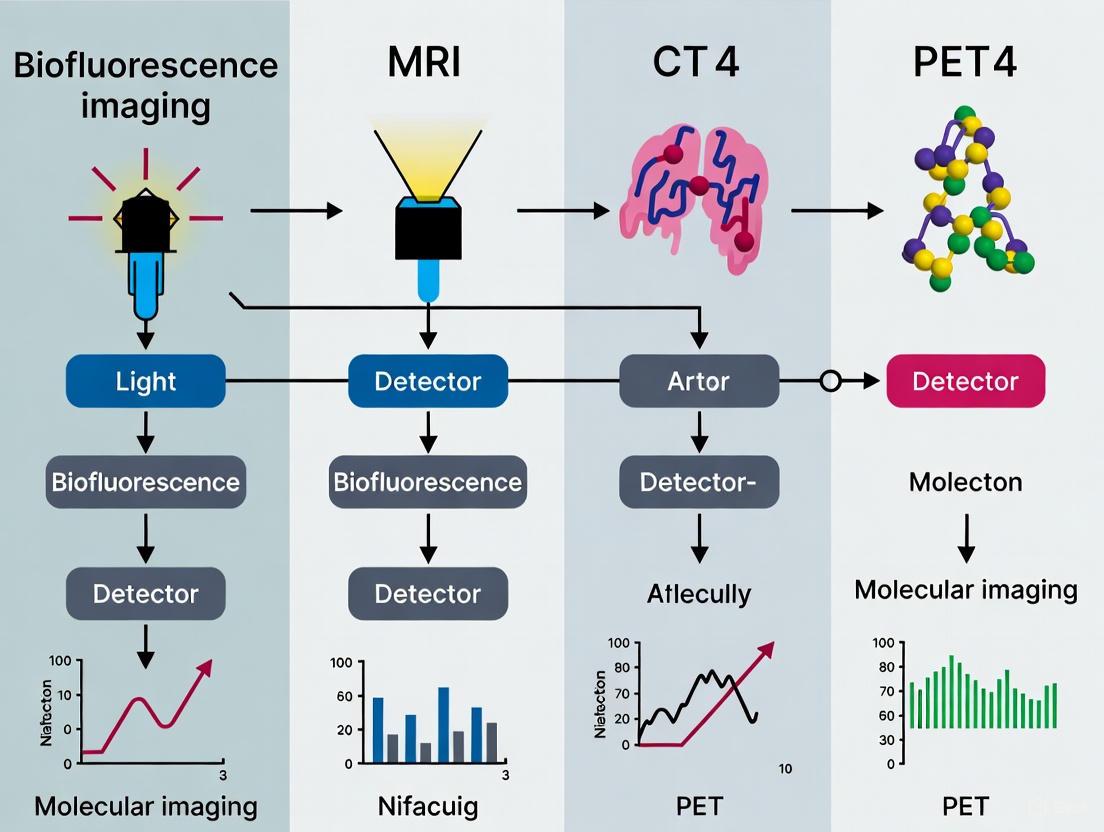
This article provides a comprehensive comparison of major molecular imaging modalities—biofluorescence, MRI, CT, and PET—for researchers, scientists, and drug development professionals.
Molecular Imaging Modalities: A Comparative Analysis of Biofluorescence, MRI, CT, and PET
Abstract
This article provides a comprehensive comparison of major molecular imaging modalities—biofluorescence, MRI, CT, and PET—for researchers, scientists, and drug development professionals. It covers foundational principles, methodological applications, optimization strategies, and comparative validation. The scope includes examining the high sensitivity and real-time capabilities of fluorescence imaging against the deep-tissue penetration and anatomical precision of radiographic techniques, with insights into overcoming inherent limitations through probe development and hybrid imaging. The content also explores future directions, including the integration of deep learning and multimodal approaches, to enhance diagnostic accuracy and therapeutic monitoring in biomedical research.
Core Principles and Instrumentation of Molecular Imaging Technologies
This guide provides an objective comparison of five core molecular imaging modalities: bioluminescence, fluorescence, MRI, CT, and PET. The table below summarizes their fundamental mechanisms and key performance characteristics to inform tool selection for research and drug development.
| Imaging Modality | Fundamental Mechanism | Primary Signal | Key Performance Metric | Quantitative Data (Representative) |
|---|---|---|---|---|
| Bioluminescence (BLI) | Light emission from enzyme-substrate (e.g., luciferase-luciferin) chemical reaction [1] [2] | Bioluminescent light (photons) | Sensitivity / Signal-to-Noise Ratio | Very high; minimal background light yields excellent signal-to-noise [1] [2] |
| Fluorescence (FLI) | Light emission from fluorophore excited by an external light source [2] | Fluorescent light (photons) | Spatial Resolution / Multiplexing | High; enables multiplexing with different fluorophores [2] |
| Magnetic Resonance Imaging (MRI) | Emission of radiofrequency signals from hydrogen protons realigning in a strong magnetic field [3] | Radio waves | Soft-Tissue Contrast / Specificity | Sensitivity: 92%; Specificity: 85% (ovarian tumors) [3] |
| Computed Tomography (CT) | Differential absorption of X-rays by tissues [4] | X-rays | Anatomical Detail / Speed | Sensitivity: 68%; Specificity: 94% (colorectal liver metastases) [4] |
| Positron Emission Tomography (PET) | Detection of gamma rays from positron-emitting radiotracer decay [5] | Gamma rays | Metabolic Sensitivity / Quantification | Sensitivity: 61%; Specificity: 99% (colorectal liver metastases) [4] |
Performance Comparison in Research Applications
Lesion Detection and Staging
Direct comparisons in clinical and preclinical oncology highlight trade-offs between sensitivity and specificity.
Table 2: Oncologic Staging Performance (Per-Lesion Analysis)
| Pathology | Modality | Sensitivity | Specificity | Context & Comparative Findings |
|---|---|---|---|---|
| Colorectal Liver Metastases [4] | CT | 68% | 94% | MRI demonstrated significantly higher sensitivity, especially for sub-centimeter lesions. |
| MRI | 90% | 87% | ||
| PET/CT | 61% | 99% | ||
| Breast Cancer (Whole-Body) [6] [7] | PET/CT | - | - | Trend toward higher sensitivity for PET/MRI, particularly for liver and bone metastases; PET/CT had higher specificity in some studies [6]. |
| PET/MRI | Higher | - | ||
| Nodal/Distant Staging (NSCLC) [8] | PET/CT | 82% / 86%* | 88% / 89%* | No significant differences reported; modalities have similar value for staging Non-Small Cell Lung Cancer [8]. |
| PET/MRI | 86% / 93%* | 90% / 90%* | ||
| *Sensitivity/Specificity for nodal metastases / distant metastases |
Functional and Metabolic Imaging
- Bioluminescence Imaging: Ideal for longitudinal tracking of tumor growth, gene expression, and cell migration in live animals due to very low background [1] [9]. A key application is developing safer BSL-2 models for studying highly pathogenic viruses via longitudinal BLI [9].
- Fluorescence Imaging: Excels in visualizing protein localization, enzymatic activity, and cellular trafficking with high spatial resolution, though background autofluorescence can be a limitation [1] [2].
- PET-based Modalities: Provide highly sensitive, quantitative mapping of metabolic activity (e.g., with 18F-FDG), specific molecular targets (e.g., with 68Ga-PSMA), or fibroblast activation (e.g., with FAPI tracers) [8] [3].
Experimental Protocols and Methodologies
Protocol 1: In Vivo Bioluminescence Imaging for Tumor Growth Monitoring
This protocol is widely used in oncology research for non-invasive, longitudinal tracking of tumor dynamics [1] [2].
- Cell Line Engineering: Stably transduce tumor cells of interest with a luciferase reporter gene (e.g., Firefly luciferase - Fluc).
- Subject Preparation: Implant luciferase-expressing cells into an appropriate animal model (e.g., mouse).
- Substrate Administration: Once tumors are established, inject the luciferase substrate (e.g., D-luciferin for Fluc) intraperitoneally or intravenously. The standard dose is 150 mg/kg body weight for D-luciferin [1].
- Image Acquisition: Place the animal in a light-tight chamber of a bioluminescence imaging system. Acquire data after a brief incubation period (typically 10-20 minutes for IP injection) to allow for substrate distribution and peak light emission. Exposure times can range from 1 second to several minutes.
- Data Analysis: Quantify the total photon flux (photons/second) within a region of interest (ROI) drawn around the tumor signal. This provides a quantitative measure of tumor burden over time.
Protocol 2: PET/MRI for Synergistic Whole-Body Staging
This hybrid protocol leverages the functional strength of PET and the superior soft-tissue contrast of MRI [7].
- Tracer Administration: Intravenously inject the subject with a PET radiotracer (e.g., 18F-FDG, 68Ga-PSMA). The administered activity for 18F-FDG in human studies is typically 258 ± 50 MBq [7].
- Uptake Period: Allow ~60 minutes for the tracer to distribute and be taken up by target tissues.
- Sequential Imaging: First, acquire a low-dose CT scan for initial anatomical correlation and attenuation correction. This is followed by the PET acquisition. Subsequently, perform the MRI scan on an integrated system. A typical whole-body MRI protocol includes [7]:
- Attenuation Correction Sequence: A coronal 3D Dixon VIBE sequence.
- Anatomical Imaging: Transverse T1-weighted and T2-weighted sequences.
- Functional/Diffusion Imaging: Diffusion-weighted imaging (DWI) sequences to assess tissue cellularity.
- Image Reconstruction and Fusion: Reconstruct PET data using iterative algorithms (e.g., ordered-subset expectation maximization). The MRI-derived attenuation maps are used for accurate PET attenuation correction. Fused PET/MRI images are generated for analysis.
- Interpretation: Images are reviewed in consensus by a radiologist and nuclear medicine physician. Findings are classified, and clinical relevance is assessed.
Fundamental Mechanisms and Workflows
Diagram 1: Bioluminescence vs Fluorescence Mechanism
Diagram 2: PET/MRI Integrated Imaging Workflow
The Scientist's Toolkit: Research Reagent Solutions
Table 3: Essential Reagents and Materials for Molecular Imaging
| Item | Function & Application | Example(s) |
|---|---|---|
| Luciferase Reporters | Genetically encoded enzymes that catalyze light-emitting reactions for BLI [1]. | Firefly luciferase (Fluc), Renilla luciferase (Rluc), Bacterial Lux operon [1]. |
| Luciferin Substrates | Chemical compounds oxidized by luciferases to produce bioluminescent light [1] [2]. | D-luciferin (for Fluc), Coelenterazine (for Rluc and Gaussia luciferase) [1]. |
| Fluorescent Proteins & Dyes | Molecules that absorb external light and re-emit it at a longer wavelength for FLI [2]. | GFP (Green Fluorescent Protein), RFP (Red Fluorescent Protein), Cyanine dyes (Cy5, Cy7) [9]. |
| PET Radiotracers | Radioactive molecules that target specific metabolic pathways or receptors for functional imaging [8]. | 18F-FDG (glucose metabolism), 68Ga-PSMA (prostate cancer), 68Ga-DOTATOC (neuroendocrine tumors) [7] [8]. |
| MRI Contrast Agents | Paramagnetic or superparamagnetic materials that alter tissue relaxation times to enhance contrast [10]. | Gadolinium-based chelates (Gd-DOTA, Gd-DTPA), Manganese-based complexes, Iron oxide nanoparticles [10]. |
| Dual-Modality Probes | Integrated agents designed to provide contrast for two imaging modalities simultaneously [10]. | Small-molecule probes (e.g., Gd-DOTA-4AMP-18F for PET/MRI), Nanoparticle-based probes [10]. |
Molecular imaging is indispensable for biomedical research and drug development, enabling the non-invasive visualization of biological processes. Two dominant technological approaches for this task are biofluorescence imaging and radiation-based modalities like MRI, CT, and PET. Each offers a distinct combination of strengths in resolution, sensitivity, and depth penetration, making the choice of instrumentation critical for experimental design. This guide provides an objective comparison of the hardware underlying these technologies, equipping researchers with the data needed to select the optimal system for their specific research context.
Performance Comparison: Biofluorescence Imaging vs. Anatomical and Nuclear Modalities
The table below summarizes the core performance characteristics of key molecular imaging modalities, highlighting their complementary nature.
Table 1: Instrumentation Performance Comparison for Molecular Imaging
| Imaging Modality | Spatial Resolution | Penetration Depth | Key Strength | Primary Limitation | Common Instrumentation & Hardware |
|---|---|---|---|---|---|
| Fluorescence Imaging (NIR-II) | ~μm to mm scale [11] | ~1-10 mm (highly wavelength-dependent) [11] [12] | High sensitivity, real-time imaging, non-radioactive [11] | Limited tissue penetration, scattering, autofluorescence [11] | NIR-sensitive cameras (InGaAs/CCD), lasers, optical filters [12] |
| Magnetic Resonance Imaging (MRI) | Sub-mm to mm scale [13] | No practical limit (full body) [14] | Excellent soft-tissue contrast, no ionizing radiation [13] | Low sensitivity, high cost, long scan times [14] | Superconducting magnet (1.5T-7T), RF coils, gradient systems [13] |
| Positron Emission Tomography (PET) | Mm scale [11] [15] | No practical limit (full body) [14] | Exceptional sensitivity (picomolar), quantitative metabolic data [16] [15] | Requires radioisotopes, lower resolution, radiation exposure [11] | Gamma photon detectors (BGO, LSO crystals), photomultiplier tubes [17] |
| Computed Tomography (CT) | Sub-mm scale [14] | No practical limit (full body) [14] | High-speed bone and tissue anatomy imaging [14] | Low soft-tissue contrast, ionizing radiation [14] | X-ray tube, rotating gantry, digital detector array [14] |
Experimental Protocols and Data Acquisition
The performance data in Table 1 is derived from standardized experimental protocols. Below are the methodologies for key experiments cited in this guide, which are essential for understanding the quantitative comparisons.
Protocol 1: High-Contrast In Vivo NIR-II Fluorescence Imaging
This protocol is based on research that explored fluorescence imaging in the 1880-2080 nm window, a region previously avoided due to strong water absorption [12].
- Objective: To achieve high-contrast fluorescence imaging of vasculature in live mice by exploiting the water absorption peak at ~1930 nm.
- Materials:
- Fluorescent Probe: Water-soluble core-shell PbS/CdS quantum dots (QDs) with emission peaks at 1700 nm or beyond [12].
- Imaging System: NIR-sensitive camera (e.g., InGaAs detector) capable of detecting light in the 1880-2080 nm range.
- Animal Model: Live mice (e.g., BALB/c).
- Procedure:
- Synthesize and PEGylate PbS/CdS QDs to ensure water solubility and biocompatibility [12].
- Intravenously administer the QDs into the mouse tail vein.
- Excite the QDs with an 808 nm laser diode.
- Collect emitted fluorescence using the NIR camera through a long-pass filter (>1880 nm).
- Acquire images and analyze the Signal-to-Background Ratio (SBR) and Structure Similarity Index Measure (SSIM), comparing results to those from traditional NIR-II sub-windows (e.g., 1500-1700 nm) [12].
- Supporting Data: The study demonstrated that the 1880-2080 nm window provides a higher SBR and SSIM compared to the NIR-IIb (1500-1700 nm) window, due to enhanced suppression of scattered photons by water absorption [12].
Protocol 2: Integrated PET/MRI for Glioblastoma (GBM) Monitoring
This protocol outlines the methodology for a multimodal imaging study that combined the strengths of PET and MRI for brain tumor assessment [15].
- Objective: To evaluate the complementary value of FLT-PET and contrast-enhanced MRI in diagnosing Glioblastoma (GBM) and assessing early treatment response.
- Materials:
- Scanner: Integrated PET/MRI system (e.g., GE SIGNA PET/MRI).
- PET Tracer: 18F-fluorothymidine (FLT), a marker of cellular proliferation.
- MRI Contrast Agent: Gadolinium-based contrast agent.
- Subjects: Human patients with diagnosed GBM.
- Procedure:
- Patients undergo four sequential FLT-PET/MRI examinations: before and during radiochemotherapy.
- For the PET component, administer FLT intravenously and acquire emission data.
- For the MRI component, acquire T1-weighted images before and after gadolinium injection.
- Reconstruct PET images and correct for attenuation.
- Co-register PET and MRI image sets using advanced analysis platforms (e.g., MATLAB, imlook4d).
- Extract quantitative parameters: from MRI (tumor volume), and from PET (SUVmax, PET tumor volume, Total Lesion Activity - TLA) [15].
- Supporting Data: The study found that while MRI showed significant variations in tumor response between long-term and short-term survivors, PET parameters like SUVmax and TLA provided complementary trending data for predicting progression-free survival [15].
Instrument Workflows and Logical Relationships
The following diagram illustrates the fundamental operational principles and data acquisition workflows for fluorescence imaging and a combined PET/MRI system, highlighting their distinct approaches.
The Scientist's Toolkit: Key Research Reagents and Materials
Successful execution of molecular imaging experiments relies on a suite of specialized reagents and materials. The table below details essential components for the featured modalities.
Table 2: Essential Research Reagents and Materials for Molecular Imaging
| Item Name | Function/Application | Example Specifics |
|---|---|---|
| NIR-II Fluorophores | Fluorescent probes for deep-tissue imaging. | PbS/CdS Quantum Dots [12]; BODIPY dyes [11]. Emit in 1000-2080 nm range to reduce scattering. |
| Targeted Antibodies | Conjugates for specific molecular targeting. | Trastuzumab (Herceptin) conjugated to Alexa Fluor dyes for HER2+ tumor imaging [11]. |
| PET Radioisotopes | Radiotracers for metabolic and functional imaging. | 18F-fluorothymidine (FLT) for monitoring tumor proliferation [15]. |
| MRI Contrast Agents | Compounds to enhance soft-tissue contrast. | Gadolinium-based complexes [14] [15]; Ultrasmall Superparamagnetic Iron Oxide Nanoparticles (USPIONs) for multimodal (MRI/SPECT/PET) imaging [16]. |
| FLIM Analysis Software | Tools for analyzing fluorescence lifetime, independent of probe concentration. | FLiSimBA framework for simulating and analyzing FLIM data in biological tissue, accounting for autofluorescence [18]. |
| Quality Control Phantoms | Devices for ensuring scanner performance and quantification accuracy. | ACR-approved PET phantom for semi-annual uniformity, contrast, and resolution testing [17]. |
The choice between biofluorescence imaging and modalities like MRI, CT, and PET is not a matter of selecting a superior technology, but rather the optimal tool for a specific research question. Fluorescence instrumentation (cameras, NIR probes) offers unparalleled capabilities for real-time, high-sensitivity molecular imaging in superficial tissues or in pre-clinical models where radiation is a concern. In contrast, MRI, PET, and CT scanners provide critical anatomical and functional data from deep within the body. As evidenced by the growing development of multimodal probes and integrated systems like PET/MRI, the future of molecular imaging instrumentation lies in strategic combination, leveraging the complementary strengths of each hardware platform to achieve a more comprehensive biological picture.
The Role of Contrast Agents and Fluorophores in Signal Generation
In molecular imaging, the signal generation mechanism is fundamentally determined by the physical and chemical properties of the contrast agent used. These agents interact with specific forms of energy—whether light, magnetic fields, or radiation—to produce detectable signals that reveal biological processes at the cellular and molecular level. Optical imaging, primarily using fluorophores, relies on the absorption and re-emission of light, offering high sensitivity and spatial resolution at superficial depths. In contrast, clinical modalities like MRI, CT, and PET depend on contrasting mechanisms based on magnetic properties, X-ray attenuation, or radioactive decay, respectively, providing greater tissue penetration but often at the cost of molecular specificity or temporal resolution [19] [20] [21]. The choice of imaging agent directly dictates the type of information that can be obtained, from anatomical structure to functional and molecular activity. This guide provides an objective comparison of these agents, their performance characteristics, and the experimental methodologies used to evaluate them, framed within the context of selecting appropriate tools for research and drug development.
Fundamental Signaling Mechanisms
The underlying principles of signal generation differ significantly across imaging modalities. The following diagram illustrates the core pathways for the primary agents discussed in this guide.
The signaling pathways for different classes of contrast agents involve distinct physical processes. Fluorophores, including organic dyes like indocyanine green (ICG) and targeted antibodies conjugated to Alexa Fluor dyes, absorb high-energy photons and, after a brief period in an excited state, emit lower-energy photons [19] [22]. This Stokes shift allows the emitted light to be distinguished from the excitation light. The resulting signal is detected as fluorescence intensity, which can be quantified and mapped. Conversely, MRI contrast agents, such as gadolinium-based complexes or iron oxide nanoparticles, operate by altering the magnetic relaxation times of water protons in their immediate vicinity [21]. They do not generate a signal themselves but modify the native tissue signal, producing contrast detectable as changes in T1 or T2 relaxation times on an MRI scanner.
PET tracers incorporate positron-emitting isotopes (e.g., ¹⁸F, ⁶⁴Cu). The emitted positron travels a short distance before annihilating with an electron, producing two coincident gamma photons traveling in nearly opposite directions [23]. Detection of these simultaneous photons by a PET scanner ring allows precise localization of the radioactive source. CT contrast agents, typically iodine-based compounds or heavy metal nanoparticles, function by absorbing X-rays more effectively than surrounding tissue [21]. This differential attenuation results in increased signal (measured in Hounsfield Units) on X-ray detectors, effectively mapping tissue density or vascular structures.
Quantitative Performance Comparison
The practical utility of an imaging agent is determined by a set of key performance parameters. The table below provides a comparative overview of these characteristics for agents used in different modalities.
Comparison of Contrast Agent Performance Characteristics
| Imaging Modality | Agent Type | Sensitivity | Spatial Resolution | Tissue Penetration | Temporal Resolution | Key Quantitative Metrics |
|---|---|---|---|---|---|---|
| Fluorescence Imaging | Organic Dyes (e.g., ICG, Alexa Fluor) | High (nM-pM) [24] | Microscopic to Macroscopic (μm-mm) [19] | Limited (mm-cm) [24] | Excellent (Seconds-Minutes) [22] | Fluorescence Intensity, Quantum Yield, Stokes Shift [20] |
| MRI | Gadolinium Complexes, Iron Oxide NPs | Low (μM-mM) [21] | High (10-100 μm) [21] | Unlimited (Whole body) | Slow (Minutes-Hours) | Relaxivity (r1, r2), Contrast-to-Noise Ratio [21] |
| PET | Radiolabeled Tracers (e.g., ¹⁸F-FDG, ⁶⁴Cu-mAb) | Very High (pM-fM) [23] | Low (1-2 mm) [23] | Unlimited (Whole body) | Moderate (Minutes) | Standardized Uptake Value (SUV), % Injected Dose per Gram (%ID/g) [23] |
| CT | Iodinated Compounds, Gold NPs | Low (μM-mM) [21] | High (50-200 μm) [21] | Unlimited (Whole body) | Very Fast (Seconds) | Hounsfield Units (HU), Attenuation Coefficient [21] |
Fluorophores excel in sensitivity and temporal resolution, enabling the detection of low-abundance molecular targets and the monitoring of fast biological processes, but are constrained by limited tissue penetration due to light scattering and absorption [24]. In vivo, their signal is surface-weighted, meaning fluorescence intensity decreases rapidly the deeper a probe is embedded. MRI and CT provide high spatial resolution and unrestricted penetration, offering exquisite anatomical detail, but their contrast agents are typically less sensitive to low concentrations of molecular targets [21]. PET stands out for its exceptional sensitivity and quantitative whole-body capability, allowing for tracer quantification in picomolar to femtomolar concentrations, though with lower spatial resolution than MRI or CT [23].
A critical development is the creation of multimodal agents that combine strengths from different modalities. For example, a single nanoparticle can be tagged with both a radionuclide for PET and a fluorophore for optical imaging [23] [25] [26]. This allows for non-invasive, quantitative whole-body imaging via PET, followed by high-resolution, real-time fluorescence imaging for surgical guidance or histological validation. The stability of the fluorophore compensates for the rapid decay of the PET isotope, enabling longitudinal correlative studies [23].
Experimental Protocols for Agent Evaluation
Rigorous, standardized experimental protocols are essential for the objective comparison of contrast agents. The workflow for evaluating a novel targeted fluorescent agent, common in cancer research, is outlined below.
Protocol 1: Evaluating a Targeted Fluorescent Agent In Vivo
This protocol is designed to assess the specificity, biodistribution, and signal kinetics of a novel fluorescent probe in a preclinical tumor model [19] [22] [24].
1. Probe Synthesis & Characterization: The targeting ligand (e.g., an antibody like trastuzumab or a small peptide like RGD) is chemically conjugated to an organic fluorophore with near-infrared emission (e.g., Alexa Fluor 660, Cy5.5, or IRDye 800CW) [19]. The conjugate is purified, and the degree of labeling (dye-to-protein ratio) is determined spectroscopically. This ensures consistent optical properties and function.
2. In Vitro Cell Validation: Prior to in vivo studies, the probe's binding specificity is validated in cell culture. Target-positive and target-negative cell lines are incubated with the probe. Binding affinity and specificity are quantified using flow cytometry or confocal microscopy, comparing signal intensity between the two cell populations [19].
3. Animal Model Preparation: A relevant disease model, typically a mouse xenograft with a human tumor cell line expressing the target antigen (e.g., EGFR-overexpressing squamous cell carcinoma), is established. Animals are housed and handled according to institutional animal care guidelines.
4. In Vivo Imaging: The probe is administered intravenously via tail vein injection. Animals are imaged at multiple time points (e.g., 1, 24, and 48 hours post-injection) using a fluorescence molecular tomography (FMT) system. The animal is placed in the imaging chamber, and a 3D scan is acquired. If a hybrid system is available, a co-registered CT or MRI scan is performed immediately after to provide anatomical context [24]. This allows for longitudinal tracking of probe accumulation and clearance.
5. Ex Vivo Validation: After the final imaging time point, animals are euthanized, and tumors along with major organs (liver, spleen, kidneys, heart, lungs) are harvested. These tissues are imaged ex vivo to quantify the fluorescence signal in each organ. Tissues are then fixed, sectioned, and stained (e.g., with H&E) for histological analysis. Fluorescence microscopy is used to confirm the cellular localization of the probe signal and its co-localization with the target biomarker [19].
6. Data Analysis & Quantification: Fluorescence data is analyzed to calculate key metrics. The Tumor-to-Background Ratio (TBR) is determined by dividing the mean fluorescence intensity of the tumor by the intensity of adjacent normal tissue or muscle. For quantitative comparison, the Percentage of Injected Dose per Gram of tissue (%ID/g) is calculated [19] [23]. Statistical analysis (e.g., t-tests, ANOVA) is performed to confirm significant differences in probe uptake.
Protocol 2: Assessing a Multimodal PET/Fluorescence Agent
This protocol highlights the complementary data obtained from a single multimodal probe, combining the quantitative depth penetration of PET with the high-resolution capabilities of fluorescence imaging [23].
1. Agent Preparation: A targeting vector (e.g., an antibody or peptide) is dual-labeled with both a positron-emitting isotope (e.g., ⁶⁴Cu via a chelator like NOTA or DOTA) and a NIR fluorophore (e.g., Alexa Fluor 750) [23]. Radiochemical purity and specific activity are determined before injection.
2. Hybrid Imaging: The dual-labeled agent is injected into tumor-bearing mice. At the time of peak tumor uptake (determined from prior pharmacokinetic studies, e.g., 24 hours for antibodies), a PET scan is acquired. The scan provides whole-body, quantitative data on probe distribution and allows calculation of %ID/g in all organs, leveraging the high sensitivity of PET for deep-tissue lesions [23]. This is followed immediately by a fluorescence imaging session, which may reveal superficial tumor margins and vascular patterns with higher spatial resolution than the PET scan.
3. Data Correlation & Autoradiography: After imaging, animals are euthanized, and tumors are excised and frozen. Tissue sections are prepared. Autoradiography is performed to capture the high-resolution distribution of the radioactive signal within the tumor. The same sections are then imaged with a fluorescence slide scanner. Co-registration of the autoradiography and fluorescence images validates that both labels track the same biodistribution, confirming the probe's integrity and enabling correlation of macroscopic PET data with microscopic fluorescence findings [23].
The Scientist's Toolkit: Essential Research Reagents
This section details key reagents and materials essential for conducting experiments in molecular imaging agent development and evaluation.
Key Reagents for Contrast Agent Research
| Reagent / Material | Core Function | Specific Application Example |
|---|---|---|
| Near-Infrared Fluorophores (e.g., Cy5.5, Alexa Fluor 660, IRDye 800CW) | Serves as the optical reporter; absorbs and emits light in the NIR window (650-900 nm) where tissue absorption and autofluorescence are minimal [19] [22]. | Conjugated to antibodies or peptides for targeted tumor imaging in vivo [19]. |
| PET Radionuclides (e.g., ⁶⁴Cu, ⁸⁹Zr, ¹⁸F) | Serves as the radioactive reporter for PET; decays by positron emission, enabling deep-tissue, quantitative imaging [23]. | Radiolabeled to biologics for tracking their biodistribution and pharmacokinetics over time. |
| Bifunctional Chelators (e.g., DOTA, NOTA) | Chemically links radionuclides (like ⁶⁴Cu) to a targeting biomolecule without altering its biological function [23]. | Essential for synthesizing radioimmunoconjugates (e.g., ⁶⁴Cu-DOTA-trastuzumab). |
| Targeting Ligands (e.g., mAbs, RGD Peptide, EGF) | Confers molecular specificity by binding to biomarkers overexpressed on target cells (e.g., EGFR, integrins) [19] [21]. | The "homing" component of a targeted contrast agent, driving accumulation at the disease site. |
| Fluorescence Molecular Tomography (FMT) System | Preclinical imaging system that reconstructs 3D quantitative maps of fluorophore concentration in living animals [24]. | Used for longitudinal, quantitative assessment of probe accumulation in tumors. |
| Hybrid Imaging Systems (e.g., FMT-CT, FMT-MRI) | Combines the molecular data from FMT with high-resolution anatomical context from CT or MRI in a single session [24]. | Provides precise anatomical localization of fluorescent signals, improving accuracy. |
| Indocyanine Green (ICG) | FDA-approved non-targeted NIR fluorescent dye [22]. | Used as a control agent for vascular and perfusion imaging, and for intraoperative guidance. |
| Matrix Metalloproteinase (MMP) Sense Probe | An activatable fluorescent probe that remains quenched until cleaved by specific enzymes like MMPs [26]. | Used to image enzyme activity (e.g., in tumor microenvironment or neuroinflammation) rather than just target presence. |
Molecular imaging has revolutionized biomedical research and drug development by enabling the non-invasive visualization, characterization, and quantification of biological processes at the molecular and cellular levels within living organisms. For researchers and drug development professionals, selecting the optimal imaging modality requires careful consideration of key performance parameters, primarily sensitivity, spatial resolution, and penetration depth. These parameters determine a technology's ability to detect molecular targets, precisely locate them, and do so through various tissue depths.
This guide provides a objective, data-driven comparison of two major approaches: optical molecular imaging (specifically biofluorescence imaging) and clinical structural/functional imaging (MRI, CT, and PET). Biofluorescence imaging, including techniques like Fluorescence Lifetime Imaging (FLI) and Fluorescence Molecular Tomography (FMT), offers high sensitivity and specific molecular contrast, but is constrained by photon penetration in tissues. In contrast, MRI, CT, and PET provide superior penetration for whole-body human and preclinical applications, but with varying trade-offs in resolution, sensitivity, and molecular specificity. The following sections will dissect these trade-offs using quantitative data and experimental evidence to inform modality selection for specific research applications.
Quantitative Comparison of Key Parameters
The table below summarizes the core performance characteristics of the primary imaging modalities, synthesizing data from comparative studies and technology reviews.
Table 1: Key Parameter Comparison of Molecular Imaging Modalities
| Imaging Modality | Sensitivity | Spatial Resolution | Penetration Depth | Key Advantages | Primary Limitations |
|---|---|---|---|---|---|
| Fluorescence Imaging (FLI) | High (nanomolar to picomolar) [27] | Low to Moderate (∼1-3 mm macroscopic; μm microscopic) [28] [27] | Shallow (∼1-2 cm) [27] | High specificity, non-radiative, low cost, real-time imaging [27] | Shallow penetration, scattering & absorption effects, difficult tomography [27] |
| Magnetic Resonance Imaging (MRI) | Low (millimolar) [27] | High (∼10-100 μm preclinical; ∼1 mm clinical) [28] [29] [30] | Unlimited (whole-body) | Excellent soft-tissue contrast, anatomical & functional data, no ionizing radiation [27] | Low sensitivity, high cost, long acquisition times [27] |
| Positron Emission Tomography (PET) | Very High (picomolar) [27] | Moderate (∼1-2 mm preclinical; ∼4-7 mm clinical) [28] [31] [32] | Unlimited (whole-body) | Ultra-high sensitivity, absolute quantification, deep-tissue molecular imaging [27] [31] | Ionizing radiation, lower resolution than MRI, cyclotron requirement [27] |
| Computed Tomography (CT) | Not Applicable (anatomical) | High (∼50 μm preclinical; ∼0.5 mm clinical) | Unlimited (whole-body) | High-speed acquisition, excellent bone contrast, high resolution [27] | Low soft-tissue contrast, ionizing radiation, primarily anatomical [27] |
Deep Dive: Experimental Data and Performance Validation
Performance in Tumor Detection and Biodistribution Studies
Direct comparisons in preclinical models provide the most concrete evidence for modality performance. A seminal study compared FLI, PET, MRI, and Bioluminescence Imaging (BLI) for monitoring tumor growth in mouse models.
Table 2: Tumor Detection Performance in Preclinical Models [28]
| Imaging Modality | Ability to Detect Small, Non-Palpable Tumors | Performance in Tumor Burden Measurement | Practicality for Longitudinal Studies |
|---|---|---|---|
| Bioluminescence (BLI) | Excellent | Excellent | High |
| Fluorescence Imaging (FLI) | Limited (macroscopic tumors only) | Good | High |
| Positron Emission Tomography (PET) | Excellent | Good | Moderate (radiotracer availability) |
| Magnetic Resonance Imaging (MRI) | Limited (macroscopic tumors only) | Good | Moderate (cost, time) |
The study concluded that while BLI and FDG-PET were capable of identifying small, non-palpable tumors, MRI and FLI could only detect macroscopic, clinically evident tumors [28]. This highlights FLI's primary limitation in sensitivity for very early disease detection compared to radionuclide methods.
In biodistribution assessments, a direct comparison between FMT/CT and PET/MRI for tracking antibody delivery in xenograft models found that both methods faithfully monitored distribution and correlated significantly with ex vivo data [33]. However, the fluorescent label (Alexa750) altered pharmacokinetics, showing shorter blood half-times and higher liver uptake compared to the radiolabeled (64Cu) counterparts [33]. This is a critical consideration for drug development, indicating that the choice of label can influence the biological outcome.
Diagnostic Accuracy in Clinical Applications
The high specificity of PET is evident in clinical studies. A systematic review of 18F-FDG PET/CT for axillary lymph node staging in breast cancer found it has a modest sensitivity of 52.2% but a very high specificity of 91.6% [31]. This high specificity means a positive PET/CT scan is a strong indicator of disease (PPV of 77.8%), though its low sensitivity precludes it from ruling out metastasis alone [31].
Another 2025 study on giant cell arteritis found that combined cranial and large vessel PET/CT had the highest sensitivity (89%) and specificity (98%) compared to ultrasound, MRI, and temporal artery biopsy [34]. This demonstrates PET's power in specific clinical inflammatory conditions.
Methodologies: Experimental Protocols in Focus
Protocol for Depth-Resolved Fluorescence Lifetime Imaging (FLI)
The HSF-FLI (High Spatial Frequency-Fluorescence Lifetime Imaging) protocol addresses FLI's depth challenge using structured illumination [35].
- Aim: To selectively isolate subsurface fluorescence from surface signals while preserving accurate lifetime estimation [35].
- Setup: A time-gated Intensified Charge-Coupled Device (ICCD) camera system with a Digital Micro-mirror Device (DMD) for projecting structured illumination patterns. Excitation is provided by a tunable Ti:sapphire laser [35].
- Procedure:
- Structured Illumination: The sample is illuminated with three-phase sinusoidal patterns at high spatial frequencies projected via the DMD.
- Signal Demodulation: The modulated surface signal (
I_AC) and non-modulated subsurface signal (I_sub) are decomposed from the total fluorescence (I_DC) using phase offset signals [35]. - Lifetime Fitting: Fluorescence decays are acquired over multiple time gates. A bi-exponential model is fitted to the data via Non-linear Least Squares Fitting (NLSF) to recover depth-resolved lifetime maps [35].
- Validation: The method was cross-validated in mouse models bearing tumor xenografts using ex vivo measurements, confirming its ability to separate superficial skin signals from deeper tumor-derived fluorescence [35].
Figure 1: HSF-FLI Experimental Workflow for Depth Resolution
Protocol for Comparative Biodistribution Study (FMT/CT vs. PET/MRI)
This protocol directly compares the quantitative accuracy of optical and nuclear imaging for drug biodistribution [33].
- Aim: To systematically investigate the performance of FMT/CT versus PET/MRI for quantitative analysis of antibody biodistribution in xenografts [33].
- Animal Model: Nude mice with subcutaneously implanted A-431 squamous cell carcinoma tumors [33].
- Probe Preparation:
- FMT/CT: Anti-EGFR antibody formats (mAb, F(ab')2, Fab) labeled with Alexa750 dye.
- PET/MRI: The same antibody formats conjugated with 64Cu-NODAGA radiolabel [33].
- Imaging Protocol:
- Inject labeled compounds intravenously into separate cohorts.
- Image mice at 2 and 24 hours post-injection using both FMT/CT and PET/MRI systems.
- For FMT/CT: Acquire CT for anatomy, then FMT using multiple laser injection points for 3D reconstruction.
- For PET/MRI: Perform a 10-minute PET scan followed by a T2-weighted MRI sequence for anatomical coregistration [33].
- Quantification: Segment regions of interest (tumor, liver, kidney, muscle) on fused images. Compare in vivo imaging data to ex vivo fluorescence, γ-counting, and electrochemiluminescence immunoassay (ECLIA) of explanted organs [33].
The Scientist's Toolkit: Essential Research Reagents & Materials
Table 3: Key Reagents and Materials for Molecular Imaging Experiments
| Item | Function/Application | Example Uses |
|---|---|---|
| Reporter Genes (e.g., GFP, RFP, Luciferase) | Genetically encoded probes for tracking gene expression, protein localization, and cell fate in vivo [27] [36]. | Engineering stable cell lines for tumor models; creating transgenic reporter animals. |
| Synthetic Fluorophores (e.g., Alexa750) | Fluorescent dyes for labeling antibodies, peptides, and other biomolecules for FLI and FMT [33]. | Labeling therapeutic antibodies for biodistribution and pharmacokinetic studies [33]. |
| Radionuclides (e.g., 18F, 64Cu) | Radioactive isotopes for PET imaging, enabling ultra-sensitive detection of molecular targets [31] [33]. | Synthesizing radiotracers like 18F-FDG for metabolic imaging; labeling antibodies with 64Cu [33]. |
| Structured Illumination Devices (DMD) | Digital Micro-mirror Devices for projecting precise light patterns to enable depth resolution in wide-field fluorescence imaging [35]. | Implementing HSF-FLI to separate surface from subsurface fluorescence signals in macroscopic imaging [35]. |
| Metasurface Enhancement Plates | Thin, smart metamaterials that manipulate radiofrequency fields to locally boost the Signal-to-Noise Ratio in MRI [30]. | Placing on the subject to achieve an up to eightfold SNR increase in 3T MRI without affecting the transmit field [30]. |
Technological Advancements and Future Directions
Pushing the Boundaries of Resolution and Sensitivity
Innovations continue to push the physical limits of each modality. In PET, ongoing development of ultra-high spatial resolution clinical systems targets resolutions below 2 mm, with dedicated organ-specific scanners (e.g., for head/neck or breast) achieving ~1 mm³ resolution through advanced detector materials and readout electronics [32]. In MRI, super-resolution parallel imaging (SURE-SENSE) techniques leverage intra-voxel coil sensitivity variations from multi-channel arrays to reconstruct higher-resolution images from fully-sampled low-resolution data, particularly beneficial for fMRI and spectroscopic imaging [29]. Furthermore, the integration of smart, thin metasurfaces can significantly boost MRI SNR—up to eightfold in 3T systems—by focusing the receive field without the need for bulky hardware, overcoming some fundamental sensitivity constraints [30].
Enhancing Fluorescence Imaging for Deeper Insights
For fluorescence imaging, the development of HSF-FLI represents a significant leap. By coupling structured illumination with physics-based depth modeling, it effectively eliminates surface signal bias without chemical clearing agents, enabling more accurate lifetime readouts from deeper tissues for applications like monitoring antibody-target engagement in tumors [35]. The broader field is also advancing with new bioluminescent and fluorescent probes, including near-infrared agents and quantum dots, which offer improved photon penetration and stability, expanding the possibilities for studying molecular interactions in live animals [27] [36].
Figure 2: Decision Logic for PET/MRI versus FLI/FMT Modalities
The choice between biofluorescence imaging (FLI/FMT) and clinical modalities like MRI, CT, and PET is not a matter of superiority, but of strategic alignment with research goals. As the comparative data show, PET remains the gold standard for high-sensitivity, whole-body molecular imaging, despite its use of ionizing radiation. MRI provides unparalleled soft-tissue contrast and high resolution for anatomical and functional studies. Fluorescence imaging offers an exceptional combination of high molecular specificity, safety, and cost-effectiveness, making it ideal for high-throughput preclinical studies, particularly those focusing on superficial tissues or using optical windowing techniques.
Emerging technologies are steadily eroding the traditional limitations of each modality. Ultra-high-resolution PET, super-resolution MRI, and depth-resolved fluorescence imaging are creating a new paradigm where the boundaries of sensitivity, resolution, and penetration depth are continuously being redrawn. For the modern researcher, this evolving landscape offers an expanding toolkit to precisely target complex biological questions in drug development and molecular research.
Practical Applications in Preclinical and Clinical Research
Tracking Tumor Dynamics and Metastasis with Fluorescence and PET
Modern oncology relies heavily on advanced imaging technologies to visualize tumors, track their dynamic changes, and detect metastasis. Among the most powerful tools are optical imaging techniques, particularly fluorescence imaging (FLI), and radionuclide-based techniques like positron emission tomography (PET). These modalities offer complementary insights into the molecular underpinnings of cancer. Fluorescence imaging provides high-resolution, real-time visualization of superficial tumors and precise surgical guidance, leveraging non-ionizing radiation for longitudinal studies [37]. In contrast, PET imaging offers unparalleled sensitivity for deep-tissue metabolic profiling and whole-body metastasis screening, albeit with ionizing radiation [38]. This guide objectively compares the performance, applications, and experimental protocols of these two pivotal technologies within the broader context of molecular imaging research, providing a structured framework for researchers and drug development professionals to select the optimal tool for their specific investigative needs.
Technology Comparison: Fundamental Principles and Performance Metrics
Core Imaging Principles
Fluorescence Imaging (FLI): This technique operates on the principle of light emission from fluorophores. When a fluorescent probe (fluorophore) is excited by light at a specific wavelength, its electrons jump to a higher energy state. As they return to the ground state, they emit light at a longer, lower-energy wavelength. This emitted light is detected to create an image [11] [37]. Its utility in tumor imaging is significantly enhanced by using targeted probes that accumulate in tumors based on specific biomarkers like enzymes, receptor proteins, or the unique tumor microenvironment (e.g., hypoxia, acidosis) [39].
Positron Emission Tomography (PET): PET is a nuclear medicine technique that detects pairs of gamma rays emitted indirectly by a radioactive tracer introduced into the body. The most common tracer is 18F-fluorodeoxyglucose ([18F]FDG), a glucose analog that is preferentially taken up by highly metabolically active cancer cells via the Warburg effect. The decay of the radionuclide produces positrons, leading to gamma ray emission that is detected by the scanner to create a 3D image of tracer concentration [38]. PET provides metabolic or functional information, often combined with CT (PET/CT) or MRI (PET/MRI) to overlay this data with anatomical context [40] [41] [38].
Quantitative Performance Data
The table below summarizes the key performance characteristics of FLI and PET based on current research and clinical data.
Table 1: Performance Comparison of Fluorescence Imaging and PET in Tumor Detection
| Performance Characteristic | Fluorescence Imaging (FLI) | Positron Emission Tomography (PET) |
|---|---|---|
| Spatial Resolution | High (micrometer-level) for superficial tumors [39] | Lower than FLI; improved with hybrid PET/CT or PET/MRI [37] |
| Tissue Penetration Depth | Limited (up to ~1 cm in NIR-I; several cm in NIR-II) [39] [37] | Excellent (whole-body) [38] |
| Sensitivity | High (nanomolar level) [37] | Very High (picomolar level) [37] |
| Metabolic Imaging Capability | Indirect, via targeted probes [39] | Direct, with probes like [18F]FDG [38] |
| Real-Time Imaging | Yes, capability for real-time intraoperative guidance [42] [39] | No |
| Radiation Exposure | Non-ionizing [37] | Ionizing (requires radiotracers) [37] |
| Example Detection Rate | N/A (highly probe-dependent) | 48.28% for brain metastasis in lung adenocarcinoma [43] |
| Key Limitation | Tissue autofluorescence & limited depth [11] [37] | Radiation exposure & lower spatial resolution [37] |
Recent advances have pushed fluorescence imaging into the second near-infrared window (NIR-II, 1000-1700 nm). This spectral region offers reduced light scattering, minimal autofluorescence, and deeper tissue penetration compared to the traditional NIR-I window (700-900 nm), leading to higher resolution and signal-to-background ratios [39]. A key clinical milestone was the use of the FDA-approved dye Indocyanine Green (ICG) for NIR-II fluorescence-guided surgery in patients with liver cancer [39].
For PET, the development of novel tracers beyond [18F]FDG is a major frontier. For instance, 18F-fibroblast activation protein inhibitor (18F-FAPI) PET/CT targets cancer-associated fibroblasts in the tumor microenvironment. One study reported variable detection rates for brain metastases depending on the primary lung cancer type: 48.28% for adenocarcinoma, 16.67% for large cell carcinoma, and 0% for small cell carcinoma [43]. Furthermore, tracers like 11C-Glutamine and 18F-FSPG are being used in dynamic PET to quantify specific metabolic pathways, such as glutamine uptake suppression in colorectal cancer in response to EGFR inhibitor therapy [44].
Experimental Protocols and Methodologies
Protocol for NQO1-Targeted Tumor Imaging with a NIR Fluorescent Probe
This protocol is based on a recent study developing the ZX-CHO probe for identifying colorectal cancer tissues [42].
- Objective: To achieve prolonged, in situ imaging of the tumor biomarker NAD(P)H:quinone oxidoreductase-1 (NQO1) in human colorectal cancer tissues and mouse models.
- Probe Design: The probe, ZX-CHO, consists of three key moieties:
- A dicyanoisophorone fluorophore that emits in the near-infrared (NIR) region (~590 nm).
- A trimethyl lock quinolone propionic acid (Q3PA) group that acts as a specific recognition and cleavage site for NQO1.
- An aldehyde group that serves as an anchoring site, enabling covalent bonding to amino acid residues of the NQO1 enzyme after the Q3PA group is cleaved. This design ensures the fluorescence signal remains at the reaction site for prolonged imaging.
- Experimental Workflow:
- Synthesis & Validation: The probe is synthesized and its structure is validated via techniques like NMR and mass spectrometry. Its optical properties and reactivity with recombinant NQO1 are confirmed in vitro.
- Cell Imaging: Various cancer cell lines are treated with ZX-CHO. Fluorescence signals are measured over time (e.g., 0-12 hours) to confirm NQO1-specific activation and prolonged signal retention.
- In Vivo Tumor Imaging:
- Animal Model: Mice bearing human colorectal tumor xenografts are used.
- Administration: The ZX-CHO probe is administered intravenously.
- Image Acquisition: Fluorescence images are captured at multiple time points post-injection using a NIR fluorescence imaging system.
- Ex Vivo Tissue Imaging: After in vivo imaging, tumors and major organs are excised and imaged to ex-vivo confirm the specificity of the probe and its ability to delineate tumor margins.
- Key Outcome: The probe successfully provided stable and prolonged fluorescent labeling of NQO1 in tumor tissues, enabling clear visualization of the boundary between tumor and normal tissue.
Diagram 1: NQO1 Probe Activation Workflow
Protocol for Detecting Breast Cancer Metastasis with [18F]FDG PET/CT
This protocol follows standardized guidelines and meta-analysis findings for staging breast cancer [38] [45].
- Objective: To accurately detect and localize distant metastases in patients with breast cancer for staging and treatment planning.
- Tracer: [18F]Fluorodeoxyglucose ([18F]FDG).
- Patient Preparation:
- Fasting: Patients are required to fast for at least 4-6 hours prior to the scan to ensure low blood glucose levels and reduce competitive inhibition of FDG uptake.
- Blood Glucose Check: Blood glucose levels are measured; typically, levels below 150-200 mg/dL are required for the scan to proceed.
- Hydration: Patients are encouraged to be well-hydrated.
- Rest: Patients should avoid strenuous exercise for 24 hours before the scan.
- Image Acquisition:
- Tracer Injection: A standardized dose of [18F]FDG (e.g., 3.7-5.18 MBq/kg) is administered intravenously in a quiet, dimly lit room.
- Uptake Period: The patient rests for approximately 60-90 minutes to allow for tracer uptake and distribution.
- Scanning: The patient is positioned in the PET/CT scanner.
- CT Scan: A low-dose CT scan is performed first for anatomical localization and attenuation correction.
- PET Scan: A whole-body PET scan is immediately performed following the CT. The emission data from the PET scan is reconstructed using iterative algorithms and fused with the CT images.
- Image Analysis:
- Qualitative: Fused PET/CT images are visually assessed by a nuclear medicine physician. Areas of focally increased FDG uptake that are not explainable by normal physiology are considered suspicious for malignancy.
- Quantitative: The maximum standardized uptake value (SUVmax) is calculated for identified lesions. SUVmax is a semi-quantitative measure of the tracer concentration within the lesion, providing an index of metabolic activity.
- Performance Data: A 2025 meta-analysis concluded that for detecting distant metastases in breast cancer, [18F]FDG PET/CT demonstrates a pooled sensitivity of 93% and specificity of 95%, performance comparable to the more expensive [18F]FDG PET/MRI [38].
The Scientist's Toolkit: Essential Research Reagents and Materials
Table 2: Key Reagents and Materials for Fluorescence and PET Imaging Research
| Item Name | Category | Function in Research | Example Use Case |
|---|---|---|---|
| NQO1 Probe ZX-CHO [42] | Fluorescent Probe | Targets and covalently binds to NQO1 enzyme for in situ tumor imaging | Delineating margins of colorectal cancer in vivo and ex vivo |
| NIR-II Organic Fluorophores [39] | Fluorescent Probe | Emits light in 1000-1700 nm range for deep-tissue, high-contrast imaging | High-resolution imaging of tumor vasculature and metastasis in animal models |
| Indocyanine Green (ICG) [11] [39] | Fluorescent Dye | FDA-approved NIR-I dye; used for perfusion and lymphatic mapping | NIR-II fluorescence-guided surgery for liver cancer [39] |
| [18F]FDG [38] [45] | PET Radiotracer | Glucose analog for imaging heightened glycolytic metabolism in tumors | Whole-body staging and detection of metastases in breast cancer |
| 18F-FAPI [43] | PET Radiotracer | Fibroblast activation protein inhibitor; targets tumor stroma | Detecting metastases in adenocarcinomas (e.g., lung, breast) |
| 11C-Glutamine / 18F-FSPG [44] | PET Radiotracer | Probes for glutamine metabolism pathway | Quantifying tumor metabolic response to targeted therapy (e.g., EGFR inhibitors) |
| D-Luciferin [37] | Bioluminescence Substrate | Substrate for firefly luciferase enzyme in bioluminescence imaging | Longitudinal tracking of tumor growth and response in luciferase-expressing xenografts |
Integrated Workflow and Data Analysis
Modern imaging research often involves complex workflows that integrate multiple techniques. The diagram below illustrates a potential integrated pipeline for evaluating a novel therapeutic agent, combining both fluorescence and PET imaging.
Diagram 2: Multimodal Therapy Assessment Workflow
Data Analysis Techniques:
- FLI Data: Analysis involves quantifying fluorescence intensity over time and region of interest (ROI). For the ZX-CHO probe, a key metric is the prolonged retention of signal within the tumor, confirming successful covalent binding [42].
- PET Data: Standardized Uptake Value (SUV), particularly SUVmax, is the primary quantitative metric. In dynamic PET studies, as with 11C-Glutamine, time-activity curves are fitted to multicompartment models to calculate metabolic flux rates (KGLN), providing a more nuanced view of tumor metabolism than a static SUV [44].
- Multimodal Fusion: Software platforms (e.g., MATLAB, imlook4d) are used to co-register and analyze fused datasets, such as FLT-PET and gadolinium-enhanced MRI for glioblastoma, to extract complementary attributes from each modality [41].
The choice between fluorescence imaging and PET for tracking tumor dynamics and metastasis is not a matter of superiority but of strategic application. Fluorescence imaging, particularly with advances in NIR-II probes and covalent targeting strategies, excels in providing high-resolution, real-time molecular data for superficial tumors, longitudinal studies in animal models, and intraoperative guidance. Its limitations in penetration depth are being actively addressed by chemical engineering of novel probes. PET imaging remains the gold standard for clinical whole-body staging, deep-tissue metabolic profiling, and quantitative assessment of therapy response, despite its lower resolution and use of ionizing radiation. The most powerful approach for comprehensive oncological research lies in a multimodal strategy, leveraging the unique strengths of each technology to build a complete picture of tumor biology, from initial molecular changes to systemic metastatic spread.
Visualizing Cellular Metabolism and Gene Expression
Visualizing cellular metabolism and gene expression is fundamental to advancing our understanding of basic biology, disease progression, and therapeutic efficacy. Molecular imaging technologies allow researchers to observe these dynamic processes in living organisms non-invasively and in real time. The field is broadly divided into techniques that provide anatomical and metabolic information, such as MRI, CT, and PET, and those based on optical signals, primarily biofluorescence and bioluminescence imaging [28] [1]. Each modality offers a unique set of capabilities and limitations regarding sensitivity, resolution, depth penetration, and practicality. This guide provides an objective, data-driven comparison of these technologies, focusing on their application in visualizing gene expression and metabolic activity, to help researchers select the optimal tool for their specific experimental needs.
Core Technology Comparison
The fundamental principles of these imaging modalities dictate their respective applications in research.
Optical Imaging (Bioluminescence & Fluorescence): These methods are used primarily for visualizing molecular and cellular processes, such as gene expression and protein localization.
- Bioluminescence Imaging (BLI) generates light through an enzymatic reaction, typically involving a luciferase enzyme and its substrate (e.g., luciferin). This reaction produces light without the need for external excitation, resulting in a very low background signal and a high signal-to-noise ratio [1] [2].
- Fluorescence Imaging (FLI) requires an external light source to excite a fluorophore, which then emits light at a longer wavelength. While it can produce bright signals and is excellent for multiplexing, it can be affected by background autofluorescence from cells or media [46] [2] [47].
Positron Emission Tomography (PET): A nuclear medicine technique that uses radioactive tracers (e.g., FDG) to visualize metabolic activity. It is highly sensitive and quantitative, allowing for the tracking of processes like glucose metabolism in deep tissues, but requires the use of radioisotopes [28] [48].
Magnetic Resonance Imaging (MRI): Utilizes strong magnetic fields and radio waves to create detailed anatomical images. Functional and molecular information can be obtained with targeted contrast agents. MRI provides excellent soft-tissue contrast and spatial resolution without ionizing radiation but generally has lower sensitivity for detecting molecular targets compared to optical or nuclear techniques [28] [49] [50].
Computed Tomography (CT): Employs X-rays to generate high-resolution 3D anatomical images. It is often used in combination with functional modalities like PET (PET/CT) to provide an anatomical reference for the functional data [50] [33].
The following diagram illustrates the fundamental working principles of these key imaging modalities.
Performance Data and Experimental Evidence
Direct, side-by-side comparisons in preclinical models provide the most valuable data for evaluating performance.
Comparative Study on Tumor Model Detection
A 2011 study directly compared FDG-PET, MRI, BLI, and FLI for monitoring tumor growth in mouse models [28]. The key findings are summarized in the table below.
Table 1: Performance comparison of imaging modalities for detecting tumors in mouse models [28].
| Imaging Modality | Able to Detect Non-Palpable/Microscopic Tumors? | Practicality for Longitudinal Studies | Key Strengths |
|---|---|---|---|
| Bioluminescence (BLI) | Yes | High | Most practical; high sensitivity for small tumors; low background |
| FDG-PET | Yes | Medium | High sensitivity for small tumors; provides metabolic data |
| Fluorescence (FLI) | No (only macroscopic tumors) | High | Practical; useful for superficial and macroscopic tumors |
| MRI | No (only macroscopic tumors) | Low | High anatomical detail; good for spontaneous tumor identification |
This study demonstrated that BLI and FDG-PET were capable of identifying small, non-palpable tumors, while MRI and FLI were only able to detect larger, macroscopic tumors [28]. In terms of practicality for longitudinal studies, optical methods (BLI and FLI) were ranked highest.
Sensitivity in Clinical Staging
A 2025 meta-analysis comparing MRI, FDG-PET/CT, and FDG-PET/MRI for the initial staging of multiple myeloma provides insight into their performance in a clinical diagnostic context [49].
Table 2: Meta-analysis of imaging modalities for initial staging of multiple myeloma [49].
| Imaging Modality | Pooled Sensitivity for Lesion Detection | Key Finding |
|---|---|---|
| Whole-Body MRI (WB-MRI) | 0.920 (92.0%) | Superior sensitivity for initial staging |
| Spine/Pelvis MRI | 0.906 (90.6%) | High sensitivity, but limited field of view |
| [^18F]FDG-PET/CT | 0.807 (80.7%) | Lower sensitivity compared to MRI |
The analysis concluded that MRI demonstrated superior sensitivity compared to FDG-PET/CT, leading the authors to suggest that future guidelines might prioritize MRI and FDG-PET/MRI for staging multiple myeloma patients [49].
Quantitative Biodistribution Assessment
A 2018 study systematically compared Fluorescence-Mediated Tomography combined with CT (FMT/CT) and PET/MRI for quantitatively assessing the biodistribution of antibody formats in xenograft models [33]. The experimental protocol involved labeling monoclonal antibodies and their fragments with either a fluorescent dye (Alexa750) for FMT/CT or a radioactive isotope (64Cu) for PET/MRI. Mice were imaged at 2 and 24 hours post-injection.
Both FMT/CT and PET/MRI successfully monitored the biodistribution and elimination routes of the antibody constructs, and the in vivo data from both modalities correlated significantly with ex vivo measurements [33]. However, a critical finding was that the Alexa750 fluorescent label altered the pharmacokinetics of the antibodies, leading to shorter blood half-lives and higher liver uptake compared to the radiolabeled counterparts. This highlights that the choice of label itself can influence the biological process being studied, a key consideration for experimental design.
The workflow of this comparative experiment is detailed below.
Practical Implementation and Reagent Solutions
Choosing the right reagents is paramount to a successful molecular imaging experiment. The table below details key tools for optical and radionuclide-based imaging.
Table 3: Essential research reagents for molecular imaging experiments [28] [1] [2].
| Reagent / Material | Function in Experiment | Common Applications |
|---|---|---|
| Firefly Luciferase (Fluc) | Enzyme that catalyzes light emission from D-luciferin. | Reporter for gene expression, cell tracking, and tumor growth in BLI [1]. |
| D-Luciferin | Substrate for Firefly Luciferase. | Administered to animals to produce bioluminescent signal for Fluc-based assays [28]. |
| Fluorescent Proteins (e.g., DsRed2, GFP) | Genetically encoded proteins that fluoresce when excited by external light. | Cell labeling, tracking migration, and reporting gene expression in FLI [28] [2]. |
| Synthetic Fluorophores (e.g., Alexa750) | Synthetic dyes that can be conjugated to antibodies or other targeting molecules. | Targeted imaging of specific biomarkers (e.g., EGFR) in FLI and FMT [33]. |
| ²-deoxy-2-[¹⁸F]fluoro-D-glucose ([¹⁸F]FDG) | Radioactive glucose analog used as a tracer for PET. | Assessing metabolic activity in tissues, such as tumor glucose uptake [28] [48]. |
| ⁶⁴Cu-NODAGA | Radioactive chelator complex for labeling biomolecules. | Enables tracking of biodistribution for compounds like antibodies using PET [33]. |
Side-by-Side Modality Comparison
The choice of imaging technology involves trade-offs. The following table provides a consolidated overview of the core characteristics of each modality to guide selection.
Table 4: Comprehensive comparison of molecular imaging modalities for research.
| Feature | Bioluminescence (BLI) | Fluorescence (FLI) | PET | MRI |
|---|---|---|---|---|
| Signal Mechanism | Enzymatic reaction [2] | External excitation [2] | Radioactive decay [48] | Magnetic fields/radio waves [50] |
| Sensitivity | Very High [2] | High (but limited by background) [2] | Very High [48] | Low to Moderate [49] |
| Spatial Resolution | Low (millimeters) [1] | Moderate (micrometers to millimeters) [46] | Moderate (millimeters) [48] | Very High (sub-millimeter) [50] |
| Tissue Penetration Depth | Limited (1-2 cm) [1] | Limited (depends on wavelength) [46] | Unlimited (whole body) [48] | Unlimited (whole body) [50] |
| Quantification | Semi-quantitative | Semi-quantitative | Excellent (fully quantitative) | Semi-quantitative |
| Background Signal | Very Low [2] | Moderate (autofluorescence) [2] | Low | Low |
| Ionizing Radiation | No | No | Yes | No |
| Key Advantage | High sensitivity, low background, cost-effective [28] [2] | Multiplexing, real-time imaging [2] | High sensitivity, quantitative, whole-body [28] [48] | Excellent anatomical detail, no radiation [49] [50] |
| Primary Limitation | Requires genetic modification, low penetration [1] | Photobleaching, tissue autofluorescence [46] | Radiation exposure, cost, low resolution [48] | Low molecular sensitivity, high cost, long scan times [49] |
No single molecular imaging modality is universally superior; each serves a distinct purpose in the researcher's toolkit. Bioluminescence imaging excels in high-sensitivity, low-background longitudinal studies of pre-labeled cells and genetic activity in small animals. Fluorescence imaging is ideal for multiplexed experiments and high-resolution spatial visualization of molecular targets, particularly at superficial depths. PET offers unparalleled sensitivity and quantitative capability for tracking metabolic processes and biodistribution throughout the entire body, while MRI provides the highest anatomical soft-tissue contrast for pinpointing lesion locations.
The future of visualizing cellular metabolism and gene expression lies in multimodal imaging and technological integration. Combining modalities like PET/MRI or FMT/CT merges their strengths, providing both functional and high-resolution anatomical information in a single session [50] [33]. Furthermore, the integration of artificial intelligence (AI) is enhancing image analysis, enabling the extraction of subtle patterns and improving diagnostic accuracy [50]. Continued development of more sensitive, specific, and biocompatible probes will further push the boundaries of what we can visualize, solidifying molecular imaging's central role in biological discovery and therapeutic development.
Image-Guided Surgery and Therapeutic Monitoring
Image-guided surgery and therapeutic monitoring are critical components of modern precision medicine, enabling clinicians to visualize molecular processes in real-time, delineate tumor margins, and assess treatment efficacy. Central to these fields are two overarching classes of molecular imaging technologies: biofluorescence imaging (including techniques like fluorescence-mediated tomography or FMT) and radionuclide/anatomical hybrid imaging (such as MRI, CT, and PET). Biofluorescence imaging offers high spatial resolution and the potential for real-time visualization without ionizing radiation, making it attractive for surgical guidance. In contrast, established modalities like PET and MRI provide superior tissue penetration and whole-body quantitative biodistribution data, which are invaluable for therapeutic monitoring. This guide objectively compares the performance, applications, and limitations of these technologies for researchers and drug development professionals, framing the discussion within the broader thesis of their complementary roles in molecular imaging research.
Technology Comparison: Biofluorescence Imaging vs. Radionuclide/Anatomical Modalities
The table below summarizes the fundamental characteristics of these imaging modalities based on current technological capabilities.
Table 1: Comparative Overview of Molecular Imaging Modalities
| Imaging Modality | Key Principle | Spatial Resolution | Tissue Penetration Depth | Key Strengths | Primary Limitations |
|---|---|---|---|---|---|
| Fluorescence Imaging (e.g., FMT) | Detection of light emitted by fluorescent probes (e.g., Alexa750) [33] | ~1-3 mm (FMT/CT) [33] | Superficial (a few mm to cm) | Non-radioactive; real-time imaging; high sensitivity for superficial structures; lower cost [11] | Limited penetration; background autofluorescence; photobleaching; signal quantification affected by tissue optics [11] |
| Super-Resolution Fluorescence (e.g., SPI) | Nanoscale photon reassignment and computational processing [51] | ~116-152 nm (sub-diffraction limit) [51] | Limited to samples/specimens (microscopy) | Extremely high resolution; enables high-throughput subcellular imaging [51] | Not for deep-tissue in vivo imaging; primarily for ex vivo or microscopic analysis |
| PET | Detection of gamma rays from radiotracers (e.g., [18F]FDG, 64Cu) [52] | 1-2 mm (preclinical); 4-7 mm (clinical) | Whole-body | High sensitivity; absolute quantification; whole-body biodistribution data [52] | Use of radioisotopes; lower spatial resolution than MRI; limited anatomical context without hybrid systems |
| MRI | Detection of radiofrequency signals from protons in a magnetic field [15] | 50-500 µm (preclinical); 1-2 mm (clinical) | Whole-body | Excellent soft-tissue contrast; no ionizing radiation; functional and anatomical data [15] | Lower sensitivity than PET/optical; relatively slow imaging; high cost |
| Hybrid PET/MRI | Combination of PET and MRI in a single session [15] | PET: 4-7 mm; MRI: 1-2 mm (clinical) | Whole-body | Simultaneous metabolic/functional and high-contrast anatomical data; superior soft-tissue characterization [52] [15] | Very high cost; complex logistics and data processing; access is limited |
Quantitative Performance Data in Preclinical and Clinical Settings
Direct comparisons of these technologies in standardized settings provide crucial data for informed decision-making.
Diagnostic Accuracy in Clinical Oncology
A 2025 meta-analysis directly compared [18F]FDG PET/CT and [18F]FDG PET/MRI for detecting breast cancer recurrence, providing high-level evidence of their clinical performance [52].
Table 2: Diagnostic Accuracy for Breast Cancer Recurrence (Patient-Level Analysis) [52]
| Imaging Modality | Sensitivity (95% CI) | Specificity (95% CI) | Statistical Significance (vs. PET/CT) |
|---|---|---|---|
| [18F]FDG PET/CT | 0.93 (0.88–0.96) | 0.87 (0.80–0.93) | (Reference) |
| [18F]FDG PET/MRI | 0.99 (0.94–1.00) | 0.98 (0.90–1.00) | Sensitivity: p=0.07; Specificity: p=0.06 |
The study concluded that while PET/MRI showed a trend towards higher sensitivity and specificity, the differences were not statistically significant, highlighting their comparable diagnostic performance for this indication [52].
Preclinical Biodistribution Assessment
A seminal 2018 study directly compared the accuracy of FMT/CT and PET/MRI for assessing the biodistribution of antibody formats in squamous cell carcinoma xenografts, offering a robust preclinical performance comparison [33].
Table 3: Preclinical Performance in Quantifying Antibody Biodistribution [33]
| Performance Metric | FMT/CT (Alexa750 Label) | PET/MRI (64Cu Label) | Correlation & Notes |
|---|---|---|---|
| Organ Accumulation Correlation | Significantly correlated with ex vivo measurements | Significantly correlated with ex vivo measurements | Both methods faithfully monitored biodistribution and elimination. |
| Inter-Modality Correlation | Accumulation in kidney, muscle, and tumor correlated with PET/MRI data. | Accumulation in kidney, muscle, and tumor correlated with FMT/CT data. | Supported reliable cross-modality validation. |
| Impact of Label | Shorter blood half-life and higher liver uptake for Alexa750-labeled mAbs. | Different pharmacokinetic profile for 64Cu-labeled mAbs. | Alexa750 labeling altered pharmacokinetics, a critical consideration for preclinical drug research. |
Detailed Experimental Protocols
To ensure reproducibility and provide insight into the data generation process, here are the detailed methodologies from the key studies cited.
This protocol outlines a direct comparative imaging study in a preclinical xenograft model.
- Animal Model: Female athymic nude mice bearing subcutaneous A-431 (EGFR-expressing) squamous cell carcinoma tumors (~100 mm³).
- Therapeutic Compounds: Three formats of an anti-EGFR antibody: full-length monoclonal antibody (mAb), F(ab′)2 fragment, and Fab fragment.
- Labeling:
- For FMT/CT: Compounds were labeled with the fluorescent dye Alexa750.
- For PET/MRI: Compounds were conjugated with the chelator NODAGA and radiolabeled with ⁶⁴Cu.
- Dosing: Intravenous tail vein injection of equimolar amounts.
- Imaging Timeline: Scans were performed at 2 hours and 24 hours post-injection.
- FMT/CT Imaging:
- Animals were anesthetized with isoflurane.
- CT Scan: High-resolution protocol (180s scan) for anatomical reference.
- FMT Scan: Approximately 100 laser injection points (745 nm) were applied for 3D fluorescence data acquisition.
- Data Fusion & Quantification: FMT and CT datasets were fused. Fluorescence was reconstructed using heterogeneous absorption and scattering maps derived from CT. Organs and tumors were segmented using CT data, and fluorescence concentration was quantified.
- PET/MRI Imaging:
- Animals were anesthetized with isoflurane.
- PET Scan: 10-minute acquisition on a small-animal PET scanner.
- MRI Scan: Immediately after PET, using a 7T MRI scanner with a T2-weighted 3D turbo-RARE sequence.
- Data Analysis: PET and MRI datasets were co-registered. PET data were normalized, and regions of interest (tumor, liver, kidney, muscle) were segmented for quantification.
- Ex Vivo Validation: After final imaging, blood samples were taken, and organs were harvested for ex vivo fluorescence measurement, γ-counting, and electrochemiluminescence immunoassay (ECLIA) to validate in vivo data.
This protocol describes a high-throughput, real-time super-resolution fluorescence technique for cellular analysis.
- System Setup: Built on an epi-fluorescence microscope (e.g., Nikon Eclipse Ti2-U) with a 100×, 1.45 NA oil objective.
- Core Technology: Incorporates concentrically aligned microlens arrays in illumination and detection paths to contract the point-spread function (PSF).
- Image Acquisition:
- Multifocal Optical Rescaling: Enhances resolution by a factor of √2.
- High-Content Sample Sweeping: Physical translation of the sample for large-area imaging.
- Synchronized TDI Readout: A time-delay integration sensor synchronizes line-scan readout with sample motion, enabling continuous, high-speed data acquisition.
- Image Processing:
- Instant Image Formation: The TDI readout generates sub-diffraction-limited images on the fly.
- Non-Iterative Deconvolution: Optional rapid Wiener-Butterworth (WB) deconvolution provides an additional √2 enhancement, achieving a full 2× resolution improvement over conventional wide-field microscopy.
- Validation: Performance is validated using fluorescent point emitters (to measure PSF) and various biological specimens (e.g., β-tubulin, mitochondria, peripheral blood smears).
Workflow and Pathway Diagrams
The following diagrams illustrate the logical workflows for the key experimental and application pathways described.
Preclinical Biodistribution Study Workflow
Decision Pathway for Imaging Modality Selection
The Scientist's Toolkit: Key Research Reagent Solutions
The table below details essential materials used in the featured experiments, highlighting their critical role in generating reliable molecular imaging data.
Table 4: Essential Research Reagents and Materials
| Reagent / Material | Function / Application | Example Use Case |
|---|---|---|
| Alexa750 Dye | Near-infrared fluorescent label for optical imaging. | Labeling antibodies for FMT/CT biodistribution studies [33]. |
| ⁶⁴Cu-NODAGA | Radiometal-chelate complex for PET radiolabeling. | Radiolabeling antibodies for quantitative PET/MRI biodistribution [33]. |
| ⁶⁸Ga-PSMA-11 | PET radiotracer targeting Prostate-Specific Membrane Antigen. | Detecting brain metastases from various tumors, offering high tumor-to-background contrast [53]. |
| [¹⁸F]FDG ([¹⁸F]Fluorodeoxyglucose) | PET radiotracer for imaging glucose metabolism. | Standard clinical tool for detecting cancer recurrence in modalities like PET/CT and PET/MRI [52]. |
| BODIPY Dyes | Versatile synthetic fluorophore with high quantum yield and photostability. | Fluorescent probes for cellular imaging; can be modified with targeting moieties (e.g., folic acid) for targeted cancer imaging [11]. |
| Trastuzumab (Herceptin) | Monoclonal antibody targeting HER2 receptor. | Can be conjugated to fluorescent dyes (e.g., Alexa Fluor) or radiolabels to visualize HER2+ tumors [11]. |
| Indocyanine Green (ICG) | Near-infrared fluorescent dye approved for clinical use. | Used in angiography and for real-time visualization of tumors and inflammation during surgery [11]. |
| Anti-EGFR Antibody Formats | Targeting agent for Epidermal Growth Factor Receptor. | Used as mAb, F(ab′)2, and Fab fragments to study the impact of molecule size on biodistribution in xenograft models [33]. |
The choice between biofluorescence imaging and radionuclide/MRI-based modalities for image-guided surgery and therapeutic monitoring is not a matter of selecting a superior technology, but of aligning the tool with the specific research or clinical question. Biofluorescence imaging, particularly with the advent of high-throughput super-resolution techniques like SPI, offers unparalleled resolution for cellular and specimen-level analysis and is invaluable for real-time surgical guidance of superficial structures [51] [11]. However, its limitations in tissue penetration and the potential for labels to alter pharmacokinetics are significant considerations [33]. In contrast, PET and MRI provide critical whole-body, quantitative data for monitoring therapy response and disease progression in deep tissues, with hybrid PET/MRI emerging as a powerful platform that combines metabolic quantification with exquisite soft-tissue contrast [52] [15]. For researchers and drug developers, a synergistic approach that leverages the unique strengths of each modality—often in a sequential manner from preclinical discovery to clinical application—will yield the most comprehensive insights for advancing image-guided therapies and personalized medicine.
Multimodal imaging represents a foundational shift in medical and research imaging, defined as the combination of multiple imaging techniques to examine the same subject, with images registered in both space and time [54]. This paradigm leverages the complementary strengths of different imaging methods to overcome the limitations inherent in any single modality, thereby providing a more comprehensive and accurate visualization of biological structures and processes [54]. The core principle is that the fusion of anatomic and functional information produces a synergistic effect, where the whole becomes greater than the sum of its parts.
The success of integrated systems like PET/CT and SPECT/CT has demonstrated this value conclusively, making it difficult to imagine a time when these modalities existed separately [55]. These combinations provide a fixed, known coordinate transformation between images, eliminating the need for complex software registration and enabling sequential functional and anatomic imaging without moving the patient [55]. As the field evolves, the integration is becoming more profound, progressing from sequentially acquired datasets to truly simultaneous data acquisition, as seen in cutting-edge PET/MRI systems, and even towards shared detector technologies capable of detecting signals from multiple modalities [55]. This evolution is driven by the need to address complex scientific and clinical questions that are impossible to resolve with separate scanners, improve quantitative accuracy of molecular imaging studies, increase throughput, and potentially reduce costs through shared components [55].
The Hybrid Imaging Landscape: PET/CT vs. PET/MRI
The most established hybrid imaging combinations in clinical practice are PET/CT and SPECT/CT, while PET/MRI represents the most active frontier of technological development [55] [54]. The choice between these systems involves careful consideration of their respective strengths and limitations, which are often complementary.
Performance and Clinical Application Comparison
Table 1: Comparative Performance of PET/CT and PET/MRI in Oncology
| Cancer Type / Metric | PET/CT Performance | PET/MRI Performance | Clinical Implications |
|---|---|---|---|
| Overall Lesion-Level Detection (Recurrence/Metastasis) [56] | 91% Sensitivity, 81% Specificity | 94% Sensitivity, 83% Specificity | Comparable pooled performance for general metastasis detection. |
| Regional Nodal Metastases (Patient-Level) [56] | 86% Sensitivity, 86% Specificity | 88% Sensitivity, 92% Specificity | Broadly similar nodal staging; high specificity may reduce false positives. |
| Breast Cancer Staging Accuracy [56] | 74.5% | 98% | PET/MRI offers significantly more accurate staging. |
| Colorectal Cancer Staging Accuracy [56] | 69.2% | 96.2% | PET/MRI provides superior staging information. |
| Primary Cervical Cancer Detection [56] | 66.2% Sensitivity | 93.2% Sensitivity | PET/MRI is markedly more sensitive for detecting primary tumors. |
| Liver Metastasis Detection (Lesion-Level) [56] | 42.3-71.1% Sensitivity | 91.1-98% Sensitivity | PET/MRI is vastly superior for hepatic lesions. |
| Lung Cancer (TNM Staging) [57] | Guideline standard | Comparable overall accuracy | PET/MRI improves confidence for pleural/chest-wall invasion; PET/CT better for small lung nodules. |
| Radiation Dose [7] | ~17.6 mSv (effective dose) | ~3.6 mSv (effective dose) | PET/MRI reduces radiation exposure by nearly 80%. |
A large observational study of 1,003 sequential examinations demonstrated that PET/MRI provided additional diagnostic information in 26.3% of cases compared to PET/CT, leading to a change in TNM staging in 2.9% of patients [7]. Furthermore, PET/MRI was able to provide a definite classification for findings that were indeterminate on PET/CT in 11.1% of examinations [7]. This is largely attributable to the superior soft-tissue contrast of MRI and the utility of advanced sequences like diffusion-weighted imaging (DWI) [57] [56].
Operational and Economic Considerations
Table 2: Operational Comparison of PET/CT and PET/MRI Systems
| Parameter | PET/CT | PET/MRI |
|---|---|---|
| Availability (U.S. Installations) [56] | >1,600 systems | ~30 systems |
| Examination Time [56] | Faster | Substantially longer |
| Patient Throughput | High | Lower due to longer scan times |
| Operational Complexity [56] | Lower | Higher, requires expertise in both PET and MRI |
| Cost [56] | Lower acquisition and operational costs | Significantly higher acquisition and operational costs |
| Attenuation Correction | CT-based (robust and straightforward) | MRI-based (more complex, e.g., Dixon, UTE/ZTE sequences) [57] |
These operational factors, particularly limited availability and higher costs, currently restrict the widespread clinical deployment of PET/MRI, confining it largely to specialized academic centers [56].
Biofluorescence Imaging: A Complementary Tool for Molecular Research
While clinical hybrid systems like PET/CT and PET/MRI provide whole-body, deep-tissue capability, biofluorescence imaging has emerged as a powerful tool for preclinical molecular imaging research, offering distinct advantages and limitations.
The Rise of Thermally Activated Delayed Fluorescence (TADF)
A significant advancement in fluorescent materials is the development of Thermally Activated Delayed Fluorescence (TADF) probes [58]. These purely organic compounds harvest triplet excitons through reverse intersystem crossing (RISC), resulting in long-lived emission lifetimes (microseconds to milliseconds) without requiring toxic heavy metals [58]. This long-lived emission enables time-gated detection, which effectively isolates the specific probe signal from short-lived tissue autofluorescence, drastically improving the signal-to-noise ratio in biological imaging [58].
Diagram 1: Photophysical mechanism of TADF materials. RISC allows triplet excitons to be harvested as delayed fluorescence.
TADF probes are particularly useful for organelle-targeted imaging (e.g., mitochondria, lysosomes), dynamic live-cell tracking, and in vivo imaging in model organisms like zebrafish and mice [58]. Their performance, however, can be hampered by oxygen quenching effects and limited long-term stability in complex biological environments, driving ongoing research into improved structural designs and encapsulation strategies [58].
Comparative Analysis with Clinical Modalities
Table 3: Biofluorescence Imaging vs. Clinical Hybrid Modalities
| Imaging Characteristic | Fluorescence Imaging (e.g., TADF) | PET/CT & PET/MRI |
|---|---|---|
| Molecular Sensitivity | High (nanomolar to picomolar) | Extremely High (picomolar) |
| Spatial Resolution | High (sub-cellular to cellular) | Low (organ to tissue level) |
| Tissue Penetration Depth | Limited (millimeters) | Full body |
| Temporal Resolution | Very High (seconds to minutes) | Moderate (minutes) |
| Radiation Exposure | None | Moderate to High |
| Quantitative Capability | Semi-quantitative | Highly quantitative (e.g., SUV) |
| Cost & Accessibility | Relatively low, widely accessible | High, limited to clinical facilities |
| Primary Application Context | Preclinical research, drug discovery | Clinical diagnostics, treatment monitoring |
This comparison underscores that fluorescence imaging and clinical hybrid modalities are not mutually exclusive but are instead complementary technologies used at different stages of research and clinical practice. Fluorescence imaging is indispensable for high-resolution, real-time molecular studies in cells and small animals, whereas PET/CT and PET/MRI are unrivaled for translational research and human whole-body staging.
Technical Challenges and Enabling Solutions
The integration of multimodal imaging, whether in hardware or through data analysis, presents significant technical hurdles.
Image Registration and Data Fusion
A primary challenge in multimodal imaging is the co-registration of datasets acquired from different modalities, each with varying spatial resolutions, field-of-view sizes, and contrast mechanisms [59]. Patient motion and tissue deformation during and between scans further complicate this process [60]. Advanced computational approaches are required to align these datasets into a common coordinate space.
Experimental Protocol: Intelligent Multimodal Image Registration A state-of-the-art solution involves using a deep learning model called ATRUNet, which combines a transformer architecture with a residual UNet [60]. The methodology is as follows:
- Data Collection: A multimodal 4D dataset, such as the "Multimodal ground truth dataset for abdominal medical image registration," is used to mitigate data sparsity issues [60].
- Model Training: The ATRUNet model is trained to learn complex, non-linear relationships between different image modalities (e.g., CT and MRI) to perform deformable registration [60].
- Hybrid Optimization: A Hybrid Meta-heuristic Optimization algorithm (HGT-GRO), combining Gorilla Troops and Gold Rush Optimizer algorithms, is used to tune the parameters of the deep learning model, enhancing its registration accuracy [60].
- Performance Validation: The model's performance is evaluated using metrics like Peak Signal-to-Noise Ratio (PSNR) and Structural Similarity Index (SSIM) to ensure high fidelity and structural preservation in the registered images [60].
Contrast Agent and Probe Development
For true multimodal imaging, there is a growing need for multimodal contrast agents that can be detected by multiple imaging techniques [59]. These probes must cross imaging disciplines and retain their properties to track targets in vivo and be preserved for ex-vivo analysis. Examples under development include Gadolinium-loaded quantum dots (for MRI and fluorescence) and targeted US-optical microbubbles [59]. A key challenge is that contrast agents optimal for one modality (e.g., MRI) may interfere with downstream optical methods or exhibit toxicity [59].
The Scientist's Toolkit: Essential Research Reagents and Materials
Table 4: Key Reagents and Materials for Multimodal Imaging Research
| Reagent/Material | Category | Primary Function in Imaging | Example Applications |
|---|---|---|---|
| Fluorescein Isothiocyanate (FITC) [11] | Fluorescent Dye | Emits green fluorescence upon blue light excitation. | General cellular and tissue labeling in fluorescence microscopy. |
| Indocyanine Green (ICG) [11] | NIR Fluorescent Dye | Emits in the near-infrared spectrum for deeper tissue penetration. | Angiography, tracking tumor margins and lymphatic flow. |
| TADF Probes (e.g., AI-Cz, 4CzIPN) [58] | Organic TADF Material | Enables time-gated detection to suppress autofluorescence. | FLIM, organelle-specific imaging, and in vivo tracking in model organisms. |
| Trastuzumab (Herceptin) [11] | Targeted Antibody | Binds to HER2 receptors on cancer cells. | Can be conjugated to fluorescent dyes or radiolabels for targeted imaging of HER2+ tumors. |
| Gold Nanoparticles (AuNPs) [11] | Nanomaterial | Serves as a contrast agent for OCT and CT. | Enhancing tumor visualization in optical and X-ray-based imaging. |
| Gadolinium-Based Contrast Agents [7] | MRI Contrast Agent | Shortens T1 relaxation time, enhancing tissue contrast. | Used in contrast-enhanced MRI and PET/MRI for anatomical and vascular detailing. |
| Multimodal Probes (e.g., Gd-QDs) [59] | Hybrid Contrast Agent | Provides contrast for both MRI and fluorescence imaging. | Correlating in vivo MRI data with ex vivo microscopic validation (challenged by potential toxicity). |
The future of multimodal imaging is being shaped by several key technological trends. The integration of Artificial Intelligence (AI) and machine learning is improving every step, from image reconstruction and registration to diagnostic feature extraction [61] [54]. In one meta-analysis, AI models using multimodal imaging data outperformed retinal specialists in predicting the progression of age-related macular degeneration (AMD), demonstrating superior accuracy and sensitivity [61]. Furthermore, the development of more sophisticated multimodal contrast agents and the creation of seamless, integrated workflows that bridge in-vivo and ex-vivo imaging across scales will be critical for advancing spatial biology [59].
In conclusion, multimodal imaging represents a powerful and evolving paradigm that integrates the complementary strengths of various imaging technologies. PET/CT remains the widespread clinical workhorse, while PET/MRI offers superior soft-tissue contrast and reduced radiation at the cost of availability and throughput. In the research domain, advanced fluorescence techniques like TADF provide high-sensitivity molecular data at a cellular resolution, complementing the whole-body capabilities of clinical systems. Despite ongoing challenges in data integration and probe development, the continued convergence of imaging technologies, AI, and molecular biology promises to further enhance our understanding of complex biological systems and improve patient care through precision medicine.
Overcoming Technical Challenges and Enhancing Performance
Molecular imaging has revolutionized biomedical research by enabling the non-invasive visualization of biological processes at the cellular and molecular level. Among the various technologies available, biofluorescence imaging (BFI) stands out for its high sensitivity, real-time capabilities, and cost-effectiveness, particularly in preclinical drug development [9]. However, its widespread application is constrained by several technical limitations, including photobleaching, autofluorescence, and signal attenuation in deep tissues [11]. Meanwhile, traditional clinical modalities like magnetic resonance imaging (MRI), computed tomography (CT), and positron emission tomography (PET) offer superior depth penetration and anatomical context but often lack the molecular specificity and temporal resolution of optical methods [28] [62].
This guide provides a comprehensive comparison of these imaging technologies, focusing specifically on strategies to overcome the principal limitations of fluorescence-based approaches. We present quantitative experimental data on photobleaching efficacy, compare the performance characteristics of different modalities, and provide detailed protocols for optimizing fluorescence imaging in molecular research. Understanding these limitations and their solutions enables researchers to select appropriate imaging strategies and maximize data quality across diverse applications from basic research to drug development.
Technical Limitations of Biofluorescence Imaging
Fundamental Constraints in Biological Applications
Biofluorescence imaging faces three primary challenges that can compromise data quality and interpretation. Photobleaching, the irreversible loss of fluorescence upon prolonged light exposure, limits signal duration and quantification accuracy [11]. Autofluorescence originates from endogenous molecules like lipofuscin, collagen, and flavins that emit light in the same spectral range as synthetic fluorophores, creating background noise that obscures specific signals [63] [64]. Tissue attenuation results from the absorption and scattering of light by biological tissues, progressively reducing signal intensity with increasing depth and limiting effective imaging to superficial structures in small animals [11]. These constraints collectively diminish the signal-to-noise ratio and quantitative reliability of fluorescence imaging, particularly in deep-tissue applications.
Comparative Performance of Imaging Modalities
Table 1: Comparative Analysis of Molecular Imaging Modalities
| Imaging Modality | Spatial Resolution | Depth Penetration | Temporal Resolution | Molecular Sensitivity | Key Limitations |
|---|---|---|---|---|---|
| Fluorescence Imaging | High (μm range) [11] | Limited (1-2 mm) [11] | Excellent (seconds-minutes) [9] | High (nM-pM) [11] | Autofluorescence, photobleaching, tissue attenuation [11] |
| Bioluminescence Imaging | Moderate [28] | Moderate (several cm) [28] | Good (minutes) [28] | Very High [9] | Requires substrate injection, low spatial resolution [28] |
| PET | Low (1-2 mm) [28] | Unlimited (whole body) [62] | Moderate (minutes) [62] | Very High (pM) [62] | Ionizing radiation, limited spatial resolution, cyclotron requirement [62] |
| MRI | High (μm-mm range) [28] | Unlimited (whole body) [65] | Poor (minutes-hours) [65] | Low (μM-mM) [65] | Low sensitivity, expensive, contraindications with implants [65] |
| CT | High (μm-mm range) [28] | Unlimited (whole body) | Excellent (seconds) | Low (anatomical only) | Ionizing radiation, poor soft tissue contrast [28] |
Table 2: Quantitative Comparison of Tumor Detection Capabilities in Mouse Models
| Imaging Modality | Smallest Detectable Tumors | Tumor Burden Measurement | Specificity for Molecular Targets | Longitudinal Monitoring Capability |
|---|---|---|---|---|
| BLI | Very high (non-palpable) [28] | Excellent [28] | High (genetically encoded) [28] | Excellent [28] |
| FLI | Low (macroscopic only) [28] | Moderate [28] | High (targeted probes) [11] | Good (limited by photobleaching) [11] |
| FDG-PET | Very high (non-palpable) [28] | Good [62] | Moderate (metabolic activity) [62] | Good (radiation burden) [62] |
| MRI | Low (macroscopic only) [28] | Good [28] | Low (unless with targeted contrast) [65] | Excellent [65] |
Experimental Approaches to Address Fluorescence Limitations
Photobleaching: Mechanisms and Reduction Strategies
Photobleaching occurs when fluorophores undergo irreversible photochemical damage upon prolonged light exposure, diminishing fluorescence signal over time [11]. This phenomenon is particularly problematic in longitudinal studies requiring repeated imaging and in techniques requiring extended exposure times like super-resolution microscopy. Recent research has systematically investigated photobleaching-based methods not just as a limitation, but as a potential solution when intentionally applied to reduce autofluorescence prior to staining [63].
Quantitative studies on formalin-fixed paraffin-embedded (FFPE) human tissues demonstrate that controlled high-intensity LED illumination can significantly reduce autofluorescence signals. In one systematic investigation, FFPE tissue sections were subjected to light exposure from high-power multiwavelength LEDs for varying durations (0-24 hours) and subsequently imaged to quantify autofluorescence reduction [63]. The research analyzed autofluorescence intensity as a function of exposure time, deparaffinization, emission range, and tissue types, providing quantitative insights into optimal bleaching parameters.
Diagram 1: Experimental workflow for photobleaching-based autofluorescence reduction in FFPE tissues, featuring both standard and chemical-assisted protocols.
Quantitative Efficacy of Photobleaching Protocols
Table 3: Quantitative Efficacy of Photobleaching on Autofluorescence Reduction
| Experimental Condition | Autofluorescence Reduction | Time Required | Tissue Types Tested | Effect on Immunofluorescence Signal |
|---|---|---|---|---|
| LED-only (24 hours) | Consistent reduction across all emission channels [63] | 24 hours | Tonsil, lung, breast, skin, pancreas [63] | Preserved [63] |
| Chemical-assisted (H₂O₂ + LED) | Significant reduction within 3 hours [63] | 2-3 hours | Human dorsal root ganglion [64] | Preserved [63] |
| High-intensity white light | ~5-fold decrease in autofluorescence [64] | 24 hours (optimal) | Human dorsal root ganglion [64] | Improved signal-to-noise for RNA FISH [64] |
| Post-deparaffinization/AR | Effective reduction of DP/AR-induced AF [63] | 2-24 hours | FFPE tonsil tissue [63] | Preserved, enables accurate quantification [63] |
The most significant reduction in autofluorescence through photobleaching was observed in the 450 nm and 520 nm excitation channels [63]. Interestingly, despite an initial surge in autofluorescence intensity after deparaffinization and antigen retrieval, prolonged irradiation exposure led to a notable decrease in intensity. For lipofuscin, a major source of autofluorescence in human tissues, high-intensity white light with a spectral intensity maximum near its maximal absorbance wavelength (400-420 nm) provided rapid and effective reduction of interfering signals [64].
Advanced Techniques for Signal Isolation
Fluorescence lifetime imaging microscopy (FLIM) has emerged as a powerful technique to isolate specific immunofluorescence signals from background autofluorescence, facilitating accurate quantification [63]. By exploiting differences in the fluorescence decay characteristics between fluorophores, FLIM can distinguish target signals from autofluorescence even when their spectral properties overlap. This approach provides an additional dimension of contrast beyond traditional intensity-based measurements, significantly improving quantification reliability in autofluorescence-prone specimens.
Comparative Performance in Preclinical Applications
Biodistribution Studies: Fluorescence vs. PET Imaging
Direct comparative studies provide valuable insights into the relative strengths and limitations of fluorescence imaging versus established nuclear medicine approaches. Research comparing fluorescence-mediated tomography (FMT)/CT with PET/MRI for assessing antibody biodistribution in squamous cell carcinoma xenografts revealed that both imaging methods faithfully monitored biodistribution and elimination routes [33]. Organ accumulation measured by both modalities correlated significantly with ex vivo measurements, validating the quantitative potential of fluorescence approaches.
However, a critical limitation was identified: the pharmacokinetics of Alexa750-labeled antibody formats showed shorter blood half-times and higher liver uptake than their radiolabeled counterparts [33]. This highlights how fluorescent labeling can alter the biological behavior of molecules, potentially compromising the physiological relevance of fluorescence-based biodistribution data. Despite this limitation, FMT/CT imaging provides a viable alternative to PET analysis in preclinical drug research, particularly for initial screening studies where radiation safety concerns and cost present barriers to nuclear imaging approaches.
Detection Sensitivity and Specificity Comparisons
Table 4: Performance Comparison for Tumor Detection in Mouse Models
| Performance Metric | Bioluminescence Imaging | Fluorescence Imaging | FDG-PET | MRI |
|---|---|---|---|---|
| Sensitivity for small tumors | Identified non-palpable tumors [28] | Only detected macroscopic tumors [28] | Identified non-palpable tumors [28] | Only detected macroscopic tumors [28] |
| Practicality | Most practical [28] | Most practical [28] | Moderate (requires radioisotopes) [28] | Low (expensive, lengthy procedures) [28] |
| Quantitative accuracy | High for tumor burden [28] | Moderate (affected by attenuation) [28] | High [62] | High [28] |
| Specificity for tumor identification | High in engineered models [28] | High in engineered models [28] | High (88-100% in studies) [62] | High (well-defined specificity) [28] |
The Scientist's Toolkit: Essential Research Reagents and Materials
Table 5: Key Research Reagents and Materials for Advanced Fluorescence Imaging
| Reagent/Material | Function/Application | Examples/Specifications | Experimental Considerations |
|---|---|---|---|
| Bleaching Solution | Chemical-assisted photobleaching | 4.5% H₂O₂, 20 mM NaOH in PBS [63] | Reduces required exposure time from 24h to 2-3h [63] |
| LED Array | Broad-spectrum illumination for photobleaching | Multiwavelength (390, 430, 460, 630, 660 nm) [63] | High-intensity white light optimal for lipofuscin bleaching [64] |
| Fluorescent Dyes | Target labeling for molecular imaging | Alexa Fluor series, Cy dyes, BODIPY, ICG [11] | BODIPY offers high quantum yields (>0.8) and photostability [11] |
| Targeted Antibodies | Molecular-specific contrast | Trastuzumab (HER2), Fab fragments, nanobodies [11] | Fragments (Fab) show different pharmacokinetics vs full antibodies [33] |
| FLIM System | Fluorescence lifetime imaging for signal separation | Multi-wavelength systems (405, 450, 520, 640 nm) [63] | Enables separation of IF signal from AF via lifetime differences [63] |
Integrated Strategies for Optimal Imaging Design
Multimodal Approaches to Leverage Complementary Strengths
Given the complementary strengths and limitations of different imaging modalities, integrated approaches often provide the most comprehensive insights in molecular imaging research. Combining the high sensitivity and molecular specificity of fluorescence imaging with the superior anatomical context and depth penetration of MRI or CT enables precise spatial localization of molecular events within intact organisms [28] [33]. Similarly, correlative fluorescence and PET imaging can validate targeting specificity while providing quantitative biodistribution data across multiple tissue compartments.
Diagram 2: Decision framework for selecting appropriate molecular imaging modalities based on research requirements and constraints.
Practical Implementation Guidelines
For researchers implementing fluorescence imaging despite its limitations, several practical strategies can optimize results. For addressing photobleaching, incorporate chemical-assisted bleaching protocols (H₂O₂ + LED) to reduce procedure time from 24 hours to 2-3 hours while effectively suppressing autofluorescence [63]. Always include control specimens to quantify bleaching efficacy and its potential impact on specific signals. For minimizing autofluorescence interference, employ fluorescence lifetime imaging (FLIM) where possible to distinguish specific signals from background based on decay characteristics rather than just spectral properties [63]. For counteracting tissue attenuation, select near-infrared fluorophores (e.g., Alexa750, ICG) with emission spectra in the optical window of tissue (650-900 nm) where absorption by hemoglobin, water, and lipids is minimized [11] [33].
When planning longitudinal studies, account for potential photobleaching by standardizing exposure times and intensities across imaging sessions, and consider bioluminescence alternatives if repeated imaging over extended periods is required [28]. Most importantly, validate fluorescence findings with complementary techniques when quantitative accuracy is critical, recognizing that fluorescent labels can alter molecular pharmacokinetics compared to their unmodified or radiolabeled counterparts [33].
Biofluorescence imaging remains an indispensable tool in molecular imaging research despite persistent challenges with photobleaching, autofluorescence, and tissue attenuation. Systematic approaches to these limitations, including optimized photobleaching protocols, advanced imaging techniques like FLIM, and careful selection of fluorophores and labeling strategies, can significantly enhance data quality and reliability. The experimental data and comparative analyses presented in this guide demonstrate that while fluorescence imaging may not supplant established clinical modalities like PET and MRI for deep-tissue quantitative studies, it provides unparalleled capabilities for real-time molecular imaging in accessible tissues and engineered models.
The future of molecular imaging lies not in identifying a single superior technology, but in strategically combining complementary modalities to leverage their respective strengths while mitigating their limitations. As fluorescent materials and imaging technologies continue to advance, the boundaries of what can be achieved with biofluorescence imaging will undoubtedly expand, further solidifying its role as a cornerstone technology in biomedical research and drug development.
Strategies for Improving Signal-to-Noise Ratio and Specificity
In molecular imaging research, the ability to accurately detect and quantify biological processes hinges on two fundamental parameters: the signal-to-noise ratio (SNR) and specificity. SNR quantifies how effectively a true signal can be distinguished from background interference, while specificity determines an imaging technique's capacity to accurately target and identify molecular structures of interest without cross-reactivity. These parameters directly govern the sensitivity, resolution, and ultimate reliability of imaging data, influencing applications from basic research to clinical drug development.
The ongoing comparison between established clinical modalities (MRI, CT, PET) and emerging biofluorescence techniques represents a central debate in the field. Each technology offers distinct advantages and limitations in SNR and specificity profiles, shaped by their underlying physical principles and molecular targeting strategies. This guide provides an objective, data-driven comparison of these imaging platforms, offering researchers a framework for selecting appropriate technologies based on the specific requirements of their experimental or development programs.
Performance Comparison of Major Imaging Modalities
Technical Principles and Mechanism of Action
Biofluorescence Imaging relies on external light excitation to elevate fluorophores to higher energy states, followed by photon emission during relaxation to ground state. This process requires precise optical filtering to separate excitation light from emitted signal [2]. Bioluminescence Imaging, a related optical technique, generates light through enzymatic reactions (typically luciferase-mediated luciferin oxidation) without need for external excitation, resulting in inherently lower background [1] [2].
Magnetic Resonance Imaging (MRI) utilizes strong magnetic fields and radiofrequency pulses to manipulate hydrogen proton spins in biological tissues. Contrast in T2-weighted MRI, particularly valuable for tumor identification, arises from differences in tissue water content and microenvironments [28] [66]. Computed Tomography (CT) generates anatomical images based on tissue X-ray attenuation coefficients, providing excellent structural context but limited molecular specificity without contrast agents [33].
Positron Emission Tomography (PET) detects gamma rays emitted from radiotracer decay, most commonly using 18F-fluorodeoxyglucose (FDG) to measure metabolic activity through glucose analog uptake and trapping [28] [66]. Hybrid systems like PET/MRI and PET/CT combine functional information from PET with anatomical context from MRI or CT, creating synergistic diagnostic capabilities [66].
Quantitative Performance Metrics
Table 1: Comparative Performance of Molecular Imaging Modalities
| Imaging Modality | Sensitivity | Spatial Resolution | Temporal Resolution | Depth Penetration | Primary Applications |
|---|---|---|---|---|---|
| Fluorescence Imaging | Moderate to High (nM-μM) [2] | 2-5 mm (FMT) [33] | Seconds to Minutes [2] | <1-2 cm [2] | Cellular tracking, superficial tumor detection, intraoperative guidance [33] [2] |
| Bioluminescence Imaging | High (pM-nM) [1] [2] | 3-5 mm [28] | Minutes to Hours [1] | <1-2 cm [1] | Reporter gene assays, cell migration studies, low-abundance target detection [28] [1] |
| MRI | Moderate (μM-mM) [28] | 50-200 μm (preclinical) [28] | Minutes to Hours [66] | Unlimited | Soft tissue contrast, anatomical imaging, tumor identification [28] [66] |
| CT | Low | 50-200 μm (preclinical) | Seconds to Minutes | Unlimited | Bone imaging, anatomical reference, lung imaging [33] |
| PET | High (pM-nM) [28] [66] | 1-2 mm (preclinical) [28] | Minutes to Hours | Unlimited | Metabolic imaging, whole-body tumor burden assessment, receptor targeting [28] [66] |
Table 2: Signal-to-Noise and Specificity Characteristics
| Imaging Modality | Primary Noise Sources | Specificity Determinants | Key Advantages | Major Limitations |
|---|---|---|---|---|
| Fluorescence Imaging | Autofluorescence, light scattering, non-specific probe binding, tissue attenuation [67] [68] [69] | Target affinity, molecular specificity of fluorophore, clearance kinetics [33] | High multiplexing capability, real-time imaging, relatively low cost [2] | Limited depth penetration, background autofluorescence, photobleaching [2] |
| Bioluminescence Imaging | Substrate distribution, tissue attenuation, electronic detector noise [1] | Reporter gene specificity, substrate specificity [1] | Extremely low background, high sensitivity, no photobleaching [1] [2] | Requires genetic modification, limited to injectable substrates, lower light output [1] |
| MRI | Physiological motion, magnetic field inhomogeneity, electronic noise [66] | Contrast agent targeting, tissue relaxation differences [66] | Excellent soft tissue contrast, no ionizing radiation, functional and anatomical data [28] [66] | Lower sensitivity for molecular targets, long acquisition times, high cost [28] |
| CT | Photon starvation, electronic noise, beam hardening | Iodinated contrast agent kinetics | Excellent bone resolution, fast acquisition, high spatial resolution | Ionizing radiation, poor soft tissue contrast, limited molecular specificity |
| PET | Radioactive decay statistics, scatter, randoms, physiological noise [28] | Radiotracer biochemical specificity, receptor binding affinity [28] [66] | Ultra-high sensitivity, absolute quantification, whole-body biodistribution [28] [66] | Ionizing radiation, lower spatial resolution, cyclotron requirement for short-lived isotopes [28] |
Experimental Detection Performance
Comparative studies in preclinical models provide direct performance insights. In B16 tumor-bearing mice, bioluminescence imaging (BLI) and FDG-PET successfully identified small non-palpable tumors, while MRI and fluorescence imaging (FLI) only detected macroscopic, clinically evident tumors [28]. This highlights the superior sensitivity of BLI and PET for early tumor detection.
For tumor identification performance in spontaneous melanoma (RETAAD) models, both FDG-PET and MRI demonstrated high specificity, sensitivity, and positive predictive value [28]. A separate study comparing FMT/CT and PET/MRI for assessing antibody biodistribution in squamous cell carcinoma xenografts found that both methods faithfully monitored distribution and elimination routes, with organ accumulation measurements significantly correlating with ex vivo validation [33].
Experimental Protocols for Key Comparative Studies
Protocol 1: Preclinical Tumor Detection Comparison
This protocol outlines the methodology for comparing multiple imaging modalities in mouse tumor models, as described in the seminal comparative study [28].
Materials and Equipment:
- C57Bl/6 mice (n=4 per imaging group)
- B16-F10-luc cells (for BLI) or B16-F10-RFP cells (for FLI)
- RETAAD mouse model (for spontaneous tumors)
- Micro-PET scanner (e.g., R4 microPET, Concorde Microsystems)
- High-field MRI system (e.g., 9.4T, Varian)
- Optical imaging system (e.g., IVIS Spectrum, PerkinElmer)
- FDG (5.5 MBq, intraperitoneal injection)
- D-luciferin (15 mg/mL in PBS, for BLI)
- Isoflurane anesthesia system
Procedure:
- Cell Implantation: Inject 10⁵ B16-F10-luc or B16-F10-RFP cells subcutaneously or intravenously into C57Bl/6 mice.
- Tumor Growth Monitoring: Palpate injection sites daily and measure tumors with calipers once palpable.
- FDG-PET Imaging:
- Fast mice overnight prior to imaging
- Pre-warm animals to 37°C
- Administer 5.5 MBq FDG intraperitoneally
- Maintain at 37°C during 1-hour uptake period
- Perform 15-minute acquisition under isoflurane anesthesia
- Reconstruct images with filtered backprojection
- T2-Weighted MRI Imaging:
- Anesthetize with isoflurane
- Use multislice 2D fast spin echo with PROPELLER pulse sequence
- Brain scan parameters: TR=4000ms, TE=51ms, field-of-view=25.6×25.6mm
- Abdominal parameters: TE=20ms, slice gap=0.2mm
- Bioluminescence Imaging:
- Inject 200μL D-luciferin (15mg/mL) intraperitoneally 15-25 minutes before imaging
- Anesthetize using isoflurane
- Acquire images with appropriate exposure times (typically 1-60 seconds)
- Fluorescence Imaging:
- Anesthetize using isoflurane
- Use appropriate excitation/emission filters for RFP (typically 570nm/620nm)
- Acquire images with identical exposure times across animals
- Image Analysis: Regions of interest (ROIs) manually drawn over tumors. Calculate standardized uptake values (SUVs) for PET, signal intensity for MRI, and total flux (photons/second) for optical methods.
Validation: Necropsy analysis performed by investigator blinded to imaging results to document location, size, and morphology of all nodules [28].
Protocol 2: Quantitative Assessment of Antibody Biodistribution
This protocol details the comparative methodology for evaluating antibody biodistribution using FMT/CT versus PET/MRI [33].
Materials and Equipment:
- Athymic nude mice (female, 8-weeks-old, 22-25g)
- A-431 squamous cell carcinoma cells (EGFR+)
- Anti-EGFR antibody formats: mAb, F(ab')₂, Fab
- Alexa750 fluorescent dye (for FMT/CT)
- ⁶⁴Cu-NODAGA (for PET/MRI)
- FMT/CT imaging system (e.g., FMT 2500, PerkinElmer)
- PET/MRI system (e.g., Inveon PET, Siemens with 7T BioSpec MRI, Bruker)
- Small-animal CT scanner (e.g., TomoScope Synergy Twin)
- Image analysis software (e.g., Imalytics Preclinical)
Procedure:
- Tumor Model Establishment: Inject 7.5×10⁶ A-431 cells subcutaneously into right flank, wait until tumors reach ~100mm³.
- Antibody Labeling:
- For FMT/CT: Label antibody formats with Alexa750 using SAIVI rapid antibody labeling kit
- For PET/MRI: Conjugate antibodies with NODAGA chelator and radiolabel with ⁶⁴Cu
- Compound Administration: Inject labeled compounds intravenously at equimolar amounts (2mg/kg mAb, 1.33mg/kg F(ab')₂, 0.67mg/kg Fab).
- FMT/CT Imaging (2h and 24h post-injection):
- Anesthetize with 2% isoflurane
- Acquire CT scans (50kV, 0.8mA, 180s acquisition)
- Perform FMT imaging with ~100 laser injection points (745nm excitation)
- Reconstruct fluorescence using heterogeneous absorption and scattering maps
- PET/MRI Imaging (2h and 24h post-injection):
- Anesthetize with 2% isoflurane
- Acquire PET data (10-minute scans)
- Perform T2-weighted MRI with 3D turbo-RARE sequence
- Coregister PET and MRI datasets
- Ex Vivo Validation:
- Collect blood samples via retroorbital sinus
- Euthanize animals and harvest organs (liver, kidneys, tumor, muscle)
- Analyze tissue homogenates by fluorescence measurement, γ-counting, and ECLIA
Data Analysis: Segment organs on CT/MRI, compute fluorescence concentration (FMT) or percentage injected dose per gram (PET). Compare in vivo results with ex vivo measurements [33].
Strategic Approaches for Enhancing SNR and Specificity
Technical Optimization Strategies
Fluorescence Imaging Optimization:
- Background Reduction: Utilize time-gated detection to separate prompt autofluorescence from longer-lifetime targeted signals. Implement spectral unmixing algorithms to distinguish specific signals from background autofluorescence [68].
- Surface Engineering: For microfluidic applications, use silicon-on-insulator (SOI) substrates to create flat channel bottoms, reducing light scattering and decreasing background signal by approximately 5 times [68].
- Optical Filter Selection: Choose interference filters with sharp cutoffs and minimal angle sensitivity. Filter performance significantly degrades at incident angles exceeding 15°, contributing to background noise [68].
Magnetic Resonance Imaging Optimization:
- Sequence Selection: Utilize PROPELLER (Periodically Rotated Overlapping Parallel Lines with Enhanced Reconstruction) sequences to reduce motion artifacts and improve SNR [28].
- Field Strength Considerations: Higher field systems (e.g., 9.4T for preclinical imaging) provide inherent SNR advantages, though they may require sequence parameter adjustments to accommodate shorter T2 times in abdominal imaging [28].
PET Imaging Optimization:
- Reconstruction Algorithms: Implement advanced reconstruction methods with accurate corrections for attenuation, scatter, and partial-volume effects. In mouse models, some corrections may be less critical [28].
- Uptake Period Standardization: Control physiological variables by standardizing fasting periods, pre-warming animals, and maintaining temperature during uptake for consistent FDG biodistribution [28].
Cross-Modality General Strategies:
- Pixel Size Optimization: Balance resolution and detection sensitivity by matching pixel size to expected target size. Oversampling (too small pixels) increases noise, while undersampling (too large pixels) dilutes signal [69].
- Background Characterization: Quantify both high-frequency (rapid spatial variation) and low-frequency (slow gradients) noise components to implement effective subtraction algorithms [69].
Probe Design and Selection Strategies
Fluorescent Probe Optimization:
- Dye Selection: Near-infrared dyes (e.g., Alexa750) reduce tissue autofluorescence and improve penetration depth compared to visible fluorophores [33].
- Labeling Position: Site-specific labeling approaches preserve target binding affinity and reduce aggregation compared to random conjugation.
- Charge and Hydrophilicity: Modify surface charge and hydrophilicity to minimize nonspecific binding and liver uptake, which significantly alter pharmacokinetics [33].
Radiotracer Selection:
- Isotope Matching: Pair isotope half-life with biological half-life of target engagement (e.g., ⁶⁴Cu, t₁/₂=12.7h, for antibody imaging) [33].
- Metabolic Stability: Design tracers with metabolic stability at the target site, minimizing generation of confounding metabolites.
Specificity Enhancement:
- Affinity Optimization: Balance binding affinity with clearance rates—excessively high affinity can reduce contrast by limiting target accessibility.
- Binding Format Selection: Smaller fragments (Fab, F(ab')₂) clear faster and provide better target-to-background ratios for some applications, though with reduced absolute uptake [33].
- Dual-Modality Agents: Develop agents containing both fluorescent and radioactive moieties to leverage complementary advantages of different modalities.
Imaging Modality Workflows and Noise Sources
Noise Source Classification and Mitigation Strategies
Essential Research Reagent Solutions
Table 3: Key Research Reagents for Molecular Imaging Studies
| Reagent Category | Specific Examples | Primary Function | Considerations for SNR/Specificity |
|---|---|---|---|
| Fluorescent Dyes | Alexa750, FITC, RFP | Generate optical signal through external excitation | Near-infrared dyes (e.g., Alexa750) reduce autofluorescence; potential for altered pharmacokinetics [33] |
| Bioluminescent Substrates | D-luciferin, Coelenterazine | Enzyme substrates for light generation without excitation | Minimal background; signal dependent on substrate delivery and cellular uptake [1] |
| Radiotracers | 18F-FDG, 64Cu-NODAGA | Emit positrons for detection through PET | Ultra-high sensitivity; requires radiation safety protocols; half-life must match biological process [28] [33] |
| Targeting Agents | Trastuzumab (anti-HER2), J591 (anti-PSMA) | Provide molecular specificity through target binding | Affinity, valency, and size impact biodistribution and target-to-background ratios [33] [69] |
| Cell Lines | SKBR3 (HER2+), LnCAP (PSMA+), A-431 (EGFR+) | Provide validated in vitro and in vivo models | Target expression level and heterogeneity impact signal intensity and spatial noise [33] [69] |
| Contrast Agents | Gd-based agents (MRI), Iodinated agents (CT) | Alter contrast in anatomical imaging | Kinetics and distribution provide functional information beyond anatomy [66] |
The strategic selection and optimization of molecular imaging modalities requires careful consideration of the inherent trade-offs between sensitivity, specificity, spatial resolution, and practical implementation constraints. Biofluorescence imaging offers exceptional versatility for superficial structures and cellular processes, with ongoing improvements in probe design and noise reduction strategies enhancing its capabilities. MRI provides unparalleled soft tissue contrast with no ionizing radiation, while PET maintains superiority for deep-tissue molecular sensitivity and absolute quantification.
The emerging trend toward hybrid imaging systems, such as PET/MRI and FMT/CT, represents a promising direction that leverages the complementary strengths of individual modalities. Furthermore, standardized metrics like SNR provide a crucial framework for cross-platform performance comparison and optimization. As molecular imaging continues to evolve, the strategic implementation of these technologies—informed by their fundamental SNR and specificity characteristics—will remain essential for advancing both basic research and drug development programs.
Molecular imaging has revolutionized biomedical research and clinical diagnostics by enabling the non-invasive visualization of biological processes at cellular and molecular levels. A central pillar of this revolution is the development of advanced imaging probes, particularly near-infrared (NIR) fluorophores, targeted agents, and smart materials that provide unprecedented insights into disease mechanisms and treatment responses. This guide objectively compares the performance of fluorescence-based imaging modalities against established clinical techniques including magnetic resonance imaging (MRI), computed tomography (CT), and positron emission tomography (PET) within molecular imaging research.
The fundamental advantage of optical imaging, particularly in the NIR windows (700-1700 nm), lies in its exceptional sensitivity, real-time imaging capability, and absence of ionizing radiation. As traditional modalities like MRI provide high anatomical resolution and PET offers exceptional sensitivity for metabolic imaging, fluorescence imaging bridges a critical gap with its molecular specificity and operational flexibility [70] [71]. This comparison guide evaluates the quantitative performance characteristics of these technologies, with particular emphasis on the experimental data supporting the capabilities of advanced probe designs, including targeted NIR fluorophores and stimulus-responsive smart materials.
Comparative Analysis of Imaging Modalities
Table 1: Performance comparison of major molecular imaging modalities
| Imaging Modality | Spatial Resolution | Penetration Depth | Sensitivity | Key Advantages | Primary Limitations |
|---|---|---|---|---|---|
| NIR-I Fluorescence | High (μm-level) | < 1 cm | High | Real-time imaging, no ionizing radiation, high specificity | Limited penetration, tissue scattering & autofluorescence |
| NIR-II Fluorescence | High (μm-level) | Several cm | High | Deeper penetration, reduced scattering, minimal autofluorescence | Limited clinical translation to date |
| MRI | High (μm-mm level) | Unlimited | Low (μM-mM) | Excellent soft-tissue contrast, no radiation depth | Low sensitivity, high cost, long acquisition times |
| CT | Moderate (mm-level) | Unlimited | Low (mM) | Fast acquisition, excellent bone imaging, widespread availability | Ionizing radiation, poor soft-tissue contrast |
| PET | Low (mm-level) | Unlimited | Very High (pM-nM) | Whole-body imaging, unparalleled sensitivity, quantitative | Ionizing radiation, short isotope half-lives, high cost |
The data reveals a clear trade-off between spatial resolution, penetration depth, and sensitivity across modalities. While NIR fluorescence imaging provides exceptional resolution and real-time capability, its penetration depth remains constrained compared to clinical modalities [39]. The emergence of NIR-II imaging (1000-1700 nm) addresses several limitations of conventional NIR-I approaches through significantly reduced tissue scattering and autofluorescence, enabling deeper penetration (up to several centimeters) and superior spatial resolution [39].
MRI excels in providing high-resolution anatomical information with unlimited penetration depth but suffers from inherently low sensitivity for molecular imaging applications, typically requiring contrast agents at micro- to millimolar concentrations [71]. CT provides rapid anatomical assessment but involves ionizing radiation and offers poor soft-tissue contrast without enhancement agents. PET remains the most sensitive modality, capable of detecting picomolar concentrations of radiolabeled tracers, but requires radioactive isotopes with short half-lives and provides limited spatial resolution [70].
Advanced NIR Fluorophore Platforms
Structural Classes and Performance Characteristics
Table 2: Comparison of NIR-II organic small-molecule fluorophore platforms
| Fluorophore Class | Molecular Structure | Emission Range (nm) | Quantum Yield | Molecular Weight (Da) | Key Advantages | Representative Probes |
|---|---|---|---|---|---|---|
| D-A-D Frameworks | Symmetric donor-acceptor-donor | 1000-1300 | Moderate to High | Typically >500 | Tunable optics, good photostability | CH1055, BBTD derivatives |
| Cyanine Derivatives | Polymethine chain with heterocycles | 800-1100 | Variable | 226-950 (tunable) | Strong absorption, commercial availability | LS series, IR-783 derivatives |
| BODIPY Derivatives | Boron-dipyrromethene core | 700-900 | High | <500 | High quantum yield, excellent stability | NIR-BODIPY variants |
| Xanthene Dyes | Oxygen-bridged structure | 700-1000 | High | <500 | Excellent brightness, cell permeability | NIR-xanthene derivatives |
The D-A-D (donor-acceptor-donor) architecture represents a prominent design strategy for NIR-II fluorophores. These symmetric structures typically feature strong electron-accepting cores like benzobisthiadiazole (BBTD) flanked by electron-donating units, creating push-pull systems with narrow bandgaps suitable for long-wavelength emission [39]. The prototypical CH1055 dye, based on a BBTD core, demonstrates emission at approximately 1055 nm and has enabled vascular imaging and tumor detection in preclinical models [72].
Cyanine derivatives constitute another major fluorophore class characterized by a polymethine chain bridging heterocyclic units. Recent innovations have addressed the traditional challenge of balancing emission wavelength against molecular weight. The LS series of cyanine dyes exemplifies this progress, with molecular weights between 226-449 Da while achieving emissions extending beyond 1200 nm [73]. This compact size facilitates improved biodistribution and potential blood-brain barrier penetration, addressing a significant limitation of earlier high-molecular-weight NIR-II dyes.
BODIPY and xanthene derivatives typically emit in the NIR-I window but offer exceptional quantum yields and photostability. Recent molecular engineering efforts have successfully extended their emission further into the NIR region while maintaining their favorable photophysical properties [39].
Experimental Performance Data
Table 3: Quantitative performance data for representative NIR fluorophores
| Probe Name | Structure | Absorption (nm) | Emission (nm) | Quantum Yield | Extinction Coefficient (M⁻¹cm⁻¹) | Experimental Model | Key Findings |
|---|---|---|---|---|---|---|---|
| Cy756-CHN-1 | HN-1 peptide-conjugated cyanine | 756 | 780 | Not specified | Not specified | CAL27, SCC9, 4T1 cell lines; mouse models | Superior tumor affinity & fluorescence intensity; specific DDR1 targeting |
| GL-Cys | Hemicyanine-based dual-locked probe | 765/830 (ratio-metric) | 800-950 | Not specified | Not specified | Pancreatic/breast cancer models | Enabled differentiation of cysteine levels via dual-channel imaging |
| LS7 | GFP-chromophore derivative | ~950 | 1000-1200 | Not specified | Not specified | Alzheimer's mouse model | 22.7-fold fluorescence increase with Aβ42 fibrils; crossed BBB |
| H4-PEG-PT | Thiopyrylium-based D-A | ~850 (excitation) | 1000-1300 (NIR-II); 580 (FUCL) | Not specified | Not specified | Osteosarcoma cells & mouse models | Mitochondria-targeted; enabled subcellular resolution at 1 nM |
Recent research demonstrates innovative approaches to overcoming traditional limitations of NIR probes. The Cy756-CHN-1 conjugate exemplifies targeted fluorophore design, incorporating an HN-1 peptide that specifically binds discoidin domain receptor-1 (DDR-1), which is overexpressed in various cancers including head and neck squamous cell carcinoma, lung, breast, cervical, and colorectal cancers [74]. Comprehensive validation through molecular modeling, surface plasmon resonance, colocalization studies, and competitive inhibition assays confirmed DDR-1 targeting specificity. In vivo mouse imaging studies demonstrated superior fluorescence intensity and marked enhancement in tumor affinity compared to non-targeted controls [74].
The GL-Cys probe represents advancements in "dual-locked" design strategies for detecting specific biomarkers. Engineered from deep-NIR to NIR-II hemicyanine fluorophore scaffolds (Guilin, GL) with dual optically tunable sites, this probe exhibits concentration-dependent spectral toggling—enhanced emission at 830 nm at low cysteine levels and a distinct 765 nm signal elevation at higher concentrations [75]. This ratiometric response enabled effective differentiation of cysteine levels in pancreatic and breast cancer models, along with corresponding tumor ferroptosis models through in vivo dual-channel imaging [75].
The LS series dyes illustrate innovative molecular design strategies that tune NIR-II emissions by reducing Coulomb attraction interactions rather than traditional bandgap reduction approaches. This strategy enabled emission wavelengths exceeding 1200 nm with molecular weights under 500 Da, addressing a critical challenge in balancing fluorescence wavelength and molecular size [73]. LS7 specifically demonstrated a 22.7-fold fluorescence increase upon binding Aβ42 fibrils in Alzheimer's disease models and successfully imaged deposited Aβ proteins in mouse brains, highlighting its potential for neuroimaging applications [73].
Targeted Molecular Imaging Agents
Targeting Strategies and Ligand Performance
Table 4: Comparison of targeting ligands for molecular imaging probes
| Ligand Type | Specificity | Stability | Immunogenicity | Molecular Size | Ease of Modification | Representative Applications |
|---|---|---|---|---|---|---|
| Antibodies | Very High | Moderate | Moderate to High | ~150 kDa (IgG) | Moderate | Panitumumab-IRDye800CW (EGFR targeting) |
| Peptides | High | Moderate to High | Low | 1-5 kDa | High | HN-1 peptide (DDR1 targeting) |
| Aptamers | High | High | Very Low | ~5-25 kDa | Very High | Various experimental probes |
| Small Molecules | Moderate to High | High | Very Low | <1 kDa | Very High | Folate-cyanine conjugates |
Targeted imaging agents comprise two functional modules: an imaging moiety that generates detectable signals and a targeting module that specifically binds to molecular markers at disease sites [21]. Antibodies provide exceptional specificity but present challenges due to their large size, which can hinder tissue penetration and slow clearance kinetics. The antibody-dye conjugate Panitumumab-IRDye800CW, targeting the epidermal growth factor receptor (EGFR), has shown promising results in clinical trials for oral cancer [74].
Peptides offer an attractive alternative with their intermediate size, favorable binding characteristics, and relatively low immunogenicity. The HN-1 peptide, identified through phage display technology, demonstrates selective internalization by various cancer cells including head and neck squamous cell carcinoma, lung, breast, cervical, and colorectal cancers [74]. Conjugation of HN-1 to cyanine dyes has yielded probes with enhanced tumor specificity and retention.
Small molecule ligands provide the smallest profile and typically excellent stability. A prominent clinical example is Cytalux, an FDA-approved folate analog conjugated to a cyanine dye that targets tumors with elevated folate receptor expression, such as ovarian and lung cancers [74]. These compact probes often exhibit favorable pharmacokinetics and manufacturing consistency compared to biologics.
Experimental Protocols for Targeted Probe Validation
Protocol 1: In Vitro Validation of Targeted Probes
- Cell Culture: Maintain relevant cell lines (e.g., CAL27, SCC9, 4T1) expressing target receptors and appropriate negative controls.
- Binding Assay: Incubate cells with targeted and non-targeted probe variants (e.g., 1-100 nM concentration) for specified durations (typically 30 min - 4 h).
- Competition Study: Pre-treat cells with excess free targeting ligand (e.g., 100-fold molar excess) before probe addition to confirm specificity.
- Internalization Assessment: Perform surface acid wash or trypsinization to distinguish surface-bound from internalized probes.
- Flow Cytometry & Microscopy: Quantify cellular fluorescence intensity and visualize subcellular localization using confocal microscopy.
- Viability Assessment: Conduct MTT or similar assays to exclude cytotoxicity effects.
Protocol 2: In Vivo Biodistribution and Tumor Targeting
- Animal Models: Establish appropriate tumor models (subcutaneous or orthotopic) in immunocompromised or immunocompetent mice.
- Probe Administration: Administer probe intravenously via tail vein (typical dose: 1-5 nmol in 100-200 μL buffer).
- Longitudinal Imaging: Acquire fluorescence images at multiple time points (e.g., 1, 4, 24, 48 h) post-injection using NIR or NIR-II imaging systems.
- Ex Vivo Analysis: At endpoint, collect and image major organs and tumors to quantify biodistribution and calculate tumor-to-background ratios.
- Histological Validation: Process tissues for frozen sectioning, perform immunofluorescence staining for target receptors, and assess co-localization.
The Cy756-CHN-1 validation followed similar protocols, demonstrating specific DDR1 targeting through competitive inhibition assays where pre-incubation with free HN-1 peptide significantly reduced fluorescence signal in CAL27, SCC9, and 4T1 cell lines [74]. In vivo, this conjugate showed significantly higher tumor accumulation compared to non-targeted controls, with peak signals observed at 4-6 hours post-injection and favorable tumor-to-background ratios sustained for over 24 hours.
Smart Responsive Probes and Multimodal Approaches
Activatable and Dual-Locked Probe Designs
Smart responsive probes represent a significant advancement beyond always-on imaging agents by altering their fluorescence properties in response to specific biochemical stimuli. These include:
- Enzyme-Activatable Probes: Designed with enzyme-cleavable linkers or quenching mechanisms that release fluorescence upon enzymatic activity.
- Dual-Locked Probes: Require multiple biomarkers for activation, providing enhanced specificity. The GL-Cys probe exemplifies this approach with two optically tunable sites that respond differentially to cysteine concentrations [75].
- Environment-Responsive Probes: Modulate fluorescence based on pH, redox status, or viscosity changes within specific cellular compartments.
The dual-locked GL-Cys probe was engineered from GL dyes featuring critical meso-Cl and hydroxyl/amino groups that function as independent optically tunable sites [75]. Upon interaction with cysteine at different concentrations, the probe exhibits distinct spectral responses—enhanced emission at 830 nm at low Cys levels and increased signal at 765 nm at higher concentrations. This concentration-dependent spectral toggling enables precise differentiation of pathophysiological cysteine levels in disease models.
Multimodal Integration and Clinical Translation
The integration of multiple imaging modalities within single probe systems addresses the inherent limitations of individual technologies. Common multimodal approaches include:
- Fluorescence-PET Hybrids: Combine the high sensitivity of PET with the real-time capabilities of optical imaging.
- Fluorescence-MRI Agents: Incorporate both fluorescent tags and paramagnetic contrast elements.
- Photoacoustic Probes: Utilize light-absorbing materials that generate ultrasound signals, bridging optical contrast with acoustic depth penetration.
Clinical translation remains a significant challenge for advanced probes. While numerous innovative designs show promising preclinical results, only a select few have progressed to clinical application. Indocyanine green (ICG) represents a notable success, with recent expansion into NIR-II fluorescence-guided surgery in patients with primary and metastatic liver cancer [39]. The FDA-approved Cytalux (folate-cyanine conjugate) demonstrates the potential of targeted fluorescence imaging in ovarian and lung cancer patients [74].
Key barriers to clinical translation include potential toxicity, batch-to-batch variability during scalable manufacturing, nonspecific accumulation in the reticuloendothelial system, and regulatory hurdles [21]. Probes with favorable safety profiles, predictable pharmacokinetics, and compatibility with clinical imaging systems demonstrate the highest translational potential.
The Scientist's Toolkit: Essential Research Reagents
Table 5: Key research reagents and materials for probe development and evaluation
| Reagent/Material | Function | Application Examples | Considerations |
|---|---|---|---|
| IR-783 Chlorine | Core scaffold for structural modification | Synthesis of phenyl-substituted cyanine dyes with improved quantum yield | Provides flexibility for functionalization at C4 position |
| Rink Amide MBHA Resin | Solid support for peptide synthesis | HN-1 and CHN-1 peptide production (loading: 0.674 mmol/g) | Standard for Fmoc solid-phase peptide synthesis |
| Suzuki Coupling Reagents | Palladium-catalyzed cross-coupling | Conjugation of phenylboronic acid to IR-783 core | One-step reaction for introducing aromatic groups |
| Surface Plasmon Resonance (SPR) Chips | Binding kinetics analysis | Validation of DDR1 targeting specificity for HN-1 conjugates | Provides quantitative binding affinity data (KD values) |
| NIR-II Imaging Systems | In vivo fluorescence detection | Preclinical evaluation of probe performance in tumor models | Requires InGaAs cameras for >1000 nm detection |
Signaling Pathways and Experimental Workflows
NIR Probe Activation Pathways
Probe Development Workflow
The field of advanced molecular imaging probes continues to evolve rapidly, with several emerging trends shaping future development. Artificial intelligence and machine learning are increasingly applied to probe design, optimizing molecular structures for specific optical properties and binding characteristics [21]. The integration of imaging and therapeutic functions within single agents (theranostics) represents another significant frontier, enabling simultaneous disease detection and treatment [76] [72].
Technical innovations continue to address existing limitations. For NIR-II fluorophores, current research focuses on improving quantum yields, enhancing photostability, and developing strategies for efficient renal clearance to reduce potential long-term toxicity [39] [73]. In targeted agents, efforts concentrate on optimizing binding affinity while minimizing immunogenicity and improving tissue penetration [74] [21]. For smart materials, increasing complexity and specificity of activation mechanisms while maintaining synthetic feasibility remains a primary challenge [75].
The complementary strengths of different imaging modalities suggest that future progress will increasingly rely on multimodal approaches rather than dominance of a single technology. Fluorescence-based methods provide exceptional sensitivity and real-time capability for surgical guidance and intravital microscopy, while MRI, CT, and PET offer whole-body imaging with unlimited penetration depth [70] [71]. The ongoing development of advanced probes—NIR fluorophores, targeted agents, and smart materials—will continue to expand the capabilities of molecular imaging, ultimately enhancing both fundamental biological understanding and clinical patient care.
This guide objectively compares the performance of modern molecular imaging modalities, focusing on practical workflow solutions for standardizing protocols and implementing deep learning analysis. It is framed within a broader thesis comparing biofluorescence imaging with traditional clinical imaging systems like MRI, CT, and PET for molecular imaging research.
Comparative Analysis of Molecular Imaging Modalities
Molecular imaging enables the visualization of biological processes at the cellular and molecular level. The table below summarizes the key characteristics, strengths, and limitations of major imaging modalities relevant to preclinical research and drug development [11] [21] [77].
| Imaging Modality | Key Probes/Contrast Agents | Spatial Resolution | Penetration Depth | Key Strengths | Primary Limitations |
|---|---|---|---|---|---|
| Fluorescence Imaging (FI) | FITC, Cy-series, ICG, Alexa Fluor, BODIPY [11] | Very High (µm scale) | Superficial (µms to few mms) [11] [21] | High sensitivity, real-time imaging, non-ionizing, low cost [11] | Limited tissue penetration, background autofluorescence, photobleaching [11] [21] |
| Magnetic Resonance Imaging (MRI) | Gadolinium-based, iron oxide nanoparticles [21] | High (µm to mm scale) | Unlimited (whole body) | Excellent soft-tissue contrast, anatomical & functional data [21] [78] | Low molecular sensitivity, high cost, long acquisition times |
| Positron Emission Tomography (PET) | [18F]FDG, [68Ga]PSMA, [18F]FES [52] [77] | Moderate (mm scale) | Unlimited (whole body) | Ultra-high sensitivity, quantitative metabolic data [52] [77] | Radiation exposure, requires cyclotron, low spatial resolution |
| Computed Tomography (CT) | Iodine-based agents [21] | High (µm to mm scale) | Unlimited (whole body) | Excellent for bone imaging and anatomy, fast acquisition [21] | Low soft-tissue contrast, ionizing radiation, limited molecular sensitivity |
| Photoacoustic Imaging (PAI) | Gold nanoparticles, organic dyes [21] | High (µm scale) | Moderate (few cms) [21] | Combines optical contrast with ultrasound depth [21] | Emerging technology, limited clinical translation [21] |
Protocol Standardization for Cross-Modal Comparison
Standardized protocols are essential for generating reproducible and comparable data, especially when integrating multiple imaging modalities in a study.
Experimental Protocol: Multi-Modal Tumor Phenotyping
This protocol outlines a standardized workflow for correlating fluorescence-based molecular information with deep-tissue anatomical and metabolic data from PET/MRI.
- 1. Aim: To quantitatively characterize tumor metabolism and receptor expression in a murine model using a integrated FI-PET-MRI workflow.
- 2. Experimental Groups: Include tumor-bearing mice (n≥5/group) and appropriate healthy controls. All animal procedures must be approved by the institutional ethics committee.
- 3. Probe Administration:
- Fluorescence Imaging: Inject 2 nmol of a folate-conjugated BODIPY probe intravenously via the tail vein 24 hours prior to imaging to allow for target accumulation and background clearance [11].
- PET Imaging: Adminstrate 3.7-7.4 MBq of [18F]FDG intravenously after a 4-hour fasting period to ensure low baseline blood glucose levels [52] [78].
- 4. Image Acquisition:
- MRI: Perform first using a 7T preclinical scanner. Acquire T2-weighted anatomical images followed by Diffusion-Weighted (DW-) MRI for functional characterization. Use the following standardized parameters [78]:
- Sequence: Fast Spin-Echo.
- Field of View (FOV): 30 x 30 mm.
- Matrix: 256 x 256.
- Slice Thickness: 1.0 mm.
- b-values for DWI: 0, 300, 600, 900 s/mm².
- PET: Conduct immediately after MRI on an integrated PET/MRI system. Acquire static emission data for 10 minutes, 60 minutes post-[18F]FDG injection. Reconstruct images using an Ordered Subset Expectation Maximization (OSEM) algorithm.
- Fluorescence Imaging: Image mice using a multispectral fluorescence imager immediately following PET/MRI. Acquire images at the probe-specific excitation/emission wavelengths (e.g., Ex/Em: 650/670 nm for a near-infrared BODIPY dye). Include a white light image for overlay.
- MRI: Perform first using a 7T preclinical scanner. Acquire T2-weighted anatomical images followed by Diffusion-Weighted (DW-) MRI for functional characterization. Use the following standardized parameters [78]:
- 5. Data Analysis:
- Co-registration: Use rigid or affine transformation in image analysis software (e.g., ImageJ, 3D Slicer) to co-reginate FI, PET, and MRI datasets based on anatomical landmarks.
- Quantification:
- FI: Calculate the mean fluorescence intensity (MFI) within the tumor Region of Interest (ROI) and normalize it to background tissue.
- PET: Measure the Maximum Standardized Uptake Value (SUVmax) within the tumor ROI [78].
- DW-MRI: Compute the Apparent Diffusion Coefficient (ADCmean) within the tumor ROI from the DW-MRI sequences [78].
- Statistical Analysis: Perform Pearson correlation analysis between MFI, SUVmax, and ADCmean values across the experimental groups.
Workflow Visualization: Standardized Multi-Modal Imaging
The following diagram illustrates the logical flow and synchronization of the experimental protocol.
Deep Learning Analysis for Enhanced Workflow Efficiency
Deep learning (DL) models are revolutionizing molecular imaging by automating analysis, enhancing image quality, and extracting sub-visual biomarkers.
Experimental Protocol: DL for Automated Lymph Node Metastasis Detection
This protocol details a methodology for developing and validating a DL model to classify lymph node metastases using data from multiple imaging modalities.
- 1. Aim: To develop a convolutional neural network (CNN) that automatically detects lymph node metastases in patients with gynecologic cancers using paired [18F]FDG PET/CT and DW-MRI data, and to compare its performance against quantitative manual measurements.
- 2. Dataset Curation:
- Source: Use a retrospective dataset from a multi-center prospective study (e.g., the MAPPING study) [78].
- Inclusion: Scans from patients (e.g., n=112) with endometrial or cervical cancer who underwent surgical lymphadenectomy [78].
- Reference Standard: Use histopathological confirmation of nodal status from surgically resected lymph nodes as the ground truth [78].
- Pre-processing: Co-register PET, CT, and DW-MRI (ADC maps) volumes. Normalize SUV values to body weight and injected dose, and ADC values across scanners. Resample all images to a uniform voxel size (e.g., 1x1x1 mm³).
- 3. Model Architecture & Training:
- Input: 3D patches centered on lymph nodes, combining three channels: [18F]FDG PET SUV, CT Hounsfield Units, and ADC maps from DW-MRI.
- Architecture: Use a 3D DenseNet-121 model. The final fully connected layer is modified for binary classification (benign vs. metastatic).
- Training: Train the model using 5-fold cross-validation on 80% of the data. Use the Adam optimizer with a learning rate of 1e-4 and a binary cross-entropy loss function. The remaining 20% of the data is held out as a final test set.
- 4. Performance Comparison:
- DL Model: Evaluate the trained model on the held-out test set. Calculate sensitivity, specificity, and Area Under the Curve (AUC) of the Receiver Operating Characteristic (ROC).
- Manual Quantitative Measures: For the same test set nodes, calculate the diagnostic performance of manual quantitative measurements, including:
- Statistical Comparison: Compare the AUC of the DL model against the AUC of the best-performing manual metric using DeLong's test.
Workflow Visualization: Deep Learning Analysis Pipeline
The following diagram outlines the data flow and key steps in the deep learning-based analysis workflow.
The Scientist's Toolkit: Key Research Reagent Solutions
The following table details essential reagents and materials used in advanced molecular imaging research, as featured in the cited experiments.
| Reagent/Material | Function & Application in Research | Example Use Case |
|---|---|---|
| BODIPY Dyes [11] | Versatile synthetic fluorophore with high quantum yield and photostability; used for labeling biomolecules and sensing cellular microenvironments. | Targeted cancer imaging when conjugated to folic acid for tumor-specific uptake [11]. |
| Deuterium-Labeled Compounds [79] | Metabolic probes for Raman imaging; allows detection of newly synthesized macromolecules (lipids, proteins) via carbon-deuterium bonds. | Studying dynamic metabolic shifts in aging models (e.g., Drosophila) using DO-SRS [79]. |
| SSTR-Targeting PET Tracers [77] | Radiolabeled somatostatin receptor agonists/antagonists (e.g., ⁶⁸Ga-DOTATATE) for molecular imaging of receptor expression. | Diagnosis, staging, and therapy planning for neuroendocrine tumors [77]. |
| PSMA-Targeting PET Tracers [77] | Radioligands (e.g., ⁶⁸Ga-PSMA-11) targeting Prostate-Specific Membrane Antigen for highly specific prostate cancer imaging. | Initial staging and evaluation of biochemical recurrence in prostate cancer [77]. |
| Estrogen Receptor Tracers [77] | Radiolabeled estrogen analogs (e.g., ¹⁸F-FES) for non-invasive assessment of ER status in tumors. | Evaluating ER expression and aiding endocrine therapy selection in breast cancer [77]. |
Direct Modality Comparison and Evidence-Based Selection
Molecular imaging represents a cornerstone of modern biomedical research and drug development, providing non-invasive visualization of biological processes in vivo. For researchers and scientists, selecting the optimal imaging modality requires careful consideration of three critical performance parameters: sensitivity (the ability to detect true positive signals), specificity (the ability to exclude false positives), and spatial resolution (the ability to distinguish fine structural details). These parameters directly impact data quality, experimental outcomes, and ultimately, the translation of preclinical findings to clinical applications.
This guide provides a systematic comparison of five established imaging modalities—biofluorescence imaging, magnetic resonance imaging (MRI), computed tomography (CT), positron emission tomography (PET), and the emerging technique of immuno-PET. By presenting objective performance data and detailed experimental methodologies, this analysis aims to equip researchers with the evidence necessary to align their imaging strategy with specific research objectives, whether for tracking tumor dynamics, visualizing cellular processes, or validating therapeutic efficacy.
Performance Comparison at a Glance
The following table summarizes the key performance characteristics of the major imaging modalities discussed in this guide, providing a quick reference for researchers.
Table 1: Key Performance Metrics of Molecular Imaging Modalities
| Imaging Modality | Reported Sensitivity | Reported Specificity | Typical Spatial Resolution | Primary Research Applications |
|---|---|---|---|---|
| Bioluminescence/Optical Imaging | High (nanomolar level) [37] | High (genetically encoded) [37] | ~1-3 mm (limited by depth) [37] | Tracking tumor growth, gene expression, cell migration [37] |
| Magnetic Resonance Imaging (MRI) | Low (millimolar) [80] | High (anatomical detail) | Sub-millimeter to 1 mm [81] [82] | Neuroimaging, soft-tissue contrast, cartilage defects [82] [37] |
| Computed Tomography (CT) | Low (density-based) | High for structural analysis | Sub-millimeter [80] | Skeletal imaging, lung nodules, structural guidance [37] [83] |
| Positron Emission Tomography (PET) | High (picomolar) [80] | Variable (depends on tracer) | 1-4 mm for clinical systems [32] | Metabolic activity, receptor profiling, oncology [32] [37] |
| Immuno-PET | High (picomolar) [84] | Very High (antigen-specific) [84] | < 2 mm (ultra-high resolution) [32] | Targeted tumor detection, therapy monitoring, hematologic malignancies [84] |
In-Depth Modality Analysis
Optical Imaging: Biofluorescence and Bioluminescence
Experimental Protocols: Bioluminescence imaging (BLI) typically involves the use of genetically engineered cells or organisms to express luciferase enzymes. The standard protocol involves administering the substrate (e.g., D-luciferin for firefly luciferase) intraperitoneally or intravenously to the animal model. The substrate is oxidized by luciferase in the presence of oxygen and ATP, emitting light that is captured using a highly sensitive charge-coupled device (CCD) camera [37]. For fluorescence imaging (FLI), animals are administered fluorescent probes, dyes, or express fluorescent proteins. Excitation light at a specific wavelength is applied, and the emitted light of a longer wavelength is detected. To improve signal-to-noise ratio, particularly in deep tissues, near-infrared (NIR) fluorophores are preferred due to reduced tissue absorption and scattering [80] [37].
Performance and Trade-offs: Optical imaging excels in sensitivity, capable of detecting molecular targets at the nanomolar concentration level [37]. Its specificity is inherently high in BLI due to the genetic requirement for luciferase expression. A significant strength is its cost-effectiveness and ease of use, enabling high-throughput longitudinal studies without the burden of ionizing radiation [37]. However, its most pronounced limitation is the rapid scattering and absorption of light by biological tissues, which severely limits penetration depth and degrades spatial resolution to a few millimeters in deep tissues. Furthermore, fluorescence imaging can be confounded by tissue autofluorescence [37].
Magnetic Resonance Imaging (MRI)
Experimental Protocols: A study comparing 7-Tesla (7T) MRI to standard-of-care (1.5T or 3T) MRI for knee cartilage defects provides a clear experimental framework. Participants underwent both SOC MRI and 7T MRI scans prior to arthroscopy. Scans were independently reviewed by blinded musculoskeletal radiologists using a modified Outerbridge classification system. Image quality was rated for sharpness, contrast, artifact, and noise. Arthroscopy served as the gold standard for calculating sensitivity and specificity [82]. High-resolution functional MRI protocols, such as 3D EPI accelerated with variable density sampling, can achieve sub-millimeter isotropic resolutions (e.g., 0.56 mm) for whole-brain imaging [81].
Performance and Trade-offs: MRI's principal strength lies in its superb soft-tissue contrast and high spatial resolution, which can reach the sub-millimeter level [81] [82]. This provides excellent anatomical context. However, MRI suffers from inherently low sensitivity for molecular targets, often requiring contrast agents to achieve detectable millimolar concentrations [80]. The 7T MRI study demonstrated a key trade-off: while it offered increased sensitivity for detecting cartilage defects compared to SOC MRI, this came at the cost of decreased specificity [82]. Additionally, MRI is a high-cost modality with relatively long acquisition times.
Computed Tomography (CT)
Experimental Protocols: A meta-analysis evaluating enhanced CT for colorectal tumors followed a rigorous methodology. A systematic literature search was conducted across multiple databases (PubMed, EMBASE, Cochrane, etc.). Nine studies involving 4,857 patients were included. Diagnostic performance parameters (sensitivity and specificity) were extracted and analyzed using RevMan software, with the results presented as pooled values with 95% confidence intervals [85] [86]. For pulmonary nodule detection, a prospective study compared low-dose CT (LDCT) to standard-dose CT (SDCT) in smokers. Participants underwent both scans within 72 hours. Nodules were assessed by blinded thoracic radiologists for size, location, and number, with SDCT serving as the reference standard [83].
Performance and Trade-offs: CT provides high-resolution anatomical images with sub-millimeter detail, excellent for visualizing bone and lung structures [80] [83]. The meta-analysis on colorectal tumors demonstrated that contrast-enhanced CT can achieve a pooled sensitivity of 76% and a high pooled specificity of 87% [85] [86]. The LDCT study showed it maintains high sensitivity (92.4%) and specificity (88.3%) for pulmonary nodules while significantly reducing radiation exposure [83]. The primary trade-off for CT is its use of ionizing radiation and its poor soft-tissue contrast compared to MRI without contrast agents.
Positron Emission Tomography (PET) and Immuno-PET
Experimental Protocols: Immuno-PET is an innovative technique that combines the high sensitivity of PET with the specificity of antibody-based targeting. The general protocol involves radiolabeling an antibody or antibody fragment (e.g., full-length mAb, scFv, nanobody) with a positron-emitting radionuclide. The choice of radionuclide is critical and must match the pharmacokinetics of the targeting molecule; for example, Zirconium-89 (t₁/₂ = 78.4 h) is suited for full-length antibodies, while Gallium-68 (t₁/₂ = 68 min) is better for smaller nanobodies [84]. The radiolabeled conjugate is administered intravenously, and after an optimal circulation time (hours to days), PET imaging is performed to visualize antigen expression throughout the body.
Performance and Trade-offs: Traditional PET boasts exceptional sensitivity, capable of detecting picomolar concentrations of radiotracer, but its specificity is wholly dependent on the chosen tracer [80]. Immuno-PET enhances this by providing very high specificity for target antigens, making it ideal for visualizing tumor heterogeneity and monitoring targeted therapies [84]. A key trade-off in PET is between spatial resolution and signal-to-noise ratio. Technological advances, including smaller scintillator crystals and improved depth-of-interaction detection, are pushing clinical PET systems toward ultra-high spatial resolution (<2 mm) [32]. The main constraints are the cost and complexity of radiotracer production and the need to carefully match radionuclide half-life with biologic targeting kinetics.
Visualizing Modality Selection and Workflow
The following diagram illustrates the decision-making process for selecting an appropriate imaging modality based on key research requirements.
Diagram 1: A workflow for selecting an imaging modality based on primary research needs, highlighting the complementary roles of different technologies.
The Scientist's Toolkit: Essential Research Reagents
Successful experimental imaging relies on a suite of specialized reagents and materials. The table below details key solutions for the modalities discussed.
Table 2: Essential Research Reagents for Molecular Imaging
| Reagent / Material | Function | Associated Modality | Key Considerations |
|---|---|---|---|
| Luciferase + Substrate | Enzymatic light production for tracking cells/genetic activity. | Bioluminescence Imaging | Genetically encoded; requires transfection/transgenic models. Low background [37]. |
| Fluorescent Probes/Dyes | Emit light upon excitation for labeling structures/molecules. | Fluorescence Imaging | Risk of photobleaching & autofluorescence. NIR dyes reduce scattering [80] [37]. |
| Contrast Agents (IV/Oral) | Enhance tissue visualization by altering local signal. | CT, MRI | IV vs. oral administration showed no significant difference in diagnostic performance for colorectal CT [85]. |
| Radiotracers (e.g., ¹⁸F-FDG) | Serve as a source of positron emission for metabolic imaging. | PET | Reflects general processes like glucose metabolism, not specific antigen expression [84]. |
| Targeting Molecule (Ab, Nanobody) | Binds specifically to antigen of interest for highly specific targeting. | Immuno-PET | Format (full Ab vs. fragment) determines pharmacokinetics and radionuclide choice [84]. |
| Chelators (e.g., DOTA) | Stably link metallic radionuclides to targeting molecules. | Immuno-PET | Critical for in vivo stability; "gold standard" for radiometals like ⁶⁴Cu and ⁶⁸Ga [84]. |
Radiation Exposure, Cost, and Throughput Operational Trade-offs
The selection of an appropriate molecular imaging modality is a critical decision in biomedical research and drug development, fundamentally shaping the design, cost, and feasibility of experimental and preclinical studies. This choice almost invariably involves navigating the complex operational trade-offs between three paramount factors: radiation exposure, financial cost, and system throughput. While modalities like MRI, CT, and PET provide powerful anatomical and functional data, their inherent limitations in these areas can restrict their application in large-scale studies. Conversely, biofluorescence imaging, particularly in preclinical models, has emerged as a compelling alternative that offers a fundamentally different balance of these trade-offs. This guide provides an objective, data-driven comparison of these technologies to inform researchers and scientists in their experimental planning.
Comparative Analysis of Imaging Modalities
The table below summarizes the core operational characteristics of key molecular imaging modalities, highlighting their distinct profiles.
Table 1: Operational Trade-offs in Molecular Imaging Modalities
| Imaging Modality | Radiation Exposure | Relative Equipment Cost | Typical Throughput Capabilities | Primary Research Applications |
|---|---|---|---|---|
| Biofluorescence Imaging | Non-ionizing (optical light) [11] | Lower (e.g., ~$XX,XXX for IVIS systems) | High (e.g., 5 mice simultaneously [87]); Up to 1,000,000 events/sec in flow-based IFC [88] | Longitudinal cell tracking, gene expression studies, tumor growth monitoring [11] [87] |
| MRI (Magnetic Resonance Imaging) | Non-ionizing (radio waves) | Very High ($1,000,000+) | Low (minutes to hours per subject) | Soft tissue contrast, neurological and cardiovascular imaging, anatomical phenotyping |
| CT (Computed Tomography) | Ionizing (X-rays) [89] | High ($350,000 - $750,000 for hybrid systems [90]) | Moderate (seconds to minutes per subject) | Anatomical scaffolding, bone imaging, lung studies, coregistration with functional data (PET/CT) |
| PET (Positron Emission Tomography) | Ionizing (radiopharmaceuticals) [91] | Very High ($450,000 - $750,000 for PET/CT [90]) | Low to Moderate (constrained by radiotracer half-life) | Metabolic activity, receptor density, pharmacokinetics, oncology, neurology [91] |
In-depth Trade-off Analysis
Radiation Exposure: The use of ionizing radiation in CT and PET presents a significant operational constraint. Excessive radiation dose from CT is a documented iatrogenic health risk and a modifiable cancer risk factor [89]. This not only raises safety concerns for longitudinal studies where animals may be scanned repeatedly but can also induce biological effects that confound experimental results. Biofluorescence imaging and MRI avoid this issue entirely by using non-ionizing radiation [11].
Financial Cost: The cost structure varies dramatically across modalities. Premium-tier PET/CT scanners can reach
$750,000[90], with additional substantial costs for site preparation, shielding, and regulatory compliance. Furthermore, PET requires ongoing investment in radiopharmaceuticals, which have short half-lives and often need a local cyclotron, creating supply chain challenges [91]. In contrast, biofluorescence systems like the IVIS Lumina X5 represent a lower capital investment and use fluorophores or dyes that are typically less costly and easier to handle than radioactive tracers [87].Throughput Operational Trade-offs: Throughput is a critical factor for achieving statistical power in research. While a single PET or MRI scan can take significant time, advanced biofluorescence imaging systems enable high-throughput data acquisition. The IVIS Lumina X5 platform, for example, can image 5 mice simultaneously in 2D optical mode [87]. Furthermore, cutting-edge imaging flow cytometry (IFC) systems pushing the boundaries of throughput have demonstrated real-time analysis capabilities beyond 1,000,000 events per second, enabling large-scale single-cell analysis [88]. This makes fluorescence-based techniques uniquely suited for high-content screening applications.
Experimental Support & Methodologies
Experimental Data on Dose Reduction in CT
The drive to minimize radiation exposure has spurred the development of software solutions that maintain image quality at lower doses. A 2025 study quantitatively evaluated the impact of Intelligent Noise Reduction (INR) software on chest radiography protocols.
Experimental Protocol: Researchers used a CDRAD 2.0 phantom with 20 cm of PMMA to simulate an adult chest. They evaluated three protocols: a physical anti-scatter grid, a non-grid, and a virtual anti-scatter grid (software-based), each at multiple INR levels. Quantitative image quality was assessed using the CDRAD Analyser software to calculate the inverse image quality figure (IQFinv), while radiation dose was measured using a calibrated dosimeter and PCXMC Monte Carlo simulation software for effective dose [92].
Key Findings: The study found that protocols using a virtual grid or no grid achieved a substantial 77–82% reduction in radiation dose compared to the physical grid protocol. Furthermore, the application of INR software, particularly at higher levels (INR8), consistently improved image quality, with the virtual grid configuration enhancing quantitative image quality by 6–9% compared to the non-grid setup [92]. This demonstrates that modern software solutions can actively mitigate the radiation-cost-quality trade-off.
Workflow for High-Throughput Fluorescence Imaging
The following diagram illustrates the operational workflow of a high-throughput optofluidic time-stretch imaging flow cytometry system, a technology that exemplifies the extreme throughput potential of fluorescence-based analysis.
Diagram 1: High-Throughput Imaging Flow Cytometry Workflow (77 characters)
The Scientist's Toolkit: Key Reagents for Fluorescence Imaging
The effectiveness of fluorescence imaging is heavily dependent on the choice of fluorescent agents. The table below details essential materials used in modern fluorescence molecular imaging research.
Table 2: Key Research Reagent Solutions in Fluorescence Molecular Imaging
| Reagent Category | Example Agents | Primary Function in Research | Notable Properties |
|---|---|---|---|
| Fluorescent Dyes & Probes | Indocyanine Green (ICG), Alexa Fluor dyes, Cyanine dyes (Cy3, Cy5), BODIPY dyes [11] | General-purpose cell and tissue labeling; vascular flow imaging; specific organelle staining. | ICG is FDA-cleared and widely used in the NIR window [93]. BODIPY dyes offer high quantum yields and photostability [11]. |
| Targeted Antibodies | Trastuzumab (anti-HER2) conjugated to fluorophores [11] | Highly specific visualization of cell surface receptors (e.g., HER2) on cancer cells for phenotyping and tracking. | Enables precise molecular targeting. Validation is required for each specific application. |
| Nanoparticles | Gold nanoparticles (AuNPs), Silica nanoparticles [11] | Contrast enhancement for techniques like Optical Coherence Tomography (OCT); can be functionalized for targeted imaging. | Tunable optical properties; large surface area for conjugation. |
| Bioluminescent Reporters | Luciferase enzymes (e.g., Firefly, Renilla) | Tracking of cell populations, gene expression patterns, and protein-protein interactions in vivo without external excitation light. | Requires substrate (e.g., D-luciferin); extremely low background signal [87]. |
The operational trade-offs between radiation exposure, cost, and throughput are fundamental and unavoidable in molecular imaging research. Modalities like CT and PET provide unparalleled functional and anatomical detail but operate with significant constraints of ionizing radiation, high capital and operational costs, and limited throughput. Biofluorescence imaging and related optical technologies present a powerful alternative, offering a non-ionizing, cost-effective, and highly scalable platform ideal for longitudinal studies and high-content screening. The choice is not about identifying a single "best" technology, but rather about strategically matching the capabilities and constraints of each modality to the specific hypotheses, scale, and practical realities of the research program.
Molecular imaging is indispensable in modern biomedical research and clinical practice, providing critical insights into disease mechanisms, drug biodistribution, and treatment response. This guide objectively compares the performance of four principal imaging modalities—biofluorescence imaging, magnetic resonance imaging (MRI), computed tomography (CT), and positron emission tomography (PET)—in the context of cancer and neurological disorder staging. We synthesize experimental data from recent studies to delineate the strengths, limitations, and specific applications of each technology. Furthermore, we provide detailed experimental protocols and visualize key workflows to serve as a resource for researchers, scientists, and drug development professionals navigating the complex landscape of molecular imaging.
Molecular imaging enables the non-invasive visualization, characterization, and quantification of biological processes within living organisms. In oncology and neurology, it is crucial for accurate disease staging, treatment planning, and therapy monitoring. The field encompasses diverse technologies, including optical techniques like biofluorescence imaging and clinical mainstays such as MRI, CT, and PET. Each modality offers a unique balance of sensitivity, resolution, and functional information [1]. Biofluorescence imaging, valued for its high sensitivity and low background in preclinical research, is often contrasted with the superior anatomical detail of MRI and CT, or the metabolic profiling capability of PET [2]. However, the optimal choice of imaging technology is highly dependent on the specific research or clinical question. This guide provides a structured, data-driven comparison of these modalities, underpinned by experimental case studies, to inform their practical application in staging complex diseases.
Technology Comparison and Performance Data
Direct, side-by-side comparisons reveal the distinct performance characteristics of each imaging modality. Understanding these differences is fundamental to selecting the appropriate tool for a given application.
Table 1: Comparative Performance of Key Molecular Imaging Modalities
| Feature | Bioluminescence Imaging (BLI) | Fluorescence Imaging (FLI) | PET | MRI |
|---|---|---|---|---|
| Sensitivity | High (due to minimal background) [2] | Moderate to High [2] | High [28] | Low to Moderate [28] |
| Spatial Resolution | Low (several mm) [28] | Low to Moderate (1-2 mm) [28] | Moderate (1-2 mm) [28] | High (sub-mm) [28] [94] |
| Tissue Penetration | Low (1-2 cm) | Low (1-2 cm) | Unlimited | Unlimited |
| Quantification Capability | Good for longitudinal studies [28] | Moderate (affected by tissue optics) | Excellent (absolute quantification possible) | Good (for anatomical volumes) |
| Key Strength | High sensitivity, low background, cost-effective for preclinical use [28] [2] | Multiplexing, real-time imaging [2] | High sensitivity, quantitative metabolic data [94] | Excellent soft-tissue contrast, no ionizing radiation [94] |
| Primary Limitation | Limited penetration, requires genetic modification [28] | Autofluorescence, photobleaching [2] | Ionizing radiation, poor anatomical detail alone [7] | Low sensitivity for molecular targets, long scan times [28] |
| Typical Applications | Tracking tumor growth, gene expression, cell migration in small animals [28] [1] | Cellular and subcellular imaging, receptor targeting [33] [2] | Cancer staging, metastasis detection, therapy monitoring [94] [7] | Tumor delineation in CNS, soft-tissue characterization [94] [41] |
A pivotal 2011 study directly compared BLI, FLI, PET, and MRI for monitoring tumor growth in mouse models. It highlighted that BLI and FDG-PET were capable of identifying small, non-palpable tumors, whereas MRI and FLI were only able to detect macroscopic, clinically evident tumors [28]. This underscores BLI's superior sensitivity for early detection in preclinical models, while also illustrating a key limitation of optical imaging: its performance is highly dependent on tumor location and depth.
For clinical staging, hybrid systems that combine modalities have become the gold standard. A large 2020 study of 1,003 patients comparing PET/MRI versus PET/CT for whole-body oncologic staging found that PET/MRI provided additional diagnostic information in 26.3% of cases, leading to a change in TNM staging in 2.9% of patients [7]. Furthermore, PET/MRI reduced the effective radiation dose by approximately 80% compared to PET/CT (3.6 mSv vs. 17.6 mSv), a significant advantage for younger patients or those requiring repeated scans [7].
In neurological applications, a 2024 review confirmed that PET/MRI offers promising advantages in neuro-oncology, combining the superior soft-tissue contrast of MRI for anatomical delineation with the metabolic information from PET to differentiate tumor recurrence from treatment-related changes [94]. A 2025 study on glioblastoma patients further emphasized that integrating FLT-PET with MRI enhanced diagnostic accuracy for assessing treatment response and predicting overall survival [41].
Experimental Protocols and Data
To ensure reproducibility and provide a practical reference, this section details the methodologies from key studies cited in this guide.
Case Study 1: Comparing BLI, FLI, PET, and MRI for Tumor Monitoring
This foundational study established performance benchmarks for each modality in a controlled, preclinical setting [28].
- Objective: To compare the practicality and performance of FDG-PET, T2-weighted MRI, BLI, and FLI for detecting and monitoring tumors in mouse models.
- Animal Models:
- B16-F10 transplanted tumor model (for BLI, FLI, PET, MRI).
- RETAAD spontaneous melanoma model (for PET, MRI).
- Cell Lines: Stably transfected B16-F10 cells expressing firefly luciferase (for BLI) or DsRed2 (for FLI).
- Imaging Protocols:
- BLI: Mice were injected with D-luciferin (15 mg/mL) 15-25 minutes before imaging. Data acquisition was performed using a dedicated bioluminescence imaging system [28].
- FLI: B16-F10-RFP tumors were imaged using a fluorescence imaging system optimized for the DsRed2 fluorophore [28].
- FDG-PET: Mice were fasted, pre-warmed, and administered ~5.5 MBq of FDG intraperitoneally. After a one-hour uptake period, a 15-minute micro-PET scan was performed under anesthesia. Images were reconstructed and analyzed using standardized uptake values (SUVs) [28].
- T2W-MRI: A 9.4T MRI scanner with a fast spin echo PROPELLER pulse sequence was used. Parameters were optimized for brain (TR=4000ms, TE=51ms) and abdominal (TE=20ms) imaging [28].
- Outcome Analysis: Tumor detection sensitivity was assessed by correlating imaging findings with necropsy results. Practicality was evaluated based on ease of use, throughput, and cost.
Case Study 2: Quantitative Biodistribution with FMT/CT vs. PET/MRI
This 2018 study provides a robust protocol for quantitatively assessing drug biodistribution, directly comparing an optical technique with a nuclear standard [33].
- Objective: To systematically investigate the performance of fluorescence-mediated tomography (FMT)/CT versus PET/MRI for quantitative analysis of antibody biodistribution in xenograft models.
- Animal Model: Female athymic nude mice bearing subcutaneous A-431 squamous cell carcinoma xenografts.
- Probes: Different anti-EGFR antibody formats (mAb, F(ab′)2, Fab) labeled with either Alexa750 (for FMT/CT) or 64Cu-NODAGA (for PET/MRI).
- Imaging Protocols:
- FMT/CT: Mice were imaged at 2 and 24 hours post-injection. CT scans provided anatomical reference. Fluorescence was reconstructed using heterogeneous absorption and scattering maps derived from CT data for accurate quantification [33].
- PET/MRI: Mice underwent a 10-minute PET scan followed by MRI with a T2-weighted 3D turbo-RARE sequence. PET data were reconstructed and co-registered with MRI for anatomical segmentation [33].
- Validation: In vivo imaging data from both modalities were correlated with ex vivo fluorescence measurements, γ-counting, and electrochemiluminescence immunoassay (ECLIA) of explanted organs to validate accuracy.
Case Study 3: Clinical Staging of CNS Tumors with PET/MRI vs. PET/CT
This protocol reflects the clinical application of hybrid imaging for a complex neurological disorder [94] [7].
- Objective: To review and compare the benefits and drawbacks of PET/CT and PET/MRI in diagnosing central nervous system (CNS) tumors.
- Study Design: Literature review and observational single-center study.
- Patient Cohort: 1,003 sequential patients with various oncologic diseases for the observational study; 28 articles for the review.
- Imaging Protocols:
- PET/CT: Whole-body (skull base to mid-thigh) scans were performed using various tracers (e.g., 18F-FDG, 68Ga-PSMA). Both low-dose and full-dose CT protocols were used for attenuation correction and anatomical correlation [7].
- PET/MRI: Subsequent whole-body PET/MRI was performed after the PET/CT scan. The MRI protocol included sequences for attenuation correction (Dixon VIBE), anatomical imaging (T1-weighted), and functional assessment [7].
- Data Analysis: Two reviewers independently assessed examinations for additional findings, lesion characterization, and missed findings. Effective radiation dose was calculated for both modalities. Statistical analysis was performed using the McNemar test.
The Scientist's Toolkit: Research Reagent Solutions
Successful molecular imaging experiments rely on a suite of specialized reagents and materials. The following table details key components used in the featured studies.
Table 2: Essential Research Reagents and Materials for Molecular Imaging
| Item | Function | Example Application |
|---|---|---|
| Firefly Luciferase | Enzyme that catalyzes light emission from luciferin substrate. | Engineered into cells for bioluminescence imaging (BLI) to track tumor growth and gene expression [28] [1]. |
| D-luciferin | The substrate for firefly luciferase, oxidized to produce light. | Injected into animals prior to BLI to generate the bioluminescent signal [28]. |
| Fluorescent Proteins/Dyes (e.g., DsRed2, Alexa750) | Molecules that emit light at a specific wavelength after excitation by an external light source. | Labeling cells (DsRed2) or therapeutic antibodies (Alexa750) for fluorescence imaging and biodistribution studies [28] [33]. |
| Radiotracers (e.g., 18F-FDG, 68Ga-PSMA, 64Cu-NODAGA) | Molecules containing a radioactive isotope that allow detection by PET. | 18F-FDG for imaging glucose metabolism in tumors; 68Ga-PSMA for prostate cancer; 64Cu for labeling antibodies for PET/MRI [33] [7]. |
| MRI Contrast Agents (e.g., Gadolinium-based) | Paramagnetic compounds that shorten T1 relaxation time, enhancing tissue contrast. | Used in contrast-enhanced MRI and PET/MRI to improve visualization of brain tumors and other pathologies [41] [7]. |
| Stably Transfected Cell Lines | Cells genetically modified to express reporters like luciferase or fluorescent proteins. | Essential for creating consistent and detectable preclinical models for optical imaging studies [28]. |
Decision Workflow for Modality Selection
Choosing the right imaging modality requires a structured approach based on the research question, model, and key parameters. The following diagram outlines a logical decision pathway.
The landscape of molecular imaging for staging cancer and neurological disorders is rich with complementary technologies. Bioluminescence and fluorescence imaging offer powerful, sensitive tools for preclinical drug discovery and biological research, particularly where cost, throughput, and genetic manipulation are favorable. In the clinical realm, PET/CT remains a widely available and robust workhorse for whole-body staging, especially for cancers where bone involvement is a key concern. The emerging evidence, however, strongly supports the superior performance of PET/MRI for specific clinical scenarios, including neuro-oncology and pediatric imaging, due to its exceptional soft-tissue contrast and significantly reduced radiation exposure.
The future of molecular imaging lies not in a single dominant modality, but in the intelligent integration of these technologies. The development of novel multimodal probes and integrated scanners, such as PET/MRI, allows researchers and clinicians to leverage the unique strengths of each method simultaneously. This synergistic approach, as demonstrated in the cited case studies, provides a more comprehensive and quantitative understanding of disease biology, ultimately accelerating drug development and paving the way for more personalized and effective patient care.
Guidelines for Selecting the Optimal Modality for Specific Research Goals
Selecting the right molecular imaging modality is a critical strategic decision that can define the success of a research project. This guide provides an objective comparison of four core technologies—biofluorescence imaging, MRI, CT, and PET—to help researchers align their modality choice with specific experimental needs in preclinical and clinical research.
Performance Comparison of Core Imaging Modalities
The table below summarizes the fundamental performance characteristics of each modality, providing a baseline for initial selection.
| Modality | Spatial Resolution | Tissue Penetration Depth | Key Measurable Parameters | Primary Research Applications |
|---|---|---|---|---|
| Fluorescence Imaging | High (μm to mm) [11] | Limited (1-2 mm) [11] | Fluorescence intensity, Quantum yield, Stokes shift [11] | Cellular & subcellular imaging, Protein interaction studies (FRET), Superficial tumor monitoring [11] |
| MRI | Ultra-High to High (20 μm - mm) [95] | Unlimited (whole body) | Relaxation times (T1, T2), Contrast agent concentration [96] [95] | Soft tissue & brain morphology, Tracking of labeled cells [95] |
| PET | Moderate (mm) [97] [98] | Unlimited (whole body) | Standardized Uptake Value (SUV), Total Lesion Activity [15] | Whole-body metabolic profiling, Tumor detection, Therapy response monitoring [97] [15] |
| CT | High (μm to mm) | Unlimited (whole body) | Hounsfield Units (HU), Attenuation coefficient | Anatomical reference, Bone imaging, Attenuation correction for PET [99] |
Quantitative Diagnostic Performance in Disease Models
Beyond basic capabilities, the diagnostic accuracy of these modalities varies significantly across specific disease contexts. The following table compiles recent meta-analysis data for oncology applications.
| Disease Context | Modality | Sensitivity (Pooled) | Specificity (Pooled) | Experimental Context |
|---|---|---|---|---|
| Multiple Myeloma (Initial Staging) | WB-MRI | 0.920 (95% CI: 0.88-0.94) [49] | Consensus definitions require standardization [49] | Per-patient analysis; superior sensitivity vs. PET/CT (P <0.001) [49] |
| [18F]FDG-PET/CT | 0.807 (95% CI: 0.74-0.86) [49] | Consensus definitions require standardization [49] | Per-patient analysis; significant heterogeneity [49] | |
| Breast Cancer Recurrence (Lesion-Level) | [18F]FDG-PET/CT | 0.97 (95% CI: 0.91–1.00) [99] | 0.79 (95% CI: 0.58–0.94) [99] | Comparable performance to PET/MRI (P = 0.71) [99] |
| [18F]FDG-PET/MRI | 0.95 (95% CI: 0.91–0.99) [99] | 0.87 (95% CI: 0.75–0.95) [99] | Comparable performance to PET/CT (P = 0.66) [99] | |
| Breast Cancer Recurrence (Patient-Level) | [18F]FDG-PET/CT | 0.93 (95% CI: 0.88–0.96) [99] | 0.87 (95% CI: 0.80–0.93) [99] | |
| [18F]FDG-PET/MRI | 0.99 (95% CI: 0.94–1.00) [99] | 0.98 (95% CI: 0.90–1.00) [99] |
Detailed Experimental Protocols for Key Applications
Protocol: Enzyme-Activated Self-Immobilization MRI for Early Tumor Detection
This methodology leverages a smart contrast agent to overcome the traditional sensitivity limitations of MRI [96].
- Probe Design and Mechanism: The probe P-QM-Gd is a small molecule that remains inert until it encounters the enzyme alkaline phosphatase (ALP), which is often overexpressed on tumor cell membranes. Upon activation, ALP cleaves the probe, generating a reactive quinone methide intermediate. This intermediate covalently bonds to nearby protein residues on the cell membrane, effectively "trapping" the gadolinium complex at the tumor site [96].
- Imaging Procedure:
- Administration: Inject P-QM-Gd intravenously into mouse models (e.g., subcutaneous HeLa or orthotopic K7M2 tumors).
- Image Acquisition: Conduct longitudinal MRI on high-field scanners (e.g., 9.4 T or 11.7 T). Use a 3D gradient-echo sequence.
- Delayed Imaging: Acquire images over an extended period, up to 24 hours post-injection, to allow for clearance of non-immobilized probe and superior contrast-to-noise.
- Data Analysis: Quantify the longitudinal relaxivity (r1), which increases from 7.35 mM⁻¹s⁻¹ to 13.15 mM⁻¹s⁻¹ upon immobilization, and calculate percent contrast enhancement [96].
- Key Outcome: This protocol enables the visualization of very small (~1.3 mm) orthotopic tumors with high spatial resolution due to the significant signal amplification and reduced background [96].
Protocol: Ultra-High Resolution MR Microscopy of Labeled Cells
This protocol details the steps for tracking individual cells within their anatomical context in the brain using nanoparticle labels [95].
- Cell Labeling: Incubate cells (e.g., neuronal lineage cells) with gadolinium-gold nanoparticles (GdAuNPs), which serve as a high r1 relaxivity intracellular contrast agent [95].
- Image Acquisition:
- Animal Preparation: Use a rat model with in situ labeled cells.
- Scanner Setup: Utilize an ultra-high field MRI system (9.4 T or 11.7 T).
- Sequence Parameters: Employ a 3D gradient-echo sequence. To achieve cellular resolution (20 μm isotropic voxels), a long scan time (e.g., 400 minutes) is required.
- Signal Enhancement: Apply signal averaging (NA=5) and MR image denoising algorithms to consistently detect labeled cells [95].
- Validation: After imaging, perform histology and immunohistochemistry on brain sections to confirm the presence and intracellular location of GdAuNPs and verify the accuracy of the MR images [95].
Protocol: Bioluminescence for High-Throughput Drug Screening in Parasitic Diseases
This protocol uses engineered pathogens to enable rapid, sensitive in vivo evaluation of drug efficacy [9].
- Reporter Strain Development: Genetically engineer a luciferase-expressing strain of the parasite Trypanosoma cruzi (for Chagas disease) or Trypanosoma brucei (for sleeping sickness). Red-shifted luciferases are preferred for better tissue penetration [9].
- In Vivo Infection and Drug Testing:
- Animal Model: Infect interferon receptor-deficient (IFNAR-KO) mice with the reporter strain.
- Drug Administration: Treat groups of infected animals with candidate compounds or vehicle control.
- Image Acquisition: Use longitudinal bioluminescence imaging to monitor parasite burden in living animals over time. Data collection is non-invasive and allows for real-time observation.
- Data Analysis: Quantify the bioluminescence signal from regions of interest. A significant reduction in signal in treated groups compared to the control indicates compound efficacy [9].
- Key Outcome: This robust platform offers a highly sensitive and scalable bioassay for screening potential drugs against the parasite's amastigote stage, accelerating discovery for neglected tropical diseases [9].
Visualizing Modality Selection and Experimental Workflows
Modality Selection Pathway
Smart MRI Probe Mechanism
The Scientist's Toolkit: Key Research Reagent Solutions
| Reagent / Material | Function in Research | Key Characteristics & Applications |
|---|---|---|
| P-QM-Gd [96] | Enzyme-responsive MRI contrast agent | Self-immobilizes on ALP-rich tumor membranes; enables delayed imaging with high contrast for early-stage lesions. |
| GdAuNPs (Gadolinium Gold Nanoparticles) [95] | Intracellular contrast agent for cellular MRI | High r1 relaxivity; allows ultra-high resolution (20 μm) tracking of labeled cells in situ in neural tissues. |
| Red-shifted Luciferase Reporters [9] | Bioluminescent reporter for in vivo pathogen tracking | Engineered into pathogens (e.g., Trypanosoma); enables real-time, longitudinal monitoring of infection and drug efficacy in live animals. |
| BODIPY Dyes [11] | Synthetic fluorophores for fluorescence imaging | High quantum yields (>0.8), photostability, tunable emission; can be conjugated to targeting moieties (e.g., folic acid). |
| Cyanine Dyes (Cy5, Cy7) [11] | Near-infrared fluorophores | Emit in the NIR window for deeper tissue penetration; used in antibody and probe conjugation for FMI. |
| Indocyanine Green (ICG) [11] [100] | FDA-approved fluorescent agent | Used for perfusion imaging and fluorescence-guided surgery; serves as a baseline for vascular and lymphatic imaging. |
Conclusion
No single molecular imaging modality is universally superior; each offers a unique set of strengths tailored to specific biological questions and clinical needs. Biofluorescence imaging provides unparalleled sensitivity and real-time capability for superficial and cellular studies, while PET, MRI, and CT offer critical advantages in deep-tissue anatomical and functional assessment. The future of molecular imaging lies in the strategic combination of these techniques through hybrid systems, augmented by advancements in probe chemistry, such as targeted and biocompatible fluorophores, and computational tools like deep learning for enhanced data analysis. This synergistic approach will drive the field toward more accurate, efficient, and personalized biomedical applications, ultimately accelerating drug discovery and improving patient diagnostics.
References
- 1. Bioluminescence Imaging: Basics and Practical Limitations [https://radiologykey.com/bioluminescence-imaging-basics-and-practical-limitations/]
- 2. Bioluminescence vs. Fluorescence: Choosing the Right ... [https://www.promegaconnections.com/bioluminescence-fluorescence-choosing-the-right-assay-for-your-experiment/]
- 3. Indirect comparison of the diagnostic performance of 18F-FDG... [https://bmccancer.biomedcentral.com/articles/10.1186/s12885-021-08815-3]
- 4. Diagnostic performance of CT , MRI and PET / CT in patients with... [https://pubmed.ncbi.nlm.nih.gov/26622057/]
- 5. Resolution modeling in PET imaging - PubMed Central - NIH [https://pmc.ncbi.nlm.nih.gov/articles/PMC3663852/]
- 6. Diagnostic performance of PET /computed tomography versus... [https://cris.maastrichtuniversity.nl/en/publications/diagnostic-performance-of-petcomputed-tomography-versus-petmri-an]
- 7. PET/MRI Versus PET/CT for Whole-Body Staging [https://jnm.snmjournals.org/content/61/8/1131]
- 8. Editorial: Advances in PET-CT imaging [https://www.frontiersin.org/journals/medicine/articles/10.3389/fmed.2025.1722348/full]
- 9. Editorial: Bioluminescence and fluorescence molecular ... [https://www.frontiersin.org/journals/chemical-biology/articles/10.3389/fchbi.2025.1568300/full]
- 10. The Development and Challenges of PET/MRI Dual‐Modality ... [https://pmc.ncbi.nlm.nih.gov/articles/PMC12507149/]
- 11. An update on recent advances in fluorescent materials for ... [https://pubs.rsc.org/en/content/articlehtml/2025/ra/d5ra03102h]
- 12. High-contrast in vivo fluorescence imaging exploiting ... [https://www.nature.com/articles/s41467-025-59630-4]
- 13. MRI Equipment Breakthroughs 2025 [https://openmedscience.com/mri-equipment-breakthroughs-how-2025-innovations-transform-patient-care/]
- 14. At the crossroads of techniques and contrast agents ... [https://www.sciencedirect.com/science/article/abs/pii/S0010854525000931]
- 15. Tumor-specific PET tracer imaging and contrast-enhanced Mri ... [https://pmc.ncbi.nlm.nih.gov/articles/PMC12357862/]
- 16. Multimodal imaging in cancer detection: the role of SPIONs ... [https://pubmed.ncbi.nlm.nih.gov/40531182/]
- 17. Quality Control: PET (Revised 10-9-2025) [https://accreditationsupport.acr.org/support/solutions/articles/11000062295-quality-control-pet-revised-10-9-2025-]
- 18. The promise and peril of comparing fluorescence lifetime in ... [https://elifesciences.org/articles/101559]
- 19. Optical contrast agents and imaging systems for detection ... [https://pmc.ncbi.nlm.nih.gov/articles/PMC2902964/]
- 20. Advances in Optical Contrast Agents for Medical Imaging [https://www.mdpi.com/2313-433X/11/3/87]
- 21. Molecular imaging using (nano)probes - PubMed Central - NIH [https://pmc.ncbi.nlm.nih.gov/articles/PMC12257482/]
- 22. Translational contrast agents for use in fluorescence image ... [https://www.sciencedirect.com/science/article/abs/pii/S0142961225004685]
- 23. Dual PET and Near-Infrared Fluorescence Imaging Probes ... [https://pmc.ncbi.nlm.nih.gov/articles/PMC4958516/]
- 24. Fluorescence Molecular Tomography: Principles and Potential ... [https://pmc.ncbi.nlm.nih.gov/articles/PMC3864234/]
- 25. Recent developments in multimodality fluorescence ... [https://www.sciencedirect.com/science/article/pii/S2211383517306809]
- 26. Multimodal Contrast Agents for Optoacoustic Brain Imaging ... [https://www.frontiersin.org/journals/bioengineering-and-biotechnology/articles/10.3389/fbioe.2021.746815/full]
- 27. New Researches and Application Progress of Commonly ... [https://pmc.ncbi.nlm.nih.gov/articles/PMC3947735/]
- 28. A Comparison of Imaging Techniques to Monitor Tumor ... [https://pmc.ncbi.nlm.nih.gov/articles/PMC3216304/]
- 29. Superresolution parallel magnetic resonance imaging [https://pmc.ncbi.nlm.nih.gov/articles/PMC2782710/]
- 30. Improving magnetic resonance imaging with smart and ... [https://www.nature.com/articles/s41598-021-95420-w]
- 31. Sensitivity, Specificity and the Diagnostic Accuracy of PET ... [https://pmc.ncbi.nlm.nih.gov/articles/PMC7880779/]
- 32. Ultra-High Spatial Resolution Clinical Positron Emission ... [https://www.mdpi.com/2076-3417/15/9/5207]
- 33. Comparison of the Accuracy of FMT/CT and PET/MRI for the ... [https://jnm.snmjournals.org/content/59/1/44]
- 34. Direct comparison of the diagnostic accuracy of PET/CT, ... [https://pubmed.ncbi.nlm.nih.gov/40000462/]
- 35. Depth-Resolved Macroscopic Fluorescence Lifetime ... [https://pmc.ncbi.nlm.nih.gov/articles/PMC12259142/]
- 36. Bioluminescence and Fluorescence Molecular Imaging in ... [https://www.frontiersin.org/research-topics/58388/bioluminescence-and-fluorescence-molecular-imaging-in-chemical-biology/magazine]
- 37. Optical imaging in biomedical research: guidelines and ... [https://healthnanotechnology.biomedcentral.com/articles/10.1186/s44301-025-00004-6]
- 38. Review Article Comparison of [ 18 F] FDG PET/CT and ... [https://www.sciencedirect.com/science/article/abs/pii/S1526820924002726]
- 39. Near-Infrared-II Fluorescence Imaging of Tumors with ... [https://www.mdpi.com/1424-8220/25/22/7080]
- 40. New hybrid imaging breakthrough could transform ... [https://health.ucdavis.edu/news/headlines/new-hybrid-imaging-breakthrough-could-transform-detection-of-cancer-and-other-diseases/2025/08]
- 41. Tumor-specific PET tracer imaging and contrast-enhanced ... [https://www.nature.com/articles/s41598-025-15185-4]
- 42. A near-infrared fluorescent probe for prolonged identifying ... [https://www.sciencedirect.com/science/article/abs/pii/S0956566325010206]
- 43. Different detection rates of brain metastasis in ... [https://pmc.ncbi.nlm.nih.gov/articles/PMC12539065/]
- 44. Dynamic PET to Quantify Tumor Glutamine Uptake ... [https://jnm.snmjournals.org/content/66/supplement_1/251054]
- 45. [18F]FDG PET/CT: EANM procedure guidelines for tumour ... [https://www.sciencedirect.com/science/article/pii/S3051292125000065]
- 46. An update on recent advances in fluorescent materials for ... [https://pubs.rsc.org/en/content/articlelanding/2025/ra/d5ra03102h]
- 47. An update on recent advances in fluorescent materials for ... [https://www.sciencedirect.com/org/science/article/pii/S2046206925016924]
- 48. Molecular Imaging Market Size and Forecast 2025–2033 [https://vocal.media/longevity/molecular-imaging-market-size-and-forecast-2025-2033]
- 49. Comparison of MRI, [18F]FDG-PET/CT, and ... [https://pubmed.ncbi.nlm.nih.gov/40644586/]
- 50. The Evolution of Medical Imaging systems in 2025 [https://blog.medicai.io/en/the-evolution-of-medical-imaging-systems-in-2023/]
- 51. Real-time, high-throughput super-resolution microscopy ... [https://www.nature.com/articles/s41467-025-64368-0]
- 52. Comparing the diagnostic efficacy of [18F]FDG PET/CT and ... [https://pmc.ncbi.nlm.nih.gov/articles/PMC12354408/]
- 53. Hybrid Molecular Imaging Approaches in Cancer: PET/CT, ... [https://www.mdpi.com/journal/cancers/special_issues/38JQE65E30]
- 54. Multimodal Imaging | Integration, Techniques & Applications [https://collectiveminds.health/articles/multimodal-imaging-complete-guide-to-integration-applications]
- 55. MULTIMODALITY IMAGING: BEYOND PET/CT AND ... [https://pmc.ncbi.nlm.nih.gov/articles/PMC2735449/]
- 56. Systematic Review: PET/MRI May be More Advantageous ... [https://www.diagnosticimaging.com/view/systematic-review-pet-mri-pet-ct-cancer-imaging]
- 57. PET/CT vs PET/MRI in Lung Cancer - PubMed Central - NIH [https://pmc.ncbi.nlm.nih.gov/articles/PMC12478981/]
- 58. Enhancing biological imaging with high-performance ... [https://pmc.ncbi.nlm.nih.gov/articles/PMC12494569/]
- 59. Multimodal bioimaging across disciplines and scales [https://www.nature.com/articles/s44303-024-00010-w]
- 60. An Intelligent Multimodal Medical Image Registration using ... [https://www.sciencedirect.com/science/article/abs/pii/S0031320325013718]
- 61. Can artificial intelligence with multimodal imaging outperform ... [https://pmc.ncbi.nlm.nih.gov/articles/PMC12400700/]
- 62. PET Scanning - StatPearls - NCBI Bookshelf - NIH [https://www.ncbi.nlm.nih.gov/books/NBK559089/]
- 63. Quantitative investigation of photobleaching-based ... [https://pmc.ncbi.nlm.nih.gov/articles/PMC11828445/]
- 64. Efficient Removal Of Naturally-Occurring Autofluorescence ... [https://www.sciencedirect.com/science/article/pii/S1526590023000974]
- 65. Magnetic Resonance Imaging Contraindications - NCBI - NIH [https://www.ncbi.nlm.nih.gov/books/NBK551669/]
- 66. FDG Whole-Body PET/MRI in Oncology: a Systematic Review [https://pmc.ncbi.nlm.nih.gov/articles/PMC5313459/]
- 67. Impact of signal-to-noise ratio and contrast definition on the ... [https://pmc.ncbi.nlm.nih.gov/articles/PMC11256003/]
- 68. Improvement of the signal to noise ratio for fluorescent ... [https://www.nature.com/articles/s41598-022-23426-z]
- 69. Signal to Noise Ratio as a Cross-Platform Metric for ... [https://pmc.ncbi.nlm.nih.gov/articles/PMC7139168/]
- 70. Current status and future prospects of molecular imaging in ... [https://www.frontiersin.org/journals/immunology/articles/10.3389/fimmu.2025.1518555/full]
- 71. Advances in multimodal imaging techniques in ... [https://pubs.rsc.org/en/content/articlehtml/2025/ra/d5ra03255e]
- 72. Upconversion NIR-II fluorophores for mitochondria- ... [https://www.nature.com/articles/s41467-020-19945-w]
- 73. Breaking shackles of molecular weight and emission for ... [https://www.nature.com/articles/s41467-025-63353-x]
- 74. DDR-1 targeted fluorescent contrast agents for enhanced ... [https://www.sciencedirect.com/science/article/abs/pii/S0925400525002503]
- 75. Deep-NIR to NIR-II hemicyanine fluorophore scaffolds with ... [https://pmc.ncbi.nlm.nih.gov/articles/PMC12598615/]
- 76. Advances in Second Near-Infrared Window Photothermal ... [https://pmc.ncbi.nlm.nih.gov/articles/PMC12473562/]
- 77. Beyond fluorodeoxyglucose: Molecular imaging of cancer in ... [https://pmc.ncbi.nlm.nih.gov/articles/PMC12061632/]
- 78. Diagnostic performance of quantitative measures from [ 18 ... [https://link.springer.com/article/10.1007/s00259-025-07587-3]
- 79. Lingyan Shi of the University of California, San Diego [https://www.spectroscopyonline.com/view/the-2025-emerging-leader-in-molecular-spectroscopy-lingyan-shi-of-the-university-of-california-san-diego]
- 80. Advances in multimodal imaging techniques in nanomedicine [https://pmc.ncbi.nlm.nih.gov/articles/PMC12308829/]
- 81. Higher spatial resolution and sensitivity in whole brain ... [https://pubmed.ncbi.nlm.nih.gov/40275620/]
- 82. Seven-Tesla Magnetic Resonance Imaging Has Increased ... [https://www.sciencedirect.com/science/article/pii/S2666061X25001816]
- 83. Evaluation of Low-Dose CT Accuracy in Detecting ... [https://www.healthcare-bulletin.co.uk/article/evaluation-of-low-dose-ct-accuracy-in-detecting-pulmonary-nodules-in-smokers-3921/]
- 84. Immuno-positron emission tomography as a new frontier in ... [https://pmc.ncbi.nlm.nih.gov/articles/PMC12476588/]
- 85. a meta-analysis and systematic review [https://dirjournal.org/articles/diagnostic-sensitivity-and-specificity-of-enhanced-computed-tomography-in-colorectal-tumors-a-meta-analysis-and-systematic-review/dir.2025.243185]
- 86. Diagnostic sensitivity and specificity of enhanced ... [https://pubmed.ncbi.nlm.nih.gov/40293346/]
- 87. IVIS Lumina X5 Imaging System [https://www.revvity.com/product/ivis-lumina-x5-imaging-system-cls148590]
- 88. Imaging flow cytometry with a real-time throughput beyond ... [https://www.nature.com/articles/s41377-025-01754-9]
- 89. Excessive Radiation Dose or Inadequate Image Quality for ... [https://ecqi.healthit.gov/ecqm/hosp-inpt/2025/cms1074v2]
- 90. 2025 pet/ct scanner price guide [https://www.blockimaging.com/bid/68875/how-much-does-a-pet-ct-scanner-cost]
- 91. Canadian Medical Imaging Inventory 2022–2023: PET-CT ... [https://www.ncbi.nlm.nih.gov/books/NBK607342/]
- 92. Quantitative Evaluation of Image Quality and Radiation Dose ... [https://pmc.ncbi.nlm.nih.gov/articles/PMC12154102/]
- 93. Intraoperative Fluorescence Imaging Market Size 2025-2035 [https://www.futuremarketinsights.com/reports/intraoperative-fluorescence-imaging-market]
- 94. Comparison of PET/CT and PET/MRI in central nervous ... [https://pmc.ncbi.nlm.nih.gov/articles/PMC11411248/]
- 95. Ultra-high resolution magnetic resonance microscopy of in situ ... [https://pubs.rsc.org/en/content/articlelanding/2025/sc/d5sc01588j]
- 96. A Smart Self-Immobilization Magnetic Resonance Contrast ... [https://pubmed.ncbi.nlm.nih.gov/41159683/]
- 97. Total body PET and Oncology (Invited Commentary) [https://pubmed.ncbi.nlm.nih.gov/40711945/]
- 98. Evolving PET/CT technology for improved sensitivity and ... [https://www.gehealthcare.com/insights/article/evolving-petct-technology-for-improved-sensitivity-and-image-quality-to-increase-diagnostic-accuracy?srsltid=AfmBOoqg5yiynDKZsDk7kzD_zApdzwulXMkue4jDZWQNYE0kmmqVOD9n]
- 99. Comparing the diagnostic efficacy of [ 18 F]FDG PET/CT ... [https://www.frontiersin.org/journals/medicine/articles/10.3389/fmed.2025.1602415/full]
- 100. Perspective on the use of fluorescence molecular imaging ... [https://pmc.ncbi.nlm.nih.gov/articles/PMC12048172/]