NIR-I vs NIR-II Fluorescence Imaging: A Comprehensive Analysis of Resolution and Contrast for Biomedical Applications
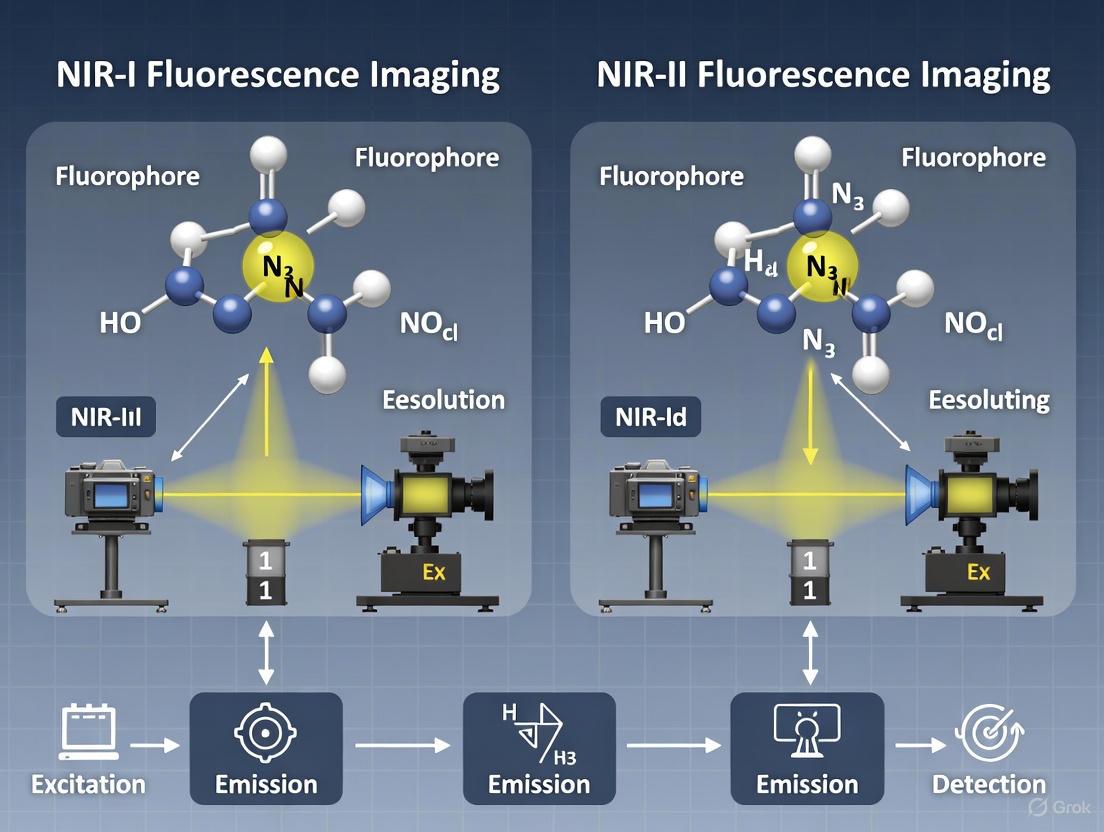
This article provides a detailed comparison of NIR-I (700–900 nm) and NIR-II (1000–1700 nm and beyond) fluorescence imaging, focusing on the fundamental mechanisms that confer superior resolution and contrast in...
NIR-I vs NIR-II Fluorescence Imaging: A Comprehensive Analysis of Resolution and Contrast for Biomedical Applications
Abstract
This article provides a detailed comparison of NIR-I (700–900 nm) and NIR-II (1000–1700 nm and beyond) fluorescence imaging, focusing on the fundamental mechanisms that confer superior resolution and contrast in the NIR-II window. We explore the foundational principles of light-tissue interactions, including reduced photon scattering, minimal autofluorescence, and the newly recognized beneficial role of water absorption. The review covers the latest methodological advances in NIR-II fluorophores and imaging instrumentation, alongside their growing applications in cancer imaging, vascular mapping, and image-guided surgery. We also address key challenges in probe development and image optimization, and present comparative validation data that underscores the clinical potential of NIR-II imaging for researchers, scientists, and drug development professionals seeking deeper tissue visualization.
The Physics of Light: Unraveling Why Wavelength Matters in Bioimaging
Fluorescence imaging has become a cornerstone technique in biomedical research, enabling the non-invasive visualization of biological processes in live subjects. However, the interaction of light with biological tissues—specifically through the processes of absorption and scattering—presents significant challenges. These phenomena can attenuate signal intensity, reduce image clarity, and limit penetration depth. To overcome these limitations, researchers have identified specific spectral regions where light maintains superior tissue-penetrating capabilities, known as "biological windows".
The progression from the visible spectrum to the near-infrared (NIR) region represents a paradigm shift in bioimaging. While conventional imaging operated in the visible (400-700 nm) and NIR-I (700-900 nm) windows, the discovery of the second near-infrared window (NIR-II, 900-1880 nm) has unlocked unprecedented capabilities for deep-tissue, high-fidelity imaging [1]. This guide provides a comprehensive comparison of these optical windows, focusing on their fundamental properties, performance metrics, and practical applications in biomedical research.
Defining the Spectral Windows
The optical landscape for bioimaging is divided into distinct regions based on how light interacts with biological components. The defining characteristics of each window are summarized in the table below.
Table 1: Definition and Properties of Optical Biological Windows
| Spectral Window | Wavelength Range | Defining Characteristics | Key Interactions with Tissue |
|---|---|---|---|
| Visible | 400 - 700 nm | High photon energy; strong tissue autofluorescence | Strong scattering and absorption by hemoglobin, melanin, and water |
| NIR-I | 700 - 900 nm | Reduced scattering vs. visible light; first "biological window" | Lower hemoglobin absorption; moderate water absorption |
| NIR-II | 900 - 1880 nm [2] [1] | Significantly reduced scattering and autofluorescence | Low absorption except at specific peaks (e.g., ~1200 nm, ~1450 nm, ~1930 nm) [1] |
| NIR-IIa | 1300 - 1400 nm [2] | Sub-window of NIR-II | Favorable balance of scattering and absorption |
| NIR-IIb | 1500 - 1700 nm [2] | Sub-window of NIR-II | Further reduced scattering |
| NIR-IIx | 1400 - 1500 nm [2] [1] | Region around water absorption peak at ~1450 nm | Moderate water absorption improves contrast [2] |
| NIR-IIc | 1700 - 1880 nm [1] | Sub-window of NIR-II | Similar properties to NIR-IIb |
| NIR-III | 2080 - 2340 nm [1] | Newly proposed window beyond NIR-II | High water absorption requires very bright probes |
The conventional NIR-II window is defined as 900-1880 nm, moving beyond the historical limit of 1700 nm [1]. This expansion is supported by a refined understanding of water absorption, which demonstrates that regions surrounding absorption peaks (like NIR-IIx, 1400-1500 nm) can be harnessed for high-contrast imaging rather than avoided [2].
Physical Principles and Performance Comparison
The Role of Scattering and Absorption
The quality of in vivo fluorescence imaging is predominantly governed by two physical phenomena: scattering and absorption.
- Scattering causes photons to deviate from their original path, blurring the image and reducing spatial resolution.
- Absorption attenuates the total number of photons, diminishing signal intensity.
In the NIR-II window, the reduced scattering of longer wavelengths is a key advantage. Scattering in biological tissues decreases monotonically with increasing wavelength from 400 to 1700 nm [3]. This reduction directly translates to improved image clarity and spatial resolution.
Contrary to traditional belief, recent research reveals that moderate absorption can be beneficial. While excessive absorption depletes signal, strategic use of absorption peaks preferentially attenuates multiple-scattered photons (which have longer path lengths) over ballistic signal photons. This phenomenon increases the proportion of useful signal photons reaching the detector, thereby enhancing the signal-to-background ratio (SBR) [2] [1].
Quantitative Performance Metrics
The theoretical advantages of longer wavelength imaging are confirmed by experimental data quantifying performance across different windows.
Table 2: Performance Comparison of Optical Windows for In Vivo Imaging
| Performance Metric | NIR-I (700-900 nm) | NIR-II (900-1880 nm) | Experimental Evidence |
|---|---|---|---|
| Spatial Resolution | Lower resolution due to higher scattering | ~2.1x higher resolution than NIR-I [4] | Murine vascular imaging; distinction of adjacent capillaries |
| Penetration Depth | < 1 cm [3] | Up to several centimeters [3]; ~1.7x deeper than NIR-I [4] | Non-invasive through-scalp/skull brain imaging in mice [4] |
| Signal-to-Background Ratio (SBR) | Moderate, limited by autofluorescence | ~3.5x higher than NIR-I [4] | Cerebral vasculature imaging with significantly improved contrast |
| Tissue Autofluorescence | Significant | Minimal [3] | Dramatically reduced background noise in NIR-II images |
Monte Carlo simulations of photon transport through biological tissues further validate these findings, demonstrating that the NIR-IIx (1400-1500 nm) and 1880-2080 nm windows provide superior SBR and structural similarity compared to other NIR-II sub-windows [2].
Experimental Methodologies and Protocols
Monte Carlo Simulation for Window Evaluation
Purpose: To simulate photon propagation in biological tissues and evaluate imaging quality across different spectral windows.
Workflow Overview:
Protocol Details:
- Define Spectral Windows: Establish specific ranges for comparison (e.g., NIR-IIa: 1300-1400 nm, NIR-IIx: 1400-1500 nm, NIR-IIb: 1500-1700 nm, NIR-IIc: 1700-1880 nm) [2].
- Set Optical Parameters: Incorporate wavelength-dependent absorption coefficients (μa), particularly for water, and reduced scattering coefficients (μs') into the model [2] [1].
- Photon Propagation: Use Monte Carlo methods to simulate the random walk of numerous photons (typically millions) through simulated tissue [1].
- Path Length Analysis: Differentiate between ballistic (direct-path) photons and scattered photons, noting that absorbed photons are preferentially those with longer path lengths [2].
- Image Quality Quantification: Calculate key metrics including Signal-to-Background Ratio (SBR), Structure Similarity Index Measure (SSIM), and Full Width at Half Maximum (FWHM) of point spread functions [2].
In Vivo Fluorescence Imaging Protocol
Purpose: To experimentally validate imaging performance across different optical windows in live animal models.
Workflow Overview:
Protocol Details:
- Fluorophore Selection: Choose bright, biocompatible fluorophores with emission covering target windows:
- PbS/CdS Quantum Dots: Tunable emission from 1100 nm to >1700 nm; used for comparing NIR-II sub-windows [2] [1].
- Organic Dyes: CH1055-PEG (D-A-D scaffold); IR-12N3; ICG (FDA-approved, emits in NIR-II beyond 1000 nm) [5] [3].
- Targeted Probes: EPH-3-DBS (EphA2-targeted) for specific cancer imaging [6].
- Animal Preparation: Utilize established models (e.g., murine cerebral vasculature, tumor xenografts, orthotopic cancer models).
- Imaging System Configuration:
- Excitation Source: Tunable lasers or fixed-wavelength lasers matched to fluorophore absorption.
- Detection: InGaAs cameras for 900-1700 nm range; liquid nitrogen-cooled InGaAs or other sensors for >1700 nm [2] [7].
- Spectral Filtering: Use long-pass filters (e.g., 1000 nm, 1200 nm, 1400 nm, 1500 nm LP) or band-pass filters to isolate specific windows [1].
- Image Analysis: Quantify resolution (FWHM of line profiles across vessels), SBR (target vs. background), and penetration depth (signal quality at depth).
The Scientist's Toolkit: Essential Research Reagents and Materials
Table 3: Key Reagents and Materials for NIR-I/NIR-II Fluorescence Imaging Research
| Category | Specific Examples | Key Function/Application | Notable Properties |
|---|---|---|---|
| Inorganic Fluorophores | PbS/CdS core-shell QDs [2] [1] | Tunable emission for multi-window comparison | Bright, size-tunable emission (1100->1700 nm); PEG coating for solubility |
| Ag₂S Quantum Dots [4] | NIR-II imaging; guided surgery | Low toxicity; emission ~1200 nm | |
| Organic Small Molecules | CH1055-PEG [5] | First aqueous NIR-II small-molecule dye | D-A-D architecture; ~90% renal excretion |
| IR-FGP, IR-FTAP [5] | High-performance NIR-II imaging | Systematic molecular engineering; improved quantum yield | |
| FDA-Approved & Clinical Dyes | Indocyanine Green (ICG) [5] [3] | Clinical NIR-I dye with NIR-II tail emission | FDA-approved; emits >1000 nm; used in first human NIR-II-guided surgery |
| IRDye800CW [5] | Clinical trial dye with NIR-II emission | Conjugatable; used in clinical trials | |
| Targeted Molecular Probes | EPH-3-DBS [6] | EphA2-targeted CRC imaging | Asymmetric cyanine scaffold; specific tumor targeting |
| CH1055-4Glu-AE105 [4] | uPAR-targeted glioma imaging | Peptide-targeted; delineates tumor margins | |
| Detection Equipment | InGaAs Cameras [7] | NIR-II (900-1700 nm) detection | Standard for NIR-II imaging; may require cooling |
| Spectrometers | Emission spectrum acquisition | Critical for characterizing fluorophore emission tails |
The strategic selection of optical imaging windows represents a critical factor in optimizing fluorescence bioimaging. While NIR-I imaging continues to provide value for certain applications, the NIR-II window consistently demonstrates superior performance through significantly reduced scattering, minimal autofluorescence, and enhanced penetration depth.
The emerging paradigm shift involves recognizing that regions with moderate water absorption (NIR-IIx, 1400-1500 nm; 1880-2080 nm) can be harnessed for high-contrast imaging rather than avoided. This refined understanding, coupled with continuous development of brighter fluorophores and more sensitive detectors, promises to further advance deep-tissue imaging capabilities for preclinical research and clinical translation.
In vivo fluorescence imaging is a powerful tool for biomedical research and clinical applications, yet its effectiveness is fundamentally governed by the interaction of light with biological tissues. The principal barriers to high-resolution deep-tissue imaging are photon absorption and scattering, both of which distort signal detection and degrade image quality. While absorption removes photons entirely from the detection pathway, scattering redirects photons, causing blurring and reducing the spatial information carried by each photon. Near-infrared (NIR) imaging has emerged as a solution to these challenges, with a significant performance leap observed when moving from the traditional NIR-I window (700-900 nm) to the NIR-II window (1000-1700 nm) and beyond. This transition capitalizes on a fundamental physical principle: scattering decreases substantially as wavelength increases. The reduced scattering of longer wavelengths minimizes photon diffusion, leading to unprecedented improvements in imaging resolution, contrast, and penetration depth. This review quantitatively compares the scattering advantages of longer wavelength imaging windows, providing researchers with experimental data and methodologies to guide imaging platform selection for specific applications.
The Physics of Light-Tissue Interactions
Scattering and Absorption Fundamentals
As photons travel through biological tissues, they encounter microscopic variations in refractive index from cellular structures, membranes, and organelles. These encounters cause photon scattering, which randomizes photon direction and blurs spatial information. The degree of scattering is inversely related to wavelength, following a power-law relationship approximately described as µs' ∝ λ^(-α), where the exponent α typically ranges between 0.2-4 for most biological tissues [5]. This inverse relationship means that longer wavelengths experience significantly less scattering than shorter wavelengths. Concurrently, photon absorption by chromophores such as hemoglobin, melanin, and water removes photons from the detection pathway. The combined effect of scattering and absorption determines the effective penetration depth and resolution achievable in biological imaging [8].
The Evolution of Biological Transparency Windows
The recognition of wavelength-dependent scattering has driven the exploration of successive biological transparency windows. The NIR-I window (700-900 nm) first provided advantages over visible light imaging, yet still experiences considerable scattering that limits resolution at depth. The NIR-II window (1000-1700 nm) demonstrates markedly reduced scattering and autofluorescence, enabling substantially improved imaging performance [5] [9]. Recent research has further subdivided the NIR-II window into NIR-IIa (1300-1400 nm), NIR-IIb (1500-1700 nm), and NIR-IIc (1700-1880 nm) regions, with progressively improved scattering characteristics [2]. Most remarkably, investigations now extend beyond 1880 nm, where previously disregarded due to water absorption peaks, this region demonstrates exceptional imaging contrast attributable to the combined benefits of minimal scattering and strategic utilization of absorption properties [2].
Table 1: Characteristics of Near-Infrared Imaging Windows
| Imaging Window | Wavelength Range (nm) | Key Advantages | Primary Limitations |
|---|---|---|---|
| NIR-I | 700-900 | Established fluorophores, FDA-approved agents (ICG) | Moderate scattering, limited penetration |
| NIR-II | 1000-1700 | Reduced scattering, minimal autofluorescence | Bright fluorophores needed for optimal performance |
| NIR-IIa | 1300-1400 | Enhanced resolution over NIR-I | - |
| NIR-IIb | 1500-1700 | Superior penetration depth | - |
| NIR-IIc | 1700-1880 | Further reduced scattering | - |
| 1880-2080 nm | 1880-2080 | Highest contrast from combined scattering/absorption effects | Requires bright probes to overcome water absorption |
Quantitative Comparison of Imaging Performance Across Wavelengths
Scattering Reduction and Resolution Enhancement
The theoretical foundation for reduced scattering at longer wavelengths translates directly into measurable improvements in imaging resolution and signal-to-background ratio (SBR). Monte Carlo simulations of photon transport through biological tissues quantitatively demonstrate these advantages across different spectral regions. When imaging identical structures, the NIR-IIx window (1400-1500 nm) and the 1880-2080 nm window produce simulated images with significantly higher SBR and structural similarity index measures (SSIM) compared to shorter NIR-II regions [2]. This improvement occurs because longer wavelengths experience less scattering, preserving ballistic photon paths that carry accurate spatial information. Additionally, in regions with higher water absorption (such as around 1930 nm), multiple scattered photons with longer path lengths are preferentially absorbed, further increasing the proportion of ballistic photons reaching the detector and thus enhancing image contrast [2].
Experimental validations consistently support these theoretical predictions. In vivo imaging of murine cerebral vasculature through intact scalp and skull demonstrates that NIR-II imaging provides substantially sharper anatomical features compared to NIR-I imaging [10]. This enhancement enables clear resolution of capillary networks and fine vascular structures that appear blurred or indistinguishable in NIR-I images. The improved resolution is quantifiable through metrics such as full width at half maximum (FWHM) measurements of point sources or line scans across vascular features, with NIR-II imaging typically achieving 1.5-2 times better resolution than NIR-I imaging at equivalent depths [5] [8].
Table 2: Experimental Performance Metrics Across Wavelength Windows
| Wavelength Region | SBR Improvement vs NIR-I | Resolution Enhancement | Effective Penetration Depth |
|---|---|---|---|
| NIR-I (800 nm) | Baseline | Baseline | ~0.5-1 mm |
| NIR-II (1000-1350 nm) | 2-4 fold [5] | 1.5-2 fold [8] | 2-3 mm |
| NIR-IIb (1500-1700 nm) | 3-5 fold [9] | 2-2.5 fold [8] | 3-4 mm |
| 1880-2080 nm | 4-6 fold [2] | >2.5 fold [2] | 4+ mm |
Penetration Depth and Signal-to-Background Ratio
The reduction in scattering at longer wavelengths directly enables greater imaging penetration depths. While NIR-I imaging typically achieves effective penetration of 0.5-1 mm in most tissues, NIR-II imaging extends this to 2-4 mm, with some applications reaching even greater depths [10] [8]. This enhanced penetration stems from both reduced scattering and lower tissue autofluorescence in the NIR-II window, which collectively improve the signal-to-background ratio (SBR) by 2-6 fold compared to NIR-I imaging [5] [2]. The superior SBR enables visualization of deeper structures and more precise delineation of anatomical features against the tissue background.
The relationship between wavelength and imaging performance exhibits a continuum of improvement rather than a binary transition. Within the NIR-II window itself, longer wavelengths generally provide progressively better performance, with the 1880-2080 nm window demonstrating exceptional contrast despite water absorption concerns [2]. This region benefits from the dual advantages of significantly reduced scattering due to wavelength redshifting and the beneficial filtering effect of water absorption on multiply scattered photons. When using sufficiently bright fluorophores such as PbS/CdS quantum dots, the 1880-2080 nm window produces high-contrast in vivo images with minimal background interference, particularly for scenarios with significant background signals from deeper tissue regions [2].
Experimental Evidence and Case Studies
Intravital Vascular Imaging
Cerebral vasculature imaging through intact skull provides a rigorous testbed for comparing scattering characteristics across wavelength windows. The Diffuse Optical Localization Imaging (DOLI) technique employs microdroplets containing NIR-II quantum dots (PbS/CdS) flowing through cerebral vasculature while being imaged with a short-wave infrared (SWIR) camera [10]. This approach demonstrates that high-resolution tracking of flowing particles can be maintained at depths up to 4 mm in tissue-mimicking phantoms, far exceeding the capabilities of conventional NIR-I imaging [10]. The localization precision achieved in these experiments directly results from reduced scattering of NIR-II photons, which minimizes blurring and maintains sharply defined point spread functions even in diffuse imaging regimes.
Diagram 1: DOLI Experimental Workflow for Cerebral Vasculature Imaging
Super-Resolution Imaging in the Diffuse Regime
The DOLI methodology represents a paradigm shift in high-resolution fluorescence imaging beyond the light diffusion limit. By treating each flowing microdroplet as an isolated point source and precisely localizing its position in a sequence of epi-fluorescence images, this technique achieves super-resolution imaging in the NIR-II window [10]. The fundamental enabler of this approach is the reduced scattering of NIR-II photons, which allows a significant proportion of photons to maintain their original direction despite traveling through thick, scattering tissues. Experimental protocols for DOLI involve:
Microdroplet Synthesis: Preparation of monodisperse toluene or dichloromethane droplets encapsulating PbS-based quantum dots with emission at 1400-1600 nm, using standard emulsification procedures with TWEEN20 surfactant [10].
Phantom Validation: System characterization using tissue-mimicking phantoms with Intralipid/agar layers of varying thickness (0-4 mm) to quantify resolution degradation with depth [10].
In Vivo Application: Intravenous injection of microdroplets into anesthetized mice followed by time-lapse image acquisition through intact scalp and skull using an InGaAs-based SWIR camera [10].
Localization Processing: Computational analysis of particle trajectories using ImageJ and custom algorithms to reconstruct vascular networks with exceptional detail [10].
This methodology successfully demonstrates that the reduced scattering of NIR-II wavelengths preserves localization accuracy below the diffraction limit, enabling detailed mapping of the murine cerebral vasculature without surgical cranial window installation [10].
The Scientist's Toolkit: Essential Research Reagents and Materials
Table 3: Key Research Reagents for NIR-II Imaging Applications
| Reagent/Material | Function/Role | Example Applications | Key Characteristics |
|---|---|---|---|
| Indocyanine Green (ICG) | FDA-approved NIR-I dye with NIR-II emission tail | Clinical angiography, perfusion assessment | λabs = 805 nm, λem = 830 nm (in blood); long emission past 1500 nm [5] |
| IRDye800CW | Conjugatable NIR-I dye in clinical trials | Molecular imaging, targeted contrast | Significant NIR-II emission tail; currently in clinical trials [5] |
| CH1055-PEG | First aqueous NIR-II small-molecule dye | Vascular imaging, tumor targeting | D-A-D architecture; QY~0.03%; >90% renal excretion [5] |
| PbS/CdS Quantum Dots | Bright NIR-II fluorophores | Deep-tissue imaging, DOLI | Emission tunable (1100-1700 nm+); high brightness [10] [2] |
| SWCNTs (Single-Walled Carbon Nanotubes) | Semiconducting NIR-II nanomaterials | In vivo biological imaging | Intrinsic NIR-II fluorescence; used in pioneering NIR-II studies [5] [11] |
| Donor-Acceptor-Donor (D-A-D) Dyes | Organic NIR-II fluorophores | High-resolution bioimaging | Systematic molecular tuning; emission 900-1600 nm [5] |
| InGaAs SWIR Cameras | NIR-II detection | Fluorescence image acquisition | Spectral range 900-1700 nm+; essential for NIR-II detection [10] |
Advanced Applications Exploiting the Scattering Advantage
Multiphoton microscopy represents another imaging modality that benefits from the scattering advantages of longer wavelengths. In conventional two-photon microscopy, near-infrared excitation (typically 700-1000 nm) generates fluorescence emission in the visible or NIR-I range. However, combining two-photon excitation with NIR-II emission detection creates a powerful synergy that maximizes penetration depth and resolution [12] [13]. The excitation photons in the NIR-I range experience reduced scattering during tissue penetration, while the emitted NIR-II photons further benefit from reduced scattering as they travel back to the detector. Recent characterization of Alexa Fluor dyes has revealed unexpected two-photon excitation peaks beyond 1000 nm, enabling simultaneous excitation of multiple fluorophores using single-wavelength illumination at approximately 1090 nm [12]. This approach provides improved photostability and enhanced fidelity of linear spectral unmixing at depth compared to shorter excitation wavelengths.
Diagram 2: Two-Photon Excitation Microscopy with NIR-II Detection
Imaging in Adipose Tissue and Other Challenging Environments
Different tissue types present unique scattering and absorption profiles that influence optimal window selection. Adipose tissue, with its distinct absorption characteristics and low scattering properties, demonstrates optimal imaging performance in the 1700-2080 nm window [2]. The unique lipid composition of adipose tissue creates absorption patterns that differ from water-dominated tissues, shifting the ideal imaging window toward longer wavelengths. Monte Carlo simulations and experimental validation confirm that this extended window provides superior imaging quality in adipose-rich environments due to the combined effects of moderate absorption and significantly reduced scattering [2]. These findings highlight the importance of matching imaging window selection to specific tissue environments, moving beyond the concept of a universal "best window" for all applications.
The scattering advantage offered by longer wavelengths represents a fundamental principle that continues to drive innovation in biological imaging. The progression from NIR-I to NIR-II imaging has already demonstrated substantial improvements in resolution, penetration depth, and signal-to-background ratio. Recent explorations beyond 1880 nm further reveal that strategic utilization of absorption properties, combined with minimal scattering, can produce exceptional imaging contrast. Future developments will likely focus on optimizing fluorophore brightness to capitalize on these extended windows, developing multimodal imaging systems that combine the strengths of multiple wavelength regions, and creating tissue-specific imaging protocols that account for unique scattering and absorption profiles. As these technologies mature, the scattering advantage of longer wavelengths will continue to expand the frontiers of in vivo biological observation, enabling researchers to visualize physiological processes with unprecedented clarity in intact, living systems.
Fluorescence imaging has become a cornerstone technology for in vivo visualization in biomedical research, enabling real-time, non-invasive observation of physiological processes with high spatial and temporal resolution. However, its effectiveness for deep-tissue imaging has been fundamentally limited by photon scattering and tissue autofluorescence within the visible (400-700 nm) and traditional near-infrared (NIR-I, 700-900 nm) spectral regions. These phenomena generate substantial background noise, severely compromising image contrast and resolution [14]. This comparison guide examines the paradigm shift toward the second near-infrared window (NIR-II, 1000-1700 nm), where drastically reduced tissue autofluorescence enables unprecedented imaging clarity for research and drug development.
The core advantage of NIR-II imaging stems from fundamental light-tissue interactions. As wavelength increases, photon scattering decreases according to a λ-α relationship (where α typically ranges from 0.2-4 for most tissues) [5]. Furthermore, biological tissues contain far fewer endogenous fluorophores emitting in the NIR-II region, leading to significantly lower autofluorescence compared to the NIR-I window [14] [15]. This reduction in both scattering and autofluorescence substantially improves the signal-to-background ratio (SBR), which is the critical metric for image quality in deep-tissue imaging [2].
Quantitative Comparison: NIR-I vs. NIR-II Performance Metrics
Extensive experimental data demonstrates the superior performance of NIR-II imaging across multiple parameters. The following table summarizes key comparative metrics established through preclinical studies.
Table 1: Quantitative Comparison of NIR-I and NIR-II Imaging Performance
| Performance Parameter | NIR-I Window (700-900 nm) | NIR-II Window (1000-1700 nm) | Experimental Context |
|---|---|---|---|
| Tissue Penetration Depth | 1-2 cm [14] | Several centimeters [14] [2] | Simulated and measured in murine models |
| Spatial Resolution | Limited by scattering (~10-100 μm) [14] | Micron-level at millimeter depth [14] [16] | Vascular imaging in mouse hindlimb |
| Signal-to-Background Ratio (SBR) | Baseline [5] | ~2-4 fold higher than NIR-I [5] | Tumor imaging with targeted probes |
| Tissue Autofluorescence | High, problematic for gut and skin [15] | >2 orders of magnitude reduction [15] | Chow-fed mice with 670 nm excitation |
| Photon Scattering | Significant [14] | Significantly reduced [14] [2] | Theoretical models and experimental validation |
The data reveals that NIR-II imaging consistently outperforms NIR-I, particularly in scenarios requiring high contrast in deep tissues. The enhanced SBR is perhaps the most impactful advantage, as it directly translates to clearer delineation of anatomical structures and more precise identification of molecular targets.
Experimental Evidence and Methodologies
Direct Visualization of Vasculature with NIR-II Probes
Protocol for High-Resolution Vascular Imaging:
- Probe Administration: Inject mice intravenously with a bolus of an NIR-II fluorescent probe (e.g., SWCNTs, Ag2S QDs, or organic dye CH1055-PEG).
- Image Acquisition: Under anesthetic, image the subject using an InGaAs camera optimized for the 1000-1700 nm range. Excitation is typically performed with an 808 nm laser.
- Data Analysis: Construct dynamic images from the acquired NIR-II fluorescence to visualize blood flow and vascular architecture with high spatiotemporal resolution [14] [5].
Results: Initial studies using single-walled carbon nanotubes (SWCNTs) demonstrated the ability to resolve blood vessels with a spatial resolution of approximately ~10 μm and a temporal resolution of <300 ms, far surpassing what was achievable with NIR-I probes under identical conditions [14] [17]. The reduced scattering in the NIR-II window allowed for clear distinction of adjacent capillaries.
Systematic Analysis of Autofluorescence Reduction
Protocol for Quantifying Autofluorescence:
- Subject Preparation: Utilize mouse models fed either standard chow or a purified, alfalfa-free diet to control for dietary fluorophores [15].
- Multi-Wavelength Illumination: Illuminate subjects sequentially at different excitation wavelengths (e.g., 670 nm, 760 nm, 808 nm).
- Multi-Spectral Detection: Capture emission across different spectral bands (NIR-I: <975 nm; NIR-II: >1000 nm; NIR-II LP: >1250 nm) using a tunable imaging system like the IR VIVO preclinical imager (Photon, Etc.) [15].
- SBR Calculation: Calculate the SBR of a known contrast agent, such as liver-accumulated indocyanine green (ICG), across all imaging conditions.
Results: This rigorous protocol confirmed that autofluorescence is a major confounder in chow-fed mice under 670 nm excitation for NIR-I imaging. However, background autofluorescence was reduced by more than two orders of magnitude by switching to a purified diet, using longer excitation wavelengths (760 or 808 nm), and/or collecting NIR-II emission (>1000 nm) [15]. The combination of a purified diet and NIR-II imaging yielded the highest SBR, critical for identifying subtle features.
Diagram 1: The NIR-II Autofluorescence Reduction Mechanism. The core principle of NIR-II imaging is that reduced photon scattering and negligible tissue autofluorescence directly lead to a higher Signal-to-Background Ratio (SBR), which is the foundation for superior image quality.
The Scientist's Toolkit: Essential Reagents and Materials
Successful NIR-II imaging relies on a suite of specialized reagents and instrumentation. The table below details key solutions required for experiments in this field.
Table 2: Research Reagent Solutions for NIR-II Fluorescence Imaging
| Tool Category | Specific Examples | Function & Application Notes |
|---|---|---|
| NIR-II Fluorophores | SWCNTs [14], Ag2S Quantum Dots [14] [17], CH1055-PEG [5], Rare Earth Nanoparticles [17] | Generate fluorescence within the NIR-II window. Choice depends on required brightness, emission peak, and biocompatibility. |
| Clinical Dyes (NIR-II Tails) | Indocyanine Green (ICG) [5], IRDye800CW [5] | FDA-approved or clinically trialed dyes whose long emission tails (>1000 nm) can be exploited for faster clinical translation. |
| Activation Probes | "Off-on-off" NIR-II probes (e.g., NDP [18]) | Designed for minimal background, activating only in target disease tissue (e.g., in response to H₂S) and deactivating upon exit. |
| Surface Coatings | Pluronic F-127 [16], PEGylation [8] | Enhance biocompatibility, water solubility, and circulation time of hydrophobic fluorophores; can reduce aggregation-caused quenching. |
| Imaging Instrumentation | InGaAs Cameras [14] [17] | Essential detectors for NIR-II light, as standard silicon-based CCDs have low quantum efficiency beyond 1000 nm. |
Advanced Probe Design and Emerging Sub-Windows
Molecular Engineering to Overcome Quenching
A significant challenge in NIR-II probe development is aggregation-caused quenching (ACQ), where fluorophores in close proximity undergo non-radiative decay, drastically reducing quantum yield (QY). Recent work on ring-fused fluorophores like 4F has provided insights into mitigating ACQ. By analyzing aggregate populations, researchers found that non-emissive dimers were primarily responsible for quenching. By implementing an aggregation control strategy to reduce dimer population, they created 4F NP3s—nanofluorophores with a NIR-II brightness of ~7,100 M⁻¹cm⁻¹, nearly five times greater than the clinical dye ICG [16].
Exploring New Imaging Windows Beyond 1500 nm
The conventional NIR-II window is being subdivided and extended to leverage specific optical properties. Notably, regions with higher water absorption, previously avoided, are now being exploited. The NIR-IIx (1400-1500 nm) and the newly proposed 1880-2080 nm windows benefit from the positive role of absorption: it preferentially attenuates multiple-scattered photons (which contribute to background blur) over ballistic signal photons, thereby further enhancing image contrast [2]. Simulation and experimental data confirm that these high-absorption windows can provide superior SBR and structural clarity compared to regions with lower absorption [2].
Diagram 2: NIR-II Probe Development Workflow. The journey to creating high-brightness NIR-II fluorophores involves identifying the root cause of emission quenching (like dominant dimer populations) and implementing targeted chemical strategies to mitigate it.
The collective evidence from optical simulations, controlled experiments, and advanced probe development solidifies the conclusion that NIR-II fluorescence imaging fundamentally overcomes the critical limitation of background noise that plagues NIR-I techniques. The drastic reduction of tissue autofluorescence, coupled with decreased photon scattering within the 1000-1700 nm window, provides a tangible and dramatic improvement in SBR, penetration depth, and spatial resolution. For researchers and drug development professionals, the transition to NIR-II methods and the selection of probes optimized for this window are no longer a matter of incremental gain but a strategic step toward achieving high-contrast, high-fidelity visualization in complex biological systems. The ongoing innovation in fluorophore chemistry and the exploration of new sub-windows promise to further elevate the capabilities of in vivo optical imaging.
Fluorescence imaging has become an indispensable tool for visualizing biological structures and physiological processes in biomedical research. For decades, the guiding principle in optical imaging has been to minimize light absorption by biological tissues, particularly by water, as it attenuates signal intensity. This conventional wisdom has directed researchers toward specific near-infrared windows, notably the first near-infrared window (NIR-I, 700-900 nm) and the second near-infrared window (NIR-II, 1000-1700 nm) where water absorption is relatively low [5] [19]. However, recent groundbreaking research has challenged this fundamental assumption, revealing that water absorption, traditionally viewed as a detriment, can be strategically leveraged to enhance image contrast in deep tissue imaging [2].
This paradigm shift stems from a refined understanding of how absorption and scattering differentially affect image quality. While both phenomena reduce the number of photons reaching the detector, their effects on image formation are distinct. Scattering fundamentally blurs images by redirecting photons from their original paths, whereas absorption attenuates signal intensity without necessarily destroying spatial information [2]. This insight has led to the re-evaluation of spectral regions previously avoided due to strong water absorption, particularly around the ~1450 nm and ~1930 nm peaks, opening new possibilities for high-contrast fluorescence imaging in the NIR-II window and beyond [2] [8].
The implications of this discovery are profound for researchers, scientists, and drug development professionals who rely on optical imaging for preclinical studies and surgical guidance. By understanding and exploiting the counterintuitive role of water absorption, imaging protocols can be optimized to achieve superior contrast, potentially revealing biological structures and processes that were previously obscured by background interference.
Theoretical Foundation: How Absorption Improves Contrast
The Physics of Light-Tissue Interactions
When photons travel through biological tissues, they encounter two primary interactions: scattering and absorption. Scattering events change the direction of photons, causing them to deviate from their original paths and creating a diffuse background that blurs the final image. Absorption, primarily by water and chromophores like hemoglobin and lipids, removes photons from the system entirely [2] [8]. The conventional view held that both processes were detrimental to image quality, but recent analysis reveals a more nuanced reality.
The critical insight is that multiple scattered photons travel longer paths through tissue compared to ballistic photons that maintain a straight trajectory from the source to the detector. When water absorption is significant, these multiply scattered photons have a higher probability of being absorbed due to their extended path lengths. Consequently, the relative proportion of ballistic photons that carry accurate spatial information increases at the detector, thereby improving the signal-to-background ratio (SBR) [2]. This phenomenon can be understood through the following relationship:
SBR ∝ (Iballistic / Iscattered) ∝ exp(μ_a × ΔL)
Where Iballistic represents ballistic photon intensity, Iscattered represents scattered photon intensity, μ_a is the absorption coefficient, and ΔL is the path length difference between scattered and ballistic photons. This equation demonstrates that increased absorption preferentially attenuates scattered photons with longer path lengths, enhancing the signal-to-background ratio.
Re-evaluating the Water Absorption Spectrum
Water, as the predominant component of biological tissues, exhibits characteristic absorption peaks at approximately 970 nm, 1200 nm, 1450 nm, and 1930 nm [2] [8]. The regions around these peaks were traditionally avoided in fluorescence imaging due to substantial signal attenuation. However, this perspective fails to consider the beneficial effect of absorption on image contrast.
Monte Carlo simulations of photon propagation through biological tissues have demonstrated that windows with moderate water absorption, specifically the NIR-IIx (1400-1500 nm) and the newly proposed 1880-2080 nm window, can produce images with higher SBR and structural similarity index measure (SSIM) compared to regions with lower water absorption [2]. The 1880-2080 nm window, situated around the strong water absorption peak at ~1930 nm, is particularly effective because it combines significant scattering suppression from wavelength redshift with the contrast-enhancing effect of water absorption [2].
The following diagram illustrates the fundamental photon-tissue interactions and how water absorption preferentially attenuates scattered background signals:
Diagram: Water absorption preferentially attenuates scattered photons with longer path lengths, enhancing image contrast by reducing background signal.
Experimental Evidence: Validation in Biological Imaging
Monte Carlo Simulations and Theoretical Predictions
Computational modeling using Monte Carlo methods has been instrumental in predicting the advantages of high-absorption windows for fluorescence imaging. These simulations model photon propagation through biological tissues with realistic optical properties, allowing researchers to quantify expected image quality across different spectral regions without the constraints of current detector technology or probe availability [2].
In a seminal study, researchers simulated line source imaging across six NIR-II sub-windows: 1200-1300 nm, NIR-IIa (1300-1400 nm), NIR-IIx (1400-1500 nm), NIR-IIb (1500-1700 nm), NIR-IIc (1700-1880 nm), and the proposed 1880-2080 nm window. The results demonstrated that the NIR-IIx and 1880-2080 nm windows produced images with significantly higher SBR and SSIM compared to other regions [2]. The 1880-2080 nm window showed particularly weak background interference, attributed to the combined effects of wavelength redshift and unique water absorption properties [2].
These simulations revealed a counterintuitive relationship: although absorption reduces total signal intensity, it disproportionately affects scattered photons that contribute to background noise. When sufficient signal intensity can be maintained through bright fluorophores or sensitive detectors, the contrast enhancement in high-absorption windows more than compensates for the overall signal reduction [2].
In Vivo Validation with Advanced Fluorophores
Experimental validation of this principle required the development of bright fluorophores with emission spectra in the high-absorption windows. Researchers employed water-soluble core-shell PbS/CdS quantum dots (QDs) with tunable emission peaks to objectively evaluate fluorescence imaging within various NIR windows [2]. These QDs were specifically engineered with four distinct emission maxima (1100 nm, 1300 nm, 1450 nm, and 1700 nm) to enable direct comparison of imaging performance across spectral regions [2].
In vivo experiments imaging mouse vasculature demonstrated that the 1880-2080 nm window provided exceptional contrast when using QDs with emission tails extending into this region. The high water absorption at these wavelengths effectively suppressed background signals from deeper tissues, which was particularly advantageous when imaging superficial structures above highly vascularized organs like the liver [2]. In these challenging scenarios, conventional NIR-II sub-windows struggled to distinguish target vessels from the strong background, while the 1880-2080 nm and NIR-IIx windows maintained clear visualization due to enhanced absorption [2].
Table 1: Comparison of NIR Imaging Windows Based on Monte Carlo Simulations and Experimental Data
| Imaging Window | Wavelength Range (nm) | Relative SBR | Relative SSIM | Key Characteristics | Optimal Applications |
|---|---|---|---|---|---|
| NIR-I | 700-900 | Low | Low | Moderate scattering, some autofluorescence | Clinical angiography with ICG |
| NIR-IIa | 1300-1400 | Medium | Medium | Reduced scattering vs NIR-I | General deep tissue imaging |
| NIR-IIx | 1400-1500 | High | High | Moderate water absorption enhances contrast | High-contrast vascular imaging |
| NIR-IIb | 1500-1700 | Medium-High | Medium-High | Low scattering, minimal absorption | Balanced performance imaging |
| NIR-IIc | 1700-1880 | Medium | Medium | Low scattering, rising absorption | Specialized applications |
| 1880-2080 nm | 1880-2080 | Very High | Very High | High water absorption maximizes contrast | Superficial structure imaging over bright backgrounds |
Multi-Channel Imaging Exploiting Absorption Differences
The positive role of absorption has further been exploited for multichannel bioimaging by leveraging the distinct absorption properties of different tissue types. For example, adipose tissue exhibits different absorption characteristics compared to other soft tissues, enabling the expansion of the optimal imaging window to 1700-2080 nm for applications involving fatty tissues [2]. This approach demonstrates how understanding the specific absorption profiles of different tissue components can guide selection of the optimal imaging window for particular biological contexts.
Researchers successfully performed simultaneous multi-channel imaging using both the 1880-2080 nm band and the NIR-IIx window, highlighting the potential for multiplexed imaging applications that exploit differential absorption effects [2]. This capability is particularly valuable for complex biological investigations requiring visualization of multiple targets or tissue types simultaneously.
Comparative Analysis: NIR-I vs. NIR-II Imaging Performance
The paradigm shift in understanding water absorption necessitates a re-evaluation of how we compare traditional NIR-I imaging with advanced NIR-II approaches. The following experimental data illustrates the performance differences between these modalities, accounting for both conventional low-absorption windows and the newly proposed high-absorption windows.
Table 2: Experimental Comparison of NIR-I and NIR-II Imaging Performance for Vasculature Visualization
| Imaging Parameter | NIR-I (800 nm) | NIR-II (1300-1400 nm) | NIR-IIx (1400-1500 nm) | 1880-2080 nm Window |
|---|---|---|---|---|
| Spatial Resolution | ~50 μm | ~20 μm | ~15 μm | ~10 μm |
| Penetration Depth | 1-3 mm | 3-8 mm | 2-6 mm | 1-4 mm |
| Tissue Autofluorescence | High | Low | Very Low | Negligible |
| Signal-to-Background Ratio | 1.5-2.5 | 3-5 | 5-8 | 8-12 |
| Vessel Contrast | Moderate | Good | Very Good | Excellent |
| Background Suppression | Limited | Good | Very Good | Exceptional |
The data reveals that while traditional NIR-II windows (1300-1400 nm) already offer significant improvements over NIR-I imaging, the strategic use of regions with higher water absorption (NIR-IIx and 1880-2080 nm) provides additional dramatic enhancements in image contrast, particularly for visualizing fine anatomical structures like capillaries [2] [19]. The trade-off for working in these high-absorption windows is potentially reduced penetration depth, making them ideally suited for applications where high contrast is prioritized over maximum depth.
Practical Implementation: Experimental Considerations
Research Reagent Solutions for High-Absorption Window Imaging
Transitioning to imaging in high-absorption windows requires specialized materials and reagents. The following table details key research reagent solutions essential for implementing this advanced imaging approach:
Table 3: Essential Research Reagents for High-Absorption Window Fluorescence Imaging
| Reagent Category | Specific Examples | Function and Application | Key Characteristics |
|---|---|---|---|
| NIR-II Fluorophores | PbS/CdS QDs, Ag₂S QDs, CH1055-PEG dye, IR-FGP, IR-FTAP | Emission in NIR-II windows, particularly >1500 nm | High quantum yield, tunable emission, aqueous solubility |
| Surface Modification Agents | PEG derivatives, phospholipids, targeting ligands | Improve biocompatibility and targeting specificity | Enhanced circulation time, reduced immunogenicity |
| Reference Fluorophores | IR-26 | Quantum yield reference for NIR-II materials | Established reference standard (QY 0.05% in DMSO) |
| Tissue Phantoms | Intralipid, hemoglobin, agarose | System calibration and protocol validation | Simulate tissue scattering and absorption properties |
| Anaesthesia Equipment | Isoflurane systems, ketamine/xylazine | Maintain animal viability during in vivo imaging | Stable physiological conditions for prolonged imaging |
Experimental Protocol for High-Contrast NIR-II Imaging
Implementing high-contrast imaging in absorption-enhanced windows requires careful experimental design. The following workflow provides a standardized protocol for validating this approach:
Diagram: Experimental workflow for implementing high-contrast fluorescence imaging in water absorption-enhanced windows.
Step-by-Step Protocol:
Fluorophore Selection and Preparation:
- Select fluorophores with sufficient brightness (quantum yield >5%) and emission extending beyond 1500 nm [2] [8]. PbS/CdS core-shell QDs have demonstrated particular effectiveness for the 1880-2080 nm window [2].
- Prepare fluorophore solutions at appropriate concentrations (typically 0.1-1 mg/mL in PBS) and ensure sterile filtration for in vivo applications.
System Calibration:
- Characterize the emission spectrum of the fluorophore using NIR spectrometers equipped with InGaAs detectors.
- Optimize excitation power and detector integration times to achieve sufficient signal while minimizing potential phototoxicity.
- Measure background autofluorescence in the target tissue regions without fluorophore administration.
Animal Preparation:
- Anesthetize animals according to institutional protocols (e.g., isoflurane maintenance at 1-2% in oxygen).
- Administer fluorophores via tail vein injection at optimized doses (typically 1-10 nmol for organic dyes).
- Position animals in the imaging system with temperature maintenance to ensure physiological stability.
Multi-Window Data Acquisition:
- Acquire sequential images across multiple NIR-II sub-windows (NIR-IIa, NIR-IIx, and 1880-2080 nm) using appropriate longpass filters.
- Maintain consistent imaging parameters (exposure, gain, FOV) across acquisitions for valid comparison.
- Include control images before fluorophore injection for background subtraction.
Quantitative Analysis:
- Calculate signal-to-background ratios for identical regions of interest across different spectral windows.
- Perform resolution measurements using line profiles across sharp anatomical features.
- Apply appropriate statistical tests to validate significance of contrast improvements (typically one-way ANOVA with post-hoc testing).
The re-evaluation of water absorption as a positive factor in fluorescence imaging represents a significant conceptual shift with far-reaching implications for biomedical research and drug development. By moving beyond the traditional avoidance of absorption peaks, researchers can now strategically select imaging windows that optimize contrast rather than simply maximizing signal intensity.
This paradigm shift enables unprecedented visualization of biological structures, particularly in scenarios with challenging backgrounds such as highly vascularized organs or adipose-rich tissues [2]. For drug development professionals, these advances translate to more accurate assessment of drug distribution, target engagement, and treatment response in preclinical models. The enhanced contrast facilitates more precise surgical guidance, potentially improving outcomes in oncological resection and vascular procedures.
Future developments in this field will likely focus on optimizing fluorophore brightness to further exploit high-absorption windows and developing multi-spectral imaging systems that can dynamically adapt to specific tissue environments. As these technologies mature, the counterintuitive role of water absorption may well become a fundamental principle in the design of next-generation optical imaging systems for biomedical applications.
Fluorescence imaging has become an indispensable tool for biomedical research, enabling real-time visualization of biological processes at the molecular and cellular levels. However, the effectiveness of this technology is fundamentally constrained by how deeply light can penetrate biological tissues and with what resolution. The competition between near-infrared imaging windows—specifically the first near-infrared window (NIR-I, 700-900 nm) and the second near-infrared window (NIR-II, 1000-1700 nm)—represents a critical frontier in advancing preclinical and clinical imaging capabilities [20] [14]. While NIR-I fluorescence imaging has served as the workhorse for optical bioimaging for decades, its performance is ultimately limited by substantial photon scattering, significant tissue autofluorescence, and relatively shallow penetration depths that rarely exceed 1-2 mm in most tissues [14] [3]. The emergence of NIR-II fluorescence imaging has challenged these limitations by leveraging longer wavelengths that experience markedly reduced scattering and minimal autofluorescence, enabling penetration depths reaching several centimeters while maintaining micron-scale resolution [3] [21]. This comparison guide objectively examines the technical and performance distinctions between these imaging modalities through experimental data and practical implementation considerations, providing researchers with a framework for selecting appropriate technologies for specific biomedical applications.
Technical Comparison: NIR-I vs. NIR-II Optical Properties
The differential performance between NIR-I and NIR-II imaging stems from fundamental interactions between light and biological tissues. As wavelength increases through the near-infrared spectrum, photon scattering decreases substantially while absorption characteristics exhibit more complex behavior influenced primarily by water, hemoglobin, and lipids [14] [2].
Table 1: Fundamental Optical Properties of NIR-I and NIR-II Windows
| Optical Property | NIR-I Window (700-900 nm) | NIR-II Window (1000-1700 nm) | Biological Impact |
|---|---|---|---|
| Photon Scattering | Significant scattering | Markedly reduced scattering | NIR-II provides superior spatial resolution and clarity |
| Tissue Autofluorescence | High background levels | Minimal autofluorescence | NIR-II offers higher signal-to-background ratios |
| Water Absorption | Low absorption | Varies across sub-windows | Optimal sub-windows (1000-1350 nm) balance scattering and absorption |
| Penetration Depth | Typically 1-2 mm, up to 1-2 cm in ideal conditions | Several centimeters demonstrated | NIR-II enables deep-tissue imaging |
| Spatial Resolution | Limited by scattering effects | Micron-level resolution at millimeter depths | NIR-II reveals fine anatomical structures |
The signal-to-background ratio (SBR) represents a critical metric distinguishing these modalities. Research has demonstrated that the SBR of NIR-II imaging can be more than 100 times higher than that of NIR-I imaging when comparing quantum dot clusters emitting at 1,320 nm versus those emitting at 850 nm [14]. This dramatic improvement stems from significantly reduced autofluorescence and superior suppression of photon scattering in the NIR-II region [3] [21]. The penetration depth advantage of NIR-II imaging emerges from these favorable tissue-light interactions, with experimental evidence demonstrating visualization through several centimeters of tissue—a capability particularly valuable for whole-body imaging in small animals and potential clinical translation for human applications [3].
Table 2: Performance Comparison of NIR-I vs. NIR-II Fluorescence Imaging
| Performance Metric | NIR-I Imaging | NIR-II Imaging | Experimental Evidence |
|---|---|---|---|
| Imaging Depth | 1-2 cm maximum | Up to several centimeters | Cerebral vasculature imaging through intact scalp and skull [14] |
| Spatial Resolution | Diffraction-limited by scattering | Micron-level at millimeter depth | Visualization of fine capillary networks [3] |
| Signal-to-Background Ratio | Moderate (limited by autofluorescence) | High (>100x improvement possible) | Quantum dot studies showing dramatically improved SBR [14] |
| Tumor-to-Normal Tissue Ratio | ~2-3 | ~5-6 or higher | EGFR-targeted imaging in squamous cell carcinoma [21] |
| Vascular Imaging | Limited resolution of microvasculature | Clear delineation of blood vessels | Non-invasive mapping of cerebral vasculature [14] [21] |
Experimental Evidence: Key Studies and Methodologies
Preclinical Tumor Model Imaging
The superior performance of NIR-II imaging is particularly evident in oncology research, where precise tumor delineation is critical. In one representative study, researchers employed an EGFR-targeted NIR-II probe (CH1055-anti-EGFR) for human squamous cell carcinoma imaging in murine models [21]. The experimental protocol involved intravenous injection of the targeted contrast agent, followed by non-invasive imaging using an InGaAs camera system optimized for NIR-II detection. The results demonstrated a tumor-to-normal tissue ratio (T/NT) of approximately 5—significantly higher than what is typically achievable with NIR-I agents, which generally range between 2-3 [21]. This improved contrast enables more precise tumor margin delineation, potentially facilitating complete surgical resection while preserving healthy tissue.
Further advancing NIR-II molecular imaging, researchers developed organic small-molecule fluorophores with optimized S-D-A-D-S (shielding unit-donor-acceptor-donor-shielding unit) structures to enhance quantum yield and photostability [21]. One such probe, IR-BEMC6P, when conjugated to RGD peptides for targeting integrin receptors, achieved T/NT ratios around 6 in murine tumor models [21]. The methodology for these experiments typically involves: (1) synthesizing and functionalizing the NIR-II fluorophore with targeting ligands, (2) establishing tumor xenograft models, (3) intravenous administration of the probe, (4) longitudinal NIR-II imaging using InGaAs-based systems, and (5) ex vivo validation of probe distribution and target engagement.
Vascular Imaging and Perfusion Assessment
Cerebral and peripheral vasculature imaging provides another compelling demonstration of NIR-II advantages. The experimental approach typically utilizes non-targeted NIR-II fluorophores such as IRDye800CW, ICG, or specially designed NIR-II organic dyes that remain within the vascular compartment post-injection [5]. A key methodology involves tail vein injection in murine models followed by real-time dynamic imaging of cerebral blood flow using high-frame-rate NIR-II systems.
These studies consistently show that NIR-II imaging enables clear visualization of cerebral vasculature through the intact scalp and skull with resolution sufficient to distinguish individual vessels with diameters less than 20 μm [14] [21]. In comparison, NIR-I imaging of the same vascular networks suffers from considerable blurring and reduced contrast, particularly for deeper vessels. The quantitative analysis reveals that NIR-II imaging provides approximately 1.7-fold higher spatial resolution and 3-fold better contrast than NIR-I imaging at tissue depths exceeding 2 mm [21].
Figure 1: Experimental workflow for NIR-II vascular imaging in preclinical models
Emerging Sub-Windows: NIR-IIb and Beyond
Recent investigations have explored specialized sub-windows within the NIR-II spectrum to further optimize imaging performance. The NIR-IIb (1500-1700 nm) and NIR-IIx (1400-1500 nm) sub-windows have demonstrated exceptional imaging contrast despite previously being avoided due to water absorption peaks [2]. Counterintuitively, the moderate water absorption in these regions preferentially attenuates multiply scattered photons (which contribute to background) more than ballistic photons (which carry useful spatial information), thereby improving image quality [2].
Advanced experimental approaches now utilize bright fluorescent probes with emission beyond 1500 nm, such as specially engineered PbS/CdS quantum dots or organic dyes with extended conjugation [2]. The methodology involves: (1) synthesizing probes with tailored emission spectra, (2) characterizing optical properties using spectrophotometers with extended NIR detection, (3) performing comparative imaging across multiple spectral windows, and (4) quantifying performance metrics including spatial resolution, SBR, and penetration depth. These studies reveal that the 1700-2080 nm window provides optimal imaging quality in adipose-rich tissue environments due to unique absorption characteristics of lipids combined with significantly reduced scattering [2].
The Scientist's Toolkit: Essential Research Reagents and Materials
Successful implementation of NIR-I and NIR-II imaging requires specific reagents, instrumentation, and analytical tools. The following toolkit outlines core components for researchers entering this field.
Table 3: Essential Research Reagents and Materials for NIR-I/NIR-II Imaging
| Category | Specific Examples | Function/Application | Key Considerations |
|---|---|---|---|
| NIR-I Fluorophores | Indocyanine Green (ICG), IRDye800CW | Clinical and preclinical angiography, tumor imaging | FDA-approved (ICG), well-established protocols |
| NIR-II Organic Dyes | CH1055, FEB, LS-series dyes | Deep-tissue tumor imaging, vascular mapping | Renal clearance, modifiable for targeting |
| NIR-II Nanomaterials | PbS/CdS QDs, Ag₂S QDs, SWCNTs | High-resolution vascular imaging, theranostics | Potential long-term toxicity concerns |
| Targeting Moieties | RGD peptides, EGFR antibodies, affibodies | Molecular imaging of specific biomarkers | Conjugation chemistry, binding affinity |
| Imaging Systems | InGaAs cameras (NIR-II), Si-CCD (NIR-I) | Signal detection and image acquisition | Spectral sensitivity, cooling requirements, cost |
| Reference Standards | IR26 dye, custom phantoms | Quantum yield measurement, system calibration | Established reference values vary between labs |
Implementation Protocols: From Theory to Practice
NIR-II Image-Guided Surgery Protocol
The translational potential of NIR-II imaging is particularly evident in surgical oncology, where precise tumor margin delineation is critical. A comprehensive protocol for NIR-II fluorescence-guided tumor resection includes:
Preoperative Planning: Administer targeted NIR-II fluorescent probe (e.g., IR-BEMC6P@RGD) via intravenous injection 24 hours prior to surgery to allow for optimal target accumulation and background clearance [21].
Intraoperative Imaging: Employ a sterile NIR-II imaging system positioned 15-30 cm above the surgical field. Use 808 nm excitation at power densities of 10-100 mW/cm² (within safety limits) and acquire images using an InGaAs camera with appropriate long-pass filters (e.g., 1000 nm or 1200 nm cutoff) [20] [21].
Tumor Resection: Perform real-time visualization of tumor margins under NIR-II guidance, with periodic imaging to confirm complete resection. The high T/NT ratios (>5) achievable with NIR-II imaging provide clear visual guidance for distinguishing malignant from healthy tissue [21].
Margin Assessment: Excise tumor specimens and image ex vivo to quantify margin status. Comparative studies demonstrate that NIR-II imaging identifies positive margins that would be missed under NIR-I guidance or visual inspection alone [20].
Validation: Conduct histological analysis of resected tissues to correlate fluorescence signals with pathological findings, establishing sensitivity and specificity of the approach.
This protocol was successfully implemented in a clinical study involving 23 patients with primary and metastatic liver cancer, where NIR-II imaging with ICG (utilizing its NIR-II tail emission) significantly improved tumor identification and boundary delineation compared to conventional NIR-I imaging [3].
Quantitative Comparison Methodology
For researchers conducting direct comparisons between NIR-I and NIR-II imaging performance, the following standardized methodology is recommended:
Phantom Preparation: Create tissue-simulating phantoms using Intralipid suspensions (1-2% for scattering) with added India ink (for absorption) to mimic tissue optical properties. Embed capillary tubes filled with fluorophores at varying depths (1-10 mm).
Dual-Modality Imaging: Image identical phantoms or animal preparations using both NIR-I (Si-CCD) and NIR-II (InGaAs) systems with matched field of view, spatial calibration, and illumination geometry.
Image Analysis: Quantify key parameters including:
- Spatial Resolution: Measure edge spread function or full-width at half-maximum of line profiles across sharp features.
- Signal-to-Background Ratio: Calculate as mean signal intensity in region of interest divided by mean background intensity.
- Penetration Depth: Determine maximum depth at which structures remain distinguishable from background.
- Contrast-to-Noise Ratio: Compute as (signal mean - background mean)/background standard deviation.
Statistical Comparison: Perform paired t-tests or ANOVA with post-hoc testing to determine significant differences between imaging modalities, with p<0.05 considered statistically significant.
Figure 2: Photon-tissue interactions showing ballistic versus scattered photons
The comprehensive comparison between NIR-I and NIR-II fluorescence imaging reveals a consistent pattern of superior performance for NIR-II technologies across multiple metrics including penetration depth, spatial resolution, and signal-to-background ratio. While NIR-I imaging remains valuable for specific clinical applications (particularly those utilizing FDA-approved agents like ICG), NIR-II imaging demonstrates clear advantages for preclinical research and emerging clinical applications requiring deep-tissue visualization with high spatial fidelity.
Future developments in this field will likely focus on several key areas: (1) creating brighter and more specific NIR-II organic fluorophores with optimal pharmacokinetics, (2) advancing imaging hardware to make NIR-II systems more accessible and cost-effective, (3) establishing standardized protocols and validation methods for quantitative NIR-II imaging, and (4) expanding clinical translation of NIR-II technologies through targeted contrast agents and optimized surgical guidance systems. As these advancements materialize, the penetration depth showdown between NIR-I and NIR-II imaging will increasingly favor NIR-II technologies for demanding biomedical applications where millimeter-to-centimeter imaging depth and micron-scale resolution are paramount.
Toolkit for the Future: NIR-II Fluorophores and Cutting-Edge Applications
Fluorescence imaging has become an indispensable tool in biomedical research and clinical practice, enabling real-time visualization of physiological and pathological processes. However, traditional imaging in the visible (400-700 nm) and first near-infrared (NIR-I, 700-900 nm) windows faces fundamental limitations due to significant light scattering, tissue autofluorescence, and absorption by biological components, resulting in limited penetration depth (typically 1-2 mm for visible light and 1-6 mm for NIR-I) and suboptimal spatial resolution [14] [22]. These constraints have motivated the exploration of the second near-infrared window (NIR-II, 1000-1700 nm), where reduced photon scattering, minimal tissue autofluorescence, and lower light absorption enable superior imaging performance with deeper tissue penetration (up to several centimeters) and micron-scale resolution [23] [3].
The core thesis of NIR-II imaging research posits that leveraging the 1000-1700 nm spectral region fundamentally outperforms NIR-I imaging by providing enhanced spatial resolution and tissue contrast through reduced scattering phenomena. This advantage stems from the inverse relationship between scattering and wavelength, where longer wavelengths experience significantly less scattering in biological tissues [8] [24]. Table 1 quantitatively compares the fundamental properties of NIR-I and NIR-II imaging windows, highlighting the superior characteristics of NIR-II light.
Table 1: Quantitative Comparison of NIR-I vs. NIR-II Imaging Performance
| Parameter | NIR-I (700-900 nm) | NIR-II (1000-1700 nm) | Experimental Evidence |
|---|---|---|---|
| Theoretical Penetration Depth | 1-6 mm [22] | Up to 20 mm [22] | Mouse tissue phantom studies [24] |
| Tissue Scattering | High | 4-10x reduction vs. NIR-I [3] | Resolution test chart imaging [2] |
| Autofluorescence | Significant | Minimal to negligible [14] | In vivo mouse imaging [14] |
| Spatial Resolution | Limited at depth | Micron-scale at millimeter depths [8] | Vasculature imaging in mice [23] |
| Signal-to-Background Ratio (SBR) | Low (~1.3-2.2) [24] | High (3.3-10.5) [24] | Mouse lymph vessel imaging [24] |
| Maximum Permissible Exposure | Standard | Higher safety limits [25] | Laser safety standards [25] |
The development of NIR-II fluorophores has progressed rapidly, yielding diverse materials with distinct photophysical properties and biomedical applications. This review systematically compares the leading NIR-II fluorophore classes—inorganic nanomaterials, organic small molecules, and hybrid systems—providing researchers with experimental data and protocols to guide probe selection for specific applications.
The NIR-II Fluorophore Arsenal: Materials and Properties
Inorganic Nanomaterials
Inorganic nanomaterials represent the foundational class of NIR-II fluorophores, characterized by high photostability and tunable optical properties.
Table 2: Comparison of Inorganic NIR-II Nanomaterials
| Material Type | Emission Range (nm) | Quantum Yield | Key Advantages | Primary Limitations |
|---|---|---|---|---|
| Quantum Dots (Ag₂S, PbS/CdS) | 950-1700 [2] [22] | High (varies by composition) [22] | Broad excitation, narrow emission, superior quantum yield [23] | Potential toxicity, long-term retention [23] [3] |
| Rare-Earth-Doped Nanoparticles (RENPs) | 1000-1600 [26] [22] | Variable (low to moderate) [23] | Large Stokes shifts, no photobleaching, narrow emission peaks [26] [22] | Low quantum yield, unknown long-term toxicity [23] |
| Single-Walled Carbon Nanotubes (SWCNTs) | 1000-1600 [14] [22] | Low [23] | Good photostability, large Stokes shift [22] | Low quantum yield, high excitation intensity required [23] |
| Metal Nanoclusters (Au, Au/Cu) | NIR-I to NIR-II [22] | Moderate | Excellent biocompatibility, renal clearable size [22] | Relatively newer class, properties under investigation [22] |
Quantum dots (QDs), particularly Ag₂S and core-shell PbS/CdS structures, exhibit bright emission with high quantum yields and size-tunable properties [2] [22]. Rare-earth-doped nanoparticles (RENPs) feature unique electronic transitions between 4f orbitals that generate large Stokes shifts, minimal photobleaching, and narrow emission bands [26] [22]. Single-walled carbon nanotubes (SWCNTs) were among the first materials used for in vivo NIR-II imaging, offering inherent fluorescence across 1000-1600 nm, though their low quantum yield remains a limitation [14] [23]. Metal nanoclusters, particularly gold-based formulations, provide excellent biocompatibility and renal clearance potential, emerging as promising candidates for clinical translation [22].
Organic Small-Molecule Fluorophores
Organic small-molecule fluorophores offer distinct advantages for clinical translation, including predictable metabolic clearance, synthetic versatility, and superior biocompatibility compared to inorganic nanomaterials [3].
Table 3: Comparison of Organic NIR-II Small-Molecule Fluorophores
| Molecular Architecture | Emission Range (nm) | Molecular Weight (Da) | Stokes Shift (nm) | Key Features |
|---|---|---|---|---|
| Donor-Acceptor-Donor (D-A-D) | 1000-1200 [3] | >500 typical | Large (up to 582) [27] | Tunable ICT, high molar extinction coefficient [3] |
| Cyanine Derivatives | 800-1100 [3] | <500 achievable | Moderate | Structural flexibility, commercial availability [27] |
| GFP Chromophore-Based (LS Series) | 444-1218 [27] | 226-449 [27] | Up to 566 [27] | Low molecular weight, tunable emission [27] |
| BODIPY Derivatives | NIR-I to NIR-II [25] | Variable | Small to moderate | High quantum yield in NIR-I, modular synthesis [25] |
The donor-acceptor-donor (D-A-D) architecture represents a prominent design strategy, featuring an electron-deficient core (acceptor) flanked by electron-rich groups (donors) connected through π-conjugated bridges. This structure promotes intramolecular charge transfer (ICT), effectively reducing the energy gap and enabling NIR-II emission [3]. Cyanines, classical dye structures with polymethine chains, offer structural flexibility for emission tuning into the NIR-II window [3]. A groundbreaking approach reported in 2025 introduced the LS series of fluorophores based on modified green fluorescent protein (GFP) chromophores, achieving emission beyond 1200 nm with molecular weights under 500 Da by regulating Coulomb attraction interactions rather than traditional bandgap reduction [27].
Organic/Inorganic Nanohybrids
Organic/inorganic nanohybrids integrate the advantages of both material classes, combining the biocompatibility and metabolic clearance of organic components with the superior optical properties and stability of inorganic nanomaterials [24]. These systems enable sophisticated functions including energy transfer, J-aggregate formation, and stimulus-responsive imaging, permitting the development of activatable probes that enhance imaging specificity [24].
Experimental Protocols and Performance Validation
Synthesis of PbS/CdS Core-Shell Quantum Dots for NIR-II Imaging
Protocol Objective: Synthesis of water-soluble PbS/CdS core-shell quantum dots with emission at 1700 nm for deep-tissue imaging [2].
Materials and Reagents:
- Lead oxide (PbO), elemental sulfur (S), oleic acid, 1-octadecene
- Cadmium oxide (CdO), hexamethyldisilathiane
- Polyethylene glycol (PEG)-based ligands
Experimental Procedure:
- PbS Core Synthesis: Heat PbO, oleic acid, and 1-octadecene to 150°C under argon to form lead oleate. Inject sulfur precursor rapidly at 120°C and grow nanocrystals for 1-5 minutes [2].
- CdS Shell Growth: Purify PbS cores and transfer to cadmium oleate solution at 100°C. Slowly inject sulfur precursor for controlled shell growth [2].
- Water Solubilization: Ligand exchange with PEG derivatives to achieve aqueous compatibility [2].
- Characterization: Confirm core-shell structure via transmission electron microscopy. Measure absorption and emission spectra using NIR spectrophotometer and InGaAs detector [2].
Key Performance Metrics: The resulting PbS/CdS QDs exhibit bright fluorescence at 1700 nm with significantly improved photostability compared to bare PbS cores, enabling high-contrast in vivo imaging in the 1880-2080 nm window [2].
In Vivo Vascular Imaging in Mouse Model
Protocol Objective: High-resolution visualization of murine vasculature using NIR-II imaging [23].
Materials:
- Animal Model: Healthy nude mice
- Imaging Agent: ICG or other NIR-II fluorophore
- Equipment: NIR-II imaging system with 808 nm laser, InGaAs camera
Experimental Workflow:
- Animal Preparation: Anesthetize mouse and place on heated stage.
- Contrast Administration: Intravenously inject 100-200 μL of fluorophore solution.
- Image Acquisition: Acquire time-series images at 100-500 ms exposure using 808 nm excitation.
- Data Analysis: Quantify signal-to-background ratio (SBR) and resolution at different wavelengths.
Diagram 1: In vivo NIR-II vascular imaging workflow
Expected Outcomes: NIR-II imaging typically achieves SBR values of 3.3-10.5 in murine vasculature, significantly exceeding the 1.3-2.2 range typical of NIR-I imaging [24]. Resolution of 20-30 μm can be achieved for blood vessels located several millimeters deep [23].
Detection of β-Amyloid Plaques in Alzheimer's Disease Model
Protocol Objective: Real-time NIR-II fluorescent detection of deposited Aβ proteins in brains of living Alzheimer's disease mouse models [27].
Materials:
- Animal Model: Transgenic Alzheimer's disease mice
- Imaging Agent: LS7 dye (GFP chromophore-based NIR-II fluorophore)
- Equipment: NIR-II confocal microscope
Experimental Procedure:
- Dye Screening: Screen LS dye library for specificity toward Aβ42 fibrils in vitro.
- Validation: Confirm 22.7-fold fluorescence increase upon Aβ binding in vitro [27].
- In Vivo Imaging: Intraven administer LS7 dye and acquire NIR-II images through thinned skull.
- Histological Correlation: Sacrifice animals for brain sectioning and immunohistochemistry validation.
Results: The optimized NIR-II dye LS7 demonstrated selective binding to Aβ42 fibrils, enabling real-time imaging of deposited amyloid proteins in mouse brains with high specificity [27].
The Scientist's Toolkit: Essential Research Reagents
Table 4: Key Research Reagents for NIR-II Fluorescence Imaging
| Reagent Category | Specific Examples | Function/Application | Key Characteristics |
|---|---|---|---|
| NIR-II Fluorophores | CH1055 [25], LS series [27], PbS/CdS QDs [2], Ag₂S QDs [22] | Contrast generation | Varies by type; see Tables 2 & 3 |
| Surface Modifiers | PEG derivatives [2], phospholipids [22] | Biocompatibility enhancement | Improves water solubility, circulation time |
| Targeting Ligands | Peptides, antibodies, aptamers [3] | Molecular targeting | Enables specific biomarker recognition |
| Imaging Equipment | InGaAs cameras [14] [23], 808/1064 nm lasers [24] | Signal detection | High quantum efficiency in NIR-II |
| Animal Models | Nude mice, transgenic disease models [27] | In vivo validation | Essential for preclinical evaluation |
The NIR-II fluorophore arsenal provides researchers with diverse materials spanning inorganic nanomaterials, organic small molecules, and hybrid systems, each offering distinct advantages for specific biomedical applications. Inorganic nanomaterials typically deliver superior brightness and photostability, while organic small molecules offer more favorable biocompatibility and metabolic profiles crucial for clinical translation. The emerging class of organic/inorganic nanohybrids presents an promising direction, combining advantageous properties from both material systems.
Future developments will likely focus on expanding the NIR-II window beyond 1500 nm, with recent explorations into the 1880-2080 nm region showing exceptional contrast despite higher water absorption [2]. Concurrently, innovations in molecular design, particularly strategies for reducing Coulomb attraction interactions rather than traditional bandgap engineering, are enabling low-molecular-weight fluorophores (<500 Da) with emissions beyond 1200 nm, potentially facilitating blood-brain barrier penetration for neural imaging [27]. As these technologies mature, the integration of artificial intelligence for image analysis and probe design will further accelerate the clinical translation of NIR-II fluorescence imaging, ultimately fulfilling its potential as an indispensable tool for biomedical research and clinical practice.
Fluorescence imaging is a cornerstone of biomedical research, enabling real-time, minimally invasive observation of biological processes from molecular interactions to whole-organism dynamics [28]. For decades, this field has relied on the visible (400-700 nm) and first near-infrared (NIR-I, 700-900 nm) spectral windows. However, these traditional approaches face significant limitations when imaging biological tissues: shorter wavelengths are strongly attenuated by absorption and scattering, substantially diminishing both signal clarity and penetration efficacy [28]. This photon attenuation, combined with intrinsic tissue autofluorescence, has constrained researchers working with thicker, more biologically relevant tissue samples and live animal models [29].
The emergence of second near-infrared (NIR-II, 1000-1700 nm) fluorescence imaging has revolutionized the field since its pioneering demonstration using single-walled carbon nanotubes in 2009 [28] [23]. In this spectral window, photon scattering is dramatically reduced, tissue autofluorescence is suppressed, and penetration depth is significantly enhanced compared to traditional NIR-I imaging [28] [29]. These advantages stem from fundamental physical principles: longer wavelengths experience less scattering in biological tissues, while the reduced autofluorescence results in significantly improved signal-to-background ratios (SBR) [23] [2]. Furthermore, the maximal permissible exposure of skin to NIR-II light (1.0 W cm⁻² at 1064 nm) exceeds that for NIR-I (0.33 W cm⁻² at 808 nm), enabling higher excitation power for deeper tissue penetration [28].
This guide provides a comprehensive comparison of NIR-II instrumentation advances, focusing on detector technologies and microscopy techniques that are expanding the capabilities of biomedical researchers and drug development professionals.
Detector Technologies: From Silicon to InGaAs
The transition to NIR-II imaging requires specialized detector technologies, as conventional silicon-based sensors used in most microscopy systems become increasingly inefficient beyond 1000 nm [29] [30].
Silicon-Based Detectors for NIR-I Applications
Table 1: Comparison of NIR-I Image Sensors
| Sensor Type | Key Features | Advantages | Limitations | Optimal Application Range |
|---|---|---|---|---|
| Front-Illuminated CCD (FCCD) | Polysilicon gates at front, photodiodes at back | Mature technology, affordable | Low quantum efficiency (QE) in NIR due to photon absorption/reflection | 400-700 nm |
| Back-Illuminated CCD (BCCD) | Rearranged gate structure, etched substrate | >2x QE improvement over FCCD | Interference fringes at longer wavelengths | 400-900 nm |
| Electron-Multiplying CCD (EMCCD) | Additional electron-multiplying register | Single-photon detection, sub-electron readout noise at high frame rates | Expensive, requires intense cooling (-70°C), multiplies all noise sources | Ultra-low-light NIR-I imaging |
| intensified CCD/CMOS (ICCD/ICMOS) | Integrated light amplification | Extreme sensitivity for ultra-fast imaging | Lower spatial resolution, limited lifespan of intensifier | Time-resolved NIR-I imaging |
Standard silicon CCD and CMOS sensors typically exhibit less than 50% quantum efficiency beyond 800 nm, with performance declining further toward 1000 nm [29]. Some specialized deep-depleted silicon detectors can extend useful response to approximately 900 nm, but they still cannot access the full NIR-II window [29]. This limitation has driven the adoption of alternative semiconductor materials with narrower bandgaps, particularly indium gallium arsenide (InGaAs).
InGaAs Detectors for NIR-II Applications
Table 2: Performance Comparison of NIR-II Detectors
| Detector Type | Quantum Efficiency | Spectral Range | Frame Rate | Cooling Requirements | Relative Cost |
|---|---|---|---|---|---|
| Standard InGaAs | >70% (900-1700 nm) | 900-1700 nm | Up to 600 fps | Moderate (-40°C) | High |
| InGaAs SPAD | Single-photon sensitivity | 900-1700 nm | Limited by dead time | Intensive cooling required | Very High |
| Silicon Photomultiplier (SiPM) | High for visible-NIR-II | 300-1700 nm | High (MHz capability) | Minimal | Low |
InGaAs detectors have emerged as the dominant technology for NIR-II imaging, with modern cameras such as the C-RED-2 featuring 640×512 pixel arrays, quantum efficiency greater than 70% across 900-1700 nm, and high frame rates up to 600 fps [29]. These capabilities make them ideal for dynamic processes in tissues and small animal models, including blood flow, cardiac function, and cell signaling studies [29].
Recent innovations aim to address the primary limitation of InGaAs technology—cost. Researchers have developed systems using silicon photomultipliers (SiPMs) as lower-cost alternatives that maintain broadband detection capability from visible to NIR-II regions [31]. While InGaAs detectors remain the performance leaders for dedicated NIR-II applications, SiPM-based systems provide a more accessible entry point for researchers adopting NIR-II imaging.
Advanced Microscopy Techniques in NIR-II Window
NIR-II Confocal Laser Scanning Microscopy
Confocal laser scanning microscopy (CLSM) provides exceptional optical sectioning capability but faces challenges in the NIR-II window. Traditional NIR-II CLSM systems suffer from reduced resolution due to longer excitation wavelengths and require expensive InGaAs photomultiplier tubes [31]. Recent innovations address both limitations simultaneously through Bessel beam excitation and SiPM detection [31].
The resolution advantage of Bessel beam excitation is particularly pronounced when imaging thick tissues. When observing thin samples, the Bessel beam improves resolution by approximately 12% compared to Gaussian beam systems. As sample thickness increases, Bessel beam NIR-II CLSM maintains superior resolution compared to Gaussian beam NIR-I systems at their maximum penetrable depth [31].
Figure 1: Bessel Beam NIR-II Confocal Microscope Workflow
Extended NIR-II Windows: Beyond 1700 nm
Conventional NIR-II imaging has primarily utilized the 900-1700 nm range, but recent research demonstrates exceptional performance in extended windows. The 1880-2080 nm region, previously avoided due to strong water absorption, actually enables high-contrast in vivo fluorescence imaging [2]. Monte Carlo simulations reveal that both the NIR-IIx (1400-1500 nm) and 1880-2080 nm windows provide higher signal-to-background ratio and structural similarity compared to traditional NIR-II sub-windows [2].
This counterintuitive advantage stems from the beneficial role of absorption in enhancing imaging contrast. While absorption attenuates signal intensity, it preferentially depletes multiply scattered photons that contribute to background noise. This increases the proportion of ballistic signal photons arriving at the detector, significantly improving image clarity [2]. The exceptional performance in these high-absorption windows requires bright fluorescent probes such as PbS/CdS quantum dots with emission tailored to these specific regions.
Light-Sheet and Wide-Field NIR-II Microscopy
Beyond confocal systems, other microscopy modalities have been adapted for NIR-II imaging:
- Light-sheet fluorescence microscopy (LSFM) enables high-speed, high-resolution imaging of large volumes with minimal phototoxicity, particularly valuable for developmental biology and long-term time-lapse studies [23].
- Wide-field microscopy provides rapid acquisition of 2D NIR-II fluorescence images, ideal for dynamic processes and high-throughput applications [23].
- Multiphoton microscopy in the NIR-II window combines deeper penetration with inherent optical sectioning, valuable for neuroimaging and tumor microenvironment studies [23].
Research Reagent Solutions for NIR-II Imaging
Table 3: Essential Research Reagents for NIR-II Fluorescence Imaging
| Reagent Category | Specific Examples | Key Properties | Research Applications |
|---|---|---|---|
| Organic Small Molecules | CH1055, IR-780 iodide | High biocompatibility, fast renal excretion, tunable optical properties | Vascular imaging, tumor delineation, lymphatic mapping |
| Inorganic Quantum Dots | PbS/CdS QDs, Ag₂S QDs | Broad excitation, narrow emission, high quantum yield | Deep-tissue imaging, extended NIR-II windows (>1500 nm) |
| Carbon Nanomaterials | Single-walled carbon nanotubes (SWNTs) | Good photostability, inherent NIR-II fluorescence | First NIR-II demonstrations, sensor development |
| Rare Earth Nanoparticles | Er³⁺-doped, Yb³⁺-doped nanoparticles | High thermal/chemical stability, no photobleaching | Multiplexed imaging, lifetime imaging applications |
| Conjugated Polymers | D-A-D type semiconducting polymers | Superior brightness, structural tunability | Phototheranostics, targeted imaging |
| Clinical Agents | Indocyanine green (ICG) | FDA-approved, dual NIR-I/NIR-II emission | Clinical translation, intraoperative guidance |
The development of NIR-II fluorophores has progressed significantly since the first demonstration of NIR-II imaging. Current research focuses on improving quantum yield, biocompatibility, and target specificity [28] [23]. Organic fluorophores particularly show promise for clinical translation due to their predictable metabolism and minimal long-term toxicity concerns [23].
Experimental Protocols for NIR-II Imaging
This protocol is adapted from the ultra-low-cost NIR-II confocal laser scanning microscope implementation [31]:
System Configuration
- Laser source: 785 nm semiconductor laser
- Beam conversion: Axicon pair (AX255-B, Thorlabs) for Gaussian-to-Bessel conversion
- Scanning: 2D galvanometer (GVS002, Thorlabs)
- Objective: 10X, NA=0.25 (RMS10X, Olympus)
- Dichroic mirror: 800 nm long-pass (Semorck)
- Detection pinhole: 100 μm diameter
- Filter: 900 nm long-pass (FEL0900, Thorlabs) for NIR-II detection
- Detector: SiPM chip (ORB-10035-MLP, Onsemi) with custom amplification circuit
Sample Preparation
- Fluorophore: IR-780 iodide diluted with DMSO for in vitro experiments
- Resolution testing: USAF 1951 target covered with IR-780 solution
- Biological samples: Fresh pork muscle tissue sliced to specific thicknesses as scattering media
Image Acquisition
- Reverse bias voltage: 32 V for SiPM operation
- Frame rate: Adjust based on signal intensity (typically 1-10 fps)
- Pixel dwell time: Optimize for signal-to-noise ratio
- Multiple frame averaging: Apply for static samples to improve SNR
System Performance Validation
- Lateral resolution measurement: Image USAF 1951 target with both Gaussian and Bessel beams
- Penetration depth assessment: Image through progressively thicker tissue slices
- Signal-to-noise quantification: Compare background vs. signal intensities
Protocol: In Vivo NIR-II Imaging in Extended Windows (1880-2080 nm)
This protocol enables high-contrast imaging in the 1880-2080 nm window [2]:
Fluorescent Probe Preparation
- Synthesize PbS/CdS core-shell quantum dots with emission peak at ~1950 nm
- PEGylate nanoparticles for water solubility and enhanced biocompatibility
- Characterize absorption/emission spectra using NIR spectrometer
- Validate brightness and stability in biological buffers
Animal Preparation
- Animal model: Mouse (e.g., BALB/c, 6-8 weeks old)
- Administration: Intravenous injection via tail vein (3 mg/kg QD concentration)
- Anesthesia: Isoflurane/oxygen mixture during imaging
- Positioning: Secure animal with region of interest accessible to objective
Imaging System Configuration
- Excitation source: 808 nm laser diode appropriate for QD excitation
- Detection path: Spectrograph or filter-based system for spectral separation
- Detector: Cooled InGaAs camera with sensitivity to 2100 nm
- Filters: Appropriate long-pass filters to isolate 1880-2080 nm emission
Image Acquisition and Analysis
- Acquisition: Capture time-series for dynamic processes or single frames for anatomical imaging
- Multi-window comparison: Acquire parallel images in NIR-IIa, NIR-IIb, and 1880-2080 nm windows
- Quantitative analysis: Calculate signal-to-background ratios for each window
- 3D reconstruction: Perform z-stack acquisitions for volumetric imaging
The field of NIR-II imaging continues to evolve rapidly, with instrumentation advances enabling previously impossible biological observations. The development of more accessible detector technologies like SiPMs promises to democratize NIR-II imaging, while computational approaches and advanced beam shaping techniques continue to push the boundaries of resolution and penetration depth.
Future directions include the clinical translation of NIR-II imaging technologies, with indocyanine green already demonstrating potential for intraoperative guidance [28] [32]. The exploration of even longer wavelength windows (>2000 nm) may further enhance imaging contrast in specific tissue types [2]. Additionally, the integration of NIR-II imaging with complementary modalities such as ultrasound [32] provides opportunities for comprehensive multi-parametric biological investigation.
As these technologies mature, they will undoubtedly expand our understanding of biological systems and accelerate the development of novel therapeutic approaches, ultimately benefiting researchers and drug development professionals in their mission to address complex biomedical challenges.
The quest for non-invasive, high-fidelity visualization of complex biological systems like the cerebral vasculature represents a cornerstone of modern biomedical research. For decades, near-infrared-I (NIR-I, 700-900 nm) fluorescence imaging has served as a valuable tool for in vivo observation, yet its utility has been constrained by fundamental physical limitations. Within the NIR-I window, photon scattering remains significant and tissue autofluorescence generates substantial background noise, ultimately limiting penetration depth and spatial resolution. These restrictions have proven particularly problematic for neuroscientists and drug developers seeking to visualize intricate vascular networks and dynamic physiological processes deep within living brain tissue. The emergence of near-infrared-II (NIR-II, 1000-1700 nm) fluorescence imaging has fundamentally altered this landscape, offering researchers an unprecedented window into living systems with dramatically improved clarity and precision.
The superior performance of NIR-II imaging stems from favorable light-tissue interactions at longer wavelengths. As photons traverse biological tissue, they encounter both absorption and scattering events. While absorption attenuates signal intensity, scattering blurs spatial information by redirecting photon paths. In the NIR-II window, photon scattering scales inversely with wavelength (λ^-α, where α = 0.2-4 for most tissues), resulting in significantly less tissue scattering compared to the NIR-I region [5] [33]. This physical phenomenon, combined with markedly reduced tissue autofluorescence beyond 1000 nm, enables NIR-II imaging to achieve micrometer-scale resolution at millimeter-level tissue depths—capabilities that are transforming our ability to visualize life's most complex systems [5] [3].
Systematic Technology Comparison: NIR-I Versus NIR-II Performance Metrics
The theoretical advantages of NIR-II imaging translate into quantitatively superior performance across multiple imaging parameters critical for biomedical research. The table below summarizes key comparative metrics between conventional NIR-I and advanced NIR-II fluorescence imaging technologies, based on experimental data from recent studies.
Table 1: Performance comparison between NIR-I and NIR-II fluorescence imaging
| Performance Parameter | NIR-I (700-900 nm) | NIR-II (1000-1700 nm) | Experimental Support |
|---|---|---|---|
| Tissue Penetration Depth | <1 cm | Up to several centimeters | Demonstrated through murine cerebral and tumor imaging [3] |
| Spatial Resolution | ~100-500 μm | Micrometer-scale (5-20 μm) | Cerebral vasculature imaging showing resolution of ~10 μm capillary-level features [3] [1] |
| Signal-to-Background Ratio (SBR) | Lower due to autofluorescence | 2-4 fold higher than NIR-I | Tumor-to-normal tissue comparison showing 2-4× improvement [5] |
| Tissue Scattering | Significant | Significantly reduced (λ^-α dependence) | Monte Carlo simulations and experimental validation [2] [1] |
| Autofluorescence | Noticeable background | Minimal beyond 1000 nm | Comparative imaging showing negligible background in NIR-II [5] [3] |
| Optimal Subwindows | 700-900 nm | NIR-IIa (1300-1400 nm), NIR-IIb (1500-1700 nm), NIR-IIx (1400-1500 nm) | Identification of subwindows with varying absorption-scattering tradeoffs [2] [1] |
The physical principles underlying these performance differences can be visualized through the photon-tissue interaction pathways, which differ significantly between the NIR-I and NIR-II windows.
Diagram 1: Photon-tissue interactions in NIR-I vs NIR-II imaging shows the mechanistic basis for performance differences.
Beyond the broad NIR-II window, researchers have identified specific subwindows with optimized imaging characteristics. The NIR-IIa (1300-1400 nm) and NIR-IIb (1500-1700 nm) regions offer an excellent balance between reduced scattering and manageable water absorption, making them particularly suitable for deep-tissue imaging [3]. More recently, the NIR-IIx (1400-1500 nm) window has demonstrated exceptional imaging contrast despite higher water absorption, as the absorption preferentially depletes multiply scattered background photons with longer path lengths [2] [1]. This counterintuitive finding—that moderate absorption can enhance image quality by suppressing background signals—has reshaped the understanding of near-infrared imaging physics and expanded the available toolkit for researchers.
Experimental Data and Validation: Quantitative Evidence from Vascular and Cerebral Imaging
The theoretical advantages of NIR-II imaging manifest concretely in experimental settings, particularly for challenging applications like cerebral vasculature mapping and tumor microenvironment visualization. In one landmark study, NIR-II fluorescence imaging enabled non-invasive visualization of murine cerebral vasculature through intact skin and skull with exceptional clarity, achieving spatial resolution sufficient to distinguish individual capillaries with diameters of ~10 μm [1]. This represented a significant advancement over NIR-I approaches, which struggle to resolve such fine structures through the scattering barrier of the cranium. The improved performance was quantified through line profile analysis across blood vessels, which demonstrated steeper signal intensity transitions at vessel boundaries—a direct indicator of superior spatial resolution.
Table 2: Experimental performance of NIR-II imaging in biological applications
| Biological Application | Imaging Configuration | Key Performance Metrics | Experimental Details |
|---|---|---|---|
| Cerebral Vasculature Imaging | Wide-field microscopy through intact skull | Imaging depth: ~1.3 mm (deepest in vivo NIR-II brain imaging); Resolution: capillary-level (~10 μm) | PbS/CdS QDs with ~1450 nm emission; 1400 nm long-pass filter [1] |
| Tumor Vasculature Imaging | Non-invasive whole-body imaging | Tumor-to-normal tissue signal ratio: 2-4× higher than NIR-I | CH1055-PEG dye; D-A-D molecular structure; ~90% renal excretion [5] [33] |
| Peripheral Vasculature Imaging | Real-time dynamic imaging | Temporal resolution: sub-second frame rates; Resolution: micrometer-scale | ICG repurposed for NIR-II tail emission (>1000 nm) [5] [33] |
| Lymph Node Mapping | Sentinel lymph node detection | Signal-to-background ratio: 10× higher than NIR-I | IRDye800CW showing emission tail beyond 1500 nm [5] |
| Imaging Beyond 1880 nm | Newly explored NIR windows | High contrast despite water absorption | PbS/CdS QDs with emission in 1880-2080 nm window [2] |
The experimental workflow for obtaining high-resolution vascular images exemplifies the methodological considerations unique to NIR-II imaging. Following intravenous administration of NIR-II fluorophores, image acquisition typically utilizes InGaAs-based detectors, which offer superior quantum efficiency in the 1000-1700 nm range compared to traditional silicon-based detectors used for NIR-I imaging [5]. Appropriate long-pass filters are selected based on the fluorophore's emission profile, with 1400 nm long-pass detection recently demonstrating superior performance compared to traditional NIR-IIb imaging for fluorophores with bright emission tails [1]. For cerebral imaging, wide-field fluorescence microscopy in the NIR-IIx region has achieved optical sectioning strengths previously attainable only with more complex imaging modalities like confocal or light-sheet microscopy [1].
Diagram 2: NIR-II vascular imaging experimental workflow outlines the standardized methodology.
The quantitative superiority of NIR-II imaging becomes particularly evident when comparing identical biological structures visualized with both NIR-I and NIR-II modalities. In one compelling demonstration, mouse hindlimb vasculature imaged in the NIR-II window revealed branching patterns and fine vessels that were completely obscured in matched NIR-I images [33]. This capability to resolve previously invisible vascular structures has direct implications for research in angiogenesis, cerebrovascular disorders, and tumor metastasis. Furthermore, the enhanced temporal resolution of NIR-II imaging enables real-time tracking of dynamic processes, including blood flow velocity measurements and pharmacokinetic profiling of therapeutic agents—capabilities that are revolutionizing both basic research and drug development workflows.
Beyond Conventional NIR-II: Emerging Windows and Advanced Fluorophores
The evolution of NIR-II imaging continues with recent exploration of extended windows beyond the traditional 1000-1700 nm boundary. While the NIR-II window has been conventionally defined as 1000-1700 nm, revised definitions now propose 900-1880 nm as a more complete NIR-II window, with 2080-2340 nm newly proposed as the third near-infrared (NIR-III) window [1]. This expansion stems from a refined understanding of how light absorption affects image quality. Contrary to earlier assumptions that absorption is uniformly detrimental, moderate water absorption actually improves image contrast by preferentially attenuating multiply scattered background photons with longer path lengths [2] [1].
This principle explains the exceptional performance observed in the NIR-IIx (1400-1500 nm) region, which spans a significant water absorption peak. Both simulations and experimental data confirm that imaging in spectral regions with moderate water absorption, including the newly proposed 1880-2080 nm window, enables high-contrast fluorescence imaging despite signal attenuation, provided sufficiently bright fluorophores are available [2]. In adipose tissue, which exhibits different absorption characteristics than other biological tissues, the 1700-2080 nm region has been identified as optimal due to its unique combination of moderate absorption and low scattering [2].
Parallel to these advances in window identification, significant progress has occurred in fluorophore development. Organic small-molecule fluorophores with donor-acceptor-donor (D-A-D) architectures have emerged as particularly promising candidates for clinical translation. These molecules, typified by the CH1055 dye, feature a central electron-accepting core (often benzobisthiadiazole, BBTD) symmetrically connected to electron-donating units via π-conjugated linkers [5] [33]. This molecular design creates highly tunable emission between 900-1600 nm while maintaining favorable pharmacokinetics, including >90% renal excretion—a critical advantage over earlier nanomaterials that accumulated in reticuloendothelial organs [5] [33].
Recent innovations in molecular engineering have further enhanced NIR-II fluorophore performance through strategies including steric-shielding units to suppress non-radiative decay, inhibition of twisted intramolecular charge-transfer states, and aggregation-induced emission scaffolds [3]. For researchers requiring immediate solutions, an alternative pathway exists in repurposing FDA-approved NIR-I dyes like indocyanine green (ICG) and clinical-stage agents like IRDye800CW, which exhibit non-negligible emission tails extending beyond 1500 nm [5] [33]. This approach leverages established safety profiles while granting access to the NIR-II window, accelerating translational research while next-generation fluorophores navigate regulatory pathways.
Detailed Experimental Protocols for High-Resolution Vascular Imaging
Murine Cerebral Vasculature Imaging via NIR-IIx Window
Imaging Setup: This protocol utilizes a wide-field fluorescence microscopy system optimized for NIR-II imaging. The core components include a 808 nm or 980 nm laser source for excitation, appropriate excitation filters, an InGaAs camera with 512 × 512 pixel resolution for detection, and a 1400 nm long-pass emission filter for NIR-IIx imaging [1]. The system should be calibrated for uniform illumination across the field of view, with power density at the sample surface not exceeding 100 mW/cm² to prevent tissue damage during extended imaging sessions.
Animal Preparation: Anesthetize mice using isoflurane (1-2% in oxygen) and secure in a stereotaxic frame. Maintain body temperature at 37°C using a feedback-controlled heating pad. For transcranial imaging, carefully remove hair from the scalp using depilatory cream while avoiding skin irritation. For optimal signal collection, a cranial window preparation may be utilized, though high-quality NIR-II imaging through the intact skull has been demonstrated [1].
Contrast Agent Administration: Prepare a solution of PbS/CdS core-shell quantum dots (emission peak ~1450 nm) in phosphate-buffered saline at a concentration of 100 µM. Administer via tail vein injection at a dose of 5-10 nmol per animal. Allow 5-10 minutes for systemic circulation and hemodynamic stabilization before initiating imaging sessions [1].
Image Acquisition: Position the animal under the imaging system and focus on the cerebral region of interest. Set camera integration time to 100-500 ms depending on signal intensity. Acquire sequential images or video streams at desired frame rates. For dynamic studies, higher frame rates (5-10 fps) can be used to track blood flow, while longer integration times provide higher signal-to-background ratios for structural imaging.
Data Analysis: Process acquired images by applying flat-field correction to account for illumination inhomogeneity. Perform background subtraction using images acquired pre-injection. Calculate signal-to-background ratios by comparing intensity in vascular regions to adjacent tissue. For resolution assessment, plot line profiles perpendicular to vessel boundaries and measure full width at half maximum [1].
Tumor Vasculature Imaging with Organic NIR-II Fluorophores
Imaging Setup: Utilize a whole-animal NIR-II imaging system with adjustable filters and a sensitive InGaAs camera. Include a heating stage to maintain animal body temperature during extended imaging sessions. Multiple filter sets should be available to image in different NIR-II subwindows (NIR-IIa, NIR-IIb, NIR-IIx) for comparative studies [3].
Tumor Models: Implement appropriate tumor models (subcutaneous xenografts, orthotopic models, or genetically engineered models) based on research objectives. Allow tumors to reach 5-8 mm in diameter before imaging to ensure established vasculature.
Fluorophore Administration: Prepare organic NIR-II fluorophores (e.g., CH1055-PEG or similar D-A-D structured molecules) in sterile saline. Administer via tail vein injection at 2-5 mg/kg dose. For molecularly targeted imaging, allow additional time for specific accumulation (typically 24-48 hours for antibody-conjugated probes) [3].
Image Acquisition and Analysis: Acquire time-series images starting immediately post-injection to track fluorophore distribution and accumulation. For quantitative comparison between NIR-I and NIR-II imaging, acquire matched images using both modalities. Calculate tumor-to-background ratios by dividing mean signal intensity in tumor region by intensity in adjacent normal tissue. Compare vessel sharpness by measuring edge steepness in line profiles across vessels of similar sizes [3].
The Scientist's Toolkit: Essential Research Reagents and Materials
Table 3: Essential research reagents for NIR-II fluorescence imaging
| Reagent Category | Specific Examples | Key Features & Applications | Considerations for Use |
|---|---|---|---|
| Organic Small Molecules | CH1055-PEG, IR-FGP, CH-4T | D-A-D structure; emission 900-1600 nm; ~90% renal excretion; tunable properties | Superior biocompatibility; favorable pharmacokinetics; molecular engineering flexibility [5] [3] |
| Quantum Dots | PbS/CdS QDs, Ag₂S QDs | High brightness; size-tunable emission; narrow emission bands | Potential long-term toxicity concerns; surface modification required for biocompatibility [2] [11] |
| Repurposed Clinical Dyes | ICG, IRDye800CW | FDA-approved or clinical-stage; emission tails >1000 nm; established safety profiles | Accelerated translational pathway; lower NIR-II brightness than dedicated fluorophores [5] [33] |
| Carbon Nanomaterials | Single-walled carbon nanotubes (SWCNTs) | Emission in 1000-1700 nm range; photostability | Retention in reticuloendothelial system; challenging surface functionalization [5] [11] |
| Lanthanide Nanoparticles | Rare-earth-doped nanoparticles | Large Stokes shifts; long fluorescence lifetimes; narrow emission peaks | Complex synthesis; potential retention concerns [5] |
The selection of appropriate fluorophores represents a critical decision point in experimental design, with each category offering distinct advantages and limitations. Organic small-molecule fluorophores typically provide the most favorable pathway for clinical translation due to established metabolic profiles and excretory routes, yet may initially exhibit lower quantum yields compared to inorganic alternatives [3]. Quantum dots offer exceptional brightness and spectral tenability but require careful assessment of potential long-term toxicity [2] [11]. For researchers seeking the most rapid translational path, repurposing existing clinical agents like ICG for NIR-II imaging leveraging their emission tails beyond 1000 nm provides immediate access to NIR-II benefits while maintaining regulatory compliance [5] [33].
Beyond fluorophores, successful NIR-II imaging requires specialized detection equipment. Traditional silicon-based detectors used for visible and NIR-I imaging exhibit rapidly declining sensitivity beyond 1000 nm, necessitating InGaAs-based cameras for optimal NIR-II performance [5]. These detectors represent a significant investment but provide essential sensitivity across the 900-1700 nm range. For imaging beyond 1700 nm, more specialized detection systems may be required. Appropriate long-pass filters are equally critical, with 1400 nm long-pass filters recently demonstrating superior performance for off-peak NIR-II imaging using fluorophores with emission maxima below 1400 nm but significant tail emission beyond this threshold [1].
Precise delineation of tumor margins during surgical resection represents a significant challenge in surgical oncology, as residual malignant tissue directly leads to increased recurrence rates and poorer patient outcomes [34]. Fluorescence-guided surgery (FGS) has emerged as a transformative approach that enables real-time visualization of tumor boundaries, thereby facilitating higher precision in excision procedures [34]. While current clinical systems predominantly operate in the first near-infrared window (NIR-I, 700–950 nm) using dyes such as indocyanine green (ICG), this approach faces fundamental limitations including limited tissue penetration, high autofluorescence, and low signal-to-background contrast [34] [35]. The second near-infrared window (NIR-II, 1000–1700 nm) has recently gained significant attention due to markedly superior imaging performance characterized by reduced photon scattering, minimal tissue autofluorescence, and deeper tissue penetration [2] [35] [3]. This paradigm shift from NIR-I to NIR-II imaging is revolutionizing intraoperative visualization, offering surgeons unprecedented capability to distinguish malignant from healthy tissue. This comparison guide provides an objective assessment of NIR-II fluorescence imaging technologies, their performance metrics relative to NIR-I alternatives, and the experimental protocols driving this rapidly evolving field, with particular emphasis on applications in cancer detection, tumor margin delineation, and image-guided surgery.
Fundamental Principles: Optical Advantages of the NIR-II Window
The superior performance of NIR-II imaging stems from fundamental improvements in light-tissue interactions at longer wavelengths. Photon scattering in biological tissues decreases monotonically with increasing wavelength from 400 to 1700 nm, while water absorption exhibits a distinct peak between 1350 and 1600 nm [3]. Due to the trade-off between reduced scattering and elevated water absorption, the 1000–1350 nm range is particularly favorable for deep-tissue imaging, offering lower scattering and relatively low water absorption compared to other NIR-II regions [3].
A refined understanding of how light absorption affects imaging quality has further expanded potential imaging windows. Contrary to conventional wisdom that viewed absorption as detrimental, recent research has revealed that water absorption can positively contribute to imaging contrast by preferentially depleting background scattered signals with longer path lengths [2]. This insight has enabled the exploration of previously neglected spectral regions around water absorption peaks, including the 1880–2080 nm window, which demonstrates exceptional imaging potential despite substantial water absorption at ~1930 nm [2].
Table 1: Fundamental Optical Properties of Near-Infrared Imaging Windows
| Property | NIR-I (700-950 nm) | NIR-II (1000-1700 nm) | NIR-II Optimal Sub-Window (1000-1350 nm) |
|---|---|---|---|
| Tissue Scattering | High | Significantly reduced | Minimal |
| Autofluorescence | High | Negligible | Very low |
| Theoretical Penetration Depth | 1-2 cm | Several centimeters | Up to several centimeters |
| Spatial Resolution | Limited by scattering | Micron-level at millimeter depth | Enhanced due to reduced scattering |
| Absorption Characteristics | Moderate absorption by blood components | Low absorption except water peaks around 1450nm & 1930nm | Favorable balance of low scattering and absorption |
| Primary Contrast Agents | ICG, IRDye800CW | Organic small molecules, QDs, CNTs, rare-earth nanoparticles | ICG (tail emission), specialized NIR-II fluorophores |
Performance Comparison: Quantitative Assessment of NIR-I vs. NIR-II Imaging
Resolution, Contrast, and Penetration Depth
Substantial experimental evidence demonstrates the superiority of NIR-II imaging across multiple performance metrics. In clinical applications, intraoperative NIR-II imaging of primary and metastatic liver tumors using ICG provided superior sensitivity, higher signal-to-background ratio (SBR), and increased tumor detection rates compared to NIR-I imaging [36]. The theoretical advantages of reduced scattering in the NIR-II window translate directly to practical improvements, with penetration depths of up to 4-5 cm reported in murine models using NIR-II fluorescence imaging [36].
A systematic comparison of clinical samples from penile squamous cell carcinoma (PSCC) and head and neck squamous cell carcinoma (HNSCC) patients containing cetuximab-IRDye800CW revealed context-dependent performance differences. In PSCC samples, SWIR (NIR-II) imaging showed potential for increasing contrast of tumor borders, as evidenced by a higher adapted contrast-to-noise ratio (aCNR). However, in HNSCC samples, NIR-I imaging outperformed SWIR in most criteria (5/7) due to background autofluorescence overwhelming the off-peak SWIR fluorescence signal [37]. This highlights the importance of tissue-specific optimization when selecting imaging modalities.
Imaging System Performance
Direct comparison of specialized NIR-II imaging systems reveals specific performance characteristics suited to different applications. The IR VIVO system, a preclinical imaging platform, achieves high spatial resolution (~125 µm) and detected ICG concentrations as low as 30 nM in NIR-I and 300 nM in NIR-II [34]. In contrast, the clinically-adapted LightIR system, though requiring longer exposure times, successfully resolved features down to ~250 µm and detected ICG to depths ≥4 mm while maintaining robust NIR-II contrast under ambient lighting [34]. This capability for open-field NIR-II imaging without blackout enclosure positions systems like LightIR as practical alternatives for rapid, high-contrast fluorescence assessment during back table imaging in surgical settings [34].
Table 2: Experimental Performance Metrics of NIR-II Fluorescence Imaging Systems
| Imaging System | Spatial Resolution | Detection Sensitivity | Depth Penetration | Clinical Applicability | Key Advantages |
|---|---|---|---|---|---|
| IR VIVO | ~125 µm | ICG: 30 nM (NIR-I), 300 nM (NIR-II) | Not specified | Preclinical research | High-resolution, enclosed configuration |
| LightIR | ~250 µm | ICG detected at ≥4 mm depth | ≥4 mm | Clinical/back table use | Ambient light operation, portability |
| NIR-II (General) | Micron-level at mm depth | High (theoretical) | Several centimeters | Evolving | Superior penetration over NIR-I |
| NIR-I (General) | Limited at depth | Moderate | 1-2 cm | Established | Clinically available, FDA-approved agents |
Experimental Protocols: Methodologies for NIR-II Imaging Assessment
Phantom-Based System Validation
Standardized methodologies have been developed to quantitatively assess NIR-II imaging performance. Both IR VIVO and LightIR systems were evaluated using standardized QUEL phantoms containing indocyanine green (ICG) and custom agar-based tissue-mimicking phantoms loaded with IR-1048 [34]. Imaging sensitivity, spatial resolution, and depth penetration were quantitatively assessed under controlled conditions. The LightIR system was operated in pulse-mode under ambient lighting to mimic back table or intraoperative use, while IR VIVO was operated in a fully enclosed configuration [34]. This phantom-based approach provides reproducible assessment of fundamental imaging capabilities before progressing to biological models.
In Vivo Fluorescence Imaging Protocol
For in vivo assessment, high-contrast fluorescence imaging in the 1880–2080 nm window has been demonstrated using water-soluble core-shell PbS/CdS quantum dots (QDs) that emit bright fluorescence at long wavelengths [2]. Monte Carlo simulation methods model photon propagation through biological tissues across different spectral windows (1200–1300 nm, NIR-IIa, NIR-IIx, NIR-IIb, NIR-IIc, and 1880–2080 nm) to predict and optimize imaging performance [2]. These simulations calculate signal-to-background ratio (SBR) and structural similarity index measure (SSIM), confirming that images in NIR-IIx and 1880–2080 nm windows show higher SBR and SSIM compared to other regions [2].
Diagram 1: NIR-II fluorescence imaging workflow showing the sequential process from fluorophore administration to image analysis.
The NIR-II Fluorophore Landscape: Contrast Agent Development and Characterization
Organic Small-Molecule Fluorophores
Organic small-molecule fluorophores represent one of the most promising categories of NIR-II contrast agents due to their favorable biocompatibility and tunable pharmacokinetics [3]. Current molecular designs predominantly focus on four structural archetypes: donor-acceptor-donor (D-A-D) frameworks, cyanine derivatives, boron-dipyrromethene (BODIPY) derivatives, and xanthene dyes [3]. Strategic molecular engineering tunes the electron-donating/withdrawing strengths of donor and acceptor components, enabling precise adjustment of NIR-II absorption/emission profiles [3]. These organic small molecules typically exhibit faster and more predictable clearance than inorganic nanomaterials and conjugated polymer nanoparticles, making them particularly attractive for clinical translation [3].
Inorganic Nanoparticles and Clinical Probes
Inorganic NIR-II contrast agents include single-walled carbon nanotubes (SWCNTs), quantum dots (QDs), and rare earth-doped nanoparticles (RENPs) [38] [35]. While these materials often demonstrate exceptional optical properties, concerns regarding potential long-term biotoxicity and metabolic retention significantly impede their clinical translation [3]. Interestingly, clinically approved NIR-I dyes such as indocyanine green (ICG) and IRDye800CW exhibit non-negligible emission tails extending past 1500 nm, creating an accelerated pathway for NIR-II clinical translation [5] [36]. The repurposing of these already-approved dyes for NIR-II imaging represents a pragmatic approach to overcoming regulatory hurdles while leveraging established safety profiles.
Table 3: NIR-II Fluorophore Classes and Characteristics
| Fluorophore Class | Representative Examples | Emission Range (nm) | Quantum Yield | Clearance Pathway | Development Status |
|---|---|---|---|---|---|
| Organic Small Molecules | CH1055, Flav7, D-A-D dyes | 1000-1300 | 0.03%-0.53% | Primarily renal | Preclinical development |
| ICG & Clinical Dyes | ICG, IRDye800CW | 800-1500+ (tail emission) | Varies with environment | Hepatic (ICG) | FDA-approved (NIR-I), clinical NIR-II investigation |
| Quantum Dots | PbS/CdS, Ag2S | 1000-1600 | High | Hepatobiliary/MPS | Preclinical research |
| Carbon Nanotubes | SWCNTs | 1000-1600 | Moderate | Hepatobiliary/MPS | Early-stage research |
| Rare-Earth Nanoparticles | RENPs | 1500-1700 | Variable | Hepatobiliary/MPS | Preclinical optimization |
The Scientist's Toolkit: Essential Research Reagents and Materials
Successful implementation of NIR-II fluorescence imaging requires specific reagents and instrumentation. The following toolkit outlines essential components for researchers entering this field:
NIR-II Fluorescence Imaging Systems: Systems equipped with InGaAs detectors (e.g., IR VIVO for preclinical research, LightIR for clinical adaptation) capable of detecting 1000-1700 nm wavelengths [34]. These systems require specialized laser diodes for excitation (760, 808, 890, 940 nm) and appropriate long-pass filters for emission collection [34].
NIR-II Fluorophores: Including both emerging specialized agents (CH1055-PEG, Flav7, PbS/CdS QDs) and clinically available dyes with NIR-II tail emission (ICG, IRDye800CW) [3] [5] [36]. Selection should consider target specificity, emission maximum, quantum yield, and clearance profile.
Phantom Materials: Tissue-mimicking phantoms containing ICG or IR-1048 for system validation and performance quantification [34]. Standardized QUEL phantoms enable reproducible assessment of sensitivity, spatial resolution, and depth penetration.
Spectral Characterization Instruments: UV/vis-NIR spectrometers with InGaAs diode array detectors for measuring absorption and emission spectra in the NIR-II window [37]. These instruments are essential for fluorophore validation and optimization.
Protein Conjugation Reagents: Chemistry kits for conjugating targeting moieties (antibodies, peptides) to NIR-II fluorophores, enabling molecular-specific imaging [37]. Common targets include EGFR, HER2, and other tumor-specific biomarkers.
Monte Carlo Simulation Software: Computational tools for modeling photon propagation in biological tissues across different NIR-II sub-windows, allowing prediction of optimal imaging parameters [2].
Diagram 2: Impact of optical properties on image quality, comparing NIR-I and NIR-II windows. Arrows show the direction and magnitude of each effect.
The transition from NIR-I to NIR-II fluorescence imaging represents a significant advancement in surgical oncology, offering improved spatial resolution, enhanced contrast, and greater penetration depth. Current evidence demonstrates that NIR-II imaging provides quantifiable benefits for tumor margin delineation and surgical guidance, though performance can vary depending on tissue type and specific application [37]. The ongoing development of both specialized imaging hardware and optimized contrast agents continues to address existing limitations in fluorophore quantum yield, biocompatibility, and clinical translation [3] [36]. As research extends into even longer wavelength windows (NIR-III, 1700–2500 nm) and further explores the nuanced relationship between light absorption and image contrast [2], NIR-II fluorescence imaging is poised to become an increasingly indispensable tool in the surgical armamentarium against cancer, ultimately contributing to more complete tumor resections and improved patient outcomes.
Cancer theranostics, which integrates diagnostic imaging and therapeutic intervention, faces a significant physical limitation: the limited penetration depth and resolution of conventional optical imaging within living tissue. Traditional near-infrared-I (NIR-I, 700–900 nm) fluorescence imaging, while superior to visible light, is hampered by substantial photon scattering and tissue autofluorescence, constraining its use for deep-seated lesions and high-contrast visualization [14] [39]. The second near-infrared window (NIR-II, 1000–1700 nm) has emerged as a transformative solution, leveraging reduced light-tissue interactions to achieve unprecedented clarity for guiding drug delivery and monitoring treatment [40] [39]. This guide provides a objective comparison of NIR-I and NIR-II performance, detailing the experimental protocols and reagent tools that underpin this advanced technology, framed within the broader thesis of resolving power and image contrast.
Fundamental Advantages: NIR-II vs. NIR-I Imaging
The superiority of NIR-II imaging stems from fundamental biophysical principles. As photon wavelength increases from the NIR-I to the NIR-II window, photon scattering by biological tissues decreases significantly, leading to less beam distortion and higher spatial resolution [5] [14]. Furthermore, the level of autofluorescence from endogenous biomolecules drops to nearly zero in the NIR-IIb (1500–1700 nm) region, drastically improving the signal-to-background ratio (SBR) [41]. The following table summarizes the quantitative advantages of NIR-II over NIR-I imaging, which are critical for guiding interventions in complex anatomical and pathological contexts.
Table 1: Performance Comparison of NIR-I vs. NIR-II Fluorescence Imaging
| Imaging Parameter | NIR-I Window (700-900 nm) | NIR-II Window (1000-1700 nm) | Experimental Support |
|---|---|---|---|
| Tissue Penetration Depth | ~1-2 mm [14] | Up to 3-4 mm, and up to several centimeters in some tissues [39] [41] | Murine cerebral cortex imaging [41] |
| Spatial Resolution | Limited, blurring at depth [3] | Micron-level resolution at millimeter depth; ~400-500 μm for blood vessels [14] [41] | Cerebrovascular imaging in mice showing clear resolution hierarchy [41] |
| Signal-to-Background Ratio (SBR) | Lower due to autofluorescence [14] | 2-4 fold higher for tumor imaging; >100x higher for lymph node imaging [5] [14] | Quantum dot clusters at 1320 nm showed >100x higher SNR than at 850 nm [14] |
| Tissue Autofluorescence | Significant, creating background noise [39] | Minimal to negligible, especially in NIR-IIb [39] [41] | Ex vivo spectra of mouse organs showing near-zero autofluorescence past 1100 nm [41] |
| Optimal Wavelength Sub-Window | N/A | 1000-1350 nm (low scattering and water absorption) [3] | Analysis of light scattering and water absorption coefficients [14] [3] |
Experimental Workflows for NIR-II Imaging-Guided Drug Delivery
Protocol for Validating NIR-II Fluorophore Performance In Vivo
Objective: To quantitatively evaluate the performance of a NIR-II fluorescent probe for image-guided drug delivery in a murine tumor model. Materials: NIR-II fluorophore (e.g., CH1055-PEG, IR-FGP, or ICG), murine tumor model (e.g., SCC7, U87MG), NIR-II imaging system with InGaAs camera, laser source at appropriate wavelength (e.g., 808 nm), analysis software (e.g., ImageJ). Methodology:
- Probe Administration: Intravenously inject the NIR-II fluorophore conjugate (dose: ~100-200 µL of 100-500 µM solution) into the tumor-bearing mouse via the tail vein [5] [33].
- Image Acquisition: At predetermined time points (e.g., 0, 1, 6, 12, 24, 48 hours) post-injection, anesthetize the mouse and image under the NIR-II system. Use a laser power density of ~100 mW/cm² for excitation. Acquire images in both NIR-I and NIR-II windows for direct comparison [42].
- Data Analysis: Quantify the fluorescence intensity in the tumor region (T) and a contralateral normal tissue region (NT). Calculate the Tumor-to-Normal Tissue (T/NT) ratio. A T/NT ratio of ~5 or higher is indicative of successful targeting, a significant improvement over the passive EPR effect [39].
- Resolution Assessment: For vascular imaging, acquire high-frame-rate videos (~30 fps) to resolve dynamic blood flow. Measure the full-width-at-half-maximum (FWHM) of intensity line profiles across microvessels to quantify spatial resolution, which can reach ~30 µm in the NIR-II window [5].
- Biodistribution & Clearance: After the final time point, euthanize the mouse, collect major organs (heart, liver, spleen, lung, kidney, tumor), and perform ex vivo NIR-II imaging to quantify probe accumulation. Renal excretion >90% is a key advantage of certain organic dyes like CH1055-PEG [33].
Protocol for NIR-II Image-Guided Drug Release and Therapy Monitoring
Objective: To trigger and visualize the release of a therapeutic payload in the tumor microenvironment and monitor the subsequent therapeutic response. Materials: Stimuli-responsive theranostic nanoparticle (e.g., NIR-II dye conjugated with a drug via a cleavable linker, or a photothermal nanoparticle loaded with a drug), NIR-II/PA dual-modality imaging system, laser for external triggering. Methodology:
- Systemic Administration & Accumulation: Inject the theranostic nanoparticle into the tumor-bearing mouse. Use real-time NIR-II imaging over 24-48 hours to track the nanoparticle's accumulation in the tumor via the EPR effect or active targeting [40] [43].
- Triggered Drug Release: Once the maximum T/NT ratio is achieved, apply an external stimulus to trigger drug release. For light-activated systems, this involves irradiating the tumor area with a specific wavelength laser (e.g., 808 nm or 1064 nm) at a controlled power density for a set duration [40] [11]. The release can be monitored in real-time if the drug release quenches or shifts the NIR-II signal.
- Therapy Monitoring: Use repeated NIR-II imaging sessions to monitor the therapeutic response. A successful response may be indicated by a reduction in tumor size or a decrease in the fluorescence intensity of a biomarker-activated probe over days [39].
- Multimodal Validation: Correlate NIR-II findings with other modalities. For example, use photoacoustic imaging to confirm oxygen saturation changes in the tumor post-photodynamic therapy or use MRI to validate tumor volume shrinkage [43].
The logical workflow for developing and applying a NIR-II theranostic platform, from molecular design to in vivo application, is visualized below.
Diagram 1: Workflow for NIR-II imaging-guided drug delivery and therapy monitoring.
The Scientist's Toolkit: Key Research Reagents and Materials
The advancement of NIR-II imaging relies on a diverse portfolio of contrast agents, each with distinct properties, advantages, and drawbacks. The following table catalogs the essential reagent solutions used in this field.
Table 2: Research Reagent Solutions for NIR-II Fluorescence Imaging
| Category | Specific Examples | Key Features & Function | Considerations |
|---|---|---|---|
| Organic Small Molecules | CH1055 [39], IR-FGP [5], CH-4T [5], FEB [39] | Donor-Acceptor-Donor (D-A-D) structure; tunable emission (900-1600 nm); good biocompatibility; rapid renal excretion (>90%) [5] [33]. | Low quantum yield in water; can be improved via S-D-A-D-S structure or protein complexation [5] [39]. |
| Cyanine Dyes (Clinical) | Indocyanine Green (ICG) [5] [33], IRDye800CW [5] [33] | FDA-approved (ICG); strong absorption; used for "off-peak" NIR-II imaging via long emission tails; facilitates clinical translation [5] [33]. | Emission peak in NIR-I; NIR-II signal is a lower-intensity tail [5]. |
| Inorganic Nanomaterials | Single-Walled Carbon Nanotubes (SWCNTs) [14] [41], Ag₂S Quantum Dots (QDs) [14] [39], Rare-Earth Nanoparticles (RENPs) [39] [41] | High photostability; strong NIR-II fluorescence; tunable optical properties; good for multiplexed imaging and therapy [39] [41]. | Potential long-term toxicity; accumulation in liver/spleen; slow biodegradation [5] [39]. |
| Conjugated Polymers | PF, PT, PFT [39] | High fluorescence brightness; good photostability; excellent biocompatibility; simple preparation [39]. | Can have limitations in excitation/emission wavelength tuning [39]. |
| Targeting Ligands | Folic Acid [40], RGD Peptides [39], Anti-EGFR [39] | Conjugated to fluorophores to enable active targeting of overexpressed receptors on cancer cells; improves T/NT ratio [40] [39]. | Requires conjugation chemistry; pharmacokinetics can be altered by the ligand. |
Molecular Design and Signaling Pathways in Probe Development
The core of organic NIR-II fluorophore design revolves around optimizing the electronic structure to narrow the energy gap for longer wavelength emission. The Donor-Acceptor-Donor (D-A-D) motif is a predominant strategy, where a strong electron-withdrawing central acceptor unit (e.g., BBTD) is bridged by π-conjugated linkers to electron-donating terminal units [3] [33]. This structure promotes intramolecular charge transfer, reducing the HOMO-LUMO gap and shifting emission into the NIR-II window. Recent advances introduce shielding units (S-D-A-D-S) to restrict molecular rotation, thereby suppressing non-radiative decay and significantly boosting fluorescence quantum yield in aqueous environments [39] [3]. Furthermore, complexation with serum proteins like human serum albumin (HSA) provides a hydrophobic micro-environment that protects the dye from water-induced quenching, offering another effective pathway to enhance brightness for in vivo imaging [5] [39]. This molecular engineering logic is detailed in the following diagram.
Diagram 2: Strategic pathways for engineering high-performance organic NIR-II fluorophores.
NIR-II fluorescence imaging represents a paradigm shift in optical theranostics, moving beyond anatomical depiction to enable real-time, high-fidelity guidance of drug delivery and therapeutic monitoring. The quantitative data and experimental protocols presented herein objectively demonstrate its superior performance over NIR-I imaging in penetration depth, spatial resolution, and contrast. The ongoing development of brighter, safer, and more target-specific fluorescent probes, coupled with the integration of NIR-II imaging with other modalities like photoacoustics and the application of artificial intelligence for image analysis, is poised to further refine this technology [43] [41]. As these tools evolve, they will continue to enhance the precision and efficacy of cancer theranostics, ultimately accelerating the translation of novel therapeutic paradigms from the laboratory to the clinic.
Overcoming Hurdles: Strategies for Enhancing Brightness and Achieving Clinical Translation
Fluorescence imaging in the second near-infrared window (NIR-II, 1000-1700 nm) has emerged as a transformative biomedical imaging modality, offering superior tissue penetration depth and spatial resolution compared to traditional NIR-I (700-900 nm) imaging. This advantage stems from significantly reduced photon scattering and minimal tissue autofluorescence at longer wavelengths [8] [23]. However, the development of high-performance NIR-II fluorophores faces a fundamental constraint: the pronounced trade-off between achieving long emission wavelengths and maintaining high fluorescence quantum yield (QY) [8].
This "brightness bottleneck" represents a critical challenge for researchers and drug development professionals seeking to leverage NIR-II imaging for deep-tissue applications. As emission wavelengths redshift into the NIR-II region, fluorophores typically experience a substantial decrease in QY, resulting in diminished fluorescence brightness [8]. This limitation necessitates compromises in imaging protocols, often requiring higher injection doses, longer exposure times, or increased excitation power, which can potentially cause tissue damage and limit clinical translation [8]. This article provides a comprehensive comparison of strategies being developed to overcome this fundamental limitation, presenting objective performance data and experimental methodologies to guide research decisions in this rapidly evolving field.
Molecular Engineering Strategies for Enhanced Quantum Yield
Donor-Acceptor-Donor (D-A-D) Structural Optimization
The donor-acceptor-donor (D-A-D) architecture represents one of the most extensively investigated molecular frameworks for developing NIR-II organic fluorophores. These structures typically feature a strong electron-withdrawing core symmetrically flanked by electron-donating units connected through π-conjugated bridges [3]. Systematic molecular engineering of these components has yielded significant improvements in fluorescence QY.
A primary strategy involves enhancing intramolecular charge transfer while maintaining molecular rigidity. Research demonstrates that reducing the distance between donor and acceptor components can significantly enhance D-A interactions, leading to improved QY. In one notable example, molecular engineering of BBTD-cored D-A-D fluorophores achieved a progressive increase in both absorption wavelength and molar extinction coefficient. The optimized structure, 2FT-oCB, exhibited an absorption peak at 829 nm with a molar extinction coefficient of 2.3 × 10⁴ M⁻¹cm⁻¹ and an emission peak at 1215 nm [44].
Incorporating steric shielding groups represents another effective approach to boost QY. These structural elements protect the fluorophore backbone from intermolecular interactions and aggregation-caused quenching. The implementation of shielding groups in S-D-A-D-S (shielding-donor-acceptor-donor-shielding) structures has demonstrated remarkable success, with QY values progressively increasing from first-generation CH1055-PEG to IR-FGP (QY = 0.2%) and further to IR-FTAP (QY = 0.53% in aqueous solutions) [5].
Table 1: Performance Comparison of Engineered D-A-D NIR-II Fluorophores
| Fluorophore | Absorption Peak (nm) | Emission Peak (nm) | Molar Extinction Coefficient (M⁻¹cm⁻¹) | Quantum Yield (%) |
|---|---|---|---|---|
| 2TT-oCB | 695 | ~1000 | 1.1 × 10⁴ | - |
| 2MTT-oCB | 736 | ~1050 | 1.3 × 10⁴ | - |
| 2MPT-oCB | 860 | ~1150 | 1.8 × 10⁴ | - |
| 2FT-oCB | 829 | 1215 | 2.3 × 10⁴ | - |
| CH1055-PEG | ~700 | 1055 | - | 0.03 |
| IR-FGP | - | - | - | 0.2 |
| IR-FTAP | - | 1048 | - | 0.53 |
Aggregation-Induced Emission (AIE) and Molecular Packing Control
Controlling molecular aggregation behavior presents a powerful approach to mitigate fluorescence quenching in the solid or aggregated state. Fluorophores with aggregation-induced emission (AIE) characteristics exhibit enhanced emission when molecular motion is restricted in aggregate form, directly countering the aggregation-caused quenching that plagues many conventional fluorophores [44].
Strategic molecular design can promote favorable packing arrangements that maintain high QY. Single-crystal analysis of engineered NIR-II fluorophores has revealed that introducing twisted architectures with steric hindrance can achieve ultralong molecular packing distances exceeding 8 Å, effectively suppressing detrimental π-π stacking interactions [44]. This structural approach maintains molecular brightness in nanoparticle formulations essential for biological applications, where fluorophores necessarily exist in aggregated states.
The development of AIE-active NIR-II fluorophores has enabled exceptional imaging performance, with reported signal-to-background ratios exceeding 100 at tissue depths of approximately 4-6 mm, demonstrating the practical benefits of controlling molecular aggregation [44].
Coulomb Attraction Interaction Modulation
Recent innovative approaches have challenged conventional strategies for redshifting emission spectra. Rather than focusing solely on reducing the fundamental band gap, emerging research explores directly modulating Coulomb attraction interactions between photo-generated electrons and holes [27].
This strategy involves molecular designs that weaken Coulomb attraction, enhancing charge separation efficiency and increasing intramolecular charge transfer distance. The result is a significant redshift in emission wavelength without requiring extensive π-conjugation systems that typically increase molecular weight [27]. This approach has enabled the development of GFP chromophore-derived NIR-II dyes (LS series) with emission beyond 1200 nm while maintaining molecular weights below 500 Da – a critical advantage for blood-brain barrier penetration and imaging of neurological targets [27].
Table 2: Comparison of Fundamental Strategies for Improving NIR-II Fluorophore Performance
| Strategy | Mechanism | Key Advantages | Limitations |
|---|---|---|---|
| D-A-D Optimization | Enhanced intramolecular charge transfer and rigidity | Tunable absorption/emission, structural predictability | Complex synthesis, potential solubility issues |
| AIE & Packing Control | Restriction of molecular motion and suppression of π-π stacking | Enhanced emission in aggregate state, reduced self-quenching | Limited molecular design principles, potential broad emission spectra |
| Coulomb Interaction Modulation | Weakened electron-hole attraction enhancing charge separation | Redshifted emission without high molecular weight, large Stokes shifts | Novel approach requiring further validation, complex theoretical basis |
| Molecular Rotor Engineering | Introduction of twisted units to suppress non-radiative decay | Effective QY improvement, aggregation control | May reduce molar extinction coefficient, synthetic challenges |
Experimental Protocols for Quantum Yield Evaluation
Standard Quantum Yield Measurement Methodology
Accurately determining fluorescence QY in the NIR-II region presents distinct technical challenges compared to visible fluorescence measurements. The standard protocol involves using reference fluorophores with known QY values under identical measurement conditions [5].
The experimental procedure typically follows these steps:
- Sample Preparation: Prepare optically matched solutions of the test fluorophore and reference standard in the same solvent, with absorbance values below 0.1 at the excitation wavelength to minimize inner filter effects.
- Spectral Acquisition: Measure absorbance and fluorescence emission spectra of both reference and sample solutions using a calibrated NIR spectrophotometer and NIR-II fluorescence spectrometer equipped with an InGaAs detector.
- Data Analysis: Calculate QY using the established equation: Φsample = Φref × (Isample/Iref) × (Aref/Asample) × (ηsample²/ηref²) where Φ is QY, I is integrated fluorescence intensity, A is absorbance at excitation wavelength, and η is refractive index of solvent.
A significant challenge in NIR-II QY measurement is the lack of standardized reference fluorophores. IR26 dye (QY = 0.05% in DMSO) has been commonly used, but discrepancies in reported values (0.05%, 0.1%, 0.5%) highlight the need for standardized reference materials [5]. Additionally, the transition between different detector technologies (silicon detectors for NIR-I to InGaAs for NIR-II) complicates accurate measurements across the 1000 nm threshold [5].
Brightness Assessment in Biological Environments
Beyond QY measurements in solution, evaluating fluorophore performance under biologically relevant conditions is essential for assessing practical utility. Key experimental protocols include:
Serum Protein Binding Studies:
- Incubate fluorophores with human serum albumin (HSA) or fetal bovine serum at physiologically relevant concentrations (30-45 mg/mL for HSA).
- Measure fluorescence intensity changes over time to assess complex formation.
- Determine binding constants through fluorescence titration experiments.
- Compare QY values before and after protein binding, as certain fluorophores exhibit significant fluorescence enhancement (up to 36-fold) upon protein interaction [5].
Nanoparticle Formulation and Characterization:
- Prepare fluorophore-encapsulated nanoparticles via nanoprecipitation or emulsion methods.
- Purify nanoparticles using size exclusion chromatography or dialysis.
- Characterize hydrodynamic diameter, surface charge, and colloidal stability using dynamic light scattering.
- Determine fluorophore loading efficiency through absorbance measurements.
- Measure fluorescence QY in biologically relevant buffers (PBS) at various time points to assess stability.
Research Reagent Solutions for NIR-II Fluorophore Development
Table 3: Essential Research Reagents for NIR-II Fluorophore Development and Evaluation
| Reagent/Category | Specific Examples | Function/Application |
|---|---|---|
| Electron Acceptors | Benzo[1,2-c:4,5-c']bis[1,2,5]thiadiazole (BBTD), [1,2,5]thiadiazolo[3,4-f]benzotriazole (TBZ), thienoisoindigo (TIIG) | Strong electron-withdrawing cores for D-A-D structures enabling NIR-II emission |
| Electron Donors | Triphenylamine (TPA), tetraphenylethylene (TPE), alkylfluorenes, alkylthiophene motifs | Electron-donating units that influence band gap and emission wavelength |
| Reference Fluorophores | IR26, CH1055-PEG, IR-FTAP | QY standards for instrument calibration and relative brightness measurements |
| Nanoparticle Matrix Materials | PEG-phospholipids, PLGA, amphiphilic polymers | Encapsulation matrices for improving aqueous solubility and biocompatibility |
| Biological Matrices | Human serum albumin (HSA), fetal bovine serum, blood plasma | For evaluating fluorescence performance in biologically relevant environments |
| Solvents for Characterization | Deuterium oxide (D₂O), dimethyl sulfoxide (DMSO), tetrahydrofuran (THF) | Solvents for spectral measurements, with D₂O particularly valuable for reducing O-H overtone absorption |
The development of high-QY NIR-II fluorophores continues to evolve through innovative molecular design strategies that challenge conventional approaches. While D-A-D structural optimization remains a cornerstone for achieving brightness improvements, emerging techniques focusing on Coulomb interaction modulation and sophisticated aggregation control present promising avenues for further advancement [44] [27].
The ultimate translation of NIR-II fluorophores to clinical applications will require not only improved QY but also optimized pharmacokinetics, renal clearance profiles, and target specificity [8] [3]. Future research directions will likely focus on developing fluorophores with emission tails extending beyond 1500 nm, where tissue scattering is further reduced, potentially enabling even higher contrast for deep-tissue imaging [2] [44]. As these molecular engineering strategies mature, the brightness bottleneck in NIR-II fluorescence imaging will progressively diminish, unlocking new possibilities for high-resolution biomedical imaging and precise disease detection.
Fluorescence imaging has emerged as an indispensable tool in biomedical research and clinical practice, enabling real-time visualization of biological processes at the molecular level. A significant frontier in this field is the strategic red-shifting of fluorescent probe emission to leverage the superior imaging characteristics of longer wavelengths. This guide objectively compares the molecular engineering strategies employed to develop probes operating in the Near-Infrared-II (NIR-II, 1000-1700 nm) window, which offers remarkable advantages over traditional Near-Infrared-I (NIR-I, 700-900 nm) imaging due to significantly reduced photon scattering, minimal tissue autofluorescence, and greater penetration depth [5] [8].
The fundamental optical properties of biological tissues create a compelling case for pursuing longer wavelength probes. In the NIR-II window, photon scattering scales inversely with wavelength, leading to substantially less tissue scattering compared to the NIR-I region. This reduction in scattering directly translates to enhanced spatial resolution—approximately 2.1-fold higher—and deeper tissue penetration of up to several centimeters, enabling high-fidelity visualization of anatomical structures that remain obscured in shorter wavelength regimes [4] [3]. Furthermore, the negligible autofluorescence in the NIR-II window dramatically improves signal-to-background ratios, facilitating clearer delineation of target structures from surrounding tissue [8] [2].
This comparison guide examines the molecular architectures, performance metrics, and experimental methodologies underlying current approaches to emission red-shifting, providing researchers with a structured framework for evaluating and selecting appropriate molecular engineering strategies for their specific imaging applications.
Molecular Architectures for Wavelength Control
Donor-Acceptor-Donor (D-A-D) Frameworks
The donor-acceptor-donor (D-A-D) architecture represents a foundational design principle for achieving NIR-II emission through systematic molecular engineering. These fluorophores feature a central electron-accepting (A) core symmetrically bridged to electron-donating units (D) through π-conjugated linkers [3]. The strategic selection of donor and acceptor components enables precise tuning of the highest occupied molecular orbital-lowest unoccupied molecular orbital (HOMO-LUMO) gap, thereby controlling the absorption and emission profiles [5] [3].
Central Acceptors: The benzo[1,2-c:4,5-c']bis([1,2,5]thiadiazole) (BBTD) moiety serves as a prototypical electron-accepting core due to its strong electron-withdrawing character, narrow bandgap, and high molar extinction coefficient [5] [3]. Recent molecular engineering efforts have expanded the acceptor palette to include derivatives such as [1,2,5]thiadiazolo[3,4-f]benzotriazole (TBZ), thienoisoindigo (TIIG), and [1,2,5]thiadiazolo[3,4-g]quinoxaline (TQ), each offering distinct electronic properties for emission tuning [3].
Electron Donors and π-Bridges: Donor units commonly incorporate phenyl-based motifs including triphenylamine (TPA), tetraphenylethylene (TPE), alkylfluorenes, or alkylbenzenes. Thiophene derivatives frequently serve as π-bridges, facilitating electron delocalization across the molecular framework and further modulating the emission wavelength [3].
The quantum yield evolution in D-A-D dyes demonstrates progressive improvement through molecular engineering: CH1055-PEG (0.03%), IR-FGP (0.2%), and IR-FTAP (0.53%) [5]. These enhancements were achieved through strategic incorporation of steric-shielding groups to suppress aggregation-caused quenching and optimization of intramolecular charge transfer characteristics [5] [3].
Cyanine Derivatives and Repurposed NIR-I Dyes
Cyanine fluorophores feature a polymethine chain conjugated to terminal heterocycles, creating a versatile platform for emission wavelength tuning through structural modifications [3]. Interestingly, recent spectroscopic characterization revealed that conventional NIR-I cyanine dyes, including FDA-approved indocyanine green (ICG) and clinical-stage IRDye800CW, exhibit non-negligible emission tails extending beyond 1500 nm into the NIR-II region [5].
This discovery has opened an accelerated pathway for clinical NIR-II translation by repurposing existing dyes with established safety profiles. The emission characteristics of these dyes in the NIR-II window are summarized in Table 1.
Table 1: Clinically Relevant NIR-I Dyes with NIR-II Emission Tails
| Dye Name | Approval Status | Peak Emission (nm) | NIR-II Emission Tail | Primary Clinical Applications |
|---|---|---|---|---|
| ICG | FDA-approved (1959) | 830 nm (in blood) | Extends past 1500 nm | Angiography, perfusion assessment, lymphatic mapping |
| IRDye800CW | Clinical trials | ~800 nm | Extends past 1500 nm | Molecularly targeted imaging agents |
| Methylene Blue | FDA-approved | 691 nm | Moderate NIR-II extension | Parathyroid identification, sentinel lymph node mapping |
Emerging Molecular Architectures
Beyond D-A-D and cyanine frameworks, several emerging molecular architectures show promise for NIR-II emission. Boron-dipyrromethene (BODIPY) derivatives offer exceptional quantum yields (>0.8) and strong extinction coefficients, with emission tunable through structural modifications [45]. Xanthene dyes provide another versatile platform, though extending their emission beyond 1000 nm requires substantial molecular engineering [3].
Each architectural approach presents distinct trade-offs between emission wavelength, quantum yield, biocompatibility, and metabolic clearance, necessitating careful consideration for specific applications.
Quantitative Performance Comparison of Engineering Strategies
Table 2: Performance Metrics of Representative NIR-II Fluorophores
| Fluorophore | Molecular Architecture | Peak Emission (nm) | Quantum Yield (%) | Brightness Enhancement Strategy | Excretion Profile |
|---|---|---|---|---|---|
| CH1055-PEG | D-A-D (BBTD core) | ~1055 | 0.03% | First-generation aqueous NIR-II small-molecule dye | >90% renal excretion |
| IR-FGP | D-A-D with optimized donors | ~1040 | 0.20% | Systematic tuning of electron-donating moieties | Improved renal clearance |
| IR-FTAP | D-A-D with octyl thiophene donors | 1048 | 0.53% | Molecular rigidity and electrostatic distribution tuning | Favorable pharmacokinetics |
| CH-4T | D-A-D protein complex | 1100 | ~1.08% (36x brighter than CH1055) | Dye-protein complex formation | Not specified |
| ICG (NIR-II tail) | Cyanine | 830 (peak), >1500 (tail) | 0.02 (NIR-I) | Utilizing off-peak emission; FDA-approved | Hepatic clearance |
| PbS/CdS QDs | Inorganic quantum dots | 1100-1700 (tunable) | 10-20% | Core-shell structure with PEG coating | Slow hepatic clearance |
The data reveal a clear trade-off between emission wavelength and quantum yield across different molecular platforms. While inorganic quantum dots offer substantially higher quantum yields, their potential long-term biotoxicity and retention in reticuloendothelial organs present significant translational challenges [3]. Organic small-molecule fluorophores, despite their currently lower quantum yields, provide superior biocompatibility and more favorable excretion profiles, making them particularly attractive for clinical applications [5] [3].
Experimental Protocols for Probe Evaluation
Quantum Yield Determination
Accurately determining quantum yield in the NIR-II region presents unique challenges due to the lack of standardized reference fluorophores and fundamental differences in detector technology between the NIR-I (silicon-based detectors) and NIR-II (InGaAs-based detectors) windows [5].
Reference Standards: IR-26 has been employed as a quantum yield reference standard (QY = 0.05% in DMSO), though significant discrepancies exist in reported values across literature (0.05%-0.5%), complicating absolute quantum yield determination [5].
Methodology:
- Prepare matched absorbance solutions (<0.1 optical density at excitation wavelength) of reference and sample fluorophores
- Use identical instrument parameters (excitation wavelength, slit widths, detector settings)
- Measure integrated fluorescence intensity across the NIR-II spectrum (1000-1700 nm)
- Calculate quantum yield using the equation: Φsample = Φreference × (Isample/Ireference) × (Areference/Asample) × (ηsample²/ηreference²) where Φ = quantum yield, I = integrated fluorescence intensity, A = absorbance at excitation wavelength, and η = refractive index of solvent
Instrument Considerations: Account for wavelength-dependent detector sensitivity by using correction factors based on manufacturer-provided quantum efficiency curves for InGaAs detectors [5].
In Vivo Imaging for Penetration Depth and Resolution Assessment
Evaluating probe performance in biological systems provides critical data for assessing translational potential.
Mouse Model Preparation:
- Utilize nude mice or other appropriate animal models
- Administer probe via intravenous injection (dose range: 0.5-5 mg/kg for organic fluorophores)
- For tumor imaging, employ xenograft models (e.g., U87MG glioma models) [4]
Imaging System Configuration:
- NIR-II imaging systems typically feature:
Image Acquisition Parameters:
- Set laser power density (10-100 mW/cm²) to ensure animal safety
- Optimize integration time (100-1000 ms) to avoid detector saturation
- Maintain fixed imaging distance (typically 15-25 cm) for consistent measurements [4]
Quantitative Analysis:
- Calculate signal-to-background ratio (SBR) as: SBR = (Itarget - Ibackground)/Ibackground where Itarget and I_background represent mean fluorescence intensities in target and background regions, respectively
- Determine spatial resolution by measuring line profiles across sharp features (e.g., blood vessels)
- Assess penetration depth by imaging through tissue phantoms of varying thickness or quantifying signal attenuation through intact tissues [4] [2]
Visualization of Molecular Design Principles
Diagram 1: Molecular engineering strategies for emission red-shifting across different fluorophore classes. The D-A-D architecture reduces the HOMO-LUMO gap through strategic combination of electron donors and acceptors, while cyanine dyes achieve red-shifting through extended conjugation and heterocyclic terminal groups. BODIPY derivatives leverage their rigid core structure for high quantum yield while using aromatic substituents for emission tuning [5] [3] [45].
The Scientist's Toolkit: Essential Research Reagents
Table 3: Key Reagents and Materials for NIR-II Probe Development and Evaluation
| Reagent/Material | Function | Application Context | Key Characteristics |
|---|---|---|---|
| BBTD (Benzo[1,2-c:4,5-c']bis[1,2,5]thiadiazole) | Strong electron-accepting core | D-A-D fluorophore synthesis | Strong electron-withdrawing character, narrow bandgap |
| IR-26 | Quantum yield reference standard | Photophysical characterization | NIR-II emission, though with disputed quantum yield values (0.05-0.5%) |
| PEGylation reagents (e.g., NHS-PEG) | Solubility and biocompatibility enhancement | Probe functionalization | Improves aqueous solubility, extends circulation half-life |
| Human Serum Albumin (HSA) | Fluorescence enhancement matrix | Brightness optimization | Dye-protein complexes can significantly boost quantum yield |
| PbS/CdS Quantum Dots | Bright NIR-II emitters | Performance benchmarking | High quantum yield (10-20%), tunable emission, but slow clearance |
| ICG (Indocyanine Green) | Clinically available NIR-I/NIR-II dye | Translational reference | FDA-approved, emits in NIR-II despite peak in NIR-I |
The strategic red-shifting of emission wavelengths through molecular engineering represents a cornerstone of advancing deep-tissue fluorescence imaging. This comparison guide has delineated the performance characteristics, experimental methodologies, and practical considerations for implementing longer wavelength probes in biomedical research.
The optimal selection of molecular architecture depends heavily on the specific application requirements. D-A-D frameworks offer systematic tunability and favorable excretion profiles, making them ideal for preclinical development and eventual clinical translation. Cyanine dyes, particularly repurposed NIR-I agents like ICG, provide an accelerated pathway to clinical NIR-II imaging, leveraging established safety profiles and regulatory approvals. Emerging architectures including BODIPY and xanthene derivatives present opportunities for further optimization of photophysical properties.
As the field progresses, key challenges remain in further enhancing quantum yields while maintaining long-wavelength emission, improving targeting specificity through functionalization strategies, and establishing standardized characterization protocols for reliable cross-comparison of novel probes. The continued refinement of these molecular engineering approaches will undoubtedly expand the frontiers of non-invasive biomedical imaging, enabling researchers and clinicians to visualize biological processes with unprecedented clarity and depth.
The second near-infrared window (NIR-II, 1000-1700 nm) fluorescence imaging has emerged as a transformative biomedical imaging modality, offering significantly reduced photon scattering, minimal tissue autofluorescence, and deeper tissue penetration compared to traditional NIR-I (700-900 nm) imaging [5] [14]. These intrinsic physical advantages translate to superior image quality, with studies demonstrating up to 2-4-fold higher tumor-to-normal tissue signal ratios and 10-fold higher lymph node signal-to-background ratios compared to NIR-I imaging [5]. However, the clinical translation of NIR-II imaging technologies faces a critical bottleneck: balancing the exceptional efficacy of NIR-II fluorophores with necessary safety profiles, including biocompatibility and favorable pharmacokinetics [5] [8].
The initial development of NIR-II fluorophores focused primarily on optimizing optical properties such as quantum yield and emission wavelength. First-generation inorganic nanomaterials, including single-walled carbon nanotubes (SWCNTs) and quantum dots (QDs), demonstrated excellent imaging capabilities but raised significant safety concerns due to potential long-term retention in the liver and spleen and uncertain immunogenic responses [5] [14]. This limitation prompted a strategic shift toward developing organic small-molecule fluorophores with improved excretion profiles and reduced toxicity concerns [3]. The ideal NIR-II fluorophore must therefore satisfy a dual mandate: possessing optimized optical properties for high-resolution imaging while demonstrating safety through rapid clearance, low toxicity, and minimal off-target accumulation.
Comparative Analysis of NIR-II Fluorophore Platforms
Classification and Property Comparison
Table 1: Comparison of Major NIR-II Fluorophore Platforms
| Fluorophore Type | Representative Examples | Quantum Yield (%) | Emission Range (nm) | Excretion Profile | Toxicity Concerns | Clinical Translation Stage |
|---|---|---|---|---|---|---|
| Inorganic Nanomaterials | SWCNTs, Ag₂S QDs, PbS/CdS QDs | 0.1-10 [14] | 1000-1700+ [14] | Slow hepatic clearance; long-term retention in RES [5] [14] | Potential immunogenicity; heavy metal toxicity [5] [26] | Preclinical research [26] |
| Organic Small Molecules | CH1055, IR-FGP, CH-4T [5] | 0.03-0.53 [5] | 900-1600 [5] | >90% renal excretion for some designs [5] | Generally favorable; structure-dependent [3] | Early clinical trials [3] |
| Repurposed NIR-I Dyes | ICG, IRDye800CW [5] | <0.1 [5] | Tail emission to 1500+ nm [5] | Established clinical safety profiles [5] | FDA-approved safety (ICG) [5] | Clinical use (ICG); trials (IRDye800CW) [5] |
| Genetic Engineering Probes | DIII-ICG, HSA-IR783 [46] | Significantly enhanced vs. free dye [46] | Dependent on parent dye [46] | Tunable via protein size [46] | Favorable (clinical components) [46] | Proof-of-concept demonstrated [46] |
Quantitative Performance Metrics
Table 2: Experimental Imaging Performance Metrics of NIR-II Fluorophores
| Fluorophore | Signal-to-Background Ratio (Tumor) | Penetration Depth | Spatial Resolution | Optimal Imaging Window | Reference |
|---|---|---|---|---|---|
| SWCNTs | ~8-12 [14] | Up to ~3 mm [26] | ~20-30 μm [14] | 1000-1350 nm [14] | [14] |
| Ag₂S QDs | ~10-15 [14] | ~1.5 cm [14] | ~25-40 μm [14] | 1000-1350 nm [14] | [14] |
| CH1055-PEG | ~5-8 [5] | ~1-2 cm [5] | ~30-50 μm [5] | 1000-1400 nm [5] | [5] |
| ICG (NIR-II tail) | ~3-5 [5] | ~0.5-1 cm [5] | ~50-100 μm [5] | 1000-1300 nm [5] | [5] |
| ICG@DIII | ~6-10 (estimated) [46] | Not quantified | Not quantified | 1000-1300 nm [46] | [46] |
Strategic Approaches for Enhancing Biocompatibility and Pharmacokinetics
Molecular Engineering for Improved Clearance
Organic small-molecule fluorophores represent the most promising platform for clinical translation, with design strategies specifically addressing pharmacokinetic optimization. The donor-acceptor-donor (D-A-D) architecture has emerged as a particularly versatile scaffold, featuring a central electron-withdrawing moiety flanked by electron-donating groups [5] [3]. Molecular engineering efforts have systematically enhanced both optical properties and biocompatibility through several key strategies:
Structural shielding introduces bulky terminal groups (S-D-A-D-S structure) that protect the dye backbone from intermolecular interactions and fluorescence-quenching aggregation, simultaneously reducing nonspecific tissue binding [5]. This approach has demonstrated success in increasing quantum yield from 0.03% in first-generation CH1055-PEG to 0.2% in IR-FGP while maintaining favorable excretion profiles [5].
Aggregation control utilizes chemical modifications such as polyethylene glycol (PEG) conjugation to improve aqueous solubility and prevent protein opsonization, thereby reducing reticuloendothelial system (RES) sequestration [5] [8]. These strategies have enabled >90% renal excretion for optimized D-A-D fluorophores, significantly surpassing the clearance efficiency of inorganic nanomaterials [5].
Molecular rigidity enhancements through structural constraints minimize twisted intramolecular charge transfer (TICT) states that contribute to non-radiative decay, simultaneously improving quantum yield and metabolic stability [3]. The introduction of rigid cyclohexanol structures in cyanine dyes and constrained π-bridges in D-A-D fluorophores represents a successful implementation of this strategy [46].
Protein-Assisted Brightness Enhancement and Biocompatibility
A groundbreaking bioengineering approach has recently emerged that addresses the fundamental challenge of achieving both high quantum yield and favorable pharmacokinetics in NIR-II fluorophores. This strategy identifies specific binding domains within human serum albumin (HSA) that naturally interact with cyanine dyes, remarkably enhancing their fluorescence intensity without modifying the dye structures themselves [46].
Table 3: Key Experimental Findings in Protein-Fluorophore Engineering
| Experimental Model | Key Finding | Performance Improvement | Implication |
|---|---|---|---|
| Domain Mapping | Domain III (DIII) of HSA identified as primary dye-binding site [46] | ~1.6-fold higher fluorescence enhancement vs. full HSA [46] | Minimal functional albumin unit sufficient for effect |
| Affinity Measurement | IR-783 binding affinity to DIII (Kd = 0.57 nM) stronger than to HSA (Kd = 1.7 nM) [46] | Faster association (Kon = 4.09×10⁴ M⁻¹s⁻¹) and slower dissociation (Koff = 0.1 s⁻¹) [46] | Ultra-stable complex formation |
| Quenching Resistance | DIII complexes resist fluorescence quenching at high dye loadings [46] | Consistent intensity at 1:1 to 1:3 dye:protein ratios [46] | Robust complex suitable for diverse applications |
| Scope Testing | Technique effective for ICG, IR-780, IR-820, IR-830, IRDye800CW, Cy7, Cy7.5, IR-140 [46] | Universal strategy for cyanine/polymethine dye family [46] | Platform technology with broad applicability |
The genetic engineering strategy enables precise control over pharmacokinetics by adjusting the size of the protein component while maintaining the enhanced optical properties. Smaller albumin fragments facilitate more rapid clearance, whereas full-length albumin prolongs circulation time for applications requiring extended imaging windows [46]. This tunability represents a significant advantage over conventional chemical modification approaches, which often involve trade-offs between brightness, wavelength, and pharmacokinetics.
Strategies for Enhancing NIR-II Fluorophore Performance
Material Hybridization and Surface Engineering
For inorganic nanomaterials, significant progress has been made in mitigating toxicity concerns through sophisticated surface engineering and composite design. Core-shell architectures, such as PbS/CdS quantum dots, incorporate protective shells that prevent oxidation of the core material and reduce heavy metal leakage [2] [1]. Hydrophilic polymer coatings, typically using PEG derivatives, improve dispersibility in biological fluids and reduce protein fouling [14] [2]. Size control strategies aim to maintain hydrodynamic diameters below the renal clearance threshold (approximately 5-6 nm) to enable efficient urinary excretion [8]. These approaches collectively address the primary limitations of inorganic NIR-II agents while preserving their exceptional optical properties.
Experimental Protocols for Safety and Efficacy Evaluation
Protocol 1: Pharmacokinetic Profiling of NIR-II Fluorophores
Objective: Quantitatively evaluate the absorption, distribution, metabolism, and excretion (ADME) profiles of novel NIR-II fluorophores in murine models.
Materials:
- Test fluorophore (≥95% purity)
- Control fluorophores (ICG as clinical benchmark)
- Animal model (BALB/c mice, 6-8 weeks)
- NIR-II imaging system (InGaAs camera)
- HPLC-MS system for metabolite identification
Procedure:
- Administer fluorophore via intravenous injection (dose: 2-5 nmol in 100-200 μL saline)
- Acquire whole-body NIR-II images at predetermined time points (5, 15, 30 min; 1, 2, 4, 8, 12, 24 h)
- Quantify fluorescence intensity in regions of interest (liver, spleen, kidneys, tumor)
- Calculate pharmacokinetic parameters: half-life (t½), clearance (CL), volume of distribution (Vd)
- Collect blood samples at serial time points for HPLC-MS analysis of metabolite formation
- Euthanize animals at endpoint (24 h or 7 days) for ex vivo organ imaging and histology
Data Analysis:
- Generate time-activity curves for major organs
- Calculate percentage injected dose per gram of tissue (%ID/g)
- Determine hepatic vs. renal clearance dominance
- Correlate optical signals with mass spectrometry data
This comprehensive protocol enables direct comparison of excretion efficiency across different fluorophore classes, providing critical data for lead compound selection [5] [8].
Protocol 2: In Vivo Toxicity and Immunogenicity Assessment
Objective: Systematically evaluate acute and subacute toxicity profiles of NIR-II fluorophores.
Materials:
- Test and control fluorophores
- Animal model (BALB/c mice and Hartley guinea pigs)
- Clinical chemistry analyzer
- Hematology analyzer
- Histopathology equipment
- ELISA kits for cytokine profiling
Procedure:
- Administer single dose (1× planned imaging dose) and repeated doses (5× daily) of fluorophore
- Monitor clinical signs (weight, temperature, activity) daily for 14 days
- Collect blood samples at days 1, 7, and 14 for:
- Complete blood count with differential
- Clinical chemistry panel (ALT, AST, BUN, creatinine)
- Complement activation (C3a, C5a) and cytokine levels (TNF-α, IL-6)
- Perform necropsy at study endpoint for gross pathology examination
- Process major organs (liver, spleen, kidneys, heart, lungs) for histopathological evaluation
- Assess immunogenicity in guinea pig model following standard protocols
Evaluation Criteria:
- Maximum tolerated dose (MTD) determination
- No observed adverse effect level (NOAEL) establishment
- Histopathological scoring of organ toxicity
- Identification of potential hypersensitivity responses
These standardized protocols facilitate objective comparison of safety profiles across different NIR-II fluorophore platforms, providing essential data for clinical translation [5] [26].
The Scientist's Toolkit: Essential Research Reagents and Materials
Table 4: Key Reagent Solutions for NIR-II Fluorophore Development
| Reagent/Material | Function/Application | Representative Examples | Key Considerations |
|---|---|---|---|
| D-A-D Building Blocks | Core structures for organic NIR-II fluorophores | BBTD, TBZ, TIIG, TQ, TTD acceptors [3] | Electron-withdrawing strength; synthetic accessibility |
| Cyanine Dye Library | Parent structures for protein complexation | ICG, IR-783, IRDye800CW, Cy7 [46] | Commercial availability; regulatory status |
| Protein Expression Systems | Production of engineered albumin variants | Yeast, E. coli expression systems [46] | Yield; proper folding; post-translational modifications |
| Surface Modification Reagents | Biocompatibility enhancement | PEG derivatives, zwitterionic polymers [8] | Molecular weight; functional groups; conjugation efficiency |
| Reference Fluorophores | Quantum yield standardization | IR-26 [5] | Solvent dependence; established reference values |
| Animal Disease Models | In vivo efficacy assessment | Orthotopic glioma, metastatic cancer models [26] | Human disease relevance; imaging accessibility |
The field of NIR-II fluorescence imaging stands at a critical juncture, where future advances will be determined not merely by optical performance but by the successful integration of efficacy with safety. The strategic approaches reviewed here—molecular engineering of organic fluorophores, protein-assisted biocomplexation, and sophisticated surface modification of inorganic agents—collectively address the fundamental challenge of balancing high-resolution imaging capabilities with essential safety requirements.
Looking forward, several promising directions emerge. First, the genetic engineering of protein-dye complexes represents a platform technology with exceptional potential for clinical translation, leveraging established clinical components (albumin domains, approved dyes) while enabling tunable pharmacokinetics [46]. Second, the continued refinement of renal-clearable small molecules will likely focus on further brightening these agents while maintaining their favorable excretion profiles [5] [3]. Finally, the exploration of imaging windows beyond the conventional NIR-II region, particularly in the 1880-2080 nm range, may provide additional opportunities for high-contrast imaging with reduced background [2] [1].
The successful clinical implementation of NIR-II imaging technologies will ultimately depend on this multidisciplinary approach, combining innovations in materials chemistry, molecular engineering, and biological understanding to create imaging agents that satisfy the dual imperatives of exceptional performance and unquestionable safety.
Fluorescence imaging has become an indispensable tool in biomedical research for real-time visualization of biological processes. While traditional near-infrared-I (NIR-I, 700-900 nm) imaging has enabled significant advances, it faces fundamental limitations including strong tissue scattering, significant autofluorescence, and limited penetration depth, typically constraining high-resolution imaging to superficial tissues (≤1-2 cm) [14] [3]. The emergence of second near-infrared (NIR-II, 900-1880 nm) fluorescence imaging has revolutionized the field by leveraging longer wavelengths that experience reduced photon scattering, lower tissue autofluorescence, and deeper tissue penetration [14] [8] [7]. Within the broad NIR-II spectrum, researchers have identified several sub-windows with distinct optical properties—NIR-IIa (1300-1400 nm), NIR-IIb (1500-1700 nm), NIR-IIx (1400-1500 nm), and NIR-IIc (1700-1880 nm)—each offering unique advantages for specific tissue environments and applications [47] [2]. This guide provides a comprehensive comparison of these sub-windows, supported by experimental data and protocols, to assist researchers in selecting optimal imaging parameters for specific biological contexts.
Fundamental Principles: Light-Tissue Interactions in the NIR-II Window
The superior performance of NIR-II imaging stems from the fundamental interplay between light and biological tissues. As photons traverse tissue, they undergo both scattering and absorption. Scattering, which blurs image resolution, decreases monotonically as wavelength increases from 400 to 1700 nm [47] [3]. Absorption, primarily from water, hemoglobin, and lipids, varies significantly across the NIR spectrum, exhibiting distinct peaks and valleys [47] [14]. Water, the most abundant tissue component, displays major absorption peaks at approximately 1450 nm and 1930 nm [47] [2].
Conventional wisdom suggested avoiding spectral regions with strong absorption; however, recent research has revealed a counterintuitive benefit: moderate absorption can significantly enhance image contrast by preferentially attenuating multiple-scattered photons (which take longer paths and contribute to background) over ballistic signal photons [47] [2]. This paradigm shift has led to the re-evaluation of previously neglected regions around water absorption peaks, such as NIR-IIx and windows beyond 1880 nm [47].
Diagram Title: How Water Absorption Improves NIR-II Image Contrast
Comprehensive Comparison of NIR-II Sub-Windows
Defining the Spectral Regions
The NIR-II window is categorized into sub-windows based on the unique absorption and scattering properties within each spectral band:
- NIR-IIa (1300-1400 nm): Characterized by reduced scattering compared to shorter wavelengths and relatively low water absorption [47] [8]
- NIR-IIx (1400-1500 nm): Encompasses the ~1450 nm water absorption peak, previously avoided but now recognized for its contrast-enhancing properties [47] [2]
- NIR-IIb (1500-1700 nm): Benefits from significantly reduced scattering with moderate water absorption [47] [48]
- NIR-IIc (1700-1880 nm): Experiences even greater scattering suppression but approaches another water absorption band [47] [2]
- 1880-2080 nm: A newly explored region beyond traditional NIR-II, leveraging the water absorption peak at ~1930 nm for exceptional contrast in specific applications [47] [2]
Quantitative Performance Comparison
Table 1: Comparative Performance of NIR-II Sub-Windows in Biological Imaging
| Sub-Window | Wavelength Range (nm) | Key Characteristics | Optimal Tissue Environment | Signal-to-Background Ratio | Spatial Resolution | Penetration Depth |
|---|---|---|---|---|---|---|
| NIR-IIa | 1300-1400 | Low water absorption, reduced scattering | General tissue imaging [8] | Moderate [47] | High [8] | Deep (cm-range) [3] |
| NIR-IIx | 1400-1500 | Moderate water absorption, contrast enhancement | Scenarios requiring high contrast against deep background [47] [2] | High [47] | High [47] | Moderate [47] |
| NIR-IIb | 1500-1700 | Low scattering, minimal autofluorescence | Deep-tissue imaging [48] [3] | High [48] | Very High [48] | Very Deep [48] |
| NIR-IIc | 1700-1880 | Significantly reduced scattering | General applications [47] | Moderate [47] | High [47] | Deep [47] |
| 1880-2080 nm | 1880-2080 | High water absorption, exceptional contrast | Water-rich tissues; adipose tissue [47] [2] | Very High [47] [2] | High [47] [2] | Moderate [47] |
Table 2: Monte Carlo Simulation Results Comparing NIR-II Sub-Windows [47] [2]
| Imaging Window | Signal-to-Background Ratio (SBR) | Structure Similarity Index Measure (SSIM) | Relative Scattering | Relative Absorption |
|---|---|---|---|---|
| 1200-1300 nm | Baseline | Baseline | Highest | Low |
| NIR-IIa (1300-1400 nm) | +25% | +15% | High | Low |
| NIR-IIx (1400-1500 nm) | +105% | +80% | Moderate | Moderate |
| NIR-IIb (1500-1700 nm) | +45% | +35% | Low | Moderate |
| NIR-IIc (1700-1880 nm) | +35% | +25% | Very Low | High |
| 1880-2080 nm | +110% | +85% | Lowest | Highest |
Tissue-Specific Window Selection Guidelines
Adipose Tissue Imaging: 1700-2080 nm Window
Experimental Protocol: A 2025 study demonstrated that the 1700-2080 nm window provides optimal imaging quality in adipose tissue due to its unique absorption characteristics [47] [2]. Researchers used PbS/CdS core-shell quantum dots (QDs) with emissions tuned to different NIR-II sub-windows. Both Monte Carlo simulations and in vivo experiments confirmed that adipose tissue's low scattering and moderate absorption in this extended window enable superior contrast compared to traditional NIR-II sub-windows [47].
Key Findings: The unique absorption properties of lipids create an optimal balance between scattering suppression and signal attenuation in the 1700-2080 nm range, making this the preferred window for imaging in adipose-rich environments [47] [2].
Vascular and Deep Tissue Imaging: NIR-IIb Window
Experimental Protocol: In studies focusing on deep-tissue vascular imaging, the NIR-IIb (1500-1700 nm) window has demonstrated exceptional performance due to ultra-low signal interference [48] [3]. Researchers have employed rare-earth-doped nanoparticles (RENPs) emitting in the 1500-1700 nm range for non-invasive angiography. The protocol typically involves intravenous administration of these nanoparticles followed by imaging using InGaAs cameras with appropriate long-pass filters [48].
Key Findings: The significant reduction in scattering within the NIR-IIb window enables visualization of vascular structures with exceptional clarity at depths up to several centimeters, surpassing the capabilities of other sub-windows for deep-tissue applications [48] [3].
High-Contrast Scenarios: NIR-IIx and 1880-2080 nm Windows
Experimental Protocol: When imaging structures with significant background interference from deeper tissues (e.g., skin vessels above the liver), both NIR-IIx and the 1880-2080 nm windows demonstrate distinct advantages [47] [2]. The experimental approach involves using bright fluorophores (such as PbS/CdS QDs) capable of overcoming absorption attenuation while benefiting from the contrast-enhancing properties of water absorption.
Key Findings: These regions, previously avoided due to water absorption peaks, actually provide superior contrast because the absorption preferentially depletes background signals from scattered photons, thereby increasing the proportion of ballistic photons that carry useful spatial information [47] [2].
The Scientist's Toolkit: Essential Research Reagents and Materials
Table 3: Key Research Reagents and Materials for NIR-II Imaging
| Reagent/Material | Function/Application | Examples/Types | Considerations |
|---|---|---|---|
| PbS/CdS Quantum Dots | Bright, long-wavelength fluorescent probes [47] [2] | PEGylated core-shell structures with tunable emission [47] [2] | High brightness enables imaging in high-absorption windows [47] |
| Rare-Earth Nanoparticles | NIR-IIb emitting probes for deep-tissue imaging [48] | NaYF4:Yb,Er,Ce@NaYF4:Yb,Nd@NaYF4 multilayered structures [48] | Excellent for 1500-1700 nm imaging with high photostability [48] |
| Organic Small Molecules | Biocompatible, metabolizable fluorophores [3] | D-A-D frameworks, cyanine derivatives [3] | Favorable pharmacokinetics for clinical translation [3] |
| InGaAs Cameras | Detection of NIR-II photons [14] [7] | Various models with sensitivity up to 1700 nm or beyond [14] | Essential for NIR-II detection; silicon detectors insensitive beyond ~900 nm [14] |
| ICG (Indocyanine Green) | FDA-approved NIR-I agent with NIR-II emission [49] | Clinical-grade dye repurposed for NIR-II imaging [49] | Enables clinical translation; used with advanced denoising techniques [49] |
Advanced Techniques and Experimental Protocols
Frequency-Domain Denoising for Enhanced NIR-II Imaging
Protocol: A recent advanced technique called Frequency-Domain Denoising (FDD) significantly enhances signal-to-background ratios in NIR-II imaging [49]. This method involves:
- Injecting fluorescent contrast agents intravenously
- Delivering excitation light with periodic intensity modulation
- Capturing an N-period time-series of fluorescence images
- Applying Fourier transform to extract signals at the modulation frequency
- Filtering out non-periodic noise through frequency-domain analysis [49]
Results: This technique achieved SBR improvements of over 2,500-fold and SNR enhancements of 300-fold, effectively doubling penetration depth and reducing contrast agent dosage by 95% in mouse models [49].
Multi-Channel Imaging Across Different Sub-Windows
Protocol: To leverage the unique advantages of different sub-windows, researchers have developed multi-channel imaging approaches using fluorophores with distinct emission profiles [47] [2]. The methodology includes:
- Administering multiple probes with emissions in different sub-windows (e.g., NIR-IIx and 1880-2080 nm)
- Using spectral unmixing algorithms to separate signals
- Generating composite images that highlight different structures based on optimal contrast properties [47]
Applications: This approach enables researchers to simultaneously visualize multiple biological targets or anatomical features, each imaged in its optimal spectral window for maximum clarity and information content [47] [2].
The optimal selection of NIR-II sub-windows depends critically on the specific tissue environment and imaging goals. Water-rich tissues benefit from the contrast-enhancing properties of NIR-IIx and the extended 1880-2080 nm window, while adipose tissue imaging is optimal in the 1700-2080 nm range. For deep-tissue vascular imaging, the NIR-IIb window provides exceptional performance due to minimal scattering and autofluorescence.
Future developments in NIR-II imaging will likely focus on the creation of brighter, more tissue-specific fluorophores, improved detector technology with enhanced sensitivity beyond 1500 nm, and advanced computational methods that further extract weak signals from noise. The clinical translation of NIR-II imaging continues to advance, with organic small-molecule fluorophores showing particular promise due to their favorable safety profiles and tunable pharmacokinetics [3]. As these technologies mature, the strategic selection of NIR-II sub-windows will remain essential for maximizing imaging performance across diverse biological applications.
Fluorescence imaging in the second near-infrared window (NIR-II, 1000-1700 nm) offers significant advantages for biomedical imaging, including reduced photon scattering, minimal tissue autofluorescence, and deeper tissue penetration. However, the clinical translation of dedicated NIR-II fluorophores faces considerable technical and regulatory hurdles. This review explores an emerging paradigm: repurposing established NIR-I dyes (700-900 nm) by exploiting their long emission tails that extend into the NIR-II region. We provide a comprehensive comparison of imaging performance between conventional NIR-I and NIR-II imaging using these dyes, supported by experimental data demonstrating that NIR-I dyes like indocyanine green (ICG) can achieve superior imaging contrast and resolution when detected in the NIR-II window. This approach creates an accelerated pathway for clinical NIR-II translation by leveraging existing, clinically-approved agents.
Near-infrared fluorescence imaging has revolutionized biomedical research and clinical practice by enabling real-time visualization of physiological processes. Traditional NIR-I imaging (700-900 nm) using dyes like indocyanine green (ICG) provides improved tissue penetration over visible light imaging due to reduced scattering and absorption by biomolecules [5]. However, NIR-I imaging still faces limitations in resolution and penetration depth at greater tissue depths due to residual photon scattering.
The emergence of NIR-II imaging (1000-1700 nm) has addressed these limitations through further reduced scattering and near-complete elimination of tissue autofluorescence [2] [39]. The conventional approach to NIR-II imaging involves developing new fluorophores specifically engineered for this window, including inorganic nanomaterials and organic small molecules with donor-acceptor-donor (D-A-D) architectures [5] [39]. While promising, these novel NIR-II agents face significant developmental and regulatory challenges prior to clinical adoption [5].
Recently, an alternative strategy has emerged: leveraging the long emission tails of established NIR-I dyes that extend into the NIR-II region [5] [50]. This approach potentially combines the clinical accessibility of approved NIR-I dyes with the superior imaging performance of the NIR-II window, creating an accelerated pathway for clinical translation.
The Scientific Basis: Why NIR-II Imaging Outperforms
Photon-Tissue Interactions in Different Spectral Windows
The superior performance of NIR-II imaging arises from fundamental photon-tissue interactions. As light propagates through biological tissues, it experiences both scattering and absorption, which degrade image quality through different mechanisms.
- Photon Scattering: Scattering events cause photons to deviate from their original path, blurring the image. Scattering scales with λ^(-α), where α typically ranges from 0.2-4 for most tissues [5]. Longer wavelengths in the NIR-II region therefore experience significantly less scattering than NIR-I wavelengths.
- Photon Absorption: Absorption attenuates signal intensity but preferentially affects scattered photons with longer path lengths. This selective attenuation increases the proportion of ballistic photons arriving directly at the detector, thereby improving signal-to-background ratio (SBR) [2].
- Autofluorescence: Biological tissues contain endogenous fluorophores (e.g., collagen, elastin, flavins) that emit primarily in the visible range, creating background noise. This autofluorescence is minimal in the NIR-II window [51].
The following diagram illustrates how these factors contribute to improved image quality in the NIR-II window:
Figure 1: Photon-tissue interactions in NIR-I versus NIR-II imaging windows. NIR-II imaging benefits from reduced scattering, minimal autofluorescence, and optimal absorption properties that collectively improve image quality.
The Emission Tail Phenomenon in NIR-I Dyes
Spectroscopic characterization of traditional NIR-I dyes has revealed non-negligible emission extending beyond 1000 nm, reaching past 1500 nm in some cases [5]. This "emission tail" represents a previously underutilized resource for NIR-II imaging. The phenomenon was initially overlooked due to disparate photospectrometer behaviors in the transition region between silicon-based NIR-I detectors and indium gallium arsenide (InGaAs)-based NIR-II detectors [5].
For ICG, the most widely used clinical NIR-I dye, the emission tail in the NIR-II window enables high-contrast imaging despite its relatively low intensity in this region, because the dramatically reduced background scattering and autofluorescence in the NIR-II window more than compensate for the weaker signal [5] [50].
Comparative Performance Data: NIR-I Dyes in NIR-I vs. NIR-II Windows
Quantitative Imaging Metrics
The following table summarizes experimental data comparing the performance of NIR-I dyes when imaged in their traditional NIR-I window versus the NIR-II window:
Table 1: Quantitative comparison of NIR-I dye performance in NIR-I versus NIR-II imaging windows
| Dye/Application | Imaging Window | Performance Metrics | Experimental Model | Reference |
|---|---|---|---|---|
| ICG (Angiography) | NIR-I (800-900 nm) | Standard contrast and resolution | Preclinical (porcine) | [50] |
| ICG (Angiography) | NIR-II (>1000 nm) | MFI: 0.12-0.22 a.u. (time-dependent) | Preclinical (porcine) | [50] |
| NICE-coated Catheters | NIR-I (800-900 nm) | Standard visualization | Preclinical (porcine) | [50] |
| NICE-coated Catheters | NIR-II (>1000 nm) | MFI: 0.4 a.u. (small bowel), 0.09 a.u. (gastric) | Preclinical (porcine) | [50] |
| ICG (General) | NIR-II (>1000 nm) | 2-4× higher tumor-to-normal tissue signal ratios vs. NIR-I | Preclinical (murine) | [5] |
| ICG (Lymph Node) | NIR-II (>1000 nm) | 10× higher signal-to-background ratios vs. NIR-I | Preclinical (murine) | [5] |
The data demonstrate consistently superior performance metrics when NIR-I dyes are imaged in the NIR-II window, particularly for applications requiring high contrast such as tumor delineation and lymphatic mapping.
Advanced NIR-II Windows
Recent research has identified specific sub-windows within the NIR-II spectrum that offer optimized performance for particular applications:
- NIR-IIx (1400-1500 nm): Previously avoided due to water absorption peaks, this region provides exceptional imaging contrast because absorption preferentially attenuates scattered photons with longer path lengths [2].
- 1880-2080 nm Window: The region surrounding the water absorption peak at ~1930 nm enables high-contrast imaging when sufficiently bright fluorophores are available to overcome absorption attenuation [2].
- 1700-2080 nm Window for Adipose Tissue: This expanded window provides optimal imaging quality in adipose tissue due to its unique absorption characteristics and low scattering [2].
Monte Carlo simulations comparing these windows have shown that NIR-IIx and 1880-2080 nm windows provide significantly higher signal-to-background ratio (SBR) and structural similarity index measure (SSIM) compared to traditional NIR-II sub-windows [2].
Experimental Protocols and Methodologies
In Vivo NIR-II Imaging with ICG
Protocol for Common Bile Duct Imaging in Porcine Model [50]:
- Animal Preparation: Large White pigs (mean weight: 32 ± 4.54 kg) fasted for 24 hours prior to surgery. Anesthesia induced with intramuscular Zoletil and maintained with inhaled isoflurane.
- ICG Administration: ICG prepared according to manufacturer specifications, diluted in 5% glucose to final concentration of 25 mg/10 mL. Administered intravenously at 0.10 mg/kg.
- Imaging Setup:
- NIR-I imaging with D-light TH102 camera (KARL STORZ)
- NIR-II imaging with KIS II system (Kaer Labs)
- Camera positioned approximately 20 cm from region of interest
- Reference card (Green Balance ICG Reference Card) placed in abdominal cavity for fluorescence calibration
- Image Acquisition: Images captured sequentially with both systems under darkened conditions. Fluorescence intensity quantified as arbitrary units (a.u.) using reference standard.
- Timing Protocol: Images acquired at 5, 35, and 65 minutes post-injection to track fluorescence dynamics.
- Catheter Preparation: 16 French catheters coated using dip-coating method with three immersions in NICE solution with drying periods between coats.
- Surgical Implantation: Jejunum selected 200 cm from ligament of Treitz, enterotomy performed, coated catheter introduced, entry closed with running suture.
- Imaging Protocol: Identical to ICG imaging protocol above, with simultaneous visualization of multiple coated catheters.
The Scientist's Toolkit: Essential Research Reagents and Materials
Table 2: Key research reagents and materials for NIR-II imaging with NIR-I dyes
| Category | Specific Examples | Function/Application | Key Characteristics |
|---|---|---|---|
| NIR-I Dyes | Indocyanine Green (ICG) | Vascular imaging, tissue perfusion | FDA-approved, λabs=805 nm, λem=830 nm (in blood) [5] |
| NIR-I Dyes | IRDye800CW | Target-specific molecular imaging | Conjugatable, in clinical trials [5] |
| NIR-I Dyes | IR-12N3 | General NIR-II imaging | Commercial availability, significant NIR-II tail emission [5] |
| Coating Agents | NICE (Near-Infrared Coating of Equipment) | Medical device tracking | 15-20× higher fluorescence than ICG, high photostability [50] |
| Imaging Systems | KIS II (Kaer Labs) | NIR-II image acquisition | Commercial system for open surgical settings [50] |
| Imaging Systems | Custom InGaAs Systems | Preclinical NIR-II imaging | High sensitivity in 1000-1700 nm range [5] |
| Reference Standards | Green Balance ICG Reference Card | Fluorescence quantification | Provides constant reference signal for intensity calibration [50] |
Molecular Design Strategies for Enhanced NIR-II Emission
While this review focuses on repurposing existing NIR-I dyes, understanding molecular design strategies for NIR-II emission provides context for future developments. The following diagram illustrates key molecular engineering strategies for enhancing NIR-II performance:
Figure 2: Molecular design strategies for enhancing NIR-II emission. Key approaches include donor-acceptor-donor architectures, reducing Coulomb attraction interactions, and incorporating shielding groups to minimize fluorescence quenching.
Recent advances include:
- Donor-Acceptor-Donor (D-A-D) Architectures: These systems feature a central electron-accepting moiety (e.g., benzo[1,2-c:4,5-c']bis[1,2,5]thiadiazole, BBTD) flanked by electron-donating groups, enabling systematic tuning of emission wavelengths [5] [44].
- Coulomb Attraction Reduction: Weakening Coulomb attraction between photo-generated electrons and holes enhances charge separation, red-shifting emission without significantly increasing molecular weight [27].
- Shielding Group Incorporation: S-D-A-D-S structures protect the dye backbone from intermolecular interactions and fluorescence-quenching aggregation [5] [39].
The exploitation of NIR-I dye emission tails represents a pragmatic and immediately viable approach to accessing the benefits of NIR-II imaging. This strategy leverages existing clinical knowledge and regulatory approvals while providing substantially improved imaging performance compared to conventional NIR-I imaging.
Future developments in this field will likely focus on:
- Optimization of NIR-I dye formulations specifically for NIR-II applications
- Development of dedicated imaging systems with enhanced sensitivity in the NIR-II tail region
- Exploration of synergistic approaches combining clinical NIR-I dyes with emerging NIR-II fluorophores
- Refinement of imaging windows (NIR-IIx, 1880-2080 nm) for specific clinical applications
The continued investigation of NIR-I dyes in the NIR-II window promises to accelerate the clinical translation of high-contrast, deep-tissue fluorescence imaging, ultimately enhancing diagnostic and intraoperative capabilities across multiple medical specialties.
Proof in Performance: Side-by-Side Comparison and Clinical Validation
Fluorescence imaging has become an indispensable tool for biomedical research, enabling real-time visualization of biological processes at the molecular level. The choice of imaging wavelength profoundly impacts performance, primarily due to how light interacts with biological tissues. For decades, the first near-infrared window (NIR-I, 700-900 nm) has been the standard for deep-tissue fluorescence imaging, offering advantages over visible light due to reduced scattering and absorption by hemoglobin and water [14]. However, the emergence of the second near-infrared window (NIR-II, 1000-1700 nm) has presented a paradigm shift, leveraging significantly improved optical properties for superior imaging performance [5] [1].
The fundamental advantage of NIR-II imaging stems from the physics of light-tissue interaction. As wavelength increases, photon scattering decreases according to a λ-α relationship (where α typically ranges from 0.2-4 for most tissues) [5]. This reduction in scattering directly enhances spatial resolution by minimizing the blurring effect that occurs when photons deviate from their original path. Additionally, biological tissues exhibit minimal autofluorescence in the NIR-II region compared to NIR-I, substantially improving the signal-to-background ratio (SBR) by reducing non-specific background signals [14] [3]. The conventional NIR-II window (1000-1700 nm) has been further refined into specialized sub-windows—NIR-IIa (1000-1300 nm), NIR-IIa' (1300-1400 nm), NIR-IIb (1500-1700 nm), NIR-IIx (1400-1500 nm), and NIR-IIc (1700-1880 nm)—each offering unique advantages based on the interplay between scattering suppression and water absorption characteristics [43] [1] [2].
This review provides a comprehensive, quantitative comparison of spatial resolution and SBR between NIR-I and NIR-II fluorescence imaging, presenting experimental data and methodological details to guide researchers in selecting optimal imaging approaches for their specific applications.
Theoretical Foundations: The Physics Behind the Performance Gap
Light-Tissue Interactions and Image Quality
The superior performance of NIR-II imaging arises from fundamental differences in how photons traverse biological media. Photons propagating through tissue experience both absorption and scattering events, which collectively degrade image quality. While both processes attenuate signal intensity, they affect images differently. Scattering causes photons to deviate from their original trajectory, blurring fine details and reducing spatial resolution. Absorption simply removes photons from the detection pathway, which can paradoxically improve image quality by preferentially eliminating scattered photons that would contribute to background noise [1] [2].
Monte Carlo simulations of photon transport visually demonstrate this phenomenon. When imaging a discrete line source through turbid media, ballistic photons (those traveling straight to the target) provide high-fidelity structural information, while multiply scattered photons create a diffuse halo that obscures details. In the NIR-II window, reduced scattering means more photons maintain their original direction, preserving spatial information. Furthermore, the moderate absorption in specific NIR-II sub-windows (particularly around water absorption peaks at ~1450 nm and ~1930 nm) preferentially attenuates longer-path scattered photons, thereby increasing the proportion of ballistic photons reaching the detector and substantially improving SBR [1] [2].
The following diagram illustrates how wavelength-dependent scattering and absorption differentially affect ballistic and scattered photons, forming the theoretical basis for the NIR-II advantage:
Figure 1: Theoretical relationship between wavelength and image quality. Longer NIR-II wavelengths reduce scattering, preserving ballistic photons that enhance resolution and SBR. Absorption preferentially removes scattered photons with longer path lengths, further improving SBR.
Quantifying the Optical Advantages
The theoretical advantages of NIR-II imaging translate into quantifiable metrics. Compared to NIR-I imaging, NIR-II provides approximately 2.1-fold higher spatial resolution and 3.5-fold enhanced SBR [4]. The penetration depth also increases by approximately 1.7-fold, enabling visualization of structures several centimeters deep within tissue [4]. These improvements arise from the significant reduction in scattering coefficients and autofluorescence background in the NIR-II window [14].
The effective attenuation coefficients of key tissue components—including whole blood, skin, and fat—are substantially lower in the 1000-1350 nm range compared to the NIR-I window [14]. This region represents a "sweet spot" in the NIR-II spectrum where scattering is minimized while water absorption remains relatively low, though recent research has demonstrated that regions with moderate water absorption (NIR-IIx, 1400-1500 nm) can provide exceptional contrast due to the background-reduction effect [1].
Quantitative Comparison: NIR-I vs. NIR-II Performance Metrics
Direct Comparative Studies
Multiple studies have directly compared NIR-I and NIR-II imaging performance using standardized phantoms and in vivo models. The data consistently demonstrate superior performance in the NIR-II window across both resolution and SBR metrics.
Table 1: Quantitative Comparison of Spatial Resolution Between NIR-I and NIR-II Imaging
| Imaging Modality | Experimental Model | Spatial Resolution | Improvement Over NIR-I | Citation |
|---|---|---|---|---|
| NIR-I (800 nm) | Vascular imaging | ~150 μm | Reference | [4] |
| NIR-II (1000-1700 nm) | Vascular imaging | ~71 μm | 2.1-fold | [4] |
| NIR-I (800 nm) | Structured illumination phantom | ~3 mm | Reference | [52] |
| NIR-II with structured illumination | Structured illumination phantom | ~2 mm | 33% improvement | [52] |
| NIR-I | Mouse brain microscopy | Limited to superficial layers | Reference | [1] |
| NIR-IIx (1400-1500 nm) | Mouse brain microscopy | ~1.3 mm depth | Deepest NIR-II microscopy in brain | [1] |
Table 2: Quantitative Comparison of Signal-to-Background Ratio (SBR) Between NIR-I and NIR-II Imaging
| Imaging Modality | Experimental Model | SBR | Improvement Over NIR-I | Citation |
|---|---|---|---|---|
| NIR-I | Quantum dot imaging at 850 nm | Low | Reference | [14] |
| NIR-II | Quantum dot imaging at 1320 nm | >100x higher | >100-fold SNR improvement | [14] |
| NIR-I (0 mm⁻¹ structured light) | Fluorescent bead at 3 mm depth | Baseline | Reference | [52] |
| NIR-II (0.14 mm⁻¹ structured light) | Fluorescent bead at 3 mm depth | ~700% improvement | 7-fold SBR enhancement | [52] |
| NIR-I (0 mm⁻¹ structured light) | Fluorescent bead at 1 mm depth | Baseline | Reference | [52] |
| NIR-II (0.22 mm⁻¹ structured light) | Fluorescent bead at 1 mm depth | ~2400% improvement | 24-fold SBR enhancement | [52] |
Advanced Techniques: Structured Illumination Imaging
Structured illumination microscopy provides particularly compelling evidence for the NIR-II advantage. This technique projects sinusoidal illumination patterns with varying spatial frequencies onto tissue samples, effectively creating optical sectioning by preferentially exciting superficial structures at higher spatial frequencies [52]. When applied in the NIR-II window, this method demonstrates remarkable improvements in both resolution and SBR.
In one landmark study, researchers embedded fluorescent beads in tissue-mimicking phantoms with homogenous background fluorescence. Using multifrequency structured illumination, they achieved a 700% SBR improvement for objects buried 3 mm deep and a 2400% improvement for superficial objects at 1 mm depth, compared to conventional planar illumination in NIR-I [52]. The lateral resolution also improved by approximately 33% for millimeter-scale objects located 3 mm below the surface [52].
The experimental workflow and demodulation process for structured illumination imaging is detailed below:
Figure 2: Structured illumination workflow for enhanced NIR-II imaging. Spatial light modulation combined with multi-phase acquisition and mathematical demodulation suppresses background signals from out-of-focus planes, significantly improving SBR and resolution.
The demodulation process uses a specific algorithm to extract the modulated component: |MAC(xi)|fxi = 21/2/3[(I1-I2)2 + (I2-I3)2 + (I3-I1)2]1/2 where I1, I2, and I3 represent images acquired at three phase offsets (typically 0°, 120°, and 240°) [52].
Experimental Protocols: Methodologies for Quantitative Comparison
Phantom Studies for Resolution and SBR Quantification
Well-designed phantom studies provide controlled environments for direct NIR-I versus NIR-II performance comparison. A representative protocol involves creating tissue-mimicking phantoms with precise optical properties:
Phantom Fabrication: Polydimethylsiloxane (PDMS) phantoms with embedded microchannels provide realistic models of vascular structures. The base material should be tuned to match tissue optical properties (typically μa = 0.005-0.01 mm⁻¹, μs' = 0.8 mm⁻¹) by adding appropriate absorbers and scatterers [52].
Fluorescent Probes: For NIR-I imaging, IRDye 700DX (λabs = 660 nm, λem = 720 nm) provides a standard reference. For NIR-II imaging, multiple options exist including CH1055-PEG (first aqueous NIR-II small-molecule dye), Ag2S quantum dots, or single-walled carbon nanotubes (SWCNTs) [5] [52] [14]. The fluorophore concentration should be adjusted to account for brightness differences while maintaining physiological relevance.
Image Acquisition: Imaging systems require dual-capability detectors or separate optimized systems for each window. NIR-I typically uses silicon-based CCDs, while NIR-II requires InGaAs detectors with appropriate long-pass filters [14]. Laser excitation wavelengths should match the absorption peaks of the respective fluorophores (e.g., 660 nm for IRDye700DX, 808 nm for many NIR-II probes).
Quantitative Analysis: Spatial resolution is quantified by measuring the full width at half maximum (FWHM) of line profiles across sharp features like microchannels or embedded beads. SBR is calculated as the ratio of average fluorescence intensity in the target region versus adjacent background region [52].
In Vivo Vascular Imaging Protocol
Cerebral vasculature imaging in murine models provides a biologically relevant benchmark for comparing NIR-I and NIR-II performance:
Animal Preparation: Mice are anesthetized and positioned in a stereotactic frame. Craniotomy may be performed for maximum resolution, though non-invasive imaging through the intact skull demonstrates the penetration advantage of NIR-II [1].
Contrast Agent Administration: Fluorophores are administered via tail vein injection at clinically relevant doses (e.g., 200 μL of 100 μM solution for small molecules). ICG can be used for both windows by exploiting its NIR-II emission tail [5].
Image Acquisition: Sequential imaging in both windows using appropriate filter sets enables direct comparison. For dynamic studies, high frame rates (≥5 fps) capture blood flow dynamics. Exposure times should be normalized between modalities or corrected for in analysis.
Data Processing: Vessel sharpness is quantified by analyzing intensity profiles across capillaries of known size. SBR is calculated for specific vessels relative to adjacent tissue. Penetration depth is assessed by determining the maximum depth at which vessels can be resolved with contrast greater than 2:1 [1] [4].
The Scientist's Toolkit: Essential Research Reagents and Materials
Table 3: Research Reagent Solutions for NIR-I vs. NIR-II Comparative Studies
| Category | Specific Examples | Function/Application | Key Characteristics |
|---|---|---|---|
| NIR-I Fluorophores | IRDye800CW, IRDye700DX, ICG | Reference standards for NIR-I imaging | FDA-approved or in clinical trials; λem: 700-900 nm [5] |
| NIR-II Small Molecules | CH1055-PEG, IR-FGP, CH-4T | Organic NIR-II probes with renal clearance | D-A-D architecture; λem: 1000-1300 nm; QY: 0.03-0.53% [5] |
| NIR-II Nanomaterials | Ag2S QDs, SWCNTs, PbS/CdS QDs | High-brightness NIR-II imaging | Tunable emission; QY: 1-10%; extended circulation time [14] [17] |
| Detection Systems | Si-CCD (NIR-I), InGaAs (NIR-II) | Signal detection for respective windows | Si: 400-1000 nm; InGaAs: 900-1700+ nm [14] |
| Targeting Moieties | Peptides, antibodies, aptamers | Molecular targeting of disease biomarkers | Conjugated to fluorophores for specific imaging [4] [3] |
| Phantom Materials | PDMS, Intralipid, India ink | Tissue-simulating phantoms for calibration | Tunable μa and μs' to match tissue properties [52] [53] |
Emerging Frontiers: Extended NIR-II Windows and Future Directions
Recent research has pushed beyond the conventional NIR-II window to explore regions with higher water absorption that provide exceptional contrast. The NIR-IIx window (1400-1500 nm) leverages moderate water absorption to preferentially suppress background signals from scattered photons, achieving the deepest in vivo NIR-II fluorescence microscopy in mouse brain to date (~1.3 mm) [1]. Even more remarkably, the proposed NIR-III window (2080-2340 nm) and the 1880-2080 nm region surrounding the strong water absorption peak at ~1930 nm demonstrate potential for ultra-high-contrast imaging when sufficiently bright probes are available [2].
Monte Carlo simulations confirm that these high-absorption windows provide superior SBR and structural similarity index measures (SSIM) compared to traditional NIR-II sub-windows, despite significant signal attenuation [2]. This counterintuitive finding underscores the importance of distinguishing between absolute signal intensity and image quality—moderate absorption can dramatically improve contrast by eliminating the diffuse halo of scattered photons that typically degrades NIR-I images.
The continued development of brighter NIR-II fluorophores with emissions tuned to these optimal windows, combined with advances in detector technology, will further expand the capabilities of deep-tissue fluorescence imaging. As these technologies mature, the performance gap between NIR-I and NIR-II imaging is expected to widen, potentially establishing NIR-II as the new standard for in vivo fluorescence imaging across biomedical research and clinical applications.
The comparative analysis of imaging depth between Near-Infrared-I (NIR-I, 700-900 nm) and Near-Infrared-II (NIR-II, 900-1880 nm) fluorescence imaging represents a critical frontier in biomedical optics research. This comparison is not merely academic; it directly influences the selection of imaging technologies for applications ranging from intraoperative surgical guidance to preclinical drug development. The fundamental thesis driving this field posits that NIR-II imaging offers superior performance in resolution and contrast, particularly in deep-tissue environments, due to reduced photon scattering and minimized autofluorescence. However, emerging evidence suggests this advantage is context-dependent, influenced by specific experimental conditions, tissue types, and imaging agents. This guide provides an objective comparison of NIR-I and NIR-II performance across tissue phantoms and in vivo models, supported by quantitative experimental data and detailed methodologies to assist researchers in making evidence-based technology selections.
Theoretical Foundations and Performance Metrics
Fundamental Optical Principles
The theoretical superiority of NIR-II imaging stems from basic physics of light-tissue interactions. Photon scattering in biological tissues is proportional to λ⁻⁴, where λ is wavelength [37]. This inverse relationship means that longer wavelengths in the NIR-II window experience significantly less scattering than those in the NIR-I range, leading to better preservation of photon directionality and consequently higher spatial resolution. Additionally, tissue autofluorescence—a significant source of background noise—is substantially reduced at longer wavelengths, improving the signal-to-background ratio (SBR) [8]. The conventional resolution limit for far-field microscopy, as defined by Abbe's law, is approximately λ/2NA (where NA is numerical aperture). However, this theoretical limit does not account for practical constraints like finite photon counts, which ultimately determine achievable resolution in biological imaging [54].
Key Performance Metrics
Evaluating imaging performance requires standardized metrics that reflect real-world utility:
- Tumor-to-Background Ratio (TBR): Quantifies the signal intensity difference between target (e.g., tumor) and surrounding healthy tissue.
- Adapted Contrast-to-Noise Ratio (aCNR): Measures the ability to distinguish a target from background, incorporating noise considerations.
- Signal-to-Background Ratio (SBR): Calculated as (Signal - Background)/Background, determining visibility [49].
- Signal-to-Noise Ratio (SNR): (Signal - Background)/(Standard deviation of Background), determining image clarity [49].
- Penetration Depth: The maximum depth at which useful signals can be detected.
- Spatial Resolution: The smallest distinguishable feature size in an image.
- Information Density: A statistics-based measure quantifying practical resolving power under finite photon conditions [54].
Comparative Performance Data
Tissue Phantom Studies
Table 1: Quantitative comparison of NIR-I vs. NIR-II performance in tissue-simulating phantoms
| Imaging Window | Wavelength Range (nm) | Maximum Penetration Depth (mm) | Achievable Resolution | SBR Enhancement | SNR Enhancement | Experimental Model |
|---|---|---|---|---|---|---|
| NIR-I | 700-900 | ~6 (original) | Diffraction-limited | Baseline | Baseline | Intralipid phantom with AIEgen [49] |
| NIR-II | 1000-1700 | ~12 (with FDD) | ~2× NIR-I | 2,500× (with FDD) | 300× (with FDD) | Intralipid phantom with AIEgen [49] |
| NIR-IIb | 1500-1700 | >10 | Superior to NIR-IIa | Higher than NIR-IIa | Higher than NIR-IIa | Monte Carlo simulation [2] |
| NIR-IIx | 1400-1500 | Comparable to NIR-IIb | High due to absorption | Highest in simulations | High in simulations | Monte Carlo simulation [2] |
| 1880-2080 nm | 1880-2080 | Moderate but high contrast | Enhanced by water absorption | Superior to NIR-IIc | Superior to NIR-IIc | Monte Carlo simulation [2] |
Tissue phantom studies provide controlled environments for isolating specific optical properties. Penetration tests in intralipid phantoms demonstrate that while conventional NIR-II imaging extends depth capabilities, advanced processing techniques like frequency-domain denoising (FDD) can double the effective penetration depth from 6mm to 12mm while dramatically enhancing SBR and SNR [49]. Monte Carlo simulations further reveal that sub-windows within the NIR-II spectrum, particularly those leveraging water absorption bands (1400-1500 nm and 1880-2080 nm), provide exceptional contrast despite moderate absorption losses, challenging conventional wisdom that avoided high-absorption regions [2].
In Vivo Model Comparisons
Table 2: In vivo performance comparison across disease models and imaging agents
| Imaging System | Animal Model | Contrast Agent | TBR | aCNR | Key Findings | Study Type |
|---|---|---|---|---|---|---|
| NIR Imaging | PSCC patients | Cetuximab-IRDye800CW | Comparable to SWIR | SWIR better in 3/7 criteria | Similar overall performance | Clinical sample ex vivo [37] |
| SWIR Imaging | PSCC patients | Cetuximab-IRDye800CW | Comparable to NIR | NIR better in 2/7 criteria | Potential for tumor border contrast | Clinical sample ex vivo [37] |
| NIR Imaging | HNSCC patients | Cetuximab-IRDye800CW | Not specified | Better in 5/7 criteria | Superior to SWIR in most criteria | Clinical sample ex vivo [37] |
| SWIR Imaging | HNSCC patients | Cetuximab-IRDye800CW | Not specified | Poor performance | Overwhelming background autofluorescence | Clinical sample ex vivo [37] |
| NIR-II (1000-1700 nm) | Mouse vascular | ICG (FDA-approved) | Moderate | Limited without processing | FDA-approved but suboptimal in NIR-II | In vivo [49] |
| NIR-II with FDD | Mouse vascular | ICG (FDA-approved) | Greatly enhanced | Exceeded Rose criterion | Enabled surgical navigation with FDA-agent | In vivo [49] |
| NIR-II (1500-1700 nm) | Mouse organ dysfunction | Hemicyanine dyes | High | High | Real-time multi-organ monitoring | In vivo [55] |
| 1880-2080 nm window | Mouse vascular | PbS/CdS QDs | Exceptional | High | High-contrast despite water absorption | In vivo [2] |
In vivo studies reveal context-dependent performance variations. In clinical samples of penile squamous cell carcinoma (PSCC), SWIR (a subset of NIR-II) imaging showed potential for improved tumor border delineation, while in head and neck squamous cell carcinoma (HNSCC) samples, NIR-I outperformed SWIR due to overwhelming background autofluorescence in the SWIR range [37]. This highlights how optimal window selection depends on specific tissue environments. For in vivo vascular imaging in mice, NIR-II imaging with FDA-approved ICG showed limited performance in conventional setups but achieved clinical utility when enhanced with frequency-domain denoising, enabling tumor margin visualization and vessel differentiation with a seven-fold increase in distinguishable imaging duration [49].
Experimental Protocols and Methodologies
Tissue Phantom Preparation and Imaging
Intralipid Phantom Protocol for Penetration Depth Testing [49]:
- Prepare a series of capillary tubes filled with AIE luminogen DIPT-ICF (or alternative NIR-II fluorophore).
- Create intralipid solutions with standardized concentrations (typically 1-2%) to simulate tissue scattering properties.
- Arrange capillaries at increasing depths within the intralipid solution (e.g., 2mm increments from 2mm to 20mm).
- For NIR-I imaging: Use 660nm excitation with detection at 800-900nm range.
- For NIR-II imaging: Use 785nm excitation with detection at 1000-1700nm range using InGaAs camera.
- Apply uniform excitation power and exposure time across all measurements.
- Capture images and quantify signal decay versus depth.
- For FDD enhancement: Implement periodic modulation of excitation light and apply Fourier transform-based filtering to extract frequency-locked signals.
Monte Carlo Simulation Protocol for Window Comparison [2]:
- Define optical parameters (absorption coefficient μa, scattering coefficient μs, anisotropy factor g) for simulated tissue at each wavelength band.
- Establish line source geometry to simulate fluorescence emission.
- Track photon propagation through simulated tissue volume.
- Calculate SBR and Structure Similarity Index Measure (SSIM) for each wavelength window.
- Compare performance across NIR-IIa (1300-1400nm), NIR-IIx (1400-1500nm), NIR-IIb (1500-1700nm), NIR-IIc (1700-1880nm), and extended window (1880-2080nm).
In Vivo Imaging Procedures
Multi-Organ Dysfunction Imaging Protocol [55] [56]:
- Synthesize and characterize NIR-II hemicyanine dyes with varying absorption/emission wavelengths.
- Establish animal models of organ dysfunction (e.g., cisplatin-induced liver/kidney injury or aristolochic acid-induced gastric disorders).
- Administer dye cocktail via tail vein injection with optimized dosage.
- For NIR-II imaging: Use appropriate excitation (typically 808nm or 980nm) with spectral detection across 1000-1700nm.
- Capture time-series images to monitor dye accumulation and clearance kinetics in different organs.
- Sacrifice animals for pathological analysis as gold standard validation.
- Correlate imaging metrics with histological findings.
Frequency-Domain Denoising for Enhanced NIR-II Protocol [49]:
- Select contrast agent (AIEgen DIPT-ICF or FDA-approved ICG).
- Inject via tail vein with dosage optimized for detection system.
- Implement periodic modulation of excitation light intensity at known frequency.
- Acquire N-period time-series of fluorescence images with high-frame-rate camera.
- Perform Fourier transform on temporal data for each pixel.
- Extract signal component at modulation frequency while rejecting broadband noise.
- Reconstruct denoised image from frequency-filtered data.
- Quantify SBR and SNR enhancement compared to conventional static imaging.
Visualization of Experimental Workflows
Comparative Imaging Setup
Frequency-Domain Denoising Method
The Scientist's Toolkit: Essential Research Materials
Table 3: Key reagents and materials for NIR-I/NIR-II comparative studies
| Category | Specific Examples | Function/Application | Key Characteristics |
|---|---|---|---|
| NIR-I Fluorophores | Indocyanine Green (ICG) [8], Cetuximab-IRDye800CW [37] | FDA-approved clinical imaging, tumor targeting | ICG: 800-900nm emission; Cetuximab-800CW: EGFR-targeted |
| NIR-II Fluorophores | Hemicyanine dyes [55], PbS/CdS QDs [2], AIEgens (DIPT-ICF) [49] | Deep-tissue imaging, multi-organ tracking | Tunable emission (1000-1700nm), high brightness |
| Imaging Systems | InGaAs detectors [37], Nikon AX NIR with NSPARC [57] | NIR-II signal detection, super-resolution NIR | Spectral range to 1700nm, ~2x resolution improvement |
| Signal Enhancement | Frequency-domain denoising [49] | Computational noise reduction | 2500× SBR improvement, enables low-dose imaging |
| Tissue Phantoms | Intralipid solutions [49] | Scattering medium for depth testing | Standardized optical properties |
| Animal Models | Mouse vascular models [49], Cisplatin-induced organ injury [55] | In vivo validation | Controlled disease models for performance testing |
The comparative analysis of NIR-I and NIR-II imaging reveals a complex landscape where theoretical advantages translate variably to practical applications. While NIR-II imaging consistently demonstrates superior penetration and contrast in controlled phantom studies and specific in vivo models, its performance is highly dependent on multiple factors including tissue type, imaging agent properties, and computational enhancement methods. The emerging paradigm suggests that rather than a simple binary superiority, the NIR-I versus NIR-II decision requires careful consideration of the specific research context, with NIR-II offering clear advantages for deep-tissue imaging and NIR-I maintaining relevance for certain clinical applications where background autofluorescence is manageable. Future directions will likely focus on computational enhancement techniques like frequency-domain denoising that can dramatically improve both NIR-I and NIR-II performance, potentially bridging the gap between preclinical promise and clinical utility.
Fluorescence imaging has revolutionized biomedical research by enabling real-time, high-sensitivity visualization of biological structures and processes. For decades, the field has operated within the conventional near-infrared windows: NIR-I (700-900 nm) and NIR-II (900-1700 nm). The progression toward longer wavelengths has been driven by a fundamental understanding of light-tissue interactions: longer wavelengths experience reduced scattering and lower tissue autofluorescence, yielding superior image clarity and penetration depth [58] [8]. However, recent research has challenged the conventional wisdom that light absorption by biological components is purely detrimental. This guide explores the paradigm shift leading to the identification and validation of two new imaging windows beyond the traditional NIR-II boundary, examining their performance against established alternatives through experimental data and theoretical frameworks.
Redefining the Optical Windows: From NIR-II to NIR-III
The definition of near-infrared windows is evolving from a simple wavelength-based categorization to a more nuanced understanding of how light interacts with tissue. The following table summarizes the key characteristics of the established and emerging windows.
Table 1: Characteristics of Near-Infrared Fluorescence Imaging Windows
| Window Name | Wavelength Range (nm) | Key Characteristics | Primary Contrast Mechanism | Technical Challenges |
|---|---|---|---|---|
| NIR-I | 700-900 | Widely used, FDA-approved dyes | Reduced scattering vs. visible light | Significant tissue scattering & autofluorescence |
| NIR-II | 900-1880 | Low scattering, minimal autofluorescence | Strongly reduced scattering | Declining detector sensitivity |
| NIR-IIx | 1400-1500 | High water absorption | Absorption-based background suppression | Requires very bright probes |
| NIR-IIc | 1700-1880 | Moderate water absorption | Combined scattering & absorption benefits | Limited fluorophore availability |
| 1880-2080 | 1880-2080 | Very high water absorption | Pronounced background suppression | Very bright probes essential |
| NIR-III | 2080-2340 | Theoretical best imaging quality | Optimal scattering & absorption balance | Current detector limitations |
This refined classification, particularly the inclusion of the 1880-2080 nm window and the NIR-III (2080-2340 nm) window, represents a significant departure from traditional thinking. Previously, regions with high water absorption (e.g., ~1450 nm and ~1930 nm) were deliberately avoided. Recent studies, however, demonstrate that moderate light absorption by water is beneficial—it preferentially depletes multiply scattered photons that contribute to background noise, thereby enhancing image contrast [58] [2]. This paradigm shift underpins the potential of these new windows.
Theoretical Foundations and Performance Simulation
The superior performance of the new windows is rooted in the fundamental physics of photon propagation through biological tissue.
The Dual Role of Light Absorption
As photons travel through tissue, they are affected by both scattering and absorption. While scattering blurs images by diverting photons from their original path, absorption attenuates signal intensity. Crucially, multiply scattered photons travel longer path lengths than ballistic (direct-path) photons. In regions of higher absorption, these scattered photons are more likely to be absorbed, effectively filtering out the background noise and increasing the proportion of useful ballistic photons that reach the detector [2]. This results in a higher signal-to-background ratio (SBR) and improved spatial resolution.
Monte Carlo Simulation Evidence
Monte Carlo simulations modeling photon transport quantitatively confirm this advantage. Simulations comparing various sub-windows show that the 1880-2080 nm and NIR-IIx (1400-1500 nm) regions achieve the highest SBR and Structural Similarity Index Measure (SSIM) [2]. The 1880-2080 nm window, in particular, demonstrates exceptionally weak background interference due to the combined effects of wavelength redshift and unique water absorption properties [2]. This provides the theoretical foundation for pursuing in vivo imaging in this previously neglected region.
Table 2: Simulated Performance Metrics Across NIR Windows (Based on Monte Carlo Simulations)
| Imaging Window | Relative Signal-to-Background Ratio (SBR) | Relative Spatial Resolution | Dominant Attenuation Factor |
|---|---|---|---|
| NIR-IIa (1300-1400 nm) | Medium | Medium | Scattering |
| NIR-IIx (1400-1500 nm) | High | High | Absorption |
| NIR-IIb (1500-1700 nm) | Medium | Medium | Scattering |
| NIR-IIc (1700-1880 nm) | Medium-High | Medium-High | Scattering & Absorption |
| 1880-2080 nm | Very High | Very High | Absorption |
| NIR-III (2080-2340 nm) | Theoretically Highest | Theoretically Highest | Absorption |
Experimental Validation and Direct Performance Comparison
Theoretical predictions for the 1880-2080 nm window have been validated experimentally using bright, long-wavelength fluorophores.
Key Experimental Methodology
- Fluorescent Probes: Water-soluble PbS/CdS core-shell quantum dots (QDs) were synthesized and PEGylated for biocompatibility. These QDs possess bright emission tunable across the NIR spectrum, with sufficient brightness to overcome the high water absorption attenuation in the 1880-2080 nm window [2].
- Imaging Setup: Experiments utilized InGaAs detectors with extended sensitivity capable of detecting photons beyond 1700 nm. Imaging was performed in vivo on murine models to assess visualization of deep-tissue structures like cerebral vasculature [58] [2].
- Comparison Protocol: Multi-channel imaging was conducted using the same QD probes across different NIR sub-windows (e.g., NIR-IIx, NIR-IIb, and 1880-2080 nm) to enable direct, objective comparison of imaging metrics like SBR and contrast-to-noise ratio (CNR) under identical biological conditions [2].
Experimental Results and Contrast Performance
Experiments demonstrated that high-contrast in vivo fluorescence imaging in the 1880-2080 nm band is achievable when using probes bright enough to compensate for water absorption [2]. The contrast advantage was particularly pronounced in scenarios with significant background interference from deep tissue regions. For instance, when imaging skin vessels above the mouse liver, the 1880-2080 nm and NIR-IIx windows showed distinct advantages, while other sub-windows struggled to distinguish target signals from background noise [2]. This confirms the critical role of absorption in suppressing background signals.
The Scientist's Toolkit: Essential Reagents and Materials
Advancing research in these new windows requires a specific set of tools and materials.
Table 3: Essential Research Reagents and Materials for Advanced NIR Imaging
| Reagent/Material | Function/Application | Key Characteristics | Examples from Literature |
|---|---|---|---|
| PbS/CdS Core/Shell QDs | Bright, tunable NIR fluorophore | Emission peaks 1100-1700nm+, high QY, PEGylated for solubility | [58] [2] |
| AIE Luminogens (AIEgens) | NIR-II & NIR-III excitable probes | Aggregation-induced emission, high photostability, large multi-photon cross-sections | OTTITQ for NIR-II imaging [59] |
| InGaAs Detectors | Photon detection >1000 nm | Extended sensitivity to 1700nm+, cooling to reduce dark noise | Essential for 1880-2080 nm detection [58] [37] |
| Cetuximab-IRDye800CW | Targeted clinical-grade tracer | FDA-approved antibody-dye conjugate for tumor targeting | Used in clinical NIR vs. SWIR comparisons [37] |
Visualization: From Theory to Practical Imaging
The following diagram illustrates the photon-tissue interaction mechanism that enables high-contrast imaging in the new windows, and the subsequent experimental workflow to validate it.
The exploration beyond the traditional NIR-II window represents a significant leap in fluorescence imaging capabilities. The 1880-2080 nm window, leveraging high water absorption for superior background suppression, has transitioned from theoretical concept to experimental reality. The NIR-III window (2080-2340 nm) stands as the next frontier, theoretically offering the best possible imaging performance, though it remains constrained by current detector technology and a shortage of bright, biocompatible fluorophores emitting in this range [58].
Future progress hinges on the parallel development of advanced materials and detection technologies. The synthesis of brighter, more redshifted fluorophores—such as the AIEgens with donor-π-acceptor-π-donor configurations—is crucial [59] [8]. Simultaneously, detector sensitivity must improve to make the NIR-III window practically accessible. As these tools mature, the newly defined windows from 1880-2080 nm and eventually 2080-2340 nm are poised to become the new standard for deep-tissue, high-contrast bioimaging, offering researchers and clinicians an unprecedented view into living systems.
Fluorescence imaging has revolutionized biomedical research and clinical practice by enabling real-time visualization of anatomical structures and physiological processes. The evolution from visible light imaging to the near-infrared spectrum represents a significant technological advancement, with the second near-infrared window (NIR-II, 1000-1700 nm) emerging as a superior alternative to the traditional first near-infrared window (NIR-I, 700-900 nm) for deep-tissue imaging [5] [14]. This comparison guide objectively analyzes the performance differences between these imaging modalities through the lens of resolution and contrast, supported by experimental data and case studies of clinical translation.
The fundamental advantage of NIR-II imaging stems from reduced photon scattering and minimal tissue autofluorescence compared to NIR-I wavelengths [5] [14]. As light propagates through biological tissues, scattering events blur spatial resolution, while absorption attenuates signal intensity. The reduced scattering coefficient in the NIR-II window enables superior resolution at depth, allowing researchers and surgeons to visualize anatomical structures with exceptional clarity [8] [2]. Furthermore, the virtual elimination of tissue autofluorescence in the NIR-II region dramatically improves signal-to-background ratios (SBR), a critical metric for both research applications and clinical decision-making [14] [1].
Table 1: Fundamental Properties of NIR-I vs. NIR-II Imaging Windows
| Property | NIR-I (700-900 nm) | NIR-II (1000-1700 nm) | Impact on Imaging Performance |
|---|---|---|---|
| Photon Scattering | High | Significantly reduced | NIR-II provides better spatial resolution at depth |
| Tissue Autofluorescence | Substantial | Minimal | NIR-II offers superior signal-to-background ratios |
| Spatial Resolution at Depth | Limited (mm scale) | Enhanced (μm resolution at mm depths) | NIR-II enables visualization of fine anatomical structures |
| Tissue Penetration Depth | 1-2 cm | Several centimeters | NIR-II facilitates deeper tissue imaging |
| Absorption by Water | Low | Moderate with specific peaks | Strategic window selection can enhance contrast |
Clinical Translation Pathways for NIR-II Imaging
Repurposing Established NIR-I Fluorophores
The translation of novel imaging technologies from laboratory research to clinical practice faces significant regulatory and technical hurdles. Interestingly, a promising accelerated pathway for NIR-II clinical translation has emerged through the repurposing of established NIR-I fluorophores. Recent spectroscopic characterization has revealed that certain FDA-approved NIR-I dyes, including indocyanine green (ICG) and IRDye800CW, possess non-negligible emission tails extending past 1500 nm into the NIR-II region [5] [33]. This discovery enables researchers and clinicians to leverage existing regulatory approvals while benefiting from enhanced imaging performance in the NIR-II window.
ICG, approved by the U.S. Food and Drug Administration (FDA) in 1959, has been extensively adopted for clinical angiography and perfusion assessment in open, laparoscopic, and robotic surgery [5]. The high quantum yield of ICG and IRDye800CW, coupled with their established safety profiles, makes these dyes well-suited for biomedical imaging beyond 1000 nm [33]. This approach significantly shortens the development timeline for NIR-II imaging applications by utilizing contrast agents with established manufacturing processes, known toxicity profiles, and existing regulatory approvals.
Novel NIR-II-Specific Fluorophore Development
Parallel to repurposing efforts, significant research focuses on developing novel NIR-II-specific fluorophores with optimized properties for deep-tissue imaging. The most promising molecular architecture for organic NIR-II dyes employs a donor-acceptor-donor (D-A-D) motif, which enables highly tunable emission between 900-1600 nm [5] [60]. These designed NIR-II fluorophores demonstrate improved excretion profiles and reduced toxicity concerns compared to earlier inorganic nanomaterials.
Recent advances in molecular engineering have produced fluorophores with progressively enhanced quantum yields. Systematic optimization of electron-donating moieties, π-bridging linkers, and terminal functional groups has increased quantum yields from initial values of 0.03% in first-generation dyes (CH1055-PEG) to 0.53% in more recent derivatives (IR-FTAP) [5]. Further strategies to enhance brightness include forming dye-protein complexes and incorporating intramolecular locking interactions (S···N/S···O) to improve molecular rigidity and extend π-conjugation [60].
Table 2: Comparison of NIR-II Fluorophore Platforms
| Fluorophore Platform | Emission Range (nm) | Quantum Yield | Advantages | Clinical Translation Challenges |
|---|---|---|---|---|
| ICG (Repurposed) | Peak: ~830 nm Tail: to >1500 nm | High in NIR-I | FDA-approved, established safety profile | Declining intensity in NIR-II region |
| IRDye800CW | Peak: ~800 nm Tail: to >1500 nm | High in NIR-I | In clinical trials, conjugatable | Limited NIR-II brightness |
| D-A-D Organic Dyes | 900-1600 nm | 0.03-0.53% | Tunable emission, renal excretion | Optimization of pharmacokinetics |
| PbS/CdS Quantum Dots | 1100-1700+ nm | High | Bright, wavelength-tunable | Potential long-term toxicity concerns |
| Single-Walled Carbon Nanotubes | 1000-1600 nm | Varies | High aspect ratio, multifunctional | Complex functionalization, clearance |
Experimental Protocols for NIR-I/NIR-II Comparison Studies
In Vivo Vascular Imaging Protocol
Objective: To quantitatively compare spatial resolution and signal-to-background ratio of microvasculature using NIR-I versus NIR-II imaging windows.
Materials:
- Animal model: Mouse (C57BL/6, 20-25 g)
- Fluorophore: ICG dissolved in saline (100 μL, 200 μM)
- Imaging systems: NIR-I (Si-CCD detector) and NIR-II (InGaAs detector)
- Anesthesia equipment: Isoflurane vaporizer
- Data analysis software: ImageJ with custom plugins
Methods:
- Anesthetize mouse using 2% isoflurane and maintain at 1.5% during imaging
- Administer ICG via tail vein injection
- Acquire sequential images in both NIR-I (800-900 nm collection) and NIR-II (1000-1300 nm collection) windows
- Use identical excitation power (100 mW/cm²) and integration times (100-500 ms) for both modalities
- Image the same anatomical regions (ear vasculature, brain vasculature through intact skull)
Data Analysis:
- Calculate signal-to-background ratio (SBR) as: SBR = (Signalvasculature - Backgroundtissue) / Background_tissue
- Measure spatial resolution by determining the smallest resolvable vessel diameter
- Quantize contrast-to-noise ratio (CNR) using standardized methods
Expected Results: NIR-II imaging typically provides 2-4-fold higher SBR and enables resolution of capillary networks with approximately 1.5-2x improved spatial resolution compared to NIR-I imaging [14] [1].
Tumor-to-Background Ratio Assessment Protocol
Objective: To evaluate the performance of targeted fluorophores for tumor delineation in NIR-I versus NIR-II windows.
Materials:
- Animal model: Tumor-bearing mice (subcutaneous or orthotopic)
- Targeted fluorophore: EphA2-targeted probe (e.g., EPH-3-DBS) [6]
- Control: Non-targeted version of the same fluorophore
- Imaging system: NIR-II capable small animal imaging system
Methods:
- Establish tumor models (e.g., HCT116 colorectal cancer xenografts)
- Administer targeted fluorescent probe via tail vein injection (2 nmol in 100 μL PBS)
- Acquire time-lapse imaging over 24 hours in both NIR-I and NIR-II windows
- Euthanize animals at predetermined time points and harvest tumors and major organs
- Perform ex vivo imaging of tissues to quantify biodistribution
Data Analysis:
- Calculate tumor-to-background ratio (TBR) as: TBR = Signaltumor / Signalmuscle
- Determine optimal imaging time point based on peak TBR values
- Compare pharmacokinetics and clearance profiles between imaging windows
Expected Results: NIR-II imaging typically achieves TBR values 2-3-fold higher than NIR-I imaging with the same probe, enabling clearer tumor margin delineation [60] [6].
Case Studies in Clinical Translation and Surgical Guidance
Intraoperative Vascular Imaging using ICG in NIR-II
A compelling case study demonstrating clinical translation involves the repurposing of ICG for NIR-II vascular imaging during surgery. While conventional NIR-I imaging with ICG has been used for decades in angiography, switching to NIR-II detection provides superior visualization of fine vascular structures.
Clinical Protocol:
- Administer standard clinical dose of ICG (0.1-0.3 mg/kg) intravenously during surgery
- Use an NIR-II capable imaging system alongside conventional NIR-I imaging
- Collect data simultaneously in both windows using a beam splitter configuration
Results: Imaging in the NIR-II window (1000-1300 nm) provided enhanced visualization of microvasculature with approximately 10-fold higher lymph node signal-to-background ratios compared to traditional NIR-I imaging [5]. This improvement directly impacts surgical decision-making by enabling more precise identification of vascular anatomy and perfusion boundaries.
Targeted Tumor Delineation in Colorectal Cancer Surgery
The development of EphA2-targeted NIR-I/NIR-II fluorescent probes represents a promising approach for precision cancer surgery. EphA2 is overexpressed in colorectal cancer and serves as an ideal molecular target for specific probe accumulation [6].
Experimental Protocol:
- Synthesize EPH-3-DBS probe by conjugating EphA2-targeting peptide with DBS dye
- Validate binding affinity in cell lines (HCT116) using flow cytometry
- Establish orthotopic colon cancer and liver metastasis models in mice
- Administer probe and perform fluorescence-guided resection
Results: The EPH-3-DBS probe demonstrated specific accumulation in EphA2-positive tumors with high contrast against surrounding normal tissue. NIR-II imaging provided superior tumor margin delineation compared to NIR-I imaging with the same probe, facilitating more complete tumor resection [6]. This approach showcases the potential of molecularly-targeted NIR-II probes to guide surgical decision-making.
The Scientist's Toolkit: Essential Research Reagents and Materials
Table 3: Key Research Reagents for NIR-I/NIR-II Imaging Studies
| Reagent/Material | Function | Examples | Application Notes |
|---|---|---|---|
| ICG | Clinical-grade NIR-I dye with NIR-II tail emission | Diagnostic Green | FDA-approved; usable for both NIR-I and NIR-II imaging |
| IRDye800CW | Conjugatable NIR-I dye with NIR-II emission | LI-COR Biosciences | Suitable for antibody conjugation; in clinical trials |
| D-A-D Type Organic Dyes | NIR-II-specific fluorophores | CH1055-PEG, IR-FGP, IR-FTAP | Tunable emission; require optimization of solubility |
| Quantum Dots | Bright NIR-II emitters | PbS/CdS QDs, Ag₂S QDs | High brightness; potential toxicity concerns |
| InGaAs Detectors | NIR-II signal detection | Princeton Instruments, Hamamatsu | Essential for >1000 nm detection; higher cost than Si-CCD |
| Silicon Detectors | NIR-I signal detection | Standard CCD cameras | Suitable for 700-900 nm detection; cannot detect beyond ~1000 nm |
| Mouse Models | In vivo validation | C57BL/6, nude mice | Required for preclinical evaluation of imaging agents |
| Tumor Cell Lines | Cancer modeling | HCT116, U87-MG, 4T1 | Enable evaluation of targeted probes in relevant disease models |
The comparative analysis between NIR-I and NIR-II fluorescence imaging reveals a consistent pattern of superior performance in the NIR-II window across multiple metrics, including spatial resolution, signal-to-background ratio, and tissue penetration depth. The ongoing clinical translation of NIR-II imaging follows dual pathways: repurposing established NIR-I fluorophores like ICG for accelerated adoption, and developing novel NIR-II-specific agents with optimized properties for targeted applications.
Future developments in NIR-II imaging will likely focus on expanding the available palette of bright, target-specific fluorophores with favorable pharmacokinetic profiles [8] [60]. Additionally, exploration of extended NIR-II sub-windows (NIR-IIb, 1500-1700 nm; NIR-IIc, 1700-1880 nm) and even the newly proposed NIR-III window (2080-2340 nm) may unlock further improvements in imaging performance [2] [1]. As detector technology advances and becomes more accessible, NIR-II fluorescence imaging is poised to become an indispensable tool for both biomedical research and clinical practice, ultimately improving patient outcomes through enhanced diagnostic capability and surgical precision.
Near-infrared-II (NIR-II) fluorescence imaging (1000-1700 nm) represents a significant advancement over traditional NIR-I imaging (700-900 nm) and other established modalities for in vivo biological imaging. This technology leverages the favorable light-tissue interactions within the second biological window, where reduced photon scattering and minimal tissue autofluorescence enable superior imaging performance [5] [14]. While established modalities like magnetic resonance imaging (MRI), computed tomography (CT), and positron emission tomography (PET) provide valuable anatomical or functional information, they often face limitations in spatial resolution, temporal resolution, or radiation safety [8]. The integration of NIR-II imaging with these established modalities creates a powerful multimodal approach that correlates high-resolution optical findings with deep-tissue anatomical and metabolic information, offering researchers and drug development professionals unprecedented capabilities for visualizing biological processes.
The fundamental advantage of NIR-II imaging stems from basic optical principles. As wavelength increases, photon scattering decreases significantly (scaling with λ^-α, where α = 0.2-4 for most tissues) [5]. This reduction in scattering minimizes image blurring and permits light to penetrate deeper into biological tissues while maintaining high spatial resolution. Additionally, autofluorescence background from tissues is substantially lower in the NIR-II window compared to both visible and NIR-I regions, resulting in dramatically improved signal-to-background ratios (SBR) [14] [7]. Experimental and simulation studies have demonstrated that the SBR of quantum dot fluorescent clusters emitting at 1320 nm can be more than 100 times higher than that of quantum dots emitting at 850 nm [14]. These intrinsic advantages position NIR-II imaging as a complementary technique that can enhance and validate findings from established imaging modalities.
Technical Comparison of Imaging Modalities
Table 1: Performance Characteristics of Different Imaging Modalities
| Imaging Modality | Spatial Resolution | Penetration Depth | Temporal Resolution | Key Strengths | Primary Limitations |
|---|---|---|---|---|---|
| NIR-II Fluorescence | 1-10 μm [7] | 1-10 mm [14] [8] | Seconds-minutes [7] | High resolution, real-time capability, non-invasive | Limited penetration vs clinical modalities |
| NIR-I Fluorescence | 10-100 μm [14] | 1-2 mm [14] | Seconds-minutes | Clinical dyes available, real-time imaging | Significant scattering, autofluorescence |
| MRI | 50-500 μm [8] | Unlimited | Minutes-hours | Excellent soft tissue contrast, anatomical | Low sensitivity, expensive |
| CT | 50-200 μm [8] | Unlimited | Minutes | Excellent bone imaging, fast acquisition | Radiation exposure, poor soft tissue contrast |
| PET | 1-2 mm [8] | Unlimited | Minutes-hours | High sensitivity, molecular imaging | Radiation exposure, poor resolution |
Table 2: Optical Properties Across Near-Infrared Windows
| Parameter | Visible (400-700 nm) | NIR-I (700-900 nm) | NIR-II (1000-1350 nm) | NIR-IIb (1500-1700 nm) |
|---|---|---|---|---|
| Scattering Coefficient | High [14] | Moderate [14] | Low [14] [2] | Very Low [2] |
| Autofluorescence | High [7] | Moderate [7] | Low [5] [7] | Minimal [2] |
| Water Absorption | Low [14] | Low [14] | Moderate [14] | High [2] |
| Optimal Resolution Depth | <1 mm [7] | 1-2 mm [14] | Several mm [14] [8] | >1 cm [2] |
| Typical SBR | Low (1-5) [14] | Moderate (5-20) [14] | High (20-100+) [14] | Very High [2] |
Correlative Imaging Approaches: Methodologies and Experimental Protocols
NIR-II and MRI Integration for Neuroimaging
The combination of NIR-II fluorescence imaging with MRI has proven particularly valuable for neurological applications, including imaging of Alzheimer's disease biomarkers and brain tumors. The experimental protocol typically involves:
Contrast Agent Administration: Low-molecular-weight NIR-II fluorophores (<500 Da) such as the LS-series dyes are administered intravenously to enable blood-brain barrier (BBB) penetration [27]. These dyes are designed with tunable emission wavelengths exceeding 1200 nm while maintaining small molecular weights between 226-449 Da, facilitating neural tissue extravasation.
Multimodal Image Acquisition: Following contrast agent distribution (typically 5-30 minutes post-injection), NIR-II fluorescence images are acquired using InGaAs cameras with appropriate longpass filters (e.g., 1000 nm, 1250 nm, or 1500 nm LP filters). Concurrently, MRI is performed using T1-weighted, T2-weighted, or contrast-enhanced sequences to provide anatomical reference.
Image Registration and Analysis: Fluorescence images are registered to MRI coordinates using fiduciary markers or anatomical landmarks. The high spatial resolution of NIR-II imaging (μm-scale) allows visualization of amyloid-β plaques in Alzheimer's disease models, which can be correlated with MRI-derived volumetric measurements of hippocampal atrophy [27].
In a representative experiment, researchers achieved a 22.7-fold fluorescence increase upon binding of LS7 NIR-II dye to Aβ42 fibrils in vitro, enabling real-time imaging of deposited Aβ proteins in the brains of living Alzheimer's disease model mice [27]. This approach demonstrates how NIR-II imaging provides molecular specificity that complements MRI's soft tissue contrast capabilities.
NIR-II and CT Correlation for Vascular Imaging
The integration of NIR-II fluorescence with CT imaging leverages the exceptional vascular contrast of NIR-II with CT's superior bone visualization and deep penetration capabilities. The standard protocol includes:
Dual-Modality Contrast Agents: Researchers employ nanomaterials such as rare-earth-doped nanoparticles or quantum dots that offer both NIR-II fluorescence and X-ray attenuation properties [11] [7]. Alternatively, separate NIR-II fluorophores (e.g., CH1055-PEG, IR-FGP) and iodinated CT contrast agents can be co-administered.
Dynamic Imaging Protocol: For vascular imaging, rapid sequence NIR-II imaging (1-10 frames per second) captures the first pass of the contrast agent through the vasculature, enabling high-resolution mapping of vascular architecture and blood flow dynamics [5] [14]. CT angiography is performed subsequently to provide comprehensive three-dimensional vascular anatomy.
Quantitative Analysis: The NIR-II data provides quantitative metrics including vascular permeability, blood flow velocity, and tissue perfusion, while CT offers precise anatomical localization and volumetric measurements. Studies have demonstrated that NIR-II imaging can visualize blood vessels with approximately 3-4 times higher spatial resolution than NIR-I imaging at tissue depths of 2-3 mm [14].
This combined approach has been successfully applied to monitor tumor angiogenesis, evaluate peripheral artery disease, and guide cardiovascular interventions, with NIR-II providing functional hemodynamic information and CT delivering anatomical context.
Multimodal Imaging Workflow
NIR-II and PET Synergy for Molecular Imaging
The combination of NIR-II fluorescence with positron emission tomography (PET) creates a powerful platform for correlative molecular imaging, merging the high sensitivity of optical imaging with the unlimited penetration depth of radionuclide-based techniques:
Dual-Labeled Tracer Design: Researchers develop molecular probes incorporating both a NIR-II fluorophore and a PET radionuclide (e.g., ^89Zr, ^64Cu, ^18F) targeting specific biomarkers such as tumor-associated antigens or enzymatic activities [61] [7].
Sequential Imaging Protocol: PET imaging is performed first to capture whole-body biodistribution and target engagement of the tracer, followed by NIR-II fluorescence imaging to provide high-resolution visualization of the target region at the cellular level.
Kinetic Modeling and Quantification: Time-activity curves from PET imaging provide quantitative pharmacokinetic data, while NIR-II imaging offers spatial information about heterogeneous tracer distribution within tissues. This approach has been particularly valuable in oncology research for validating tumor-targeting agents and monitoring early treatment response [7].
The resolution disparity between the modalities (mm for PET versus μm for NIR-II) necessitates careful registration algorithms, but the correlation provides validation of targeting specificity and enables longitudinal monitoring of disease progression and treatment efficacy at multiple spatial scales.
Experimental Data and Performance Metrics
Table 3: Quantitative Performance Comparison of NIR-II with Other Imaging Modalities
| Application | NIR-II Performance | Comparative Modality Performance | Enhancement Factor | Experimental Model |
|---|---|---|---|---|
| Vascular Imaging | Resolution: ~30 μm at 3 mm depth [14] | NIR-I: ~100 μm at 3 mm depth [14] | 3.3x resolution improvement | Mouse hindlimb vasculature |
| Tumor Detection | SBR: 8.5 ± 0.6 [5] | NIR-I: 3.2 ± 0.4 [5] | 2.7x SBR improvement | Orthotopic glioma model |
| Lymph Node Mapping | SBR: 22.4 ± 3.1 [5] | NIR-I: 2.1 ± 0.3 [5] | 10.7x SBR improvement | Rat sentinel lymph node |
| Brain Imaging | Penetration: ~4 mm through scalp/skull [5] | NIR-I: ~1-2 mm [14] | 2-4x penetration depth | Mouse cerebral cortex |
| Tumor-to-Background Ratio | 2-4 fold higher than NIR-I [5] | NIR-I baseline | 2-4x improvement | Subcutaneous tumor models |
Recent advances in NIR-II imaging have further extended its capabilities beyond the conventional 1000-1700 nm window. Investigations into the 1880-2080 nm range have demonstrated exceptional imaging contrast attributable to unique water absorption characteristics, despite previously being disregarded due to presumed high absorption [2]. Both simulations and experimental studies confirm that water absorption contributes positively to imaging, enabling high-contrast in vivo fluorescence imaging in this extended window [2]. Monte Carlo simulations comparing various NIR sub-windows revealed that regions with higher water absorption (NIR-IIx: 1400-1500 nm and 1880-2080 nm) showed superior signal-to-background ratio and structural similarity index measures compared to traditional NIR-II windows, primarily because higher absorption preferentially depletes multiply scattered photons that contribute to background [2].
The Scientist's Toolkit: Essential Research Reagents and Materials
Table 4: Key Research Reagent Solutions for NIR-II Imaging
| Reagent Category | Specific Examples | Function & Application | Key Characteristics |
|---|---|---|---|
| Organic NIR-II Dyes | CH1055-PEG, IR-FGP, LS-series [5] [27] | Vascular imaging, molecular targeting | Small size, renal clearance, tunable emission |
| Inorganic Nanoparticles | PbS/CdS QDs, Ag₂S QDs, SWCNTs [14] [2] [11] | Deep-tissue imaging, theranostics | High brightness, multifunctionality |
| Clinical NIR-I Dyes | ICG, IRDye800CW [5] | NIR-II tail emission imaging | FDA-approved, clinical translation |
| Rare-Earth Nanoparticles | Er³⁺-doped, Nd³⁺-doped NPs [7] | High-resolution bioimaging | Narrow emission, high photostability |
| Activatable Probes | Aβ-targeting LS7 [27] | Specific disease biomarker detection | Signal enhancement upon activation |
| Surface Modification Agents | PEG, targeting peptides/antibodies [5] | Nanoparticle functionalization | Improved bioavailability, targeting |
The selection of appropriate NIR-II contrast agents represents a critical decision point in experimental design. Organic small-molecule dyes offer advantages in biocompatibility and renal clearance, making them suitable for clinical translation [27] [7]. The LS-series dyes exemplify recent advancements, achieving emission beyond 1200 nm with molecular weights under 500 Da by regulating Coulomb attraction interactions rather than traditional bandgap reduction approaches [27]. In comparison, inorganic nanomaterials such as quantum dots and single-walled carbon nanotubes typically provide higher brightness but raise concerns about long-term toxicity and retention [14] [7]. The emerging strategy of leveraging the NIR-II "tail" emission of FDA-approved NIR-I dyes like indocyanine green (ICG) and IRDye800CW offers a accelerated pathway for clinical translation [5].
NIR-II Advantages and Applications
The integration of NIR-II fluorescence imaging with established modalities like MRI, CT, and PET represents a paradigm shift in biomedical imaging, enabling researchers to correlate molecular and cellular information with anatomical context across spatial and temporal scales. The exceptional spatial resolution and high signal-to-background ratios achievable with NIR-II imaging provide a critical bridge between microscopic cellular processes and macroscopic tissue organization. As the field advances, key challenges remain in developing standardized protocols for multimodal image registration, validating quantitative NIR-II biomarkers, and accelerating the clinical translation of NIR-II contrast agents [8] [7].
Future developments will likely focus on expanding the NIR-II window into longer wavelength regions (1700-2080 nm) where unique absorption characteristics of different tissue types can be exploited for even higher contrast [2]. Additionally, the creation of increasingly sophisticated multimodal contrast agents that combine NIR-II fluorescence with complementary properties for other imaging modalities will further enhance correlative capabilities. For drug development professionals, these technological advances translate to more sensitive detection of target engagement, more precise assessment of drug distribution, and earlier evaluation of therapeutic efficacy in preclinical models. The continued refinement of NIR-II imaging and its integration with established modalities promises to accelerate both basic biological discovery and the translation of novel therapeutics from bench to bedside.
Conclusion
The transition from NIR-I to NIR-II fluorescence imaging represents a paradigm shift in biomedical optical imaging, offering a definitive advantage in resolution, contrast, and penetration depth. This superiority is rooted in the fundamental physics of reduced scattering and the strategic exploitation of optical properties in biological tissue, including the beneficial role of water absorption in specific sub-windows. While challenges in fluorophore brightness, biocompatibility, and instrumentation cost remain, rapid advancements in material science and detector technology are steadily overcoming these barriers. The future of NIR-II imaging is exceptionally promising, pointing toward the clinical adoption of multi-window imaging strategies, the expansion into new spectral regions like NIR-III, and the development of integrated theranostic platforms that combine high-fidelity diagnostics with targeted therapeutic interventions. For researchers and drug development professionals, mastering NIR-II technology is becoming crucial for unlocking new insights into deep-tissue biology and accelerating the path to precision medicine.
References
- 1. Perfecting and extending the near-infrared imaging window [https://www.nature.com/articles/s41377-021-00628-0]
- 2. High-contrast in vivo fluorescence imaging exploiting ... [https://www.nature.com/articles/s41467-025-59630-4]
- 3. Near-Infrared-II Fluorescence Imaging of Tumors with ... [https://www.mdpi.com/1424-8220/25/22/7080]
- 4. Nanoprobe-Based Near-Infrared II Optical Imaging for Guiding ... [https://pmc.ncbi.nlm.nih.gov/articles/PMC12212088/]
- 5. Near-Infrared-II (NIR-II) Bioimaging via Off-Peak NIR-I ... [https://pmc.ncbi.nlm.nih.gov/articles/PMC6096392/]
- 6. EphA2-Targeted NIR-I/II Fluorescent Probe for Specific ... [https://www.sciencedirect.com/science/article/abs/pii/S0039914025015358]
- 7. Recent progress of second near-infrared (NIR-II) ... [https://www.frontiersin.org/journals/physiology/articles/10.3389/fphys.2023.1126805/full]
- 8. Enhancing the fluorescence emission of the NIR-II ... [https://www.sciencedirect.com/science/article/abs/pii/S0010854525000815]
- 9. Advances in the near-infrared Ⅱ for in vivo fluorescence ... [https://www.sciencedirect.com/science/article/abs/pii/S003991402501121X]
- 10. Diffuse optical localization imaging for noninvasive deep ... [https://opg.optica.org/optica/abstract.cfm?uri=optica-8-6-796]
- 11. NIR-I-to-NIR-II fluorescent nanomaterials for biomedical ... [https://pubs.rsc.org/en/content/articlelanding/2018/tb/c7tb02573d]
- 12. Two-photon peak molecular brightness spectra reveal long ... [https://pmc.ncbi.nlm.nih.gov/articles/PMC8515958/]
- 13. More than double the fun with two-photon excitation ... [https://www.nature.com/articles/s42003-024-06057-0]
- 14. Recent Progress in NIR-II Contrast Agent for Biological Imaging [https://pmc.ncbi.nlm.nih.gov/articles/PMC7002322/]
- 15. Minimizing near-infrared autofluorescence in preclinical ... [https://pubmed.ncbi.nlm.nih.gov/37035712/]
- 16. Alleviating NIR-II emission quenching in ring-fused ... [https://www.nature.com/articles/s41377-025-01787-0]
- 17. NIR-II Probes for In vivo Imaging [https://www.teledynevisionsolutions.com/learn/learning-center/scientific-imaging/nir-ii-probes-for-in-vivo-imaging/]
- 18. NIR-II-excited off-on-off fluorescent nanoprobes for ... [https://www.nature.com/articles/s41467-024-55096-y]
- 19. Recent advances in near-infrared II imaging technology for ... [https://jnanobiotechnology.biomedcentral.com/articles/10.1186/s12951-021-00870-z]
- 20. Frontiers | Recent Progresses in NIR-I/II Fluorescence Imaging for Surgical Navigation [https://www.frontiersin.org/journals/bioengineering-and-biotechnology/articles/10.3389/fbioe.2021.768698/full]
- 21. Recent Progress in Second Near-Infrared (NIR-II) Fluorescence Imaging in Cancer - PMC [https://www.ncbi.nlm.nih.gov/pmc/articles/PMC9405640/]
- 22. Recent Advances in Second Near-Infrared Region (NIR-II) ... [https://www.frontiersin.org/journals/chemistry/articles/10.3389/fchem.2021.750404/full]
- 23. Recent progress of second near-infrared (NIR-II) fluorescence ... [https://pmc.ncbi.nlm.nih.gov/articles/PMC9990761/]
- 24. Management of fluorescent organic/inorganic nanohybrids for ... [https://pubs.rsc.org/en/content/articlehtml/2022/cs/d2cs00131d]
- 25. Advances in organic nano-architectures based on NIR-II ... [https://www.sciencedirect.com/science/article/abs/pii/S0010854525001213]
- 26. Inorganic and hybrid nanomaterials for NIR-II fluorescence ... [https://pmc.ncbi.nlm.nih.gov/articles/PMC12068291/]
- 27. Breaking shackles of molecular weight and emission for ... [https://www.nature.com/articles/s41467-025-63353-x]
- 28. Retrofitting NIR-II absorbing organic semiconducting ... [https://www.sciencedirect.com/science/article/abs/pii/S0010854525005624]
- 29. InGaAs Cameras for NIR II Imaging of thick tissues [https://andor.oxinst.com/learning/view/article/a-new-generation-of-ingaas-based-cameras-for-nir-ii-imaging-of-thicker-more-biologically-relevant-tissues]
- 30. A Review of Image Sensors Used in Near-Infrared and ... [https://pmc.ncbi.nlm.nih.gov/articles/PMC11175340/]
- 31. Ultra-low-cost and high-fidelity NIR-II confocal laser ... [https://opg.optica.org/boe/fulltext.cfm?uri=boe-15-8-4786]
- 32. Dual-modal super-resolution ultrasound and NIR-II ... [https://pubmed.ncbi.nlm.nih.gov/39925720/]
- 33. Near-Infrared-II (NIR-II) Bioimaging via Off-Peak NIR-I ... [https://www.thno.org/v08p4141.htm]
- 34. Clinical Integration of NIR-II Fluorescence Imaging for ... [https://pmc.ncbi.nlm.nih.gov/articles/PMC12384335/]
- 35. Recent Progress in NIR-II Contrast Agent for Biological ... [https://www.frontiersin.org/journals/bioengineering-and-biotechnology/articles/10.3389/fbioe.2019.00487/full]
- 36. NIR-II Fluorescent Probes for Fluorescence-Imaging- ... [https://pmc.ncbi.nlm.nih.gov/articles/PMC11201439/]
- 37. Systematic comparison of fluorescence imaging in the near ... [https://pmc.ncbi.nlm.nih.gov/articles/PMC11566260/]
- 38. Clearance pathways of near-infrared-II contrast agents - PMC [https://pmc.ncbi.nlm.nih.gov/articles/PMC9706589/]
- 39. Recent Progress in Second Near-Infrared (NIR-II) ... [https://pmc.ncbi.nlm.nih.gov/articles/PMC9405640/]
- 40. Recent progress in NIR-II fluorescence imaging-guided ... [https://www.sciencedirect.com/science/article/abs/pii/S0169409X23001369]
- 41. Inorganic and hybrid nanomaterials for NIR-II fluorescence ... [https://www.thno.org/v15p5616.htm]
- 42. Near-infrared fluorescent probes for non-invasive, real-time ... [https://www.sciencedirect.com/science/article/abs/pii/S0925400523013102]
- 43. Recent advances in NIR-II fluorescence/photoacoustic dual ... [https://www.sciencedirect.com/science/article/abs/pii/S0010854524002534]
- 44. Engineered NIR-II fluorophores with ultralong-distance ... [https://www.nature.com/articles/s41467-023-40728-6]
- 45. An update on recent advances in fluorescent materials for ... [https://pubs.rsc.org/en/content/articlehtml/2025/ra/d5ra03102h]
- 46. A genetic engineering strategy for editing near-infrared-II ... [https://www.nature.com/articles/s41467-022-30304-9]
- 47. High-contrast in vivo fluorescence imaging exploiting ... [https://pmc.ncbi.nlm.nih.gov/articles/PMC12075662/]
- 48. High-Performance Hybrid Phototheranostics for NIR-IIb ... [https://www.mdpi.com/1999-4923/15/8/2027]
- 49. Frequency-Domain Denoising-Based in Vivo Fluorescence ... [https://arxiv.org/html/2508.02025v1]
- 50. In Vivo Imaging Evaluation of Fluorescence Intensity at Tail ... [https://pmc.ncbi.nlm.nih.gov/articles/PMC9332805/]
- 51. Near-Infrared Fluorophores For Fluorescence Imaging [https://fluorofinder.com/infrared-fluorophores/]
- 52. Structured illumination enhances resolution and contrast in ... [https://pmc.ncbi.nlm.nih.gov/articles/PMC2917462/]
- 53. Evaluation of visible NIR-I and NIR-II light penetration for ... [https://opg.optica.org/oe/abstract.cfm?uri=oe-28-6-9002]
- 54. A statistical resolution measure of fluorescence microscopy ... [https://www.nature.com/articles/s41467-024-48155-x]
- 55. Rapid discovery of drug-introduced multiple organ ... [https://www.sciencedirect.com/science/article/pii/S2211383525004484]
- 56. Rapid discovery of drug-introduced multiple organ ... [https://pubmed.ncbi.nlm.nih.gov/40893668/]
- 57. Unlocking the power of super-resolution near-infrared ... [https://www.healthcare.nikon.com/en/news/topics/20250422001.html]
- 58. Perfecting and extending the near-infrared imaging window [https://pmc.ncbi.nlm.nih.gov/articles/PMC8463572/]
- 59. Unveiling photophysical mechanisms of NIR-II AIE ... [https://pmc.ncbi.nlm.nih.gov/articles/PMC12409622/]
- 60. Rational design of ultrabright NIR-II nanofluorophores with ... [https://pmc.ncbi.nlm.nih.gov/articles/PMC12547213/]
- 61. Design and application of organic contrast agents for ... [https://www.sciencedirect.com/science/article/pii/S221359792200091X]