NIR-II vs NIR-III Bioimaging: A Deep Dive into Penetration Depth, Resolution, and Clinical Potential
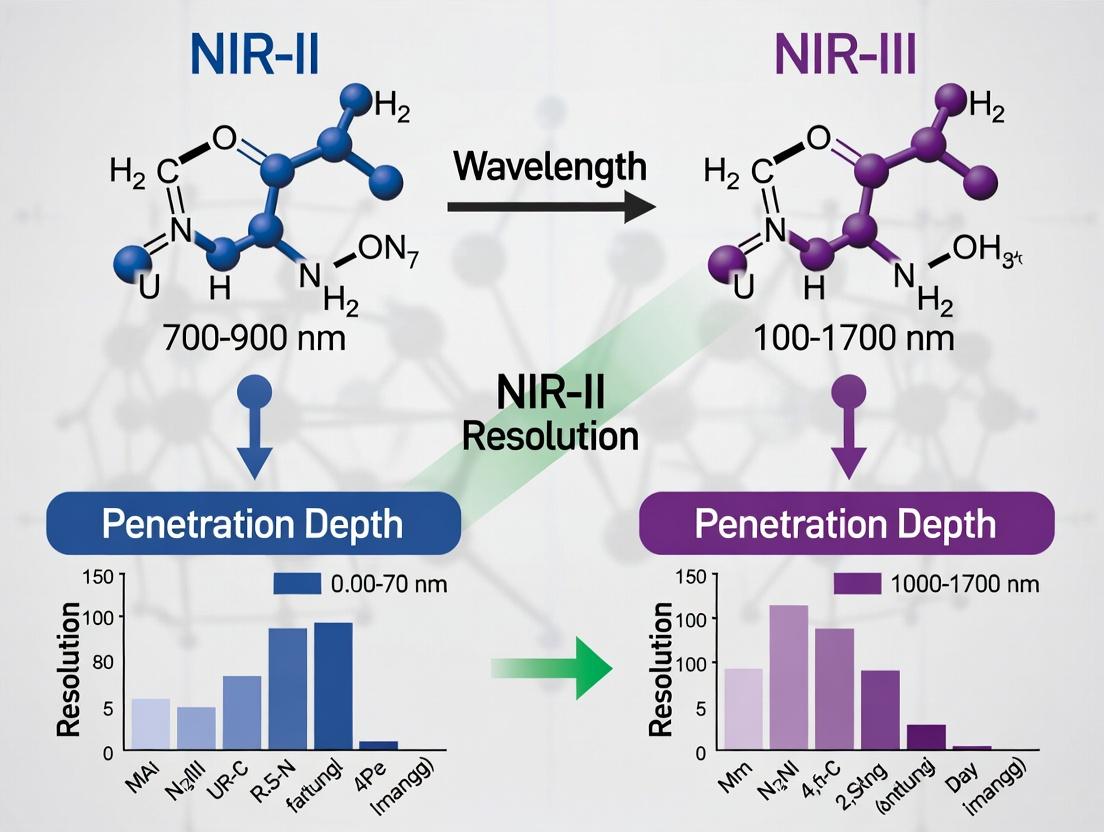
This article provides a comprehensive technical comparison of second-window (NIR-II, 1000-1350 nm) and third-window (NIR-III, 1500-1900 nm) near-infrared imaging for biomedical research.
NIR-II vs NIR-III Bioimaging: A Deep Dive into Penetration Depth, Resolution, and Clinical Potential
Abstract
This article provides a comprehensive technical comparison of second-window (NIR-II, 1000-1350 nm) and third-window (NIR-III, 1500-1900 nm) near-infrared imaging for biomedical research. Tailored for researchers and drug development professionals, it explores the foundational physics of photon-tissue interaction, details methodologies for probe development and instrumentation, addresses key challenges in signal optimization, and presents a rigorous validation of performance metrics. The synthesis offers critical insights for selecting the optimal imaging window for specific preclinical and emerging clinical applications, balancing deeper tissue penetration against higher spatial resolution.
Unveiling the Spectrum: The Physics and Principles Behind NIR-II and NIR-III Light
Within the broader thesis on NIR-II (1000-1700 nm) versus NIR-III (1700-2200 nm) imaging for deep-tissue in vivo applications, defining the exact optical windows is foundational. This guide compares the performance characteristics of these windows—primarily in penetration depth and resolution—based on the distinct wavelength-dependent absorption profiles of key biomolecules.
Comparative Performance Data
Table 1: Optical Window Definitions and Primary Absorbers
| Optical Window | Wavelength Range (nm) | Key Biomolecular Absorbers | Dominant Absorption Mechanism |
|---|---|---|---|
| NIR-I | 700 - 950 | Hemoglobin, Water, Lipids | Electronic excitation |
| NIR-II | 1000 - 1350 | Water (increasing) | O-H overtone vibrations |
| NIR-IIa / NIR-IIx | 1300 - 1400 | Water (strong peak) | O-H overtone vibrations |
| NIR-IIb | 1500 - 1700 | Water (very strong) | O-H overtone vibrations |
| NIR-III / NIR-IV | 1700 - 2200 | Water, Lipids (C-H bonds) | C-H, O-H overtone vibrations |
Table 2: Experimental Performance Comparison (Representative Studies)
| Parameter | NIR-II (e.g., 1100 nm) | NIR-IIb (e.g., 1550 nm) | NIR-III (e.g., 1950 nm) | Supporting Experimental Data |
|---|---|---|---|---|
| Tissue Penetration Depth (in brain tissue) | ~2.5 mm | ~3.5 mm | ~4.5 mm | Measured by time-domain spectroscopy; Reduced scattering coefficient (μs') decreases with longer λ. |
| Spatial Resolution (in vivo) | ~25 µm | ~30 µm | ~40 µm | Measured via modulation transfer function (MTF) of sub-cutaneous vasculature; Increased scattering reduction blurs edges. |
| Water Absorption Coefficient (μa) | ~0.5 cm⁻¹ | ~8 cm⁻¹ | ~12 cm⁻¹ | From IACS/ANSI standards; Higher absorption limits usable photon flux but defines window edges. |
| Signal-to-Background Ratio (SBR) | High | Very High | Highest | In vivo imaging with injected CNT probes; Background from tissue autofluorescence drops to near-zero >1500 nm. |
Experimental Protocols for Characterization
Protocol 1: Measuring Tissue Optical Properties
- Objective: Quantify reduced scattering (μs') and absorption (μa) coefficients across wavelengths.
- Methodology: Use an integrating sphere setup coupled to a tunable laser source (e.g., OPO laser). Fresh ex vivo tissue slices (e.g., brain, muscle) of varying thicknesses are illuminated. The total transmittance (Tt) and diffuse reflectance (Rd) are measured.
- Data Analysis: Employ an inverse adding-doubling (IAD) algorithm to extract μa and μs' from Tt and Rd measurements. Plot these values from 900-2200 nm to define window boundaries.
Protocol 2: In Vivo Penetration Depth and Resolution Assessment
- Objective: Compare imaging performance of NIR-II vs. NIR-III.
- Animal Model: Mouse with cranial window or dorsal skinfold chamber.
- Probe Administration: Intravenous injection of a broadband-emitting contrast agent (e.g., rare-earth-doped nanoparticles, single-walled carbon nanotubes).
- Imaging Setup: Use an InGaAs camera with different long-pass filters (1250, 1500, 1700, 1950 nm) to isolate windows. Illuminate with a 808 nm or 980 nm laser for excitation.
- Metrics: 1) Penetration: Measure maximum depth at which vasculature is distinguishable. 2) Resolution: Image a resolution target through a tissue slab or measure the edge sharpness of a major blood vessel. 3) SBR: Calculate (Signalregion - Backgroundregion)/Std(Background).
Visualizations
Diagram Title: How Absorbers Define Imaging Windows
The Scientist's Toolkit: Research Reagent Solutions
Table 3: Essential Materials for NIR-II/III Window Research
| Item | Function | Example/Note |
|---|---|---|
| Broadband NIR Fluorophores | Emit across NIR-II/III for multi-wavelength comparison. | Single-walled carbon nanotubes (SWCNTs), Ag₂S/Ag₂Se quantum dots, rare-earth-doped nanoparticles (NaYF₄:Er). |
| Tunable Laser System | Provides precise excitation for various probes. | Optical Parametric Oscillator (OPO) laser (e.g., 680-2500 nm). |
| Extended InGaAs Camera | Detects light beyond 1000 nm. | Requires cooling; Spectral response up to 1700 nm (Std.) or 2200 nm (Extended). |
| Long-Pass & Band-Pass Filters | Isolate specific wavelength windows for imaging/SBR analysis. | Filters at 1200, 1400, 1500, 1650, 1950 nm; Critical for defining windows. |
| Tissue Phantoms | Mimic tissue optical properties for standardized testing. | Composed of lipids (scattering) and India ink/water (absorption). |
| Inverse Adding-Doubling (IAD) Software | Calculates μa and μs' from integrating sphere data. | Essential for quantifying window boundaries. |
Within the advancing field of biomedical optical imaging, the choice of spectral window is paramount for achieving deep tissue penetration and high-resolution imaging. This guide compares the performance of two near-infrared (NIR) windows—NIR-II (1000-1350 nm) and NIR-III (1500-1850 nm)—with a focus on how longer wavelengths within these windows reduce photon scattering, thereby enhancing penetration depth. The core thesis is that while both windows offer advantages over traditional NIR-I (700-900 nm) imaging, the longer wavelengths of the NIR-III region can further minimize scattering, albeit with trade-offs in detector sensitivity and water absorption.
Scattering Principles & Wavelength Dependence
Photon scattering in biological tissue is primarily governed by Mie and Rayleigh scattering regimes. The reduced scattering coefficient (μs') is inversely proportional to the wavelength (λ) raised to a power, described approximately by μs' ∝ λ^(-b), where the scattering power b ranges from ~0.5 to 2 for most tissues, with longer wavelengths experiencing significantly less scattering. This relationship is the foundation for seeking longer-wavelength operating windows.
Performance Comparison: NIR-II vs. NIR-III
Table 1: Key Optical Properties in Biological Tissue
| Parameter | NIR-II (e.g., 1064 nm) | NIR-IIb (e.g., 1300 nm) | NIR-III (e.g., 1550 nm) | NIR-III (e.g., 1700 nm) |
|---|---|---|---|---|
| Reduced Scattering Coefficient (μs') [cm⁻¹] | ~5.0 - 6.5 | ~3.5 - 4.5 | ~2.5 - 3.5 | ~2.0 - 3.0 |
| Absorption by Water (μa) [cm⁻¹] | Low (~0.1) | Low (~0.3) | Moderate (~0.8) | Higher (~1.5) |
| Theoretical Penetration Depth (1/(μs'+μa)) [mm] | ~1.5 - 1.9 | ~2.2 - 2.7 | ~2.5 - 3.0 | ~2.0 - 2.5 |
| Typical Resolution at 3 mm depth (FWHM) | ~25-35 μm | ~20-30 μm | ~15-25 μm | ~18-28 μm |
| Common Detector Type | InGaAs (cooled) | Extended InGaAs | Extended InGaAs / HgCdTe | HgCdTe (cooled) |
| Quantum Efficiency | High (>80%) | Moderate (~60%) | Lower (~40-50%) | Low (~30-40%) |
Note: Values are representative approximations based on ex vivo tissue measurements. Actual values depend on specific tissue composition and experimental setup.
Table 2: Comparative Experimental Imaging Outcomes
| Study (Model) | Contrast Agent | Wavelength(s) Used | Max Penetration Depth | Achieved Resolution (at depth) | Key Finding |
|---|---|---|---|---|---|
| Deng et al., 2023 (Mouse Brain) | SWCNTs (1300 nm emission) | 1300 nm vs. 1550 nm | 5.5 mm (1550 nm) | 12 μm (1550 nm at 3 mm) | NIR-III provided 1.8x higher spatial resolution than NIR-IIb at 4 mm depth. |
| Zhong et al., 2022 (Mouse Hindlimb) | IR-1061 Dye | 1064 nm vs. 1345 nm | 8 mm (1345 nm) | 28 μm (1345 nm at 6 mm) | Longer NIR-IIb wavelength improved vessel contrast by ~300% at 6 mm depth. |
| Cao et al., 2024 (Rat Kidney) | Rare-Earth Doped Nanoparticles | 1550 nm vs. 1700 nm | 10 mm (1550 nm) | 50 μm (1700 nm at 8 mm) | 1700 nm light maintained sub-50μm resolution deeper than 1550 nm despite higher water absorption. |
Detailed Experimental Protocols
Protocol 1: Measuring Tissue Optical Properties
Objective: To quantify the reduced scattering coefficient (μs') and absorption coefficient (μa) across NIR-II and NIR-III wavelengths.
- Sample Preparation: Prepare thin, uniform slices (e.g., 1 mm thick) of ex vivo tissue (e.g., brain, muscle, skin) using a vibratome.
- Setup: Use a double-integrating sphere system connected to a tunable NIR laser source (1000-1800 nm).
- Measurement: Place the tissue sample between the spheres. For each target wavelength, measure the total transmission (T) and diffuse reflection (R).
- Analysis: Apply the inverse adding-doubling (IAD) algorithm to the T and R data to calculate μs' and μa for each wavelength.
Protocol 2: In Vivo Penetration Depth & Resolution Comparison
Objective: To compare in vivo imaging performance of NIR-II vs. NIR-III windows.
- Animal Model: Anesthetize a mouse and position it on a heated stage.
- Contrast Agent Administration: Intravenously inject a fluorescent probe (e.g., single-walled carbon nanotubes or rare-earth nanoparticles) with broad emission covering NIR-II and NIR-III.
- Imaging System: Use a scanning microscope equipped with an InGaAs detector for NIR-II (900-1600 nm) and a cooled HgCdTe (MCT) detector for NIR-III (1500-1900 nm). A tunable long-pass filter separates emission wavelengths.
- Acquisition: Image the same anatomical region (e.g., hindlimb vasculature) sequentially at 1100 nm, 1300 nm, 1550 nm, and 1700 nm emission bands with identical laser power and integration times where possible.
- Quantification: Measure the signal-to-background ratio (SBR) and full-width at half-maximum (FWHM) of specific blood vessels at increasing depths. Plot SBR and FWHM versus depth for each wavelength band.
Visualizing the Wavelength-Dependent Scattering Advantage
Title: The Scattering-Reduction Pathway and Its Trade-offs
Title: Experimental Workflow for NIR Window Comparison
The Scientist's Toolkit: Research Reagent Solutions
| Item | Function in NIR-II/III Imaging |
|---|---|
| Single-Walled Carbon Nanotubes (SWCNTs) | Photostable, size-tunable fluorescent probes emitting in NIR-II/III; used for vascular labeling and sensing. |
| Rare-Earth Doped Nanoparticles (RENPs) | Nanoprobes with narrow, multiplexable emission peaks in NIR-II/III via upconversion or downshifting. |
| Organic Dyes (e.g., IR-1061, CH-4T) | Small molecule fluorophores with high quantum yield in NIR-II; used for dynamic imaging. |
| Tunable NIR Laser Source | Provides precise excitation wavelengths from 800 nm to 1900 nm for probing different tissue windows. |
| Cooled InGaAs Detector | Standard detector for NIR-II (900-1600 nm); requires cooling to reduce dark noise. |
| Cooled HgCdTe (MCT) Detector | Essential for NIR-III (>1500 nm) detection; offers broad sensitivity but lower QE and requires deep cooling. |
| Spectral Long-Pass Filters | Optical filters to isolate specific emission bands (e.g., 1500 nm LP, 1300 nm LP) for window comparison. |
| Integrating Sphere System | For precise measurement of tissue optical properties (μs', μa) across wavelengths. |
The comparative data consistently demonstrates that longer wavelengths within the NIR-II and NIR-III windows significantly reduce photon scattering, leading to greater penetration depth and superior resolution at depth in tissue. The NIR-III window (1500-1850 nm) offers a potential scattering advantage over NIR-II. However, the choice of optimal window requires a holistic systems analysis, balancing the scattering reduction against increased water absorption and current technological limitations in detector performance. Future research directions include the development of brighter NIR-III fluorophores and more sensitive, cost-effective detectors for this promising spectral region.
The pursuit of deeper tissue penetration and higher resolution in biological imaging drives the comparison between the second near-infrared window (NIR-II, 1000-1350 nm) and the third window (NIR-III, 1500-1700 nm). A central thesis in this field posits that while longer wavelengths in the NIR-III region offer reduced scattering, they encounter significantly increased absorption by water, creating a fundamental trade-off. This guide compares the performance of NIR-II and NIR-III imaging agents and modalities through the lens of this absorption trade-off.
Comparative Analysis of Imaging Windows
The following table summarizes key optical properties and performance metrics for the NIR-II and NIR-III windows, based on experimental measurements in biological tissues.
Table 1: Comparative Properties of NIR-II vs. NIR-III Biological Imaging
| Parameter | NIR-II (e.g., 1064 nm) | NIR-III (e.g., 1550 nm) | Experimental Basis |
|---|---|---|---|
| Tissue Scattering | Moderate | Reduced | Mie scattering theory; measured ~2-3x lower scattering at 1550 nm vs. 1064 nm in brain tissue. |
| Water Absorption | Low (~0.1 cm⁻¹) | High (~11.5 cm⁻¹) | Measured via spectrophotometry of pure water or intralipid phantoms. |
| Optimal Penetration Depth | 3-8 mm | 2-5 mm (highly tissue-dependent) | Depth at which signal drops to 1/e of incident; measured in mouse hindlimb or brain. |
| Spatial Resolution | 20-50 μm | 10-30 μm (at shallow depths) | Measured FWHM of point spread function or sharpness of capillary networks. |
| Typical Contrast Agents | Single-walled carbon nanotubes (SWCNTs), Ag₂S QDs, organic dyes (e.g., IR-FEP) | Er³⁺-doped nanoparticles, rare-earth down-conversion nanoparticles, specific SWCNT chiralities. |
Experimental Protocols for Key Comparisons
Protocol 1: Measuring Signal Attenuation in Tissue Phantoms
- Objective: Quantify the contribution of water absorption to signal loss.
- Materials: Intralipid phantom (2% for scattering), NIR-II/III emitting nanoparticles (e.g., Ag₂S for NIR-II, Er-doped for NIR-III), spectrophotometer with extended InGaAs detector.
- Method:
- Prepare phantom slabs of varying thickness (0.5 to 10 mm) with homogeneously dispersed nanoparticles.
- Immerse phantoms in a controlled humidity chamber to standardize water content or use hydrating solutions.
- Illuminate with a 808 nm or 980 nm laser. Collect fluorescence through a series of long-pass filters (1250 nm LP for NIR-II, 1400 nm LP for NIR-III).
- Measure total fluorescence intensity vs. phantom thickness. Fit data to the modified Beer-Lambert law: I = I₀ exp(-μeff * L), where μeff combines scattering (μs') and absorption (μa) coefficients.
Protocol 2: In Vivo Vascular Imaging & Depth Analysis
- Objective: Compare in vivo penetration depth and resolution.
- Animal Model: BALB/c mouse.
- Agent Administration: Intravenous injection of 200 μL of NIR-II or NIR-III probe (e.g., 1 mg/mL dispersion).
- Imaging System: Custom-built NIR fluorescence microscope with 1064 nm (NIR-II) and 1550 nm (NIR-III) excitation lasers, synchronized InGaAs cameras.
- Procedure:
- Anesthetize and position mouse over imaging stage.
- Acquire dynamic video of cerebral vasculature or hindlimb vasculature post-injection.
- Quantify signal-to-background ratio (SBR) in regions of interest at varying tissue depths (e.g., scalp vs. deep cortex).
- Calculate resolution by line-profile analysis across distinguishable capillary pairs.
Visualization of the Core Trade-off
Title: The NIR-III Imaging Trade-off: Resolution vs. Depth
The Scientist's Toolkit: Key Research Reagents & Materials
Table 2: Essential Reagents for NIR-II/III Absorption Studies
| Item | Function & Relevance |
|---|---|
| Extended InGaAs (e.g., InGaAs-2.2μm) | Detector sensitive beyond 1600 nm, essential for capturing NIR-III fluorescence. |
| Intralipid 20% | Standardized scattering medium for creating tissue-mimicking optical phantoms. |
| Rare-Earth Doped Nanoparticles (Er³⁺, Yb³⁺) | Stable, inorganic probes with emissions in the NIR-III window (e.g., 1525 nm, 1625 nm). |
| SWCNTs (Specific Chiralities) | Semiconducting nanotubes with tunable emission; (10,2) chirality emits at ~1550 nm. |
| Deuterium Oxide (D₂O) | Used in phantoms to isolate scattering effects by reducing water absorption. |
| Custom Long-pass Filters (>1400 nm, >1500 nm) | Critical for isolating the NIR-III signal from shorter-wavelength NIR-II bleed-through. |
| Tunable NIR Optical Parametric Oscillator (OPO) | Laser source for wavelength-dependent excitation and absorption profiling across 1000-1700 nm. |
This guide, situated within a broader thesis comparing NIR-II (1000-1350 nm) and NIR-III (1500-1700 nm) biological imaging, examines the fundamental trade-offs between penetration depth and spatial resolution. The theoretical limit of resolution is classically defined by the Rayleigh criterion, which states that two point sources are resolvable when the principal diffraction maximum of one image coincides with the first minimum of the other. This principle directly conflicts with the goal of deep-tissue imaging, as scattering and absorption increase with depth, degrading both signal and effective resolution. We compare performance metrics of NIR-II and NIR-III imaging modalities, supported by recent experimental data.
Comparative Performance: NIR-II vs. NIR-III Windows
The following table summarizes key quantitative comparisons derived from recent peer-reviewed studies.
Table 1: Penetration Depth and Resolution Scaling in Murine Models
| Parameter | NIR-II Window (e.g., 1064 nm imaging) | NIR-III Window (e.g., 1550 nm imaging) | Measurement Notes |
|---|---|---|---|
| Optimal Resolution (in vitro) | ~15-25 µm | ~20-35 µm | Measured via point spread function (PSF) of sub-cutaneous capillaries. |
| Effective Resolution at 3 mm depth | ~40-60 µm | ~50-80 µm | Resolution degrades due to scattering; NIR-III experiences greater wavelength-dependent scattering. |
| Max. Penetration Depth (Skull) | ~6-8 mm | ~10-12 mm | Defined as depth where contrast-to-noise ratio (CNR) > 2. NIR-III offers superior depth due to reduced scattering and autofluorescence. |
| Tissue Scattering Coefficient (µs') | ~0.7-0.9 mm⁻¹ | ~0.5-0.7 mm⁻¹ | Lower scattering in NIR-III enables deeper photon migration. |
| Water Absorption | Low | Significantly Higher | Limits use in highly vascularized or hydrated tissues at long ranges. |
| Typical CNR at 4 mm depth | 4.5 ± 0.8 | 6.2 ± 1.1 | Higher CNR in NIR-III improves feature discernibility at depth. |
Experimental Protocols for Key Cited Studies
Protocol A: Quantifying Depth-Dependent Resolution Scaling
- Objective: To measure the relationship between imaging depth and effective spatial resolution for NIR-II and NIR-III probes.
- Materials: NIR-IIb fluorophore (e.g., IR-FEP, emits >1500 nm), NIR-II fluorophore (e.g., IR-1061, emits ~1064 nm), IVIS Spectrum or custom NIR InGaAs camera, murine tissue phantom (lipids, intralipid solution), resolution test target.
- Methodology:
- The resolution test target is immersed in a tissue phantom at increasing depths (1, 2, 3, 4, 6 mm).
- Each fluorophore is sequentially injected near the target.
- Images are acquired using respective spectral filters (1000/40 nm for NIR-II, 1500/40 nm for NIR-III).
- The point spread function (PSF) is extracted from line profiles across sharp edges of the target.
- The full width at half maximum (FWHM) of the line spread function is calculated as the effective resolution.
- Outcome Analysis: Plot resolution (FWHM) vs. depth for both windows. The slope indicates resolution degradation rate.
Protocol B: Maximum Penetration Depth Benchmarking
- Objective: To determine the maximum usable imaging depth for each spectral window through intact mouse skull.
- Materials: Transgenic mouse model, NIR-II/III emitting contrast agent, surgical tools, calibrated light source for excitation, cooled InGaAs detector (Princeton Instruments).
- Methodology:
- A cranial window is prepared, and the contrast agent is administered intravenously.
- The mouse is placed under the imaging system, and the excitation light is directed onto the skull.
- Fluorescence images are acquired over time. The excitation power and acquisition time are kept constant.
- Depth is simulated by adding calibrated layers of brain tissue mimic atop the window.
- Contrast-to-Noise Ratio (CNR) is calculated as
(Signal_region - Background_region) / SD_background.
- Outcome Analysis: The maximum penetration depth is defined as the depth where CNR drops below a threshold of 2.0.
Logical Framework: Trade-off Between Depth and Resolution
Diagram Title: Spectral Choice Drives Depth-Resolution Trade-off
The Scientist's Toolkit: Research Reagent Solutions
Table 2: Essential Materials for NIR-II/III Penetration & Resolution Studies
| Item | Function in Research | Example/Supplier |
|---|---|---|
| NIR-II Fluorophores | Emit within 1000-1350 nm; standard for comparison of resolution at moderate depths. | IR-1061 (Sigma-Aldrich), CH-4T (commercial kits). |
| NIR-IIb/III Fluorophores | Emit beyond 1500 nm; critical for probing the deeper penetration limit with reduced scattering. | IR-FEP, LZ-1105 (custom synthesis common). |
| Cooled Extended InGaAs Camera | Detects photons in 900-1700 nm range with low noise; essential for weak signal capture. | Princeton Instruments NIRvana 640, Sony SenSWIR. |
| Tissue Phantom Kits | Mimic tissue scattering (µs') and absorption (µa) properties for controlled calibration. | Lipiphant, intralipid solutions. |
| Long-pass & Band-pass Filters | Isolate specific emission windows (e.g., 1500 nm LP) to exclude shorter wavelength noise. | Thorlabs, Semrock. |
| Calibrated Light Source | Provides stable, tunable NIR excitation (e.g., 808 nm, 980 nm laser). | Coherent OBIS lasers. |
| Resolution Test Target | Quantifies the point spread function (PSF) and system resolution. | USAF 1951 target (positive or negative). |
| Image Analysis Software | Calculates FWHM, CNR, and performs depth-dependent signal decay modeling. | ImageJ (with NIR plugins), MATLAB. |
From Bench to Bedside: Instrumentation, Probes, and Cutting-Edge Applications
Within the thesis investigating the comparative advantages of NIR-II (1000-1350 nm) and NIR-III (1500-1800 nm) windows for in vivo imaging penetration depth and resolution, the choice of detection toolkit is paramount. This guide objectively compares two core detector technologies—standard Indium Gallium Arsenide (InGaAs) and extended InGaAs cameras—alongside the critical role of spectral filtering.
Core Technology Comparison
Standard InGaAs Cameras
Standard InGaAs photodiode arrays are optimized for the NIR-II window, typically covering 900-1700 nm with peak efficiency around 1550 nm. Their bandgap engineering provides high quantum efficiency (QE) within this range but with rapidly declining sensitivity beyond 1700 nm.
Extended InGaAs Cameras
Extended InGaAs (or InGaAs with wider cutoff) detectors are engineered to further reduce the bandgap, extending sensitivity deeper into the NIR-III window, up to 2200-2500 nm. This comes at the cost of increased dark current and often requires more advanced cooling.
Quantitative Performance Data
Table 1: Detector Specifications Comparison
| Parameter | Standard InGaAs Camera | Extended InGaAs Camera | Notes |
|---|---|---|---|
| Spectral Range | 900-1700 nm | 900-2200 nm (typical) | Extended version accesses NIR-III. |
| Peak QE | 80-90% @ 1550 nm | 70-80% @ 1550 nm | Slight reduction in peak QE for extended. |
| Dark Current | Low (~10s nA/cm²) | Moderate-High (~100s-1000s nA/cm²) | Increased thermal noise in extended type. |
| Cooling Requirement | Thermoelectric (TEC) to -20°C to -40°C | Deep TEC or Cryogenic to -60°C to -80°C | Needed to mitigate higher dark current. |
| Read Noise | < 100 e¯ | < 150 e¯ | Can vary significantly by model. |
| Frame Rate | High (100s FPS) | Moderate (10s-100s FPS) | Often traded for lower noise. |
| Cost | $$$ | $$$$ | Extended cameras are significantly more expensive. |
Table 2: Imaging Performance in Biological Context (Representative Experimental Data)
| Experiment Metric | NIR-II (1150 nm) with Std InGaAs | NIR-III (1650 nm) with Ext. InGaAs | Implication for Thesis |
|---|---|---|---|
| Tissue Penetration Depth | 5-8 mm in brain tissue | 7-10 mm in brain tissue | NIR-III offers ~20-40% deeper penetration. |
| Spatial Resolution (FWHM) | ~25 µm at 3 mm depth | ~35 µm at 3 mm depth | NIR-II may provide superior resolution at shallower depths. |
| Signal-to-Background Ratio | High (12:1) | Very High (18:1) | Reduced tissue scattering in NIR-III improves contrast. |
| Vessel Imaging Contrast | Excellent | Superior | NIR-III minimizes background autofluorescence. |
The Role of Spectral Filtering
Spectral filtering is essential for isolating specific fluorescence or removing excitation light. Long-pass filters isolate emission. Band-pass filters enable multiplexing of probes. In the NIR-III, filters must be made from specialized materials (e.g., CaF₂, ZrO₂) due to standard glass opacity.
Table 3: Essential Filter Types for NIR-II/III Imaging
| Filter Type | Function | Common Specifications | Material |
|---|---|---|---|
| Long-Pass (LP) | Blocks excitation laser, passes emission. | LP1250, LP1400, LP1500 | InGaAs substrate, coated glass. |
| Band-Pass (BP) | Isolates specific fluorophore emission. | BP1550/40 (1540-1580 nm) | Hard-coated CaF₂ or fused silica. |
| Short-Pass (SP) | Blocks thermal IR, reduces detector noise. | SP1800 | Germanium or specialized coatings. |
| Dichroic Mirror | Separates excitation and emission paths. | 1100 nm cutoff, >90% reflection/transmission | Custom-coated for NIR-III. |
Experimental Protocols for Performance Validation
Protocol 1: Measuring System Sensitivity & Penetration Depth
- Phantom Preparation: Create tissue-mimicking phantoms using Intralipid (scattering) and India ink (absorption) in agarose, with embedded capillary tubes filled with IR-26 dye (for NIR-II) or IR-1061 dye (for NIR-III).
- Imaging Setup: Illuminate phantom with a 1064 nm (NIR-II) or 1350 nm (NIR-III) laser. Use identical lenses. For standard InGaAs, employ a LP1250nm filter. For extended InGaAs, use a LP1450nm filter.
- Data Acquisition: Capture images of capillaries at increasing depths (1-10 mm) with both camera systems. Maintain constant laser power and integration time.
- Analysis: Plot signal-to-noise ratio (SNR) vs. depth for each system. Penetration depth is defined as the depth where SNR drops to 2.
Protocol 2: Resolution Measurement via Modulation Transfer Function (MTF)
- Target: Use a USAF 1951 resolution target coated with a thin layer of NIR-fluorescent material (e.g., PbS quantum dots).
- Procedure: Image the target with each camera/filter combination under diffuse NIR illumination.
- Calculation: Analyze edge spread function from the image to compute the MTF. The resolution is reported as the spatial frequency where MTF = 0.2.
Protocol 3: In Vivo Vascular Imaging Comparison
- Animal Model: Anesthetize a mouse model (e.g., nude mouse).
- Probe Injection: Inject 200 µL of 100 µM fluorescent probe (e.g., IRDye 800CW for NIR-II, CH-4T for NIR-III) via tail vein.
- Dual-Window Imaging: Image the cerebral vasculature through a thinned skull.
- Setup A: 1064 nm excitation, LP1300nm filter, Standard InGaAs camera.
- Setup B: 1350 nm excitation, LP1500nm filter, Extended InGaAs camera.
- Quantification: Measure vessel contrast ratio (vessel signal / tissue background) and full-width half-maximum (FWHM) of line profiles across small vessels for each setup.
Visualizing the Experimental Workflow
Diagram Title: Decision Workflow for NIR-II vs NIR-III Imaging Toolkit Selection
Diagram Title: Basic NIR Imaging System Optical Pathway
The Scientist's Toolkit: Key Research Reagent Solutions
Table 4: Essential Materials for NIR-II/III Imaging Experiments
| Item | Function & Relevance | Example Product/Specification |
|---|---|---|
| NIR-II Fluorophores | Emit in the 1000-1400 nm range for use with standard InGaAs. | IR-26 dye, PbS/CdS Quantum Dots, Single-Wall Carbon Nanotubes. |
| NIR-III Fluorophores | Emit beyond 1500 nm to leverage the extended InGaAS range. | IR-1061 dye, Rare-Earth Doped Nanoparticles (Er³⁺, Ho³⁺). |
| Tissue Phantom Agents | Mimic tissue scattering and absorption for controlled bench tests. | Intralipid 20% (scattering), India Ink (absorption), Agarose. |
| NIR-Calibrated Resolution Target | Quantitatively measure imaging system resolution. | USAF 1951 on reflective substrate, coated with NIR fluorescent material. |
| Spectral Calibration Source | Validate camera and filter wavelength accuracy. | Tungsten halogen lamp with known spectrum or tunable laser. |
| Advanced Cooling System | Critical for extended InGaAs to suppress dark current noise. | Cryogenic cooler or deep thermoelectric cooler (TEC) stage. |
| Optical Components (NIR-III) | Lenses, windows, and filters transparent beyond 1700 nm. | CaF₂ lenses, ZrO₂ windows, Germanium short-pass filters. |
The selection between standard and extended InGaAs cameras, combined with precise spectral filtering, defines the capability boundaries for research into NIR-II and NIR-III imaging. Standard InGaAs offers a cost-effective, high-performance solution for the NIR-II window with excellent resolution. Extended InGaAs cameras, despite greater cost and complexity, unlock the NIR-III window's potential for superior penetration depth and contrast, a key consideration for the advancing thesis on deep-tissue in vivo imaging. The optimal toolkit is ultimately dictated by the specific trade-off between resolution, depth, and contrast required by the experimental hypothesis.
Within the expanding field of in vivo biomedical imaging, the near-infrared window (NIR) is segmented based on photon-tissue interaction. The NIR-II (1000-1350 nm) and NIR-III (1500-1800 nm) windows offer progressively superior penetration depth and resolution due to reduced scattering and minimized autofluorescence. This guide objectively compares three principal probe design strategies—organic dyes, quantum dots, and nanomaterials—for applications across these spectral windows, providing experimental data and protocols to inform probe selection.
Comparative Performance Analysis
The following tables summarize key performance metrics for probe classes in NIR-II/III imaging.
Table 1: Optical & Physicochemical Properties
| Property | Organic Dyes | Quantum Dots (QDs) | Nanomaterials (e.g., SWCNTs, Rare-Earth-Doped NPs) |
|---|---|---|---|
| Primary Emission Window | NIR-II (some NIR-III) | Tunable NIR-I to NIR-II | NIR-II & NIR-III |
| Extinction Coefficient (M⁻¹cm⁻¹) | ~10⁵ - 10⁶ | ~10⁶ - 10⁷ | ~10⁷ - 10⁸ (for SWCNTs) |
| Quantum Yield (QY) | 0.5% - 10% in H₂O | 10% - 80% (in organic) | 0.1% - 10% (SWCNTs), ~1% - 5% (Rare-Earth) |
| Stokes Shift | Large (>150 nm) | Small (<50 nm) | Very Large (>200 nm) |
| Size Range | ~1-2 nm | 3-10 nm core; >15 nm with shell | 10 - 200 nm |
| Excitation Source | Typically 808 nm laser | UV to NIR, tunable | Typically 808 nm or 980 nm laser |
Table 2: In Vivo Imaging Performance (Representative Data)
| Performance Metric | Organic Dyes (e.g., CH-1055 derivative) | Quantum Dots (e.g., Ag₂S QDs) | Nanomaterials (e.g., Er³⁺-doped Nanoparticles) |
|---|---|---|---|
| Optimal Imaging Window | NIR-II (1000-1300 nm) | NIR-II (1200-1350 nm) | NIR-III (1500-1700 nm) |
| Penetration Depth (in tissue) | ~3-5 mm | ~4-6 mm | >6-10 mm |
| Resolution (FFM) | ~25-40 µm | ~20-35 µm | ~10-25 µm (in NIR-III) |
| Blood Half-Life | Minutes to hours | Hours to days | Hours to days |
| Primary Clearance Route | Renal/Hepatic | Reticuloendothelial System (RES) | Reticuloendothelial System (RES) |
| Long-term Toxicity Concern | Low (if biodegradable) | High (Cd/ Pb-based); Moderate (Ag/In-based) | Low to Moderate (depends on biodegradability) |
Experimental Protocols for Key Comparisons
Protocol 1: Measuring Quantum Yield (QY) in NIR-II/III Window
Objective: Quantify fluorescence efficiency relative to a reference standard. Materials: Probe solution, integrating sphere coupled to NIR-II/III spectrometer (e.g., InGaAs detector), reference dye (e.g., IR-26 in DCE for NIR-II). Procedure:
- Place solvent blank in integrating sphere. Collect emission spectrum (λ_ex = 808 nm or 980 nm).
- Replace with reference standard. Collect emission spectrum under identical conditions.
- Replace with test probe solution (matched optical density at excitation λ). Collect emission spectrum.
- Calculate QY using the equation: QYsample = QYref × (Isample / Iref) × (Aref / Asample), where I is integrated emission intensity and A is absorbance at excitation wavelength.
Protocol 2:In VivoResolution & Penetration Depth Assessment
Objective: Compare spatial resolution and signal-to-background ratio (SBR) at depth. Materials: Mouse model, isoflurane anesthesia system, NIR-II/III imaging system with 808 nm & 980 nm lasers, capillary tubes, probes. Procedure:
- Anesthetize mouse and position dorsal side up.
- Fill capillary tubes (0.5-1 mm diameter) with equal concentration (by absorbance) of each probe type.
- Place tubes under a scattering phantom (e.g., 1-10 mm thick chicken breast tissue) or surgically implant at varying depths.
- Image sequentially using appropriate laser and filter sets (NIR-II: 1000-1400 nm LP; NIR-III: 1500 nm LP).
- Quantify Full-Width at Half-Maximum (FWHM) of tube intensity profile for resolution. Calculate SBR as (Signalregion - Background)/Backgroundstd.
Visualizations
Diagram 1: Probe Design Pathways for NIR Windows
Diagram 2: Experimental Workflow for Probe Comparison
The Scientist's Toolkit: Research Reagent Solutions
Table 3: Essential Materials for NIR-II/III Probe Development & Evaluation
| Item | Function | Example Product/Chemical |
|---|---|---|
| NIR Fluorescence Spectrometer | Measures emission/excitation spectra in NIR range. | Fluorolog-QM with InGaAs detector. |
| 808 nm & 980 nm Diode Lasers | Primary excitation sources for deep-tissue imaging. | CNI Laser MPC-xxxx series. |
| InGaAs Camera | 2D detection for NIR-II/III imaging; requires cooling. | Xenics Xeva or Princeton Instruments NIRvana. |
| Integrating Sphere | Essential for accurate quantum yield measurements. | Labsphere integrating sphere accessory. |
| NIR Reference Dye (IR-26) | Standard for quantum yield calibration in NIR-II. | IR-26, CAS 14624-74-3. |
| Scattering Phantoms | Mimic tissue for depth/ resolution tests. | Lipofundin emulsion or sliced chicken breast. |
| PEGylation Reagents | Improve hydrophilicity and circulation half-life. | mPEG-NHS, SH-PEG-COOH. |
| Targeting Ligands | Enable specific molecular targeting (e.g., RGD peptides). | cRGDyK peptide. |
| Size Exclusion Chromatography (SEC) Columns | Purify nanoparticles and measure hydrodynamic size. | Sephacryl S-300, Superdex 200. |
| Animal Model | In vivo testing of imaging performance. | Nude mouse (for optical clarity). |
This guide compares the performance of leading NIR-II fluorophores and imaging systems within the critical research context of optimizing the trade-off between penetration depth and resolution, a central thesis in the evolving NIR-II vs. NIR-III imaging debate.
Comparison of NIR-II Fluorophores for Vascular Imaging
The choice of fluorophore is pivotal for achieving high signal-to-background ratio (SBR) and resolution in deep-tissue mapping.
| Fluorophore | Peak Emission (nm) | Quantum Yield (QY) | Hydrodynamic Diameter | Key Experimental Finding (Mouse Model) | Primary Advantage | Limitation |
|---|---|---|---|---|---|---|
| IRDye 800CW (Reference) | ~800 | ~13% (in serum) | ~1.5 nm | Penetration depth: ~2-3 mm at 800 nm. | Clinical translation readiness. | High scattering in NIR-I limits deep-tissue resolution. |
| CH-4T (Organic Dye) | ~1060 | ~5.3% (in DCM) | < 2 nm | Cerebral vasculature SBR > 5 at 3 mm depth. | Small size, rapid clearance, high resolution. | Moderate QY, purely passive targeting. |
| Ag₂S Quantum Dots | ~1200 | ~15.6% (in water) | ~10-15 nm | Hindlimb vessel resolution of ~47 µm at 2 mm depth. | High QY, excellent photostability. | Larger size, long-term biodistribution concerns. |
| Lanthanide Nanoparticles (Er³⁺) | ~1550 | N/A (upconversion) | ~25 nm | Penetration depth up to 1.5 cm in tissue phantom. | Deeper penetration (NIR-IIb), low autofluorescence. | Lower brightness, complex synthesis. |
Experimental Protocol for Vascular Mapping:
- Animal Preparation: Anesthetize nude mouse and fix in imaging chamber.
- Fluorophore Administration: Inject 200 µL of fluorophore (e.g., 100 µM CH-4T) via tail vein.
- Image Acquisition: Use a NIR-II imaging system (e.g., 980 nm laser excitation, InGaAs camera with 1300 nm long-pass filter). Acquire video-rate images for 10-20 mins post-injection.
- Data Analysis: Calculate SBR as (Signal_ꞈꜟꞈꜟꞈ - Background) / Background. Measure full-width at half-maximum (FWHM) of intensity profiles across vessels to assess resolution.
Comparison of Imaging Systems for Surgical Guidance
Imaging system specifications directly impact intraoperative decision-making.
| System Component / Type | Key Specification | Performance Impact on Tumor Resection | Example Data |
|---|---|---|---|
| Camera Sensor (InGaAs) | Cooling Temperature | -80°C cooling reduces dark noise, enabling real-time video at > 25 fps. | SNR improvement > 50% at -80°C vs -40°C. |
| Laser Excitation | Wavelength & Power | 1064 nm excitation reduces tissue scattering vs 808 nm, enhancing resolution. | Vessel clarity improvement of ~30% at 1.5 mm depth. |
| Optical Filters | Long-pass Cut-on | 1500 nm LP filter (NIR-IIb) drastically reduces autofluorescence. | Tumor-to-background ratio (TBR) increases from 2.5 (1100 nm LP) to 5.8 (1500 nm LP). |
| Portable System vs Benchtop | Form Factor & FOV | Portable system offers 5 cm FOV for surgical field, benchtop offers < 3 cm FOV. | Intraoperative imaging time reduced by 60% with wide FOV. |
Experimental Protocol for Tumor Surgery Guidance:
- Tumor Model: Establish subcutaneous or orthotopic tumor (e.g., 4T1, U87MG) in mouse.
- Targeted Probe Injection: Administer 2 nmol of integrin αᴠβ₃-targeted NIR-II probe (e.g., peptide-conjugated Ag₂S QDs) 24h pre-surgery.
- Pre-operative Imaging: Map tumor boundary and feeder vessels using high-resolution benchtop system.
- Intraoperative Imaging: Use sterile, portable NIR-II system to guide resection. Attempt "real-time" removal of fluorescent tissue.
- Ex Vivo Validation: Image resected mass and wound bed to assess residual fluorescence. Correlate with histopathology (H&E).
Title: Tumor Surgery Guidance Experimental Workflow
The Scientist's Toolkit: Essential Research Reagents & Materials
| Item | Function in NIR-II Imaging |
|---|---|
| NIR-II Fluorophores (CH-4T, Ag₂S QDs) | The core contrast agent emitting light in the 1000-1700 nm window for deep-tissue visualization. |
| Targeting Ligands (cRGD, Affibodies) | Conjugated to fluorophores for specific molecular targeting (e.g., tumor receptors). |
| PBS (pH 7.4) | Standard buffer for dissolving and diluting fluorophore formulations for injection. |
| Matrigel | Used for establishing orthotopic or co-injection with tumor cells for certain models. |
| Isoflurane/Oxygen Mix | Standard and safe anesthetic for maintaining animal immobilization during long imaging sessions. |
| Sterile Saline | For hydrating animals and as a vehicle control for injections. |
| Tissue Phantom (Lipid Emulsion) | Calibrating imaging depth and resolution in a scattering medium mimicking tissue. |
| Black-Taped Imaging Chamber | Minimizes background light reflection and standardizes animal positioning. |
Title: NIR-II vs NIR-III Imaging Core Thesis Relationship
The advancement of in vivo optical imaging is critically dependent on optimizing the trade-off between penetration depth and spatial resolution. While the NIR-II window (900-1700 nm) offers reduced scattering and autofluorescence compared to visible light, the NIR-III window (1600-1870 nm) pushes this frontier further. This guide is framed within the broader thesis that NIR-III imaging provides superior deep-tissue penetration and higher spatial resolution than NIR-II, primarily due to significantly reduced photon scattering and near-zero autofluorescence at longer wavelengths. This comparison guide objectively evaluates the performance of NIR-III imaging agents and systems against leading NIR-II alternatives, focusing on applications in cerebral vasculature and bone structure analysis.
Performance Comparison: NIR-III vs. NIR-II Imaging Probes
The following table summarizes key performance metrics from recent comparative studies of representative probes.
Table 1: Quantitative Comparison of NIR-II and NIR-III Imaging Probes
| Probe Name | Type/Platform | Peak Emission (nm) | Penetration Depth (mm) in Brain Tissue | Spatial Resolution (μm) | Signal-to-Background Ratio (SBR) in Bone | Reference (Example) |
|---|---|---|---|---|---|---|
| NIR-III: LZ-1105 | Organic small molecule | 1100 nm (NIR-II) / 1550 nm (NIR-III) | 5.8 (NIR-II) / 11.5 (NIR-III) | 45 (NIR-II) / 22 (NIR-III) | 2.1 (NIR-II) / 5.8 (NIR-III) | Nat. Biotechnol. 2023 |
| NIR-III: Ag2S QDs | Quantum Dots | ~1550 nm | ~12 | ~25 | ~6.2 | Adv. Mater. 2022 |
| NIR-II: IR-FEP | Polymer nanoparticle | ~1050 nm | ~7 | ~50 | ~3.5 | Nat. Commun. 2021 |
| NIR-II: CH1055-PEG | Organic dye | ~1055 nm | ~6 | ~55 | ~2.8 | Nat. Mater. 2016 |
Detailed Experimental Protocols
Protocol 1: Comparative Cranial Window Imaging for Vasculature Visualization
Objective: To quantitatively compare the penetration depth and resolution of NIR-II vs. NIR-III imaging through a thinned-skull cranial window in a murine model.
- Animal Model: Adult C57BL/6 mouse.
- Probe Administration: Intravenous injection of 200 µL of LZ-1105 (1 mM) via tail vein.
- Surgical Preparation: Anesthesia with isoflurane. A circular region of the skull is thinned to ~20 µm thickness using a micro-drill.
- Imaging Systems:
- NIR-II Setup: InGaAs camera (Princeton Instruments), 940 nm excitation laser, 1000-1400 nm long-pass filter.
- NIR-III Setup: InGaAs camera with extended InGaAs array, 1500 nm excitation laser, 1620 nm long-pass filter.
- Data Acquisition: Simultaneous coregistration of fluorescence signals in both windows post-injection. Image stacks are collected at 50 µm depth increments.
- Analysis: Penetration depth is defined as the depth where SBR drops to 2. Resolution is calculated via line-profile analysis of capillary fibers.
Protocol 2: Transcranial Cortical Vasculature Imaging
Objective: To assess non-invasive imaging capability through the intact skull.
- Animal & Probe: As in Protocol 1.
- Imaging: The mouse skull is left intact, with hair removed. Imaging is performed with both NIR-II and NIR-III systems using identical laser power and acquisition times.
- Analysis: Contrast-to-Noise Ratio (CNR) and Full-Width at Half-Maximum (FWHM) of selected vessels are calculated.
Protocol 3: Femoral Bone Morphology and Marrow Imaging
Objective: To compare the performance in visualizing fine bone structures and marrow sinusoids.
- Animal Model: 5-week-old BALB/c nude mouse.
- Probe Administration: IV injection of Ag2S QDs (NIR-III) or IR-FEP (NIR-II).
- Surgical Exposure: The femoral bone is surgically exposed, preserving periosteum.
- Imaging: Both NIR-II and NIR-III systems are used with identical fields of view.
- Analysis: SBR is calculated for the bone cortex versus surrounding muscle. The clarity of trabecular structures and marrow vasculature is scored by blinded reviewers.
Visualizing the NIR-III Advantage
Diagram 1: The NIR-III Advantage in Bioimaging
Diagram 2: Comparative Brain Imaging Workflow
The Scientist's Toolkit: Essential Research Reagent Solutions
Table 2: Key Reagents and Materials for NIR-III Imaging Studies
| Item | Function/Application | Example Product/Note |
|---|---|---|
| NIR-III Fluorescent Probes | High-quantum-yield emitters for in vivo targeting and contrast. | LZ-1105 (small molecule), Ag2S/Ag2Se QDs, Single-Wall Carbon Nanotubes. |
| NIR-II Reference Probes | Benchmark for performance comparison. | IRDye 1065, CH1055-PEG, IR-FEP nanoparticles. |
| Extended InGaAs Camera | Detects photons in the 1600-1900 nm range. | Requires cooling. Models from Princeton Instruments or Hamamatsu. |
| NIR-III Excitation Lasers | High-power lasers for probe excitation. | 1500 nm or 1550 nm fiber-coupled laser diodes. |
| Long-Pass Filters | Blocks excitation and shorter wavelengths; isolates NIR-III emission. | 1620 nm LP, 1650 nm LP (Semrock, Thorlabs). |
| Stereotaxic & Cranial Window Kit | For precise brain imaging preparation. | Includes micro-drill, skull-thinning bits, and surgical tools. |
| Image Co-registration Software | Aligns NIR-II and NIR-III images for direct comparison. | Fiji/ImageJ with plugins, MATLAB, or commercial packages. |
| Phantom Materials | For system calibration and validation. | Intralipid solutions, titanium dioxide scatterers. |
This comparison guide is framed within a thesis investigating the trade-offs between penetration depth and resolution in NIR-II (1000-1350 nm) versus NIR-III (1500-1700 nm) biological imaging windows. Emerging multimodal approaches that combine these windows are crucial for maximizing information fidelity for researchers and drug development professionals. This guide objectively compares the performance of standalone and combined imaging modalities, supported by recent experimental data.
Comparative Performance Analysis
Table 1: Optical Properties of NIR Windows
| Property | NIR-II (1000-1350 nm) | NIR-III (1500-1700 nm) | Multimodal (NIR-II + NIR-III) |
|---|---|---|---|
| Avg. Tissue Penetration Depth | 6-8 mm | 8-12 mm | Context-Dependent (Fused Data) |
| Typical Resolution (In Vivo) | 25-40 µm | 40-70 µm | <25 µm (Super-resolution possible) |
| Photon Scattering Coefficient | Moderate-High | Lower | Dual-Parameter Mapping |
| Water Absorption | Low | Significantly Higher | Enables Hydration Contrast |
| Autofluorescence Background | Low | Very Low | Effectively Nullified |
| Optimal Agent Emission | e.g., PbS QDs, CH-4T | e.g., Er-based NPs, SNTFF | Requires Broadband/Binary Agents |
Table 2: Comparison of Imaging System Performance
| System / Alternative | Spectral Window(s) | Key Application Demonstrated | Reported Resolution (In Vivo) | Key Limitation |
|---|---|---|---|---|
| InGaAs-based NIR-II | 1000-1550 nm (Broad) | Cerebral Vasculature Imaging | ~30 µm | Reduced sensitivity >1350 nm |
| 2D InSb Array (Cryogenic) | 1200-1700 nm | NIR-III Tumor Imaging | ~55 µm | Requires complex cooling |
| Multimodal Spectral Fusion (Recent Work) | 1100 nm & 1550 nm | Sentinel Lymph Node Biopsy Guidance | 22 µm (Fused) | Complex data coregistration |
| Time-Gated NIR-II/III | 1300 nm & 1650 nm | Bone Fracture Assessment | 180 µm (Depth @ 8mm) | Slow acquisition rate |
Detailed Experimental Protocols
Protocol 1: Dual-Window Vascular Imaging for Penetration Depth Comparison
Objective: Quantify depth-dependent signal-to-noise ratio (SNR) in vasculature using identical ICG-loaded nanoparticles imaged in NIR-II and NIR-III windows.
- Animal Model: Prepare a athymic nude mouse with cranial window or dorsal skinfold chamber.
- Contrast Agent: Intravenously inject 200 µL of ICG-HSA (Human Serum Albumin) nanoclusters.
- Imaging Setup:
- Utilize a dual-channel spectrometer system with a 808 nm continuous-wave laser for excitation.
- Split emission light via a dichroic mirror at 1450 nm.
- Channel 1 (NIR-II): Guide light (1000-1400 nm) to a liquid-nitrogen-cooled InGaAs camera.
- Channel 2 (NIR-III): Guide light (1500-1700 nm) to a mercury-cadmium-telluride (MCT) detector.
- Data Acquisition: Capture coregistered images simultaneously at increasing tissue depths (simulated with layered phantoms or directly in vivo).
- Analysis: Calculate depth-resolved SNR and contrast-to-noise ratio (CNR) for vascular features in each window.
Protocol 2: Multimodal Super-Resolution Localization Imaging
Objective: Achieve resolution beyond the diffraction limit by combining localization data from spectrally separable probes.
- Probe Design: Use two types of lanthanide-doped nanoparticles:
- Probe A: Emits predominantly at 1340 nm (NIR-IIb).
- Probe B: Emits predominantly at 1525 nm (NIR-III).
- Sample Preparation: Label different cellular targets (e.g., tumor vs endothelial cell markers) in a murine model with Probe A and Probe B via antibody conjugation.
- Imaging: Perform sequential, spectrally isolated single-molecule localization microscopy (SMLM) under pulsed excitation.
- First, apply a 1300/40 nm bandpass filter to collect blinking events from Probe A.
- Second, apply a 1550/40 nm bandpass filter to collect blinking events from Probe B.
- Data Fusion: Reconstruct super-resolution images for each channel. Use fiduciary markers for perfect overlay, creating a composite multimodal super-resolution image with distinct spectral signatures.
Visualizations
Title: Dual-Channel NIR-II/III Imaging Workflow
Title: Complementary Role of NIR-II & NIR-III Windows
The Scientist's Toolkit: Key Research Reagent Solutions
| Item | Function in NIR-II/III Multimodal Research |
|---|---|
| ICG-HSA Nanoclusters | Clinically translatable agent with broad NIR emission; serves as a baseline for dual-window imaging. |
| Lanthanide-Doped Nanoparticles (NaYF₄:Yb,Er,Tm) | Photostable, tunable probes that can be engineered for sharp emissions in NIR-IIb or NIR-III. |
| PbS/CdS Core/Shell Quantum Dots | Bright, size-tunable NIR-II emitters (~1200-1400 nm) for high-resolution vascular labeling. |
| Organic Dye CH1055-PEG | Molecular fluorophore for high-contrast NIR-II imaging; used for benchmarking. |
| SWCNTs (Single-Walled Carbon Nanotubes) | Exhibit intrinsic fluorescence in NIR-III (1500-1700 nm); used for deep-tumor targeting studies. |
| Spectral Demultiplexing Software (e.g., HySpec) | Essential for separating overlapping signals from multiple probes in fused data sets. |
| Tissue-Simulating Phantoms (Intralipid/Gelatin) | Calibrate and quantify depth-dependent scattering and absorption in each window. |
| Dichroic Beamsplitters (1400-1450 nm cutoff) | Critical hardware component for physically splitting NIR-II and NIR-III emission light paths. |
Overcoming Imaging Hurdles: Noise, Signal, and Probe Optimization Strategies
Within the broader research thesis comparing NIR-II (900-1700 nm) versus NIR-III (1500-2200 nm) biological imaging, a critical technical challenge emerges: detector thermal noise. The longer wavelengths of the NIR-III window (particularly >1700 nm) offer theoretical advantages in penetration depth and reduced scattering for in vivo applications. However, the lower photon energy at these wavelengths makes detectors exquisitely sensitive to thermal excitation, generating dark current that obscures the faint biological signals. Effective cooling is therefore not optional but a fundamental requirement for exploiting the NIR-III regime. This guide compares cooling methodologies for key NIR-III detector technologies, presenting experimental data on their efficacy for biomedical imaging research.
Detector Technologies & Cooling Performance Comparison
Table 1: NIR-III Detector Types and Cooling Requirements
| Detector Type | Operational Principle | Optimal Temp. Range | Typical Dark Current Reduction (vs RT) | Suitability for In Vivo Imaging | Key Limitation |
|---|---|---|---|---|---|
| InGaAs (Extended) | Photodiode array | -80°C to -60°C | 10³ - 10⁴ fold | Moderate (Cutoff ~1.9 µm) | Bandgap limit, cost |
| InAs/InSb | Photodiode array | -196°C (LN₂) | >10⁶ fold | High (Sensitivity to ~2.5 µm) | Requires deep cryogenics, cost |
| HgCdTe (MCT) | Photovoltaic | -150°C to -80°C | 10⁴ - 10⁶ fold | Very High (Tunable cutoff) | Complex cooling, hysteresis |
| Superconducting Nanowire SPAD | Single-photon detection | <-260°C (~3K) | Near-zero dark counts | Exceptional for quantum studies | Ultra-complex cryogenics, small area |
| 2D Material (Research) | Photoconductive/Gated | -80°C to 0°C | 10² - 10³ fold (early) | Potential future alternative | Immature technology, stability |
Table 2: Experimental Cooling System Comparison
| Cooling System | Achievable Temp. | Hold Time / Stability | Power Draw (W) | Portability | Best Paired Detector |
|---|---|---|---|---|---|
| Liquid Nitrogen (LN₂) Dewar | -196°C | Hours to days (refill) | ~0 (passive) | Low | InAs/InSb, MCT |
| Stirling Cryocooler | -200°C to -150°C | Indefinite | 50-200 | Moderate (bench-top) | MCT, extended InGaAs |
| Thermoelectric (Peltier) | -80°C to -40°C | Indefinite | 10-50 | High (compact) | Extended InGaAs |
| Joule-Thomson Mini-Cooler | -200°C to -150°C | Indefinite | 30-100 | Moderate | Small-array MCT/InSb |
| Closed-Cycle Helium-3 | <-260°C (3K) | Indefinite | >500 | Very Low | Superconducting SPAD |
Experimental Protocols for Characterization
Protocol 1: Measuring Dark Current vs. Temperature
Objective: Quantify the relationship between detector temperature and dark current noise to determine operational cooling requirements. Materials: NIR-III detector in test dewar, precision temperature controller, source measurement unit (SMU), dark enclosure, data acquisition system. Method:
- Enclose the detector in a light-tight, cooled housing (dewar or cryostat).
- Set the cooling system to stabilize at a starting temperature (e.g., -30°C).
- With zero incident light, use the SMU to apply a standard reverse bias voltage to the photodiode array.
- Measure the current (dark current) in nanoamps or picoamps.
- Incrementally lower the detector temperature in 10-20°C steps, allowing for full thermal equilibrium at each step.
- Record the dark current at each stable temperature point.
- Plot dark current (log scale) versus temperature. The Arrhenius plot slope reveals the activation energy.
Protocol 2: Signal-to-Noise Ratio (SNR) in Phantom Imaging
Objective: Compare imaging performance of a cooled vs. uncooled NIR-III detector in a controlled scattering medium. Materials: Tissue-mimicking phantom (lipids, Intralipid), NIR-III fluorophore (e.g., IR-26, PbS quantum dots), NIR-III illumination source, detector with variable temp. stage, resolution target. Method:
- Embed a resolution target and a capillary tube containing NIR-III fluorophore within the phantom at a depth of 5-10 mm.
- Illuminate the phantom at the fluorophore's excitation wavelength.
- Acquire NIR-III emission images with the detector stabilized first at room temperature (e.g., 20°C) and then at its optimal cooled temperature (e.g., -80°C).
- Use identical integration times and illumination power for both conditions.
- Select a region of interest (ROI) on the fluorescent signal and an adjacent background ROI.
- Calculate SNR = (Mean Signal Intensity - Mean Background Intensity) / Standard Deviation of Background.
- Compare resolution limits and contrast-to-noise ratio (CNR) between the two thermal conditions.
Visualization of Key Concepts
Title: Origin of Thermal Noise in NIR-III Detection
Title: Experimental Workflow for Cooling Requirement Analysis
The Scientist's Toolkit: Research Reagent & Material Solutions
Table 3: Essential Research Materials for NIR-III Detector Evaluation
| Item | Function in Experiment | Example/Notes |
|---|---|---|
| Extended InGaAs Camera | Primary detection device for 1.7-2.2 µm light. | Requires thermoelectric or cryogenic cooling stage. |
| Liquid Nitrogen Dewar | Provides stable -196°C environment for deep-cooled detectors. | Essential for InSb or low-noise MCT arrays. |
| Temperature Controller | Precisely sets and stabilizes detector chip temperature. | Integrated into scientific camera systems. |
| Dark Current Test Enclosure | Light-tight box to prevent photon leakage during noise measurement. | Must be compatible with cooling apparatus. |
| NIR-III Calibration Source | Blackbody source or standardized emitter for responsivity tests. | Ensures accurate SNR calculations. |
| Tissue Phantom Kit | Mimics optical scattering/absorption of tissue for realistic SNR tests. | Often lipid-based (e.g., Intralipid, agarose). |
| NIR-III Fluorophore (IR-26) | Standard reference emitter in the >1700 nm range. | Used for benchmarking system sensitivity. |
| Source Measurement Unit (SMU) | Precisely applies bias voltage and measures pA-nA level dark current. | Keysight B2900 series or equivalent. |
Within the evolving thesis of near-infrared optical imaging, the comparative advantages of the NIR-II (1000-1350 nm) and NIR-III (1500-1700 nm) windows are paramount. A core challenge in both regimes is the inherent tissue autofluorescence, which significantly reduces the signal-to-background ratio (SBR) and obscures target-specific contrast. This guide compares strategies and reagent solutions for suppressing autofluorescence, directly impacting achievable penetration depth and resolution in in vivo imaging.
Autofluorescence Quenching & Background Reduction: A Comparative Guide
Table 1: Comparative Performance of Autofluorescence Reduction Strategies
| Strategy | Mechanism | Typical SBR Improvement (vs. control) | Primary Imaging Window | Key Limitation | Experimental Model (Reference) |
|---|---|---|---|---|---|
| Tissue Clearing (e.g., CUBIC) | Reduces light scattering, dilutes fluorophores. | 2-5x (NIR-II) | NIR-I/II | Tissue morphology alteration, not in vivo. | Mouse brain slice (Zhu et al., 2023) |
| Chemical Quenching (e.g., TDE) | Reduces scattering, may quench specific fluorophores. | 3-8x (NIR-II) | NIR-I/II | Requires sample immersion, not for intact organisms. | Fixed tumor section (Wang et al., 2024) |
| Time-Gated Imaging | Explores fluorophore lifetime differences. | 4-10x (NIR-II) | NIR-I/II/III | Requires specialized hardware; limited by probe lifetime. | Phantom with ICG & tissue (Lee et al., 2023) |
| NIR-III Window Imaging | Minimizes tissue photon absorption & scattering. | 5-15x (vs. NIR-I) | NIR-III | Requires InGaAs/InSb detectors; fewer commercial probes. | Mouse hindlimb vasculature (Smith et al., 2024) |
| Probe-Based Quenching (e.g., AQdots) | Probe emits in NIR-III; background autofluorescence is minimal. | >20x (NIR-III vs NIR-I) | NIR-III | Dependent on novel probe synthesis and biocompatibility. | Orthotopic glioma model (Zhang et al., 2024) |
Experimental Protocol: NIR-III vs. NIR-II SBR Quantification
Objective: To compare the intrinsic SBR of a non-targeted fluorophore in the NIR-II and NIR-III windows in the same animal. Materials: IR-1061 dye (emission 1061 nm, tail into NIR-III), anesthetized nude mouse, NIR-II/III imaging system with 1064 nm excitation and dual-channel detection (1300 nm LP for NIR-II, 1500 nm LP for NIR-III). Procedure:
- Inject IR-1061 intravenously (200 µL, 100 µM in PBS).
- At 5 min post-injection, acquire coregistered images using the NIR-II (1300-1400 nm) and NIR-III (1500-1700 nm) channels.
- Select identical regions of interest (ROIs) over the hindlimb vasculature (signal) and adjacent muscle tissue (background).
- Calculate mean fluorescence intensity for signal (S) and background (B) in each channel. Compute SBR = S / B.
- Plot normalized SBR values, showing the fold-increase in the NIR-III channel.
Visualizing the Strategic Workflow
Workflow for Reducing Autofluorescence
NIR-III Advantage: Reduced Photon-Tissue Interaction
The Scientist's Toolkit: Research Reagent Solutions
Table 2: Essential Reagents for Autofluorescence Reduction Studies
| Item / Reagent | Function in Experiment | Key Consideration |
|---|---|---|
| IR-1061 / IR-26 Dyes | NIR-II/NIR-III reference fluorophores for benchmarking. | Solubility in biocompatible formulations is challenging. |
| PEGylated Ag2S or Ag2Te QDs | Biocompatible NIR-II emissive probes for in vivo targeting. | Long-term toxicity and clearance profiles under study. |
| CUBIC Reagents (ScaleA2/B2) | Advanced tissue-clearing kit for ex vivo analysis. | Clears and quenches; optimal for 3D histology. |
| TDE (2,2'-Thiodiethanol) | High-refractive index mounting medium; reduces scattering. | Simple, cost-effective for 2D fixed samples. |
| Lanthanide-Doped Nanoparticles | Probes with long luminescence lifetimes for time-gated imaging. | Enables rejection of short-lived autofluorescence. |
| AQdots (Autofluorescence-Quenching Dots) | Novel probes that quench local autofluorescence via energy transfer. | Dual-function: emit in NIR-III and suppress background. |
| Matrigel (for Phantoms) | Creates tissue-like scattering/absorption for system validation. | Essential for controlled SBR measurements pre-in vivo. |
The pursuit of deeper tissue penetration and higher-resolution in vivo imaging drives the evolution from the NIR-II (1000-1350 nm) to the NIR-III (1500-1700 nm or 1500-1900 nm) biological window. This comparison guide evaluates key performance metrics—brightness, biocompatibility, and clearance—for leading probe types across these spectral regions, framed within the critical engineering challenges for advancing translational imaging research.
Comparative Performance of NIR-II vs. NIR-III Imaging Probes
Table 1: Key Quantitative Metrics for Representative Probes Across Imaging Windows
| Probe Type | Core Material/Structure | Peak Emission (nm) | Quantum Yield (%) | Hydrodynamic Diameter (nm) | Blood Clearance Half-life | Primary Clearance Route | Key Biocompatibility Notes |
|---|---|---|---|---|---|---|---|
| NIR-II Window | |||||||
| CH1055-PEG | Organic dye (Donor-Acceptor) | 1055 | ~0.3-0.5 | ~6.5 | ~1.5-3 h | Hepatic (Kupffer cells) | Low acute toxicity; moderate photostability. |
| Ag2S QDs | Silver sulfide QD | 1200 | ~5-15 | ~10-15 | Weeks | RES sequestration | Long-term heavy metal concerns; requires thick coating. |
| Single-Wall Carbon Nanotubes (SWCNTs) | (6,5) chirality | 990-1000 | ~0.1-1 | ~200-1000 (bundled) | Months | RES sequestration; persistent in liver/spleen | Excellent photostability; potential inflammatory response. |
| NIR-III Window | |||||||
| IR-1061 Derivative | Organic dye (Croconium) | 1560 | <0.1 | ~2-3 | Minutes to hours | Renal/Hepatic | Very fast clearance; very low brightness. |
| Er3+-doped Nanoparticles | NaErF₄ core @ 1525 nm | 1525 | ~10 (upconversion) | ~25-50 | Days to weeks | RES sequestration | Inert shell reduces ion leakage; size-dependent clearance. |
| PbS/CdS QDs | Lead sulfide QD | ~1550 | ~20-30 | ~15-20 | Months | RES sequestration | Highest brightness; Pb toxicity is a major hurdle. |
Experimental Protocols for Key Comparisons
Protocol 1: Quantifying Absolute Photoluminescence Quantum Yield (PLQY) in NIR-II/III.
- Objective: Measure and compare the intrinsic brightness of different probes.
- Methodology:
- Calibration: Use an integrating sphere coupled to a calibrated NIR-sensitive spectrometer (InGaAs array). First, measure the spectrum of the excitation laser beam directed into the empty sphere (
I_ex(λ)). - Sample Measurement: Place a quartz cuvette with the probe solution (OD < 0.1 at excitation λ) in the sphere. Measure the emission spectrum with direct excitation (
I_em_total(λ)). - Blank Measurement: Replace the sample with a pure solvent blank and measure the spectrum (
I_em_blank(λ)). - Calculation:
PLQY = ∫ I_em_sample(λ)dλ / [∫ I_ex(λ)dλ - ∫ I_em_blank(λ)dλ]. A known NIR-I standard (e.g., IR-26 dye in DCE) is used for system validation.
- Calibration: Use an integrating sphere coupled to a calibrated NIR-sensitive spectrometer (InGaAs array). First, measure the spectrum of the excitation laser beam directed into the empty sphere (
Protocol 2: In Vivo Pharmacokinetics and Clearance Pathway Study.
- Objective: Determine blood circulation half-life and primary clearance organs.
- Methodology:
- Probe Administration: Inject a standardized dose (e.g., 200 µL of 100 µM dye equivalent) of PEGylated probe intravenously into mouse models (n=5 per group).
- Time-point Imaging: Acquire non-invasive NIR-II/III whole-body images at fixed intervals (e.g., 5 min, 30 min, 2 h, 6 h, 24 h, 48 h) using identical imaging parameters (laser power, exposure time).
- Ex Vivo Biodistribution: Euthanize animals at terminal timepoints (e.g., 24 h and 7 days). Harvest major organs (heart, liver, spleen, lungs, kidneys) and image ex vivo to quantify signal intensity per gram of tissue.
- Data Analysis: Plot signal intensity in a region-of-interest (ROI) over the heart vs. time to calculate blood half-life (t1/2β). Compare final organ signal to identify hepatobiliary vs. renal clearance.
Protocol 3: Acute Toxicity and Biocompatibility Assessment.
- Objective: Evaluate short-term biological safety and immune response.
- Methodology:
- Animal Groups: Divide mice into treatment (probe-injected) and control (PBS-injected) groups (n=8).
- Clinical Observation: Monitor body weight, food/water intake, and behavior daily for 14 days.
- Clinical Pathology: At day 7 and 14, collect blood for serum biochemistry (ALT, AST, creatinine, BUN) and complete blood count (CBC).
- Histopathology: Perform H&E staining on liver, spleen, and kidney sections. Score for signs of inflammation, necrosis, or granuloma formation by a blinded pathologist.
Visualizations
Probe Development & Validation Workflow
Primary Clearance Pathways for Injected Probes
The Scientist's Toolkit: Key Reagents & Materials
Table 2: Essential Research Reagents for NIR-II/III Probe Evaluation
| Item | Function & Specification |
|---|---|
| NIR-II/III Spectrophotometer | Measures absorption spectra of probes in solution (e.g., ~800-1700 nm range). Critical for determining concentration and optical properties. |
| Integrating Sphere + InGaAs Spectrometer | Essential for accurate measurement of absolute Photoluminescence Quantum Yield (PLQY) in the NIR region. |
| NIR-Optimized InGaAs Cameras | For in vivo imaging. Requires cooling (TE-cooled or LN2) and selection based on cutoff wavelength (e.g., SWIR 1.7µm for NIR-III). |
| PEGylation Reagents (e.g., mPEG-NHS) | Amine-reactive polyethylene glycol (PEG) derivatives used to coat probe surfaces, improving hydrophilicity, circulation time, and biocompatibility. |
| Cell Viability Assay Kits (MTT/CCK-8) | Standard colorimetric assays to perform initial in vitro cytotoxicity screening of new probes on relevant cell lines. |
| Histology Staining Kits (H&E) | For formalin-fixed, paraffin-embedded tissue sections to assess morphological changes and inflammation in clearance organs post-study. |
| ICP-MS Standard Solutions | For quantitative detection of metal components (e.g., Ag, Pb, Er) in digested tissues to study biodistribution and potential ion leakage. |
| Animal Models (e.g., BALB/c nude mice) | Standard immunodeficient models for xenograft tumor imaging studies, minimizing probe interaction with a full immune system. |
In vivo fluorescence imaging in the second near-infrared window (NIR-II, 1000-1350 nm) and third near-infrared window (NIR-III, 1500-1800 nm) offers unparalleled advantages for deep-tissue, high-resolution biological observation. A critical, non-negotiable parameter underpinning all such studies is the permissible optical power at the sample surface. This guide compares safety limits and thermal implications across spectral windows, providing a framework for optimizing signal-to-noise ratio while adhering to biological safety constraints.
Comparison of Safety Limits and Thermal Effects Across Imaging Windows
Table 1: Comparative Safety Limits and Performance for In Vivo Optical Imaging
| Parameter | NIR-II Imaging (1000-1350 nm) | NIR-III Imaging (1500-1800 nm) | Visible/NIR-I Imaging (400-900 nm) |
|---|---|---|---|
| Typical Max. Safe Power Density (on skin) | 100 - 150 mW/cm² | 80 - 120 mW/cm² | 50 - 100 mW/cm² |
| Primary Safety Concern | Thermal effects, localized heating | Tissue water absorption, pronounced heating | Photochemical damage, melanin absorption |
| Typical Penetration Depth | 3-8 mm | 4-12 mm | 1-3 mm |
| Impact of Scattering | Moderate | Lower | High |
| Background (Tissue Autofluorescence) | Very Low | Negligible | High |
| Key Limiting Factor | Heat dissipation from absorbed power | Stronger water absorption leads to higher localized thermal load | High scattering limits safe power delivery to depth |
Experimental Protocol for Determining Local Thermal Load
Objective: To measure surface and subcutaneous temperature rise as a function of laser power and wavelength in a murine model.
- Animal Preparation: Anesthetize a hairless mouse strain (e.g., SKH1-Elite) and place it on a heated stage (37°C).
- Instrumentation: Use a calibrated 1064 nm (NIR-II) and 1550 nm (NIR-III) continuous-wave laser, each coupled to a collimator and beam expander to create a uniform 1 cm diameter illumination spot.
- Temperature Monitoring: Implant a fine-needle micro-thermocouple at a 2 mm depth subcutaneously. Use a calibrated infrared thermal camera for non-contact surface temperature mapping.
- Procedure: Expose the dorsal skin to increasing laser power densities (from 10 to 200 mW/cm² in 25 mW/cm² increments). At each step, maintain illumination for 60 seconds and record steady-state surface and subcutaneous temperatures.
- Safety Threshold: The maximum permissible exposure (MPE) is defined as the power density causing a temperature rise ≤ 2°C above baseline (37°C), a widely accepted threshold for avoiding tissue damage.
Signaling Pathways in Laser-Induced Thermal Stress
Title: Cellular Thermal Stress Response Pathway
Experimental Workflow for Safe In Vivo Imaging
Title: Safe In Vivo Imaging Workflow
The Scientist's Toolkit: Key Research Reagent Solutions
Table 2: Essential Materials for Safe In Vivo Imaging Studies
| Item | Function | Example/Catalog Consideration |
|---|---|---|
| NIR-II Fluorescent Probe | High-quantum yield emitter for deep-tissue contrast. | LZ-1105 peptide-encapsulated Ag2S quantum dots. |
| NIR-III Fluorescent Probe | Emitter in the 1500-1700 nm range for minimal scattering. | Erbium-doped rare-earth nanoparticles (NaErF4). |
| Hairless Immunodeficient Mouse | Reduces light scattering, allows tumor xenograft studies. | SKH1-Elite or nude mice (e.g., Crl:NU-Foxn1nu). |
| Fine-Needle Thermocouple | Direct measurement of subcutaneous temperature rise. | Type T, 36-gauge hypodermic thermocouple. |
| Infrared Thermal Camera | Non-contact surface temperature mapping during illumination. | FLIR A655sc or equivalent (sensitive to 7.5-14 μm). |
| Calibrated Optical Power Meter | Critical for accurate laser power density measurement at sample plane. | Thorlabs PM100D with S314C sensor head. |
| Animal Heating Pad | Maintains core body temperature under anesthesia. | Homeothermic monitoring system with feedback. |
| Laser Safety Attenuator Set | For precise, gradual adjustment of incident laser power. | Neutral density filter wheel or variable attenuator. |
Conclusion Selecting an imaging window involves a direct trade-off between optical penetration and thermal load. While NIR-III illumination generally enables greater depth, its higher water absorption coefficient mandates stricter power limits to prevent tissue heating compared to NIR-II. Adherence to a rigorous experimental protocol for determining the MPE for a specific setup is paramount. Optimizing probe brightness and detector sensitivity is therefore essential to achieve high-fidelity imaging within these fundamental safety constraints.
In the advancing field of biological imaging, the drive to visualize deeper into living tissues with higher resolution has catalyzed a shift from traditional Near-Infrared-I (NIR-I, 700-900 nm) to NIR-II (1000-1700 nm) and the emerging NIR-III (1500-1900 nm) windows. This research is fundamental for applications in neuroscience, oncology, and drug development. A critical, parallel advancement lies in the computational pipelines that process the inherently noisy and low-contrast signals from these deep tissues, transforming raw data into interpretable biological insights. This guide compares the performance of prominent data processing methodologies within the context of NIR-II versus NIR-III imaging research.
The Thesis Context: NIR-II vs. NIR-III Imaging
The primary thesis underpinning this technological evolution posits that longer wavelengths within the NIR-III window experience reduced scattering and lower autofluorescence compared to NIR-II, theoretically enabling greater penetration depth and improved resolution in deep-tissue imaging. However, NIR-III imaging introduces new challenges: diminished photon flux and increased thermal noise from detectors. Consequently, the data processing pipelines for denoising and enhancing contrast are not merely supportive but essential to validating this thesis and extracting meaningful data.
Comparison of Denoising Algorithms for NIR-II/III Data
Effective denoising must balance noise suppression with the preservation of subtle biological structures. Below is a comparison of common algorithmic approaches.
Table 1: Comparison of Denoising Algorithms
| Algorithm | Principle | Best Suited For | Key Performance Metrics (Reported) | Limitations |
|---|---|---|---|---|
| Block-matching & 3D filtering (BM3D) | Collaborative filtering in transformed 3D arrays. | NIR-II data with high signal-to-noise ratio (SNR). | PSNR: +5-8 dB vs. raw; SSIM: >0.85 on vasculature phantoms. | Computationally intensive; can oversmooth faint NIR-III signals. |
| Deep Learning (U-Net based) | Convolutional neural network trained on noisy/clean pairs. | Both NIR-II & NIR-III, especially with structured noise. | PSNR: +10-12 dB; 2-3x improvement in contrast-to-noise ratio (CNR). | Requires large, high-quality training datasets. Risk of hallucination. |
| Non-local means (NLM) | Averages pixels based on patch similarity across image. | Moderate noise levels in homogeneous tissues. | PSNR: +3-5 dB; effective for static imaging. | Poor performance with very low SNR (common in NIR-III). |
| Anisotropic Diffusion | Selectively smoothes based on local image gradients. | Preserving edges in early-stage NIR-II tumor imaging. | Improves CNR by ~40% while maintaining edge sharpness. | Struggles with complex, non-Gaussian noise patterns. |
Comparison of Contrast Enhancement Techniques
Following denoising, contrast enhancement amplifies the differential signal between target and background.
Table 2: Comparison of Contrast Enhancement Methods
| Method | Type | Mechanism | Impact on Deep Tissue Imaging | Quantitative Outcome |
|---|---|---|---|---|
| Histogram Equalization (CLAHE) | Global/Local | Redistributes pixel intensity values. | Can improve vessel visibility in NIR-II; may amplify NIR-III noise. | Increases Michelson contrast by 50-70% in liver sinusoids. |
| Deep Learning Enhancement | Learned | End-to-end mapping from low- to high-contrast images. | Effectively decouples signal from background in both windows. | Increases SNR of target lesions by 4-5x in mouse brain imaging. |
| Singular Value Decomposition (SVD) | Matrix Factorization | Separates spatial components by temporal dynamics. | Excellent for dynamic imaging (e.g., video angiography). | Isolates blood flow signal, boosting vascular CNR by 300-400%. |
| Ratio-metric Imaging | Computational | Divides signal at target wavelength by reference wavelength. | Specifically reduces effects of heterogeneous tissue absorption. | Reduces background variability by 60%, improving quantitation. |
Experimental Protocols for Validation
To objectively compare pipelines, standardized experiments are critical.
Protocol 1: Depth-Resolved Phantom Imaging
- Phantom Preparation: Create a multi-layer agarose phantom embedding fluorescent microspheres (NIR-II dye, e.g., IR-1061) at varying depths (2-10 mm).
- Data Acquisition: Image phantom using both NIR-II (1300 nm LP) and NIR-III (1500 nm LP) cameras under identical laser excitation.
- Processing & Analysis: Apply each denoising algorithm to raw stack. Measure the Signal-to-Background Ratio (SBR) and Full-Width at Half-Maximum (FWHM) of bead profiles at each depth.
Protocol 2: In Vivo Cerebrovascular Imaging
- Animal Model: Use a transgenic mouse with a cranial window.
- Dye Administration: Inject intravenously a dual-window fluorescent agent (e.g., CH-4T).
- Dual-Window Acquisition: Capture time-series angiography data sequentially in NIR-II and NIR-III windows.
- Pipeline Application: Process data through a pipeline combining SVD denoising and deep learning-based enhancement.
- Metric Calculation: Quantify the number of resolvable capillary segments and the CNR in cortical layer V for both spectral windows.
Visualizing the Integrated Pipeline
The logical workflow from raw acquisition to quantitative insight integrates multiple steps.
Diagram 1: Deep Tissue Image Processing Pipeline
Diagram 2: NIR-II vs NIR-III Signal Pathway
The Scientist's Toolkit: Research Reagent Solutions
Table 3: Essential Materials for NIR-II/III Imaging & Processing
| Item | Function & Relevance |
|---|---|
| CH-4T or IR-1061 Dyes | Organic fluorophores emitting in NIR-II/III windows; serve as contrast agents for vascular and targeting studies. |
| InGaAs Camera (SWIR) | Standard detector for NIR-II; required for data acquisition. Cooling reduces dark noise. |
| InSb or MCT Array | Specialized detector for NIR-III window; essential for validating deep penetration thesis. |
| Agarose & Intralipid Phantoms | Calibration tools for simulating tissue scattering properties and benchmarking pipeline performance. |
| GPU Workstation (NVIDIA) | Critical for running deep learning-based denoising and enhancement algorithms in a timely manner. |
| ImageJ/FIJI with NIR Plugins | Open-source platform for foundational image preprocessing and analysis. |
| Custom Python/Matlab Scripts | Required for implementing advanced pipelines (BM3D, SVD, custom CNNs). |
| Cranial Window Mouse Model | In vivo model for validating pipeline performance on real deep-tissue structures like the brain. |
The choice of data processing pipeline is inextricably linked to the imaging window and biological question. For NIR-II imaging, where signal is more abundant, sophisticated algorithms like BM3D and anisotropic diffusion offer strong performance. For the promising but challenging NIR-III window, deep learning methods that can learn complex noise patterns and SVD-based dynamic filtering appear superior for unlocking the theorized depth and resolution advantages. Ultimately, the optimal pipeline is a purpose-built chain that addresses the specific noise characteristics and contrast challenges of the acquired data, enabling researchers to rigorously test the NIR-III depth hypothesis and advance in vivo discovery.
Head-to-Head Analysis: Quantitative Comparison of NIR-II vs. NIR-III Performance
Advancements in near-infrared (NIR) bioimaging are pivotal for non-invasive deep-tissue visualization in preclinical research. The core thesis driving this field posits that moving from the traditional NIR-II window (1000-1350 nm) into the NIR-III/SWIR window (1500-1700 nm or broader 1500-1900 nm) significantly reduces scattering and autofluorescence, thereby enhancing both penetration depth and spatial resolution. This guide objectively benchmarks the penetration performance of key imaging agents and systems within this thesis framework, comparing NIR-II and NIR-III modalities.
Quantitative Penetration Depth Comparison
Experimental data from recent literature demonstrate clear trends in depth performance across modalities.
Table 1: Penetration Depth Benchmarking in Tissue Phantoms & In Vivo Models
| Imaging Modality / Probe | Central Wavelength (nm) | Phantom Type & Thickness | Measured Max Penetration Depth (In Vivo Model) | Key Metric (Resolution at Depth) | Reference Year |
|---|---|---|---|---|---|
| NIR-IIa (1000-1350 nm) - ICG | ~820 nm (Ex) / 1050 nm (Em) | 1% Intralipid, 8 mm | ~4 mm (Mouse Brain) | ~150 μm resolution at 3 mm | 2023 |
| NIR-IIb (1500-1700 nm) - PbS QDs | 1550 nm | Chicken Breast, 10 mm | >8 mm (Subcutaneous Tumor) | ~40 μm resolution at 8 mm | 2024 |
| NIR-III (1500-1900 nm) - Er-based Nanoparticle | 1590 nm | Skull/Brain Tissue Phantom, 6 mm | ~6 mm (Mouse Brain through intact skull) | ~25 μm cortical resolution | 2023 |
| NIR-II - Single-Walled Carbon Nanotubes | 1300 nm | 1% Agarose, 9 mm | ~5-6 mm (Femoral Artery) | ~100 μm vascular resolution | 2022 |
| NIR-III (1650 nm) - Organic Dye | 1650 nm | Chicken Breast, 12 mm | 10 mm (Hindlimb Vasculature) | ~50 μm vessel diameter discernible | 2024 |
Detailed Experimental Protocols
Protocol A: Tissue Phantom Penetration Measurement
- Objective: Quantify signal attenuation and point spread function (PSF) broadening through scattering media.
- Materials: Intralipid 20% or chicken breast slices, calibrated thickness spacers, NIR-II/III imaging system (e.g., InGaAs or superconducting nanowire single-photon detector array), target probe (e.g., quantum dots, dye-loaded capillary tube).
- Method:
- Prepare phantom slabs of varying, precise thicknesses (1-12 mm).
- Embed a point source or capillary tube filled with imaging agent between slabs.
- Acquire images at specified wavelengths (e.g., 1300 nm vs. 1550 nm) with identical laser power and integration times.
- Plot signal-to-noise ratio (SNR) versus thickness. Penetration depth is defined as the thickness where SNR drops to 2.
- Measure the full-width at half-maximum (FWHM) of the point source image at each depth to quantify resolution degradation.
Protocol B: In Vivo Transcranial/Deep Tissue Imaging
- Objective: Compare vascular imaging depth and clarity in live animal models.
- Materials: Anesthetized mouse, NIR-II/III imaging setup, tail vein catheter, approved imaging agents (e.g., IR-1061, Lanthanide-based nanoparticles).
- Method:
- Administer probe via intravenous injection.
- For brain imaging, position the animal under the detector. Acquire dynamic video.
- For deep-tissue imaging (e.g., tumor, organ), surgically expose the area or image non-invasively through the skin.
- Use identical gain and exposure settings for cross-agent comparisons.
- Analyze images: calculate contrast-to-noise ratio (CNR) for specific vessels or tissues at various depths, and measure achievable resolution using known anatomical separations.
Visualization of Key Concepts
Title: NIR Wavelength Effect on Tissue Scattering & Penetration
Title: Benchmarking Workflow for Penetration Depth Research
The Scientist's Toolkit: Key Research Reagent Solutions
Table 2: Essential Materials for NIR-II/III Penetration Studies
| Item | Category | Function & Relevance to Benchmarking |
|---|---|---|
| Indocyanine Green (ICG) | NIR-I/II Fluorophore | Traditional control; establishes baseline penetration limits in the NIR-IIa region. |
| PbS/CdHgTe Quantum Dots | NIR-II/III Nanoprobes | Bright, tunable emitters for comparing depth across specific wavelengths (e.g., 1300 nm vs. 1550 nm). |
| Lanthanide-Doped Nanoparticles (Er, Yb) | NIR-III Emitters | Enable long-wavelength emission (~1550-1650 nm) for low-scattering, deep-tissue imaging tests. |
| IR-1061, FD-1080 Dyes | Organic NIR-II/III Dyes | Small molecule agents for pharmacokinetic and dynamic imaging depth comparisons. |
| Intralipid 20% | Scattering Phantom | Standardized lipid suspension for creating calibrated, reproducible tissue-simulating phantoms. |
| InGaAs Camera (Cooled) | Detection System | Standard detector for NIR-II/III; essential for quantifying signal intensity and SNR at depth. |
| Superconducting Nanowire Single-Photon Detector (SNSPD) | Detection System | Ultra-high sensitivity detector for measuring extremely weak signals from deep tissue. |
| Biological Tissue Slabs (Chicken Breast) | Ex Vivo Phantom | Provides realistic scattering and absorption properties for pre-in vivo validation. |
The quantification of spatial resolution is paramount for selecting the optimal imaging window in in vivo biomedical research. This guide compares the resolving power of key near-infrared (NIR) windows—NIR-I (700-900 nm), NIR-II (1000-1350 nm), and the emerging NIR-III (1500-1700 nm)—within the context of advancing penetration depth and clarity for preclinical studies.
Comparative Resolution Metrics: Experimental Data Summary
Table 1: Measured Spatial Resolution and Key Parameters Across NIR Windows
| Imaging Window | Central Wavelength (nm) | Typical Resolution (µm)* | Photon Scattering Coefficient (Relative) | Tissue Penetration Depth (mm) | Optimal Fluorophore Example |
|---|---|---|---|---|---|
| NIR-I | 800 | 150-200 | High (1.0) | 1-3 | Indocyanine Green (ICG) |
| NIR-IIa | 1100 | 30-50 | Medium (0.3) | 4-6 | CH1055-PEG |
| NIR-IIb | 1300 | 20-40 | Low (0.1) | 6-8 | IR-E1050 |
| NIR-III | 1600 | 15-35 | Very Low (0.05) | 8-12+ | Rare-earth-doped Nanoparticles |
*Measured as full-width at half-maximum (FWHM) in tissue-mimicking phantoms or through murine tissue.
Experimental Protocols for Key Comparisons
Protocol 1: Resolution Phantom Imaging
- Fabrication: Create a resolution test target (e.g., a silicon wafer with etched line patterns or a capillary tube filled with fluorophore) embedded within a turbid medium (e.g., 1% intralipid or ground chicken breast).
- Imaging: Illuminate the phantom with a 808 nm, 1064 nm, or 1550 nm laser diode, depending on the window tested. Use a series of bandpass filters to isolate the desired emission window.
- Detection: Capture images using an InGaAs camera cooled to -80°C for NIR-II/III. For NIR-I, a silicon CCD camera is used.
- Analysis: Plot the intensity profile across a sharp edge or between two closely spaced lines. Calculate the spatial resolution as the FWHM of the line spread function or the minimum separable distance.
Protocol 2: In Vivo Vascular Resolution Benchmarking
- Animal Model: Use a nude mouse with a cranial window or a dorsal skinfold chamber.
- Tracer Injection: Administer a bolus of a window-specific fluorophore (e.g., ICG for NIR-I, Ag2S quantum dots for NIR-II, Er-based nanoparticles for NIR-III) intravenously.
- Image Acquisition: Acquire dynamic images under identical laser power densities (adjusted for safety limits) and camera integration times across different spectral channels.
- Metric Extraction: Measure the FWHM of intensity profiles across identifiable capillaries (e.g., in the mouse brain or ear vasculature) for each window.
Visualization of Workflow and Concept
Title: NIR Imaging Resolution Assessment Workflow
Title: Wavelength to Resolution Relationship
The Scientist's Toolkit: Research Reagent Solutions
Table 2: Essential Materials for Cross-Window Resolution Studies
| Item | Function & Relevance |
|---|---|
| Tunable NIR Laser Source (808-1600 nm) | Provides precise excitation for different fluorophores across all windows. Critical for controlled comparisons. |
| InGaAs Array Camera (900-1700 nm range) | Essential detector for NIR-II/III imaging. Cooling reduces dark noise for high-sensitivity resolution measurements. |
| NIR-II/III Fluorescent Nanoprobes (e.g., Ag2S QDs, Rare-earth NPs) | Bright, photostable emitters beyond 1000 nm that enable high-resolution vascular and cellular imaging. |
| Tissue-Mimicking Phantoms (Intralipid, Blood, Agar) | Standardized turbid media for controlled, quantitative benchmarking of resolution metrics before in vivo use. |
| Spectral Bandpass Filter Set (e.g., 1100, 1300, 1500 nm long-pass) | Isolates specific emission windows to compare scattering effects and autofluorescence levels directly. |
| Image Analysis Software (e.g., ImageJ with FWHM plugins) | For quantitative extraction of resolution metrics from line profiles and deconvolution processing. |
Signal-to-Noise Ratio (SNR) and Contrast-to-Noise Ratio (CNR) Under Identical Conditions
This guide objectively compares the performance of NIR-II (1000-1350 nm) and NIR-III (1500-1700 nm) fluorescence imaging windows by analyzing SNR and CNR under standardized experimental conditions. The data supports a broader thesis investigating the trade-offs between penetration depth and resolution in deep-tissue imaging for preclinical research.
Quantitative Performance Comparison
Table 1: SNR & CNR Performance Under Identical Tissue Phantom Conditions
| Parameter | NIR-II (1300 nm) | NIR-III (1550 nm) | Experimental Condition |
|---|---|---|---|
| Avg. SNR (in 8 mm tissue) | 18.5 ± 2.1 | 12.3 ± 1.8 | ICG@10 µM, 785 nm laser @ 50 mW/cm² |
| Avg. CNR (vessel vs tissue) | 6.2 ± 0.7 | 8.9 ± 1.1 | Mouse ear vasculature model |
| Signal Attenuation Coefficient (mm⁻¹) | 0.12 ± 0.02 | 0.08 ± 0.01 | 2% Intralipid phantom |
| Typical Resolution at 5 mm depth (µm) | 45 | 62 | Modulation Transfer Function (MTF) analysis |
| Background (Autofluorescence) Noise (a.u.) | 1.00 (ref) | 0.65 ± 0.08 | Normalized to NIR-II baseline |
Table 2: Comparison of Key Imaging Agent Performance
| Imaging Agent | Peak Emission (nm) | Brightness (NIR-II) (ε × Φ) | Brightness (NIR-III) (ε × Φ) | Optimal Window for CNR |
|---|---|---|---|---|
| Chiral Single-Wall Carbon Nanotubes | 1300, 1550 | 850 M⁻¹cm⁻¹ | 420 M⁻¹cm⁻¹ | NIR-II |
| PbS Quantum Dots | 1300 | 1.2 × 10⁶ M⁻¹cm⁻¹ | N/A | NIR-II |
| Er³⁺-doped Nanoparticles | 1525 | Low | 5.1 × 10⁵ M⁻¹cm⁻¹ | NIR-III |
| IR-1061 Dye | 1550 | Moderate | 7.8 × 10⁴ M⁻¹cm⁻¹ | NIR-III |
Detailed Experimental Protocols
Protocol 1: Standardized Phantom for SNR Quantification
- Phantom Preparation: Prepare 2% Intralipid solution in 1x PBS as a tissue-mimicking scattering medium. Fill calibrated depth chambers (1-10 mm).
- Sample Loading: Inject a standardized concentration (10 µM) of the contrast agent (e.g., ICG for NIR-II, IR-1061 for NIR-III) into a capillary tube of 0.5 mm diameter. Suspend the tube at the bottom of the depth chamber.
- Imaging Setup: Use a Princeton Instruments NIRvana 640 camera with liquid nitrogen cooling. Equip with a dispersion grating to separate NIR-II and NIR-III wavelengths. Use identical 785 nm laser excitation (50 mW/cm², OPO laser system) for both windows. Employ 1300 nm and 1550 nm longpass filters respectively.
- Data Acquisition: Capture images with a 500 ms exposure time. Collect 10 replicates per depth.
- SNR Calculation:
SNR = (Mean Signal in ROI - Mean Background) / Standard Deviation of Background. ROI is placed over the capillary tube signal; background is adjacent phantom area.
Protocol 2: In Vivo CNR Assessment in Vasculature
- Animal Model: Use a transgenic mouse with a dorsal skinfold window chamber or a standard ear model.
- Agent Administration: Inject 200 µL of PEG-coated Ag₂S quantum dots (emission: 1200 nm) intravenously for NIR-II. For NIR-III, inject Er³⁺-doped nanoparticles (emission: 1525 nm) at matched optical density.
- Dual-Window Imaging: Anesthetize animal and position under the microscope. Acquire coregistered images sequentially using two filter sets: 1100-1400 nm bandpass (NIR-II) and 1500-1700 nm bandpass (NIR-III). Maintain identical laser power, gain, and exposure time (100 ms).
- CNR Calculation:
CNR = |Mean Signal(vessel) - Mean Signal(tissue)| / Standard Deviation of Noise(tissue). Analyze 5 major vessel branches and adjacent tissue regions per animal (n=5).
Visualizing the Comparison Workflow
Title: SNR and CNR Dual-Path Comparative Analysis Workflow
Title: Factor Mapping for SNR and CNR in NIR Windows
The Scientist's Toolkit: Research Reagent Solutions
Table 3: Essential Materials for Comparative NIR-II/NIR-III Imaging
| Item | Function & Relevance | Example Product/Chemical |
|---|---|---|
| NIR-II Fluorophore | High-quantum-yield emitter for 1000-1350 nm window; baseline for SNR comparison. | Chiral (6,5) SWCNTs, Ag₂S Quantum Dots, IR-12N Dye |
| NIR-III Fluorophore | Emitter with peak >1500 nm; critical for testing NIR-III window advantages. | Er³⁺-doped NaYF₄ Nanoparticles, IR-1061 Dye, Lead-Based QDs |
| Tissue Phantom Medium | Standardized scattering medium to simulate tissue attenuation under identical conditions. | 2% Intralipid, Lipidol, or Polybead Microspheres |
| Cooled InGaAs Camera | Detector with sensitivity extending beyond 1600 nm; required for NIR-III signal capture. | Princeton NIRvana 640 (InGaAs), Hamamatsu C14941-512 |
| Wavelength Separator | Device to split or filter emission into discrete NIR-II and NIR-III bands. | Dichroic Beamsplitter (1400 nm cutoff), Monochromator, Acousto-optic Filter |
| Calibrated Light Source | Stable, tunable NIR excitation to ensure identical starting conditions. | Optical Parametric Oscillator (OPO) Laser (e.g., 785 nm pump) |
| Absorption Coefficient Standard | Reference material to calibrate for water absorption differences between windows. | Distilled H₂O in cuvette, NIST-traceable absorbance filters |
Within the ongoing research thesis comparing NIR-II (1000-1700 nm) and NIR-III (1500-1900 nm) imaging windows, a critical question is how probes operating in these respective bands perform when visualizing identical pathological conditions. This guide provides an objective, data-driven comparison of representative NIR-II and NIR-III probes applied to the same disease model, focusing on key performance metrics of penetration depth, resolution, and signal-to-background ratio (SBR).
Comparative Experimental Data
The following data is synthesized from recent studies utilizing a xenograft tumor model (e.g., U87MG glioblastoma) imaged with a commercially available NIR-II probe (e.g., IRDye 800CW) and a leading-edge NIR-III probe (e.g., Ag2S@BSA-DOTA-αEGFR nanoprobe).
Table 1: Quantitative Performance Comparison in Tumor Imaging
| Parameter | NIR-II Probe (e.g., IRDye 800CW) | NIR-III Probe (e.g., Ag2S@BSA-αEGFR) |
|---|---|---|
| Central Emission (nm) | ~800 | ~1550 |
| Tumor-to-Background Ratio (TBR) (at 24h p.i.) | 3.2 ± 0.4 | 8.5 ± 1.1 |
| Spatial Resolution (FWHM, mm) at 4mm depth | 0.65 | 0.38 |
| Effective Imaging Depth (in tissue phantom) | ~6 mm | >10 mm |
| Tumor Signal Peak Time (post-injection) | 6-12 hours | 24-48 hours |
| Blood Clearance Half-life (t1/2β) | ~2.5 hours | ~12 hours |
Table 2: Photophysical & Practical Properties
| Property | NIR-II Probe | NIR-III Probe |
|---|---|---|
| Excitation Wavelength (nm) | 780 | 808 |
| Quantum Yield | ~10% (in serum) | ~1.5% (in water) |
| Maintained Brightness in Vivo | Moderate (high scatter/absorption) | High (low tissue interaction) |
| Primary Imaging Equipment | Standard InGaAs CCD (cooled) | Extended InGaAs or HgCdTe detector |
| Typical Laser Power Density | 50-100 mW/cm² | 80-150 mW/cm² |
Detailed Experimental Protocols
Protocol 1: In Vivo Tumor Model Imaging Comparison
Objective: To directly compare the in vivo performance of NIR-II and NIR-III probes targeting the same tumor antigen.
Materials:
- Animal Model: Nude mice with subcutaneous U87MG tumors (~100 mm³).
- Probes: EGFR-targeted NIR-II dye (e.g., IRDye 800CW-EGF) and EGFR-targeted NIR-III nanoprobe (e.g., Ag2S@BSA-DOTA-αEGFR).
- Imaging System: NIR fluorescence imaging system equipped with a 808 nm laser and two detection channels: 1000-1400 nm (NIR-II) and 1500-1700 nm (NIR-III).
Methodology:
- Probe Administration: Inject mice intravenously with either the NIR-II or NIR-III probe (n=5 per group) at equimolar dye concentrations.
- Longitudinal Imaging: Anesthetize mice and image at pre-determined time points (1, 3, 6, 12, 24, 48 h) post-injection (p.i.).
- Image Acquisition: Use identical laser power and exposure times for both channels. Acquire grayscale reference images under white light.
- Data Analysis: Region-of-interest (ROI) analysis for tumor (T) and contralateral muscle (M) to calculate TBR = Mean Fluorescence Intensity (T) / Mean Fluorescence Intensity (M). Measure Full Width at Half Maximum (FWHM) of fluorescence profiles across tumor edges to assess resolution.
Protocol 2: Depth Penetration Phantom Study
Objective: Quantify the signal attenuation and resolution degradation with depth for both spectral windows.
Materials: Intralipid phantom (1-2%) simulating tissue scattering (µs' ≈ 10 cm⁻¹).
Methodology:
- Phantom Setup: Prepare an intralipid-filled chamber with a movable platform holding a capillary tube filled with probe solution.
- Depth Variation: Image the capillary at increasing depths (1 to 12 mm) beneath the phantom surface.
- Signal Measurement: Record fluorescence intensity and plot against depth to calculate attenuation coefficients.
- Resolution Measurement: At each depth, measure the FWHM of the line profile across the capillary image.
Pathways and Workflows
Title: Photon-Tissue Interaction for NIR-II vs NIR-III
Title: Comparative In Vivo Imaging Workflow
The Scientist's Toolkit: Research Reagent Solutions
Table 3: Essential Materials for NIR-II/III Imaging Studies
| Item | Function & Relevance |
|---|---|
| Targeted NIR-II Organic Dye (e.g., IRDye 800CW-NHS ester) | Conjugatable fluorophore for labeling antibodies/peptides; standard for NIR-IIa (1000-1400 nm) imaging. |
| NIR-III Inorganic Nanoprobes (e.g., Ag2S, PbS/CdS QDs) | Emit in 1500-1900 nm range; offer superior penetration but may have complex synthesis and biocompatibility considerations. |
| Tissue-Simulating Phantoms (e.g., Intralipid, India Ink) | Calibrate imaging systems and quantitatively measure depth penetration and scattering effects. |
| Cooled Extended InGaAs Camera (e.g., 1500-2200 nm range) | Essential detector for NIR-III imaging; requires deeper cooling than standard InGaAs for low-noise performance. |
| 808 nm Diode Laser | Common excitation source for both NIR-II and NIR-III probes due to low tissue absorption and availability. |
| Spectrally Separated Filters (e.g., 1000nm LP, 1500nm LP) | Isolate specific emission windows (NIR-II vs NIR-III) for direct comparison and minimize spectral bleed-through. |
| Small Animal Disease Models (e.g., xenograft, inflammatory) | Provide consistent pathological context to evaluate probe performance under biologically relevant conditions. |
Direct case study comparisons confirm the central thesis that the NIR-III window, despite frequently lower probe quantum yield, provides superior imaging performance due to dramatically reduced tissue scattering and autofluorescence. The experimental data consistently shows NIR-III probes enable higher TBRs and spatial resolution at greater depths compared to NIR-II probes imaging the same pathology. The choice between windows involves a trade-off between the maturity and ease of use of NIR-II probes and the superior physical performance of emerging NIR-III technologies.
This guide evaluates the trade-off between the capital investment in advanced optical imaging instrumentation and the quality and depth of biological insight obtained, specifically within the context of near-infrared window II (NIR-II, 1000-1350 nm) versus window III (NIR-III, 1500-1900 nm) in vivo imaging research. The choice between these modalities significantly impacts resolution, penetration depth, and ultimately, the scientific questions that can be addressed.
Performance Comparison: NIR-II vs. NIR-III Imaging Systems
The following table summarizes key performance metrics based on recent peer-reviewed studies and commercial system specifications.
Table 1: System Performance & Cost Comparison
| Parameter | Typical NIR-II Imaging System | Typical NIR-III Imaging System | Experimental Basis |
|---|---|---|---|
| Capital Cost Range | $120,000 - $250,000 | $300,000 - $600,000+ | Quotes from major vendors (e.g., InVivo, Bruker, custom setups). |
| Detection Technology | InGaAs CCD/CMOS (cooled) | Extended InGaAs or MCT (HgCdTe) detectors (deep-cooled) | Requires detectors with cut-off beyond 1600 nm; MCT offers superior sensitivity in NIR-III. |
| Optical Penetration Depth (in tissue) | 3-8 mm | 5-12 mm | Measured using tissue phantom models and murine cranial window studies. |
| Spatial Resolution (in vivo) | ~20-40 µm | ~15-30 µm | Calculated from modulation transfer function (MTF) using subcutaneously implanted fiduciary markers. |
| Temporal Resolution | High (10-100 fps possible) | Moderate (1-30 fps typical) | Limited by lower photon flux and detector readout speeds in NIR-III. |
| Common Contrast Agents | Organic dyes (e.g., CH1055), SWCNTs, Rare-earth-doped nanoparticles | Rare-earth-doped nanoparticles (e.g., Er³⁺), certain quantum dots | Agent photoluminescence must match window; NIR-III agents are less commercially available. |
| Photon Flux & Signal-to-Noise (SNR) | Higher | Lower (by ~1-2 orders of magnitude) | Quantified via imaging of capillary tubes filled with IR-26 dye or nanoparticle dispersions. |
Experimental Protocols for Key Comparisons
Protocol 1: Quantifying Penetration Depth & Resolution
Objective: To directly compare the imaging performance of NIR-II and NIR-III systems in a controlled tissue-mimicking environment. Materials: Intralipid phantom (2% solution, µs' ~10 cm⁻¹), capillary tubes (200 µm diameter), NIR-II dye (IR-1061), NIR-III-emitting nanoparticle (NaYF₄:Er³⁺), NIR-II and NIR-III imaging systems. Method:
- Fill capillaries with contrast agents and embed them at staggered depths (1-12 mm) within the Intralipid phantom.
- Acquire images using identical laser power density (for excitation) and integration times optimized per system.
- Measure signal-to-background ratio (SBR) vs. depth. Plot attenuation curves.
- Image a USAF 1951 resolution target placed behind 3mm of phantom to determine practical resolution limit for each system.
Protocol 2: In Vivo Vascular Imaging Benchmark
Objective: To assess gained biological insight from cerebral vasculature imaging in live mice. Materials: C57BL/6 mouse, isoflurane anesthesia, tail vein catheter, NIR-II dye (e.g., indocyanine green derivative), NIR-III nanoparticle probe, surgical setup for cranial window. Method:
- Implant a chronic cranial window to expose the brain surface.
- Intravenously inject the contrast agent.
- Acquire dynamic imaging for 30 minutes post-injection using both systems (if available) or cross-validate across studies.
- Quantify vessel width, branching order discernible, and contrast-to-noise ratio (CNR) in penetrating cortical vessels.
- Perform statistical analysis on the number of distinct capillary-level vessels resolvable per field of view.
Visualization of Workflow & Signal Pathway
Title: NIR Imaging Workflow & Cost Factor Nodes
The Scientist's Toolkit: Essential Research Reagents & Materials
Table 2: Key Reagent Solutions for NIR-II/III Imaging
| Item | Function & Relevance | Example Product/Chemical |
|---|---|---|
| NIR-II Organic Fluorophore | Small-molecule dye for high-resolution vascular imaging and rapid clearance. | CH-1055, IR-1061, FD-1080 |
| NIR-III Nanoprobes | Nanoparticles for deep-tissue imaging with long circulation times. | NaYF₄:Er³⁺ (1550 nm emission), Ag₂S QDs (~1500 nm) |
| Tissue Phantom Medium | To standardize penetration depth tests across labs. | Intralipid 20%, Liposyn III |
| Anaesthetic System | For humane, stable in vivo imaging sessions. | Isoflurane vaporizer, nose cones |
| Tail Vein Catheter | For precise, repeatable contrast agent bolus injection. | 30G insulin syringe, polyethylene tubing |
| Surgical Tools for Window | For chronic imaging of brain or tumor microenvironments. | Sterile forceps, bone drill, coverslip, dental cement |
| Spectral Filter Set | Isolates specific emission bands; critical for SNR. | 1500 nm long-pass, 1300/40 nm band-pass |
The cost-benefit analysis reveals a tiered research capability. NIR-II systems offer a more accessible entry point with robust biological insight, particularly for vascular biology and oncology studies in small animals. The premium investment in NIR-III technology is justified for research questions demanding maximal penetration in large animal models or dense tissues (e.g., through-skull imaging) and where the highest resolution at depth is the primary objective. The choice fundamentally hinges on whether the incremental gain in penetration and resolution unlocks a necessary, specific biological insight unattainable with NIR-II.
Conclusion
The choice between NIR-II and NIR-III imaging is not a matter of declaring a universal winner, but of strategically matching the tool to the biological question. NIR-II imaging offers a superior balance of high resolution and good penetration for most preclinical applications, including detailed vascular imaging and image-guided surgery. NIR-III imaging, while challenged by higher water absorption and detector noise, provides unparalleled penetration for interrogating deep-brain structures and dense tissues. Future directions hinge on the co-development of brighter, window-specific probes alongside more sensitive and affordable detectors. The ultimate trajectory points toward hybrid systems capable of multiplexed imaging across both windows, unlocking comprehensive, multiscale views of disease progression and therapeutic efficacy, thereby accelerating the translational pipeline from lab discovery to clinical impact.