Targeted vs. Non-Targeted Fluorescent Agents: A Comparative Analysis of Performance, Applications, and Future Directions in Biomedical Research
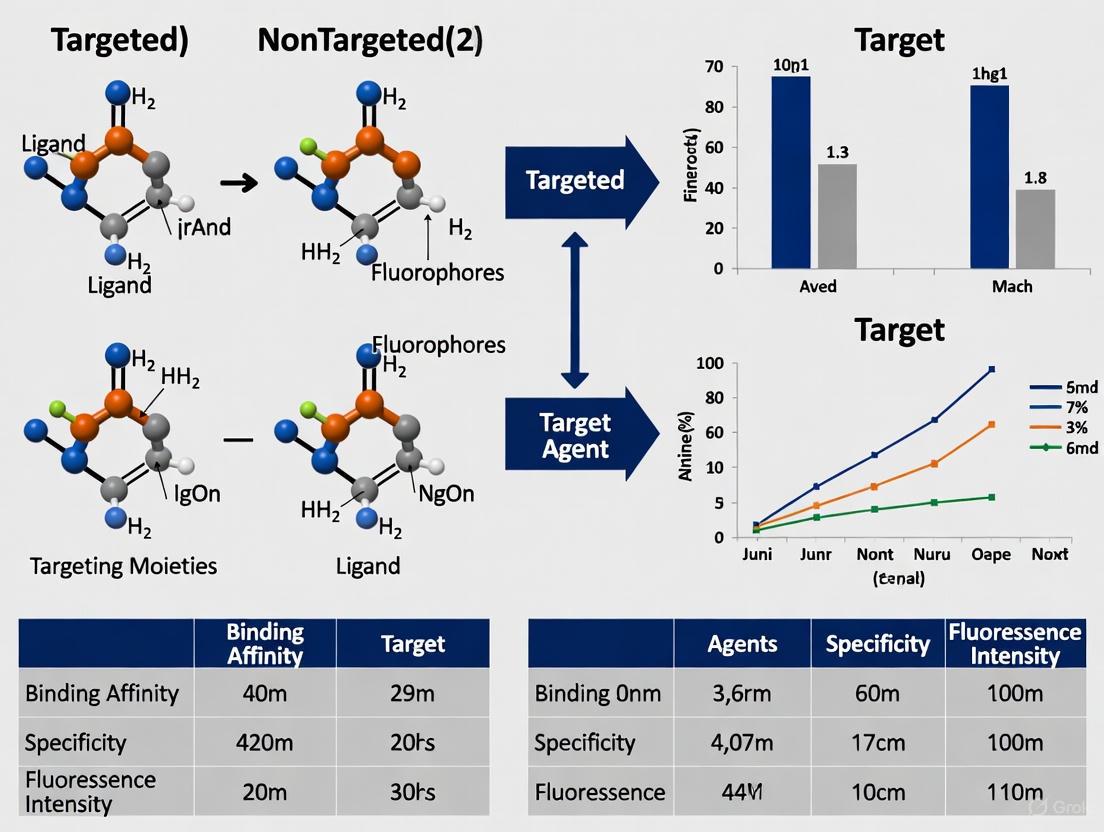
This article provides a comprehensive comparative analysis of targeted and non-targeted fluorescent agents, addressing key considerations for researchers, scientists, and drug development professionals.
Targeted vs. Non-Targeted Fluorescent Agents: A Comparative Analysis of Performance, Applications, and Future Directions in Biomedical Research
Abstract
This article provides a comprehensive comparative analysis of targeted and non-targeted fluorescent agents, addressing key considerations for researchers, scientists, and drug development professionals. It explores the foundational principles, molecular designs, and mechanisms of action underlying both agent classes. The review details methodological advances and diverse applications across bioimaging, disease diagnosis, and image-guided surgery, highlighting specific use cases from recent literature. Critical challenges such as photostability, targeting accuracy, signal-to-noise ratio, and biocompatibility are examined alongside current optimization strategies. The article concludes with a rigorous validation and performance comparison, evaluating specificity, sensitivity, and clinical translation potential to guide probe selection and future development in biomedical research.
Fundamental Principles and Molecular Design of Fluorescent Agents
Fluorescent imaging agents are injectable substances that enhance the visualization of biological processes, structures, or diseases when excited by light. These agents are fundamentally categorized into two classes: targeted and non-targeted. Their development and application are central to advances in biomedical research, diagnostics, and therapeutic monitoring, particularly in oncology [1] [2]. Targeted agents are engineered to bind specifically to molecular biomarkers, such as cell-surface receptors or enzymes, that are overexpressed in diseased tissues. This specificity aims to provide high-contrast images based on the molecular profile of the tissue. In contrast, non-targeted agents accumulate in tissues through passive physiological mechanisms, such as enhanced permeability and retention (EPR) in tumors or through general pharmacokinetic properties like vascular flow and hepatic clearance [3] [4]. The choice between these agents dictates the type of biological information obtained, influencing diagnostic accuracy and the potential for image-guided interventions.
Defining the Core Concepts
Non-Targeted Fluorescent Agents
Non-targeted fluorescent agents are dyes that do not selectively bind to a specific molecular target. Their distribution within the body is governed by their intrinsic chemical properties and the general physiology of the tissue. A classic and widely used example is Indocyanine Green (ICG), an FDA-approved fluorophore that emits in the near-infrared (NIR) range [1] [5] [4]. After intravenous injection, ICG binds non-covalently to plasma proteins, confining it primarily to the bloodstream. This makes it an excellent tool for visualizing vascular flow, tissue perfusion, and identifying anatomical structures. In oncology, ICG can accumulate in tumors via the EPR effect, a passive phenomenon where macromolecules and particles preferentially extravasate and are retained in tumor tissue due to its leaky vasculature and impaired lymphatic drainage [4]. Another example is Methylene Blue (MB), which is also used in various clinical procedures [5]. The primary mechanism of non-targeted agents is passive accumulation, relying on physiological differences between normal and diseased tissues rather than molecular recognition.
Targeted Fluorescent Agents
Targeted fluorescent agents are molecularly engineered constructs designed to home in on specific biological targets. They are typically composed of two key elements: a targeting ligand and a fluorophore [3] [6]. The targeting ligand—which can be a peptide, antibody, or small molecule—confers specificity by binding with high affinity to a defined biomarker, such as a cell-surface receptor overexpressed on cancer cells. The attached fluorophore (e.g., IRDye800CW, Cy5.5) provides the detectable signal [1] [2]. A prominent example is Cytalux, an FDA-approved agent that consists of a folate analog conjugated to a fluorescent dye. It targets the folate receptor, which is highly expressed in ovarian and lung cancers, enabling tumor-specific imaging [6]. Other experimental agents include peptides like cRGD that target integrin αvβ3, and HN-1 peptide conjugates that target Discoidin Domain Receptor-1 (DDR-1) on various cancer cells [3] [6]. The mechanism of action is active targeting, which depends on the molecular interaction between the ligand and its receptor, often followed by internalization of the probe into the target cell [4].
Comparative Performance Analysis
The practical differences between targeted and non-targeted agents are best understood through a side-by-side comparison of their key performance metrics in experimental and clinical settings. The table below summarizes these critical distinctions.
Table 1: Comparative Performance of Targeted vs. Non-Targeted Fluorescent Agents
| Performance Characteristic | Targeted Agents | Non-Targeted Agents |
|---|---|---|
| Primary Mechanism | Active binding to specific molecular targets (e.g., receptors, enzymes) [3] [6] | Passive accumulation based on physiology (e.g., EPR effect, vascular flow) [5] [4] |
| Molecular Specificity | High (e.g., Cytalux for folate receptor, cRGD for integrin αvβ3) [3] [6] | Low (e.g., ICG accumulation in leaky tumor vasculature) [4] |
| Signal-to-Background Ratio (SBR) | Potentially high, but requires time for unbound agent clearance [4] | Variable; can be high initially but diminishes rapidly as agent clears from blood [5] |
| Optimal Imaging Time | Hours to days post-injection (allows for target binding and background clearance) [4] | Minutes to hours post-injection (capitalizes on pharmacokinetic distribution) [5] |
| Tumor Delineation | Excellent, defines molecular margins [2] | Good for perfusion, but margins can be diffuse [5] |
| Information Gained | Molecular and functional data (e.g., receptor expression levels) [3] [4] | Anatomical and physiological data (e.g., perfusion, tissue viability) [5] |
| Common Clinical Examples | Cytalux, antibody-IRDye800CW conjugates (in trials) [2] [6] | Indocyanine Green (ICG), Methylene Blue [1] [5] |
Quantitative data from preclinical studies further illuminates these performance differences. For instance, a study on the cRGD-ZW800-1 probe (targeting integrin αvβ3) demonstrated specific and prolonged accumulation in tumors with a high signal-to-background ratio [2]. In a head-to-head comparison, a novel DDR-1 targeted probe (Cy756-CHN-1) showed superior tumor affinity and fluorescence intensity in CAL27, SCC9, and 4T1 cell lines compared to non-targeted dyes [6]. Conversely, while ICG provides a strong signal in liver tumors, its specificity is derived from impaired biliary excretion in hepatocellular tissue rather than molecular targeting, which can lead to non-target background signal [5] [4]. The dissociation constant (Kd) of targeted probes is a key metric of affinity; for example, the KSP*-Cy5.5 probe targeting HER2 exhibits a high affinity with a Kd of 21 nM [3].
Table 2: Experimental Data from Preclinical Studies of Selected Agents
| Agent Name | Target / Mechanism | Key Experimental Findings | Reference |
|---|---|---|---|
| Cy756-CHN-1 | DDR-1 (Peptide-targeted) | Superior fluorescence intensity and tumor affinity in CAL27, SCC9, and 4T1 cell lines in vitro and in mouse models. | [6] |
| KSP*-Cy5.5 | HER2 (Peptide-targeted) | High binding affinity with a dissociation constant (Kd) of 21 nM; effective for early-stage tumor detection. | [3] |
| ICG | Passive EPR / Vascular Flow | Effective for tumor detection and lymphatic mapping, but specificity is limited by non-target accumulation. | [5] [4] |
| cRGD-based probes | Integrin αvβ3 (Peptide-targeted) | Demonstrated long-lasting imaging signals in tumors, with persistence for over 24 hours. | [3] |
| MMP-responsive probe | MMP2/9 Enzymes (Activatable) | Selective activation in high MMP2/9 expression environments; enables combined imaging and photodynamic therapy. | [3] |
Detailed Experimental Protocols
To illustrate how the performance data for these agents is generated, below are detailed protocols for key experiments evaluating a targeted peptide-based probe and a non-targeted agent.
Protocol 1: Evaluating a Targeted Peptide-Based Probe In Vitro and In Vivo
This protocol, based on the development of DDR-1 targeted agents, outlines the process from synthesis to validation [6].
Objective: To synthesize, characterize, and validate the targeting efficacy and specificity of a novel peptide-fluorophore conjugate (e.g., Cy756-CHN-1).
Materials:
- Peptide Synthesis: Rink Amide MBHA resin, Fmoc-protected amino acids, coupling reagents (HBTU, HOBt), cleavage cocktail (TFA/TIS/water).
- Conjugation: IR-783 derivative (e.g., Cy756-COOH), dimethylformamide (DMF), triethylamine, purification columns (HPLC).
- Cell Culture: Target-positive cell lines (e.g., CAL27, SCC9), target-negative control cell lines, standard culture media and supplements.
- Imaging & Analysis: NIR fluorescence imaging system, confocal microscope, flow cytometer, software for signal quantification (e.g., ImageJ).
Methodology:
- Solid-Phase Peptide Synthesis (SPPS): Manually synthesize the HN-1 or CHN-1 peptide on Rink Amide MBHA resin using standard Fmoc chemistry. Couple amino acids sequentially using HBTU/HOBt activation. Cleave and deprotect the peptide from the resin using a TFA-based cocktail, then precipitate and purify via preparative HPLC.
- Fluorophore Conjugation: Conjugate the purified peptide to the NIR dye (e.g., Cy756-COOH) in DMF with triethylamine as a base. Purify the final conjugate (Cy756-CHN-1) using HPLC and confirm its structure with techniques like 1H NMR and HRMS.
- In Vitro Binding and Specificity:
- Culture target-positive (CAL27) and target-negative cells.
- Incubate cells with the Cy756-CHN-1 probe (e.g., 1 µM) for a set time (e.g., 2 hours) at 37°C.
- For competitive binding assays, pre-treat cells with an excess of unlabeled HN-1 peptide for 1 hour before adding the fluorescent probe.
- Analyze cells using flow cytometry and confocal microscopy to quantify uptake and visualize localization.
- In Vivo Tumor Imaging:
- Establish tumor xenograft models by subcutaneously injecting target-positive cells into mice.
- Once tumors reach a predetermined volume (e.g., 100-150 mm³), intravenously inject the Cy756-CHN-1 probe.
- Acquire non-invasive NIR fluorescence images at multiple time points post-injection (e.g., 0, 2, 6, 12, 24, 48 hours).
- Quantify the fluorescence signal intensity in the tumor region and adjacent normal tissue to calculate the tumor-to-background ratio (TBR).
- Ex Vivo Validation: After the final imaging time point, euthanize the animals, resect the tumors and major organs, and image them ex vivo to confirm probe distribution and accumulation.
Protocol 2: Assessing a Non-Targeted Agent for Perfusion and Tumor Delineation
This protocol details the use of ICG for evaluating tissue perfusion and tumor mapping, a common clinical and research application [5].
Objective: To utilize ICG fluorescence for real-time assessment of tissue perfusion and to visualize tumors via passive accumulation.
Materials:
- Contrast Agent: Indocyanine Green (ICG) powder, sterile water for reconstitution.
- Imaging System: Clinical or preclinical NIR fluorescence imaging system (e.g., FLARE, Pinpoint, PDE-neo).
- Animal Model or Patient: Tumor-bearing animal model or human patient undergoing surgery.
Methodology:
- Agent Preparation: Reconstitute ICG powder according to manufacturer instructions to achieve a standard concentration (e.g., 2.5 mg/mL).
- Dynamic Perfusion Assessment:
- Administer a bolus intravenous injection of ICG (dose varies by model/system, e.g., 0.1-0.3 mg/kg).
- Immediately initiate real-time video-rate fluorescence imaging of the region of interest (e.g., an anastomosis in bowel, a skin flap, or a tumor).
- Observe and record the arrival and wash-in of the fluorescent signal. The time from injection to tissue fluorescence provides a qualitative measure of perfusion.
- Tumor Delineation Imaging:
- Administer ICG intravenously (a similar or slightly higher dose than for perfusion).
- Allow a circulation time (e.g., 15-60 minutes) for the agent to passively extravasate and accumulate in the tumor via the EPR effect.
- Acquire fluorescence images of the surgical field. The tumor may appear as a uniformly fluorescent mass or, in the case of liver metastases, as a "negative" or "ring-shaped" fluorescent pattern due to disrupted biliary clearance.
- Data Analysis:
- Qualitative: Surgically resect the fluorescent tissue for histopathological confirmation.
- Semi-Quantitative: Calculate the Signal-to-Background Ratio (SBR) by dividing the mean fluorescence intensity of the target tissue (tumor) by the mean fluorescence intensity of adjacent normal tissue. This provides a pseudo-quantitative metric for comparison.
Signaling Pathways and Experimental Workflows
The functional difference between targeted and non-targeted agents stems from their engagement with biological pathways. The following diagrams, generated using DOT language, illustrate these core mechanisms and a typical experimental workflow.
Core Mechanism of Targeted Fluorescent Agents
This diagram illustrates the pathway by which a targeted agent, such as a peptide-dye conjugate, specifically binds to a cell-surface receptor to generate a signal.
Core Mechanism of Non-Targeted Fluorescent Agents
This diagram shows the pathway of a non-targeted agent, like ICG, which relies on passive physiological processes for tissue accumulation.
Generic Workflow for Agent Evaluation
This flowchart outlines a standard experimental process for validating the performance of a new fluorescent agent, both targeted and non-targeted.
The Scientist's Toolkit: Essential Research Reagents
Successful research and development in fluorescent imaging require a suite of essential reagents, materials, and instrumentation. The following table details key components of the research toolkit.
Table 3: Essential Research Reagents and Materials for Fluorescent Imaging Studies
| Tool Category | Specific Examples | Function & Application |
|---|---|---|
| Fluorophores | ICG, IRDye800CW, Cy5.5, Cy7, Alexa Fluor dyes [1] [7] | The light-emitting component of the imaging agent. Chosen based on excitation/emission wavelengths, quantum yield, and photostability. |
| Targeting Moieties | cRGD peptide (for integrins), HN-1 peptide (for DDR-1), folate, antibodies (e.g., Panitumumab) [3] [6] | Provides molecular specificity by binding to biomarkers on target cells. |
| Cell Lines | CAL27 (oral squamous cell carcinoma), SCC9 (squamous cell carcinoma), 4T1 (breast cancer), U87MG (glioma) [3] [6] | Validated in vitro models that express (or lack) the target of interest for binding and specificity assays. |
| Animal Models | Mouse xenograft models (e.g., from CAL27, 4T1 cells) [6] | In vivo models for evaluating agent pharmacokinetics, biodistribution, and imaging efficacy. |
| Synthesis & Purification | Rink Amide MBHA resin, Fmoc-amino acids, HBTU/HOBt, HPLC systems [6] [8] | Materials and equipment for solid-phase peptide synthesis and purification of final conjugates. |
| Imaging Instrumentation | NIR fluorescence imaging systems (e.g., IVIS, FLARE), Confocal Microscopes, Flow Cytometers [2] [5] | Devices to detect, quantify, and visualize fluorescence signals from in vitro and in vivo experiments. |
| Analysis Software | ImageJ, MATLAB, proprietary instrument software [7] | Tools for quantifying fluorescence intensity, calculating TBR, and processing image data. |
Fluorescent probes have revolutionized biomedical research and diagnostic imaging by enabling the visualization of molecular and cellular processes in real-time. The architectural design of these probes—encompassing the fluorophore, targeting moiety, and linker—directly dictates their performance, specificity, and applicability in complex biological systems. This guide provides a comparative analysis of fluorescent probe components, framing the evaluation within the critical research context of targeted versus non-targeted imaging strategies. Targeted agents use affinity ligands like antibodies or peptides to bind specific molecular signatures, offering high specificity, while non-targeted agents rely on passive accumulation or environmental activation, often providing broader applicability. Understanding this dichotomy is essential for researchers and drug development professionals to select optimal probes for their specific experimental or clinical goals, from basic cell biology to image-guided surgery [9] [10].
Core Components of Fluorescent Probes
The molecular architecture of a fluorescent probe is a modular system where each component fulfills a distinct and critical function. The synergistic relationship between these parts determines the probe's overall efficacy.
- Fluorophore: This is the light-emitting component responsible for signal generation. Its core properties—including excitation/emission wavelengths, brightness (quantum yield), and photostability—are paramount. Ideal fluorophores for in vivo imaging, particularly in the near-infrared (NIR) window (650-900 nm), offer deep tissue penetration and minimal background autofluorescence [10].
- Targeting Moiety: This component confers specificity, directing the probe to a desired biological target such as a cell-surface receptor, enzyme, or nucleic acid. Common targeting ligands include antibodies, peptides (e.g., HN-1), small molecules (e.g., folate), or inhibitor scaffolds (e.g., FAP quinolone-based inhibitors) [11] [6].
- Linker/Spacer: This segment connects the fluorophore to the targeting ligand. It is not merely a tether; its chemical nature, length, and stability profoundly influence the probe's pharmacokinetics, binding affinity, and susceptibility to enzymatic cleavage. A well-designed linker ensures the targeting function is not sterically hindered by the fluorophore [9].
The following diagram illustrates the signaling pathways and logical relationships in the design and application of these probes, particularly contrasting targeted and non-targeted strategies.
Comparative Performance of Probe Architectures
The fundamental choice between a targeted and a non-targeted strategy has a profound impact on imaging outcomes. The table below summarizes the core characteristics, mechanisms, and performance metrics of these two approaches, providing a high-level objective comparison.
Table 1: General Performance Comparison of Targeted vs. Non-Targeted Fluorescent Agents
| Feature | Targeted Fluorescent Agents | Non-Targeted Fluorescent Agents |
|---|---|---|
| Mechanism of Action | Active binding to specific molecular targets (e.g., receptors, enzymes) | Passive accumulation via EPR effect or environmental activation (e.g., pH) |
| Primary Applications | Specific tumor phenotyping, receptor occupancy studies, pathway activation imaging | Broad tumor delineation, tissue perfusion assessment, first-line contrast |
| Key Strength | High specificity and molecular contrast | Wider applicability across tumor types; simpler development |
| Key Limitation | Target expression heterogeneity can limit application; larger size may reduce tissue penetration | Lower specificity can lead to false positives; background signal can be higher |
| Representative Probes | Antibody-dye conjugates (e.g., Panitumumab-IRDye800CW), peptide-dye conjugates (e.g., HN-1-Cy756) [6] | Indocyanine Green (ICG), Fluorescein [7] [10] |
Quantitative Comparison of Specific Probe Technologies
Beyond the conceptual overview, direct quantitative comparison of experimental data is crucial for probe selection. The following table consolidates performance metrics from recent studies on specific targeted and non-targeted agents.
Table 2: Experimental Performance Data of Specific Fluorescent Probes
| Probe Name | Target / Mechanism | Key Experimental Findings | Reported Metrics |
|---|---|---|---|
| Cy756-CHN-1 [6] | DDR-1 (via HN-1 peptide) | Superior tumor affinity and fluorescence intensity in CAL27, SCC9, and 4T1 cell lines and mouse models. | High fluorescence intensity; Specific tumor accumulation demonstrated via competitive binding assays. |
| FTF Probes [11] | FAP (Fibroblast Activation Protein) | Effectively labeled cancer-associated fibroblast (CAF) populations in solid tumors after both topical and intravenous delivery. | Validated labeling of CAF populations in vivo. |
| ICG (Indocyanine Green) [7] [10] | Passive Accumulation (EPR effect) | Widely used for intraoperative imaging; lacks tumor specificity, leading to non-target accumulation and potential false positives. | Non-specific contrast; Performance highly dependent on ROI selection [12]. |
| mTFP1/EYFP FRET Pair [13] | FRET Efficiency (For protein interaction studies) | Demonstrated a high fraction of donor engaged in FRET (f~D~ = 0.7), making it a superior couple for quantitative FRET-FLIM experiments in live cells. | f~D~ = 0.7; Minimal f~D~ (for fast acquisitions) = 0.65. |
| mCherry/EGFP FRET Pair [13] | FRET Efficiency (For protein interaction studies) | Exhibited a relatively low fraction of donor engaged in FRET compared to mTFP1/EYFP. | f~D~ = ~0.35 (Minimal f~D~ for fast acquisitions). |
Detailed Experimental Protocols
To ensure reproducibility and provide a clear framework for validation, this section outlines detailed methodologies for key experiments cited in the performance comparison.
Protocol: Evaluating Tumor Targeting and Specificity of Peptide-Dye Conjugates
This protocol is adapted from studies evaluating DDR-1-targeted agents like Cy756-CHN-1 [6].
- Aim: To synthesize and validate the tumor-targeting efficacy and specificity of a peptide-dye conjugate in vitro and in vivo.
- Synthesis:
- Peptide Synthesis: Manually synthesize the targeting peptide (e.g., HN-1 or CHN-1) using standard Fmoc solid-phase peptide synthesis (Fmoc-SPPS) on Rink Amide MBHA resin.
- Dye Conjugation: Employ a one-step Suzuki coupling reaction to conjugate a phenyl-modified cyanine dye (e.g., derivative of IR-783) to the synthesized peptide, creating the final probe (e.g., Cy756-CHN-1).
- Purification & Characterization: Purify the conjugate via high-performance liquid chromatography (HPLC) and characterize it using techniques such as 1H NMR and high-resolution mass spectrometry (HRMS).
- In Vitro Validation:
- Cell Culture: Use relevant cancer cell lines (e.g., CAL27, SCC9 for oral cancer, 4T1 for breast cancer).
- Cellular Uptake & Imaging: Incubate cells with the probe (e.g., 1 µM for 2 hours). After washing, image using a confocal microscope with appropriate NIR laser lines and filters.
- Specificity Assays:
- Competitive Inhibition: Pre-treat cells with an excess of unlabeled targeting peptide before adding the fluorescent probe. A significant reduction in fluorescence signal confirms target-specific binding.
- Molecular Modeling & SPR: Validate the binding interaction between the peptide and its target (e.g., DDR-1) using molecular docking simulations and surface plasmon resonance (SPR) to determine binding kinetics (K~D~).
- In Vivo Validation:
- Animal Model: Establish subcutaneous or orthotopic tumor models in mice (e.g., using CAL27 or 4T1 cells).
- Imaging: Intravenously inject the probe (e.g., 2 nmol per mouse) and acquire whole-body fluorescence images at multiple time points (e.g., 1, 4, 24, 48 hours) post-injection using a NIR fluorescence imaging system.
- Analysis: Quantify the tumor-to-background ratio (TBR) by measuring mean fluorescence intensity in the tumor region versus a contralateral or adjacent background tissue region. Ex vivo imaging of harvested organs can further confirm biodistribution and tumor specificity.
Protocol: Assessing Performance Metrics in Preclinical Tumor Models
This generalizable protocol highlights critical methodological considerations, particularly the impact of Region of Interest (ROI) selection, as demonstrated in [12].
- Aim: To systematically evaluate the performance metrics (TBR, CNR, AUC) of a fluorescent contrast agent in a pre-clinical brain tumor model, accounting for the effect of ROI selection.
- Animal Model & Imaging:
- Tumor Induction: Establish orthotopic brain tumor models in mice.
- Agent Administration: Inject a non-targeted fluorescent contrast agent (e.g., ICG or a similar dye) intravenously 40 minutes prior to sacrifice.
- Tissue Processing & Imaging: Harvest the brain and image the specimen using high-resolution 3D fluorescence cryotomography.
- Data Analysis & ROI Selection:
- Volume Reconstruction: Reconstruct 3D fluorescence volumes from the cryotomography data.
- Systematic ROI Definition: Define tumor and normal brain ROIs in multiple ways:
- Tumor ROI: The entire tumor volume.
- Background ROIs:
- Contralateral Background: A region in the opposite hemisphere of the brain.
- Adjacent Background: A region immediately adjacent to the tumor boundary.
- Proximal Background: A region closer to the tumor margin.
- Metric Calculation: For each combination of tumor and background ROI, calculate:
- Tumor-to-Background Ratio (TBR): Mean Fluorescence Intensity (Tumor) / Mean Fluorescence Intensity (Background).
- Contrast-to-Noise Ratio (CNR): (Mean Fluorescence Intensity (Tumor) - Mean Fluorescence Intensity (Background)) / Standard Deviation (Background).
- Area Under the Curve (AUC): Calculate from receiver operating characteristic (ROC) curves to assess diagnostic performance.
- Key Consideration: The study [12] found that ROI selection drastically affects reported metrics. TBR and CNR can change by a factor of 5-7, and AUC by over 10%, depending on background ROI proximity to the tumor. Future studies must clearly define and justify ROI selection.
The Scientist's Toolkit: Essential Research Reagents and Materials
Successful development and application of fluorescent probes require a suite of specialized reagents and instruments. The following table details key solutions for researchers in this field.
Table 3: Essential Research Reagent Solutions for Fluorescent Probe Development
| Reagent / Material | Function / Application | Key Characteristics & Examples |
|---|---|---|
| Small-Molecule Fluorophores [9] [10] | Core signaling component of the probe. | Cyanine dyes (Cy5, Cy7, IRDye800CW): NIR emission, modifiable. BODIPY: High quantum yield, photostable. Rhodamine: Stable in acidic environments like lysosomes. |
| Fluorescent Proteins (FPs) [9] [13] | Genetically encoded tags for live-cell protein labeling and interaction studies (FRET). | EGFP: Well-established, but can be bulky. mTFP1: Superior donor for FRET-FLIM due to single-exponential decay. mNeonGreen, mRuby3: Newer FPs with improved brightness and stability. |
| Targeting Ligands | Provide molecular specificity to the probe. | Antibodies (e.g., Trastuzumab): High specificity, but large size. Peptides (e.g., HN-1): Small size, good tissue penetration. Small Molecules (e.g., Folate): Target receptors with high affinity. |
| Self-Labeling Tags & Enzymatic Labeling Systems [9] | Enable site-specific labeling of proteins with synthetic fluorophores in live cells. | HaloTag: Covalently binds to chloroalkane-linked fluorophores. SNAP-tag: Covalently binds to benzylguanine-linked fluorophores. Enzymatic (e.g., Lipoyl Ligase): Uses a short peptide tag for rapid, specific labeling. |
| Near-Infrared (NIR) Imaging Systems [7] [10] | Detection and quantification of fluorescence signals in vivo. | Fluorescence Cryotomography: High-resolution 3D ex vivo imaging. Whole-Body Small Animal Imagers: For longitudinal in vivo studies. Intraoperative Imaging Systems: For fluorescence-guided surgery applications. |
The architectural design of fluorescent probes is a critical determinant of their performance, dictating specificity, signal strength, and applicability. The comparative data and methodologies presented in this guide underscore a clear trade-off: targeted agents, such as peptide-dye conjugates against DDR-1 or FAP, provide exceptional molecular specificity and high contrast, making them indispensable for probing specific biological pathways. In contrast, non-targeted agents offer a broader, if less specific, utility for initial tumor delineation. The choice between these strategies must be guided by the experimental question, whether it demands molecular-level insight or tissue-level visualization. Furthermore, rigorous and standardized experimental protocols—especially in data analysis steps like ROI selection—are paramount for generating reliable, comparable, and translatable data. As the field advances, the integration of brighter, more photostable NIR fluorophores with highly specific targeting moieties will continue to push the boundaries of sensitivity and resolution in molecular imaging.
Fluorescence sensing mechanisms are fundamental to advancements in biomedical research, environmental monitoring, and drug development. These mechanisms transform molecular recognition events into measurable optical signals, enabling the detection and imaging of biological and chemical analytes with high sensitivity and specificity. Among the most prominent mechanisms are Förster Resonance Energy Transfer (FRET), Photoinduced Electron Transfer (PET), Intramolecular Charge Transfer (ICT), and Aggregation-Induced Emission (AIE). Each operates on distinct photophysical principles, offering unique advantages and limitations for specific applications. This guide provides a comparative analysis of these four key mechanisms, equipping researchers and drug development professionals with the knowledge to select optimal sensing strategies for their specific needs, particularly within the evolving field of targeted versus nontargeted fluorescent agents.
The table below summarizes the core principles, typical signal response, and key performance characteristics of the four fluorescence sensing mechanisms.
Table 1: Comparative Overview of Key Fluorescence Sensing Mechanisms
| Mechanism | Core Principle | Typical Signal Response | Sensitivity | Selectivity Source | Key Advantages | Common Limitations |
|---|---|---|---|---|---|---|
| FRET | Distance-dependent energy transfer between donor and acceptor fluorophores [14] | Ratiometric (emission shift) [15] | High (nanomolar range) [16] | Spectral overlap and molecular proximity (<10 nm) [14] | Built-in calibration, suitable for biomolecular interaction studies [14] [15] | Requires specific spectral overlap; complex probe design [14] |
| PET | Electron transfer between fluorophore and receptor quenches fluorescence [14] | Turn-On (fluorescence enhancement) [15] | Very High (picomolar to nanomolar) [16] | Receptor-analyze binding interaction [14] | High signal-to-noise ratio, strong background suppression [15] [17] | Single-intensity output, can be susceptible to interference [15] |
| ICT | Redistribution of electron density within a D-π-A system upon excitation [14] [17] | Ratiometric or shift in emission wavelength [16] [17] | High [16] | Analyte-induced change in electron donor/acceptor strength [14] | Large Stokes shift, solvatochromism [17] | Can be sensitive to environmental factors (e.g., pH, polarity) [17] |
| AIE | Restriction of intramolecular motion enables emission in aggregate state [16] [18] | Turn-On (fluorescence enhancement in aggregates) [16] | High [16] | Specific aggregation triggered by analyte [16] | Excellent photostability, outperforms probes with Aggregation-Caused Quenching (ACQ) [18] | Requires specific molecular design to control aggregation [16] |
Detailed Mechanism Analysis and Experimental Protocols
Förster Resonance Energy Transfer (FRET)
FRET is a non-radiative process where an excited donor fluorophore transfers energy to a proximal acceptor fluorophore through dipole-dipole interactions [14].
Key Experimental Protocol: A typical FRET experiment involves co-administering a targeted agent bound to a donor fluorophore and a control (non-targeted) agent bound to an acceptor fluorophore [19]. The binding potential (BP), proportional to target concentration, is quantified using formulas like:
BP = \frac{[Targeted Agent]_{bound}}{[Control Agent]_{bound}}
Accurate quantification requires correction for differences in plasma input functions (PIFs) of the co-administered agents, which can be achieved via techniques like dual-channel pulse-dye densitometry [19].
- Visualization of FRET Mechanism:
Photoinduced Electron Transfer (PET)
PET functions through electron transfer from a receptor unit to the excited fluorophore (or vice versa), leading to fluorescence quenching. Upon analyte binding, this electron transfer is suppressed, restoring fluorescence ("turn-on") [14] [17].
- Key Experimental Protocol: PET-based probe performance is highly dependent on the energy levels of the molecular orbitals. A key design principle is to tune the HOMO energy level of the fluorophore to inhibit unwanted proton interference, thereby improving selectivity [15]. Probe response is characterized by measuring the fluorescence enhancement ratio (F/F₀) after exposure to the target analyte, with higher ratios indicating better sensitivity and turn-on response.
- Visualization of PET Mechanism:
Intramolecular Charge Transfer (ICT)
ICT occurs in a donor-π-acceptor (D-π-A) structured molecule. Upon photoexcitation, electron density is redistributed from the donor to the acceptor group, often resulting in a large Stokes shift and solvatochromism [14] [17].
- Key Experimental Protocol: ICT probe design involves synthesizing a molecule with a strong electron-donating group (e.g., carbazole) linked to a strong electron-withdrawing group. The probe's sensitivity is evaluated by monitoring the spectral shift (often a ratiometric change) in emission upon analyte binding, which alters the push-pull efficiency. A variation, Twisted Intramolecular Charge Transfer (TICT), relies on restriction of molecular rotation for fluorescence turn-on, providing very low background emission [17].
- Visualization of ICT Mechanism:
Aggregation-Induced Emission (AIE)
AIE is a unique phenomenon where fluorogens (AIEgens) are non-emissive in solution but emit strongly in the aggregated or solid state due to the restriction of intramolecular motions (RIM) [16] [18].
- Key Experimental Protocol: A common application is designing an AIEgen that is initially quenched via another mechanism (e.g., FRET). Upon encountering the target analyte (e.g., hypoxia), a specific chemical change (e.g., bond cleavage) disrupts the quenching mechanism and induces aggregation, leading to a strong fluorescence turn-on. The performance is validated by comparing fluorescence intensity in solution versus in aggregates, and in vivo performance is assessed by monitoring tumor accumulation and activation post-intravenous injection [18].
- Visualization of AIE Mechanism:
The Scientist's Toolkit: Essential Research Reagents and Materials
The table below lists key reagents and materials essential for developing and working with these fluorescence sensing mechanisms.
Table 2: Essential Research Reagents and Materials for Fluorescence Sensing
| Category | Specific Item / Class | Key Function in Research | Relevant Mechanism(s) |
|---|---|---|---|
| Organic Fluorophores | 1,8-Naphthalimide, Rhodamine, BODIPY, Cyanines (e.g., Cy3, Cy5) [7] [15] | Acts as the signal unit (donor/acceptor) in probe design. | FRET, PET, ICT |
| AIE Luminogens (AIEgens) | Tetraphenylethene (TPE) derivatives [18] | Core unit that becomes emissive upon aggregation, overcoming ACQ. | AIE |
| Recognition Moieties | Boronate ester [15], Azobenzene (Azo) [18] | Provides selectivity by specifically reacting with or binding to the target analyte (e.g., HClO, hypoxic environment). | PET, FRET, AIE |
| Nanomaterial Scaffolds | Quantum Dots (QDs), Carbon Dots (CDs), Metal-Organic Frameworks (MOFs) [16] [14] | Enhances delivery, stability, and signal properties of fluorescent probes. Can act as a donor/acceptor. | FRET, PET, AIE |
| Surface Modifiers | DSPE-PEG₂₀₀₀ [18] | Improves biocompatibility, solubility, and circulation time of nano-probes in biological applications. | All (especially in vivo) |
| Targeting Ligands | Antibodies (e.g., Trastuzumab), Affibodies (e.g., ABY-029) [7] [19] | Enables active targeting of specific biomarkers (e.g., HER2 receptors on tumors) for molecular imaging. | All (for targeted agents) |
FRET, PET, ICT, and AIE represent four powerful and distinct sensing mechanisms. The choice of mechanism depends heavily on the specific application requirements, such as the need for rationetric quantification (FRET, ICT), ultra-sensitive turn-on detection (PET, AIE), or operation in aggregate-prone environments (AIE). A emerging and powerful trend is the strategic combination of these mechanisms, such as ICT-FRET [15] or FRET-based off-on AIE systems [18], to engineer probes with superior performance, including lower background, higher specificity, and built-in self-calibration. This synergy, coupled with advancements in nanomaterials and targeting ligands, is pushing the boundaries of sensitivity and specificity in fluorescence sensing, paving the way for more precise research tools and diagnostic agents in drug development.
Biomarker Identification and Validation Strategies
Fluorescence molecular imaging has emerged as a powerful technique in biomedical research and clinical oncology, enabling the visualization of molecular and cellular processes in real-time [7]. This field relies on fluorescent agents that accumulate in target tissues, primarily through two distinct mechanisms: non-targeted agents that exploit passive physiological accumulation, and targeted agents that actively bind to specific molecular biomarkers [20]. The comparative performance of these agent classes directly impacts their effectiveness in biomarker identification and validation, influencing factors such as specificity, signal-to-background ratio, and diagnostic accuracy [1] [21]. As the field of surgical optomics advances—integrating optical imaging with computational analytics—the precision of biomarker validation has significantly improved, turning the operating room into a data-rich environment for surgical decision-making [5]. Understanding the strategic applications and limitations of both targeted and non-targeted approaches provides researchers with a framework for selecting appropriate validation methodologies based on specific research objectives and clinical contexts.
Comparative Performance Analysis of Fluorescent Agents
Table 1: Key Characteristics of Non-Targeted versus Targeted Fluorescent Agents
| Parameter | Non-Targeted Agents | Targeted Agents |
|---|---|---|
| Mechanism of Accumulation | Enhanced Permeability and Retention (EPR) effect [20] | Specific binding to molecular targets (e.g., receptors, enzymes) [6] [20] |
| Primary Biomarker Basis | Physiological abnormalities (leaky vasculature, poor lymphatic drainage) [21] | Molecular overexpression (e.g., folate receptor, DDR-1, FAP) [6] [11] |
| Typical Tumor-to-Background Ratio | Variable, often lower (qualitative assessment) [5] | Generally higher (e.g., TBR changes by factor of 5 based on ROI selection) [22] |
| Optimal Validation Context | Perfusion assessment, anatomical guidance [5] | Specific biomarker quantification, margin delineation [22] |
| Clinical Translation Stage | Widespread use (ICG, methylene blue) [5] [23] | Limited approvals, mostly in clinical trials (OTL-38, Panitumumab-IRDye800CW) [23] [21] |
| Quantification Capability | Limited by variable pharmacokinetics [5] | More amenable to standardization [22] |
Table 2: Performance Metrics of Selected Fluorescent Agents in Clinical and Preclinical Studies
| Agent | Type | Molecular Target | Key Performance Metrics | Study Context |
|---|---|---|---|---|
| ICG [5] [23] | Non-targeted | Passive EPR accumulation | Reduced anastomotic leak by 4.2% (RR 0.645); NNT 22-23 in colorectal surgery [23] | Clinical (Phase III trials) |
| Cy756-CHN-1 [6] | Targeted (peptide-based) | DDR-1 receptor | Superior fluorescence intensity and tumor affinity in CAL27, SCC9, and 4T1 cell lines [6] | Preclinical (in vivo mouse models) |
| OTL-38 [21] | Targeted (small molecule) | Folate receptor | FDA-approved for ovarian cancer; improved tumor visualization [21] | Clinical (approved agent) |
| FAP-Targeted Probes [11] | Targeted (small molecule) | Fibroblast Activation Protein | Excellent performance for labeling CAF populations in solid tumors [11] | Preclinical (in vivo models) |
| TMR-PEG1k [22] | Non-targeted | Passive EPR accumulation | TBR changed by factor of 5, CNR by factor of 7 depending on background ROI selection [22] | Preclinical (orthotopic brain tumor models) |
Experimental Protocols for Biomarker Validation
In Vivo Validation of Tumor Targeting Efficiency
Purpose: To quantitatively evaluate the targeting efficiency and specificity of fluorescent agents in animal models [6] [22].
Materials Required:
- Orthotopic or subcutaneous tumor models (e.g., U87 GFP-expressing glioma cells, CAL27, SCC9, 4T1 cell lines) [6] [22]
- Fluorescent agent of interest (e.g., targeted peptide-fluorophore conjugate)
- Control agents (non-targeted fluorophores, PBS)
- Fluorescence imaging system (e.g., whole-body fluorescence cryotomography, NIRF cameras)
- Image analysis software (e.g., 3D Slicer, ImageJ) [22]
Procedure:
- Administer the fluorescent agent intravenously (e.g., 42.1 nmol for TMR-PEG1k) at a predetermined time before sacrifice (e.g., 40 minutes) [22].
- Euthanize animals and prepare specimens for imaging, maintaining consistent handling conditions across all experimental groups.
- Acquire high-resolution 3D fluorescence volumes using appropriate imaging parameters (e.g., 100μm sectioning for cryotomography) [22].
- Define tumor regions of interest (ROIs) using ground truth markers (e.g., GFP expression, co-registered H&E sections) [22].
- Establish background ROIs using standardized methods (contralateral brain, adjacent regions, whole background) to enable consistent comparison [22].
- Calculate performance metrics including Tumor-to-Background Ratio (TBR), Contrast-to-Noise Ratio (CNR), and Area Under the Receiver Operating Characteristic Curve (AUC) [22].
- Perform statistical analysis to determine significant differences between targeted and control agents.
Data Interpretation:
- TBR values > 2.0 generally indicate clinically useful contrast [23].
- ROI selection significantly impacts reported metrics; contralateral background ROIs produce more favorable values than peri-tumoral regions [22].
- Comprehensive validation requires comparison across multiple background ROI selection methods to simulate different surgical scenarios [22].
Specificity Validation Through Competitive Binding Assays
Purpose: To confirm molecular targeting specificity and receptor engagement of targeted fluorescent agents [6].
Materials Required:
- Cell lines expressing target receptor (e.g., DDR-1 expressing cancer cells)
- Fluorescently labeled targeted agent (e.g., Cy756-CHN-1)
- Unlabeled competing ligand (e.g., HN-1 peptide)
- Flow cytometer or fluorescence microscopy
- Molecular modeling software (for in silico validation) [6]
Procedure:
- Incubate cells with varying concentrations of targeted fluorescent agent (0-100 nM) for predetermined time periods.
- For competition assays, pre-treat cells with excess unlabeled ligand (10-100x concentration) before adding fluorescent agent.
- Quantify cellular fluorescence intensity using flow cytometry or quantitative fluorescence microscopy.
- Perform saturation binding experiments to determine dissociation constants (Kd) and receptor density.
- Validate binding specificity through molecular modeling and surface plasmon resonance (SPR) if applicable [6].
- Conduct colocalization studies with known receptor markers to confirm target engagement.
Data Interpretation:
- Specific binding demonstrates saturation kinetics with increasing agent concentration.
- Competitive binding shows significant reduction (>70%) in fluorescence signal with unlabeled competitor.
- Successful targeted agents typically show Kd values in nanomolar range for high-affinity binding [6].
Signaling Pathways and Experimental Workflows
Diagram 1: Biomarker Identification and Probe Validation Workflow. This diagram outlines the comprehensive pathway from initial biomarker discovery to clinical implementation of fluorescent imaging agents, highlighting key validation checkpoints.
Diagram 2: Molecular Pathways of Targeted vs. Non-Targeted Agent Mechanisms. This diagram compares the distinct biological pathways of targeted and non-targeted fluorescent agents, highlighting differences in specificity and accumulation mechanisms.
The Scientist's Toolkit: Essential Research Reagents and Materials
Table 3: Essential Research Reagents for Fluorescent Agent Validation
| Reagent/Material | Function/Purpose | Example Applications |
|---|---|---|
| Indocyanine Green (ICG) [5] [23] | Non-targeted NIR fluorophore for perfusion imaging and anatomical guidance | Clinical standard for anastomosis assessment, tumor delineation [5] |
| Tetramethylrhodamine (TMR) conjugates [22] | Fluorescent label for non-targeted agent development | Validation studies for pharmacokinetics and distribution profiling [22] |
| IRDye800CW [6] [1] | NIR fluorophore for conjugation to targeting ligands | Antibody-fluorophore conjugates (e.g., Panitumumab-IRDye800CW) [6] |
| HN-1 Peptide [6] | Targeting ligand for DDR-1 receptor | Development of tumor-specific imaging agents for multiple cancer types [6] |
| Folate Analogues [21] | Targeting moieties for folate receptor-positive tumors | Clinical agents (e.g., OTL-38/Cytalux) for ovarian and lung cancers [21] |
| Quinolone-Based FAP Inhibitors [11] | Small molecule targeting fibroblast activation protein | Imaging cancer-associated fibroblasts in tumor microenvironment [11] |
| U87 GFP-Expressing Glioma Cells [22] | Orthotopic tumor model with intrinsic fluorescent marker | Ground truth determination for fluorescence imaging validation [22] |
The strategic selection between targeted and non-targeted fluorescent agents for biomarker identification and validation depends heavily on the specific research objectives and clinical applications. Non-targeted agents like ICG provide established clinical utility for anatomical guidance and perfusion assessment, with demonstrated efficacy in reducing complications such as anastomotic leaks in colorectal surgery [5] [23]. In contrast, targeted agents offer superior molecular specificity for precise biomarker validation and tumor margin delineation, though their clinical translation remains more limited [6] [21]. The evolving field of surgical optomics continues to enhance quantitative assessment capabilities, addressing current limitations in standardization and quantification [5]. Future advancements in fluorescent probe design, particularly activatable probes and targeted agents with optimized pharmacokinetics, will further refine biomarker validation strategies and expand clinical applications across oncologic, cardiovascular, and inflammatory diseases [1] [21].
Optical Properties and Signal Generation Fundamentals
Fluorescent imaging has become an indispensable tool in biomedical research and clinical diagnostics, enabling the visualization of biological processes at the molecular level. The fundamental principles governing optical properties and signal generation form the critical foundation for comparing the performance of targeted versus non-targeted fluorescent agents. These agents function by absorbing light at specific wavelengths and re-emitting it at longer wavelengths, a process governed by their distinct photophysical properties and interaction with the biological environment [7] [24].
Targeted fluorescent probes incorporate specific targeting moieties such as antibodies, peptides, or affibodies that bind to biomarkers overexpressed on cancer cells, while non-targeted agents rely on passive accumulation through mechanisms like the enhanced permeability and retention (EPR) effect [21]. The strategic design of these agents directly influences their signal generation capabilities, pharmacokinetics, and ultimate diagnostic performance. This comparison guide examines the fundamental optical properties and signal generation mechanisms that differentiate these two classes of fluorescent agents, providing researchers with objective data to inform probe selection and development.
Fundamental Optical Properties of Fluorescent Agents
Photophysical Principles of Fluorescence
The process of fluorescence occurs through a series of photophysical events beginning with photon absorption. When a fluorophore absorbs light energy, its electrons transition from a ground state (S₀) to an excited singlet state (S₁). Following rapid vibrational relaxation, the excited electron returns to the ground state, emitting a photon with lower energy (longer wavelength) than the absorbed photon—a phenomenon known as the Stokes shift [7] [25]. This shift between excitation and emission wavelengths is crucial for effective signal detection as it enables spectral separation of the emitted signal from excitation light.
The efficiency of this process is quantified by several key parameters. The fluorescence quantum yield (Φ) represents the ratio of photons emitted to photons absorbed, with higher values indicating brighter probes. The extinction coefficient (ε) measures a probe's ability to absorb light at a specific wavelength. Together, these parameters determine the overall brightness of a fluorescent agent (brightness = ε × Φ) [25]. Additionally, the fluorescence lifetime (τ) denotes the average time a molecule remains in the excited state before returning to ground state, which can be leveraged for fluorescence lifetime imaging (FLIM) to distinguish probes from autofluorescence [25].
Table 1: Key Photophysical Properties of Major Fluorophore Classes
| Fluorophore Class | Excitation Range (nm) | Emission Range (nm) | Quantum Yield | Extinction Coefficient (M⁻¹cm⁻¹) | Primary Applications |
|---|---|---|---|---|---|
| Small Molecule Dyes (e.g., ICG, TMR) | 650-800 500-600 | 750-850 550-650 | 0.05-0.15 0.3-0.9 | ~120,000 ~80,000 | Clinical FGS, perfusion imaging Cell tracking, receptor targeting |
| Targeted Probes (e.g., OTL38, ABY-029) | 750-780 600-650 | 790-810 650-700 | 0.10-0.15 0.2-0.4 | ~100,000 ~70,000 | Tumor margin delineation EGFR-positive tumor detection |
| TADF Materials (e.g., 4CzIPN, AI-Cz) | 350-500 | 450-650 | 0.6-0.9 | ~50,000-100,000 | Time-gated imaging, FLIM, organelle tracking |
| BODIPY Dyes | 450-650 | 500-700 | >0.8 | ~80,000 | Cellular imaging, targeted cancer imaging |
Advanced Signal Generation Mechanisms
Beyond conventional fluorescence, several advanced signal generation mechanisms enhance imaging capabilities:
Thermally Activated Delayed Fluorescence (TADF): TADF materials leverage a small energy gap (ΔEₛₜ) between singlet and triplet states to facilitate reverse intersystem crossing (RISC), enabling triplet excitons to upconvert to singlet states and emit delayed fluorescence [25]. This mechanism yields exceptionally long-lived emission (microseconds to milliseconds) that permits time-gated detection, effectively suppressing short-lived background autofluorescence (typically 1-10 ns) and significantly improving signal-to-noise ratio [25].
Activatable Probes: These "smart" probes remain quenched until activated by specific tumor microenvironment biomarkers such as enzymes (e.g., γ-glutamyltranspeptidase, aminopeptidase N), pH variations, or reactive oxygen species [21] [26]. Activation mechanisms include enzyme-mediated cleavage of quenching groups, pH-dependent conformational changes, or biomarker-induced chemical transformations that restore fluorescence. This design dramatically improves target-to-background ratios compared to always-on probes [21].
Multimodal and Multifunctional Probes: Advanced probes now incorporate capabilities for simultaneous imaging and therapy. For example, probe A-H integrates methylene blue and rhodamine 6G components, enabling concurrent detection of ATP and HClO biomarkers while providing photodynamic therapy (PDT) capabilities [26]. Such designs represent the convergence of diagnostic and therapeutic functions within a single molecular platform.
Comparative Performance: Targeted vs. Non-Targeted Agents
Signal Generation and Performance Metrics
The fundamental difference between targeted and non-targeted fluorescent agents lies in their mechanism of tissue accumulation and retention. Non-targeted agents such as indocyanine green (ICG) and tetramethylrhodamine-conjugated PEG (TMR-PEG1k) primarily rely on the EPR effect for passive tumor accumulation, where leaky tumor vasculature permits extravasation and retention of circulating agents [21] [22]. In contrast, targeted agents employ molecular recognition elements—including antibodies, affibodies, or peptides—that actively bind to specific cell surface receptors overexpressed in pathological tissues [21] [27].
This distinction in accumulation mechanisms directly impacts critical performance metrics, particularly tumor-to-background ratio (TBR) and contrast-to-noise ratio (CNR), which determine the practical utility of these agents for fluorescence-guided surgery (FGS) [22]. Recent systematic evaluations have demonstrated that region of interest (ROI) selection significantly influences reported performance metrics, with background regions adjacent to tumor boundaries yielding more clinically relevant TBR and CNR values compared to contralateral background regions [22].
Table 2: Performance Comparison of Targeted vs. Non-Targeted Fluorescent Agents
| Performance Metric | Non-Targeted Agents | Targeted Agents | Experimental Conditions | Significance (p-value) |
|---|---|---|---|---|
| Tumor-to-Background Ratio (TBR) | 1.5-2.5 (TMR-PEG1k in glioma models) | 2.5-4.5 (ABY-029 in sarcoma) | Orthotopic mouse glioma model Phase 0/1 clinical trial, dose escalation | Factor of 5 change based on ROI selection [22] High correlation with EGFR expression [27] |
| Contrast-to-Noise Ratio (CNR) | 2.8-5.5 (Varies with background ROI proximity) | Not specifically reported | Cryotomography in murine models, systematic ROI analysis | Factor of 7 change based on background selection [22] |
| Time to Peak Fluorescence | 40 min - 3 hr (Varies with agent and model) | 1-6 hr (Varies with targeting moiety) | Preclinical models, intravenous administration | Non-targeted agents generally demonstrate faster kinetics |
| Signal Specificity | Moderate (Limited by EPR effect heterogeneity) | High (Molecular recognition reduces background) | Multiple cancer models, receptor overexpression | Targeted agents significantly reduce false positives [21] [28] |
| Diagnostic Sensitivity | 65-85% (In vivo LNM detection) | 70-100% (Ex vivo LNM detection) | Clinical studies, lymph node metastasis detection | Postoperative FI shows superior sensitivity [28] |
| Diagnostic Specificity | 75-90% (In vivo LNM detection) | 66-100% (Ex vivo LNM detection) | Clinical studies, lymph node metastasis detection | Higher specificity in formalin-fixed tissues [28] |
Experimental Protocols for Performance Evaluation
Orthotopic Tumor Model Imaging Protocol
Objective: Systematically evaluate TBR and CNR of fluorescent agents while controlling for region of interest selection variables [22].
Materials and Methods:
- Animal Models: 7-10 week old female nude mice with U87 GFP-expressing orthotopic gliomas [22]
- Imaging Agent: TMR-PEG1k (non-targeted) administered via tail vein injection (42.1 nmol) 40 minutes prior to sacrifice [22]
- Imaging System: Whole-body 3D fluorescence cryotomography with:
- 530 nm LED excitation (550 nm short pass filter) for TMR-PEG1k
- 470 nm LED excitation (475 nm short pass filter) for GFP
- Emission filters: 620-650 nm for TMR, 510-530 nm for GFP [22]
- Image Analysis:
- Tumor boundaries determined from GFP fluorescence with H&E validation
- Multiple background ROIs defined: whole brain, contralateral, adjacent, near margin
- TBR calculated as mean tumor fluorescence intensity divided by mean background intensity
- CNR calculated as (mean tumor intensity - mean background intensity)/noise standard deviation [22]
Key Findings: Background ROI selection dramatically impacts performance metrics, with TBR varying by a factor of 5 and CNR by a factor of 7 depending on background region proximity to tumor [22].
Clinical Trial Protocol for Targeted Agent Evaluation
Objective: Determine optimal dosing and imaging parameters for targeted fluorescent agents in human subjects [27].
Study Design: Phase 0/1 dose-escalation trial of ABY-029 (anti-EGFR affibody) in soft-tissue sarcoma patients [27].
Methodology:
- Patient Population: 12 soft-tissue sarcoma patients with EGFR-positive tumors [27]
- Dosing Regimen: Microdose followed by escalation to 3× and 6× microdose levels [27]
- Imaging Protocol:
- Administration of ABY-029 prior to surgery
- Intraoperative imaging with compatible fluorescence imaging systems
- Correlation of fluorescence with EGFR expression via histopathology [27]
- Outcome Measures:
- TBR calculation from intraoperative imaging
- Correlation coefficient between fluorescence intensity and EGFR expression
- Optimal dose determination for maximal TBR with minimal background [27]
Key Findings: ABY-029 achieved performance comparable to antibody-based agents with significantly reduced time between imaging and surgical resection, demonstrating the advantage of synthetic affibody peptides for intraoperative imaging [27].
Signaling Pathways and Experimental Workflows
Molecular Activation Pathways of Fluorescent Probes
Diagram 1: Probe Activation Pathways in Tumors
Experimental Workflow for Agent Evaluation
Diagram 2: Experimental Evaluation Workflow
The Scientist's Toolkit: Essential Research Reagents
Table 3: Essential Reagents and Materials for Fluorescence Imaging Research
| Reagent Category | Specific Examples | Function & Application | Key Characteristics |
|---|---|---|---|
| Fluorescent Probes | ICG, Methylene Blue, TMR-PEG1k, ABY-029, OTL-38 | Signal generation for tumor visualization, receptor targeting | Varying excitation/emission profiles, binding affinity, clearance rates |
| Targeting Moieties | Anti-EGFR affibody, Folate, Trastuzumab, SGM-101 | Molecular recognition of tumor-specific biomarkers | High binding affinity, specificity, modular conjugation capability |
| Imaging Systems | Whole-body 3D cryotomography, NIR fluorescence cameras, Confocal microscopes | Detection and quantification of fluorescence signals | Sensitivity, resolution, wavelength compatibility, quantification capability |
| Animal Models | U87 GFP-expressing gliomas, Orthotopic tumor models, Patient-derived xenografts | Preclinical evaluation of probe performance | Tumor microenvironment representation, biomarker expression, clinical relevance |
| Analysis Software | 3D Slicer, ImageJ, MATLAB, Custom ROI analysis tools | Image processing, quantification, and performance metric calculation | ROI definition, intensity measurement, statistical analysis, visualization |
| Histopathology Tools | H&E staining, Immunofluorescence, Antibodies for biomarker validation | Ground truth establishment and correlation with fluorescence | Tissue structure preservation, biomarker detection, correlation capability |
The comparative analysis of optical properties and signal generation fundamentals reveals a complex tradeoff between targeted and non-targeted fluorescent agents. Non-targeted agents offer practical advantages of simpler design, faster clinical translation, and more predictable pharmacokinetics, while targeted agents provide superior specificity and potential for higher TBR through molecular recognition. The emerging generation of activatable probes represents a promising middle ground, combining the signal-to-noise advantages of targeted agents with the broader applicability of non-targeted approaches.
Performance metrics, particularly TBR and CNR, remain highly dependent on methodological factors including ROI selection, imaging timing, and dose optimization. The development of standardized evaluation protocols, as demonstrated in recent systematic studies, will be crucial for objective comparison between agent classes. Future directions will likely focus on multimodal agents that combine complementary targeting strategies, along with continued refinement of TADF materials and quantitative imaging systems to overcome current limitations in penetration depth and quantification accuracy.
Advanced Applications and Imaging Methodologies in Research and Medicine
Non-Targeted Agents in Perfusion Assessment and Structure Delineation
Fluorescence imaging has emerged as a powerful technique for real-time visualization of biological processes, playing an increasingly important role in surgical navigation and cancer research [1] [29]. Within this field, a fundamental distinction exists between targeted agents, which bind to specific molecular biomarkers, and non-targeted agents, which accumulate in tissues based on physiological characteristics such as enhanced permeability and retention (EPR) effect, perfusion dynamics, and vascular abnormalities [1] [30].
Non-targeted fluorescent agents, including indocyanine green (ICG), fluorescein, and methylene blue, offer distinct advantages for perfusion assessment and structural delineation. These clinically approved agents provide rapid visualization of vascular architecture and tissue viability without requiring specific molecular targets [31] [29]. This guide objectively compares the performance characteristics of non-targeted agents against targeted alternatives, supported by experimental data and detailed methodologies relevant to researchers and drug development professionals.
Performance Comparison: Targeted vs. Non-Targeted Agents
The table below summarizes key performance characteristics based on current research findings:
Table 1: Performance comparison between targeted and non-targeted fluorescent agents
| Parameter | Non-Targeted Agents | Targeted Agents |
|---|---|---|
| Clinical Translation Status | Multiple agents FDA-approved (ICG, fluorescein, methylene blue) [29] | Mostly in preclinical or early clinical trials [1] |
| Imaging Timeline | Immediate to minutes post-injection [31] | Hours to days post-injection (wait for background clearance) [31] |
| Contrast Mechanism | Passive accumulation via EPR effect, perfusion kinetics [31] [1] | Active binding to specific molecular targets [1] [30] |
| Delineation Specificity | Distinguishes tissue types via perfusion differences [31] | Identifies specific molecular pathways [30] |
| Application in Multifocal Tumor Detection | Demonstrated capability using dynamic imaging [31] | Theoretical potential, limited by target expression heterogeneity |
| Quantitative Performance (TBR) | Variable (1.5-5×) depending on ROI selection [22] | Potentially higher but agent-dependent [22] |
Table 2: Experimental performance metrics of non-targeted agents in tumor delineation
| Agent | Sensitivity | Specificity | Tumor-to-Background Ratio | Study Model |
|---|---|---|---|---|
| Cypate | 0.97 | 0.75 | Not specified | Murine mammary cancer model [31] |
| LS288 | 0.85 | 0.81 | Not specified | Murine mammary cancer model [31] |
| TMR-PEG1k | Not specified | Not specified | Variable (1.5-5×) depending on background ROI selection [22] | Orthotopic brain tumor model [22] |
Experimental Approaches and Methodologies
Dynamic Contrast-Enhanced Imaging
Principle and Workflow: Dynamic fluorescence imaging harnesses differences in perfusion kinetics to visualize structural characteristics of different tissues [31]. The method involves continuous imaging following contrast agent administration, capturing the temporal changes in fluorescence intensity that reflect perfusion patterns, circulation, dye kinetics, and molecular interactions [31].
Detailed Protocol:
- Animal Model Preparation: Establish multifocal tumor models (e.g., bilateral mammary fat pad injections in nude mice) [31]
- Imaging System Setup: Use cooled CCD camera with appropriate filters (e.g., 830±10 nm BP filter for NIR imaging); set frame rate to 1.3 frames/sec with 400 msec exposure time [31]
- Dye Administration: Prepare dye solutions (e.g., 100 μM in PBS with 20% DMSO); inject 100 μL via tail vein catheter, accounting for catheter dead space [31]
- Image Acquisition: Capture data for approximately 10-20 minutes post-injection under anesthetic maintenance [31]
- Data Processing: Import image sequences into MATLAB; generate time-intensity curves; apply clustering algorithms to identify tissues with similar perfusion properties [31]
Region of Interest Selection Considerations
Critical Methodology Note: Background ROI selection significantly impacts reported performance metrics. Studies show TBR can vary by a factor of 5 and CNR by a factor of 7 depending on background ROI proximity to tumor boundaries [22]. Contralateral background ROIs typically produce more favorable metrics than peri-tumoral regions [22].
Mechanism of Action: Signaling Pathways and Physiological Processes
Non-targeted agents operate through fundamentally different mechanisms compared to targeted approaches:
Key Physiological Processes:
- Enhanced Permeability and Retention Effect: Tumor vessels exhibit enhanced permeability due to structural abnormalities, allowing macromolecules and nanoparticles to extravasate and accumulate in tumor tissue [30]
- Altered Perfusion Kinetics: Tumor vasculature demonstrates characteristic perfusion patterns distinguishable from normal tissue through dynamic imaging [31]
- Vascular Density Variations: Histological analysis suggests vasculature in connective tissue surrounding tumors contributes significantly to identification via perfusion imaging [31]
The Scientist's Toolkit: Essential Research Reagents and Materials
Table 3: Key research reagents and materials for non-targeted perfusion imaging
| Category | Specific Examples | Function/Application | Key Characteristics |
|---|---|---|---|
| Non-Targeted NIR Dyes | Cypate, LS288 [31] | Perfusion kinetics studies, multifocal tumor detection | Hydrophobic (cypate) vs. hydrophilic (LS288) properties affect distribution [31] |
| Clinical Agents | Indocyanine Green (ICG), Methylene Blue, Fluorescein [29] | Translational studies, clinical correlation | FDA-approved, established safety profiles [29] |
| Animal Models | Orthotopic 4T1-Luc (murine mammary), HT1080 (human fibrosarcoma) [31] | Tumor model development | Bilateral implantation for multifocal studies [31] |
| Imaging Equipment | Cooled CCD cameras, NIR filters, LED illumination [31] | Signal detection and processing | 760 nm excitation, 830 nm emission filters [31] |
| Analysis Software | MATLAB, 3D Slicer [31] [22] | Data processing, 3D visualization | Custom algorithms for time-intensity analysis [31] |
Emerging Alternatives and Complementary Technologies
Hyperspectral Imaging (HSI)
HSI has emerged as a promising, non-contact, non-invasive modality that requires no contrast agents [32]. This technology captures spatial and spectral information to assess tissue oxygenation, hemoglobin distribution, and perfusion characteristics [32]. Recent advances demonstrate HSI applications in laparoscopic surgeries, brain tumor delineation, and head and neck cancer interventions [32].
Quantitative Performance Benchmarking
Standardized assessment remains challenging for non-targeted analysis methods. The Benchmarking and Publications for Non-Targeted Analysis Working Group (BP4NTA) has developed frameworks to address terminology harmonization, performance metrics, and reporting practices [33]. These efforts aim to improve reproducibility and inter-study comparisons in non-targeted imaging research.
Non-targeted fluorescent agents provide valuable tools for perfusion assessment and structural delineation in oncological research and clinical applications. While offering advantages in clinical translation speed and imaging timelines, they demonstrate different performance characteristics compared to targeted agents, particularly in specificity and quantitative metrics. The continued development of dynamic imaging approaches, standardized evaluation methods, and complementary technologies like hyperspectral imaging will further enhance the research utility and clinical application of non-targeted agents for tissue delineation and functional assessment.
The evolution of molecular imaging has been significantly advanced by the development of receptor-targeted probes, which offer superior specificity compared to non-targeted agents. These probes are engineered to bind with high affinity to specific cell surface receptors that are overexpressed in diseased tissues, particularly in cancer. This guide provides a comparative analysis of fluorescent probes targeting three critically important receptor classes: integrins, Human Epidermal Growth Factor Receptor 2 (HER2), and Ephrin type-A receptor 2 (EphA2). The focus on these targets stems from their well-established roles in tumor progression, angiogenesis, and metastasis, making them ideal for diagnostic imaging and therapeutic monitoring. While non-targeted fluorescent agents like indocyanine green (ICG) provide valuable anatomical and perfusion information, they lack the molecular specificity required for precise lesion characterization and margin delineation. Targeted optical fluorescence imaging represents a rapidly advancing field that is progressively transitioning from preclinical research to clinical application, especially in oncology, by leveraging the specific binding of carrier molecules (antibodies, peptides, or small molecules) conjugated to fluorescent dyes to disease biomarkers [1]. This guide objectively compares the performance of probes targeting integrins, HER2, and EphA2, providing structured experimental data and methodologies to inform research and development decisions.
Performance Comparison of Receptor-Targeted Probes
The following tables summarize key performance metrics and clinical development status for probes targeting integrins, HER2, and EphA2. Data is synthesized from preclinical and clinical studies to enable direct comparison of their operational characteristics and translational potential.
Table 1: Performance Characteristics of Receptor-Targeted Probes
| Target Receptor | Probe/Ligand Example | Affinity (Kd) | Emission Wavelength | Key Applications | Imaging Advantages |
|---|---|---|---|---|---|
| Integrins | αvβ3-targeted RGD peptides | Variable (nM-μM range) | NIR-I (700-900 nm) | Angiogenesis imaging, tumor detection | Broad applicability, multiple targeting strategies |
| HER2 | Trastuzumab-IRDye800CW | ~0.1-1 nM (antibody-dependent) | ~800 nm | Breast & gastric cancer surgery guidance | High specificity, clinical validation of target |
| EphA2 | EPH-3-DBS peptide | 13.1 nM (peptide) | NIR-I & NIR-II (790-900 nm) | Colorectal cancer, glioblastoma imaging | NIR-II capability, large Stokes shift (>130 nm) |
Table 2: Clinical Translation Status and Limitations
| Target Receptor | Clinical Translation Stage | Key Limitations | Tumor Specificity | Penetration Depth |
|---|---|---|---|---|
| Integrins | Proof of concept/early clinical | Moderate affinity, heterogeneous expression | Moderate | Limited by NIR-I (~1 cm) |
| HER2 | Advanced clinical trials | Limited to HER2-positive cancers | High (in HER2+ tumors) | Limited by NIR-I (~1 cm) |
| EphA2 | Preclinical/early development | Optimal ligand validation ongoing | High in overexpression | Enhanced by NIR-II (several cm) |
Experimental Protocols for Probe Evaluation
EphA2-Targeted Probe Development and Validation
The development of EPH-3-DBS, an EphA2-targeted NIR-I/II fluorescent probe, exemplifies a standardized approach for evaluating receptor-specific imaging agents [34].
Synthesis and Conjugation:
- The asymmetric donor-acceptor-donor (D-A-D) fluorophore (DBS) is synthesized based on a cyanine scaffold, providing bright NIR-I/NIR-II emission, large Stokes shift (>130 nm), and improved water solubility.
- The high-affinity EphA2-targeting peptide EPH-3 (Tyr-HYP-Thr-[d]-Ser-Glu-HYP) is conjugated to the DBS fluorophore via solid-phase synthesis and purified using preparative high-performance liquid chromatography (HPLC).
- Mass spectrometric characterization confirms successful probe synthesis and purity.
Affinity and Specificity Assessment:
- Cell Culture: Utilize EphA2-positive HCT116 colorectal cancer cells and other relevant cell lines (e.g., U87 MG for glioblastoma).
- Binding Assay: Incubate cells with varying concentrations of EPH-3-DBS (e.g., 0-200 nM) for predetermined time points (typically 30-120 minutes) at 37°C.
- Competitive Inhibition: Pre-treat cells with excess unlabeled EPH-3 peptide (100-fold molar excess) to confirm receptor-mediated binding.
- Quantification: Measure cell-associated fluorescence using flow cytometry or fluorescence microscopy. Calculate dissociation constant (Kd) using saturation binding curves and nonlinear regression analysis.
In Vivo Imaging Protocol:
- Animal Models: Establish subcutaneous xenograft, orthotopic colon cancer, and liver metastasis models in immunodeficient mice using EphA2-expressing cancer cells.
- Probe Administration: Inject EPH-3-DBS intravenously (dose range: 1-5 mg/kg) via tail vein.
- Image Acquisition: Perform sequential fluorescence imaging at multiple time points (e.g., 0, 1, 2, 4, 6, 24 hours post-injection) using NIR-I and NIR-II imaging systems.
- Ex Vivo Validation: Sacrifice animals at endpoint, collect and image major organs and tumors to quantify biodistribution (%ID/g). Confirm EphA2 expression in tumor tissues via immunohistochemistry.
HER2-Targeted Probe Evaluation
HER2-targeted probes, typically antibody-based, require specific validation methodologies [1] [35].
Probe Design and Validation:
- Conjugate HER2-specific antibodies (e.g., trastuzumab) or antibody fragments with NIR fluorophores (e.g., IRDye800CW, Cy5.5).
- Validate binding specificity using HER2-overexpressing cell lines (e.g., SK-BR-3, BT-474) versus HER2-negative controls (e.g., MCF-7).
- Perform internalization assays to confirm probe uptake, a critical feature for signal amplification and potential therapeutic delivery.
In Vivo Specificity Assessment:
- Utilize HER2-positive and HER2-negative xenograft models in parallel to confirm target-specific accumulation.
- Administer the fluorescent probe intravenously and monitor tumor-to-background ratios over time.
- Conduct blocking studies with unlabeled antibody to demonstrate competitive inhibition of signal.
Integrin-Targeted Probe Testing
Integrin-targeted probes, typically using RGD (Arg-Gly-Asp) peptide motifs, follow a distinct evaluation pathway [36].
Binding Assay Protocol:
- Utilize αvβ3 integrin-positive cell lines (e.g., U87 MG glioblastoma, HUVECs).
- Perform fluorescence-based binding assays with increasing probe concentrations.
- Include function-blocking integrin antibodies to confirm specificity.
In Vivo Angiogenesis Imaging:
- Administer integrin-targeted probes to tumor-bearing mice.
- Exploit the predominant expression of αvβ3 integrin on tumor neovasculature for specific targeting.
- Correlate fluorescence signal with immunohistochemical analysis of CD31 and integrin expression.
Signaling Pathways and Molecular Mechanisms
Understanding the molecular pathways associated with each target receptor provides crucial context for probe design and interpretation of imaging results.
EphA2 Receptor Signaling
EphA2 mediates diverse cellular functions through both canonical (ligand-dependent) and non-canonical (ligand-independent) signaling pathways [37]. The receptor structure comprises an extracellular region with a ligand-binding domain (LBD), cysteine-rich domain, and two fibronectin type III repeats, a transmembrane helix, and an intracellular region containing a juxtamembrane region, tyrosine kinase domain, sterile alpha motif (SAM), and a PDZ-binding motif [37].
EphA2 Signaling Pathways: This diagram illustrates the two primary signaling modes of the EphA2 receptor. Canonical ligand-dependent signaling (right) leads to adhesion repulsion, while non-canonical ligand-independent signaling (left) promotes migration and invasion [37].
The canonical pathway is initiated by binding of ephrin-A1 ligands to the EphA2 extracellular domain, inducing receptor clustering, autophosphorylation, and recruitment of signaling proteins including SHP2. This leads to downstream effects such as focal adhesion kinase (FAK) dephosphorylation, which suppresses integrin function and causes adhesion repulsion [38] [37]. In contrast, non-canonical signaling occurs independently of ligand binding and kinase activity, instead involving phosphorylation of EphA2 at serine 897 (S897) by kinases like AKT, RSK, and PKA. This S897-phosphorylated EphA2 promotes cell migration, invasion, and stemness, contributing to its oncogenic functions [37]. The balance between these signaling modes has important implications for probe development, as ligand-bound versus unbound EphA2 may present different conformational epitopes.
HER2 Signaling and Dimerization
HER2 functions primarily through dimerization with other EGFR family members, particularly EGFR, forming heterodimers that initiate downstream signaling cascades [35]. Unlike other family members, HER2 has no known ligands and exists in a constitutively extended conformation primed for dimerization.
HER2-EGFR Heterodimerization: This diagram shows the ligand-induced formation of an asymmetric heterodimer between EGFR and HER2, leading to kinase activation and downstream signaling that promotes cell proliferation and survival [35].
Structural studies of the EGFR/HER2 ectodomain complex reveal an asymmetric heterodimer in which only the dimerization arm of HER2, but not that of EGFR, is essential for heterodimer formation and signal transduction [35]. This asymmetric assembly is consistent across different EGFR ligands and results in sustained signaling activation. From a probe development perspective, this dimerization interface presents a potential target for disrupting HER2-mediated oncogenic signaling.
Integrin-Mediated Signaling Cross-Talk
Integrins function as key mediators of cell-extracellular matrix interactions and engage in extensive cross-talk with growth factor receptors, including HER2 [36]. This cross-talk creates synergistic signaling networks that promote tumor progression and therapeutic resistance.
Transforming growth factor β (TGF-β) exemplifies this cross-talk by inducing focal adhesion kinase (FAK)-dependent clustering of HER2 and integrins (α6, β1, β4) in HER2-overexpressing mammary epithelial cells [36]. This integrin-HER2 co-clustering requires TGF-β-induced EGFR activation and subsequent phosphorylation of Src and FAK, ultimately promoting PI3K-Akt signaling and resistance to HER2-targeted therapy. This signaling integration provides a mechanistic basis for the co-targeting of integrins and HER2 as a therapeutic strategy.
The Scientist's Toolkit: Research Reagent Solutions
Table 3: Essential Research Reagents for Receptor-Targeted Probe Development
| Reagent/Category | Specific Examples | Research Function | Application Notes |
|---|---|---|---|
| Target Proteins | Recombinant EphA2-Fc, HER2-ECD, integrin αvβ3 | Binding assays, probe validation | Ensure proper folding and post-translational modifications |
| Cell Lines | HCT116 (EphA2+), SK-BR-3 (HER2+), U87 MG (integrin αvβ3+) | In vitro specificity and uptake studies | Select lines with varying receptor expression levels |
| Animal Models | Subcutaneous xenografts, orthotopic models, metastasis models | In vivo imaging and biodistribution | Orthotopic models better recapitulate tumor microenvironment |
| Fluorescent Dyes | IRDye800CW, Cy5.5, DBS, ICG | Probe conjugation and signal detection | Consider Stokes shift, quantum yield, and photostability |
| Validating Antibodies | Anti-EphA2, anti-HER2, anti-integrin β3 | Immunohistochemistry, Western blot | Confirm target expression in models |
| Imaging Systems | NIR-I & NIR-II fluorescence imagers, micro-PET | Signal detection and quantification | NIR-II offers superior penetration and resolution |
The comparative analysis presented in this guide demonstrates that receptor-targeted probes offer significant advantages over non-targeted agents for specific molecular imaging applications. Each target class presents unique opportunities and challenges: HER2-targeted probes benefit from well-validated targeting agents but are limited to HER2-positive cancers; integrin-targeted probes offer broad applicability but variable specificity; while EphA2-targeted probes show promise for NIR-II imaging with high tumor specificity but require further validation. The future of receptor-targeted probes lies in the development of multiplexed imaging approaches that simultaneously target multiple receptors, improved NIR-II fluorophores with enhanced quantum yields, and the integration of therapeutic payloads for theranostic applications. As these technologies mature, they will increasingly enable precise tumor delineation, margin assessment, and treatment response monitoring, ultimately advancing personalized cancer care.
Enzyme-Activatable Probes for Tumor Microenvironment Imaging
The tumor microenvironment (TME) is a complex ecosystem consisting of cancer cells, various mesenchymal cells, and bioactive molecules that collectively foster tumor growth and metastasis [39]. Within this milieu, enzymes are produced by both tumor and associated immune cells, acting as critical catalysts in biochemical reactions that drive cancer progression [40]. The ability to visualize these enzymatic activities provides invaluable insights into tumor biology, treatment responses, and potential therapeutic targets.
Molecular imaging technologies have significantly transformed cancer research and clinical practice by enabling non-invasive visualization and characterization of biological processes at the molecular and cellular levels in live organisms [41]. Enzyme-activatable probes represent a cornerstone of this technological advancement, designed to remain optically silent until activated by specific enzymatic activities within the TME [40] [42]. This activation mechanism offers superior signal-to-background ratios compared to "always-on" imaging agents, making these probes particularly valuable for precise tumor delineation [40].
This review performs a comprehensive comparative analysis of enzyme-activatable probes for TME imaging, framed within the broader context of targeted versus non-targeted fluorescent agents. We examine design strategies, performance metrics, and experimental applications of these sophisticated molecular tools, providing researchers with actionable data for probe selection and implementation in cancer research and drug development.
Probe Design Strategies and Activation Mechanisms
Fundamental Design Principles
Enzyme-activatable fluorescent probes typically comprise three key components: a fluorophore, an enzyme recognition unit (peptide substrate or functional group), and a linker [39]. The design strategy strategically positions these elements so that enzymatic cleavage induces a photophysical change, resulting in fluorescence activation [40]. Most probes utilize near-infrared (NIR-I: 650-900 nm; NIR-II: 900-1700 nm) fluorophores to minimize tissue autofluorescence, reduce light scattering, and achieve deeper tissue penetration [40] [43].
Advanced probe architectures employ sophisticated mechanisms to enhance specificity and signal response:
- FRET-Based Probes: Utilize Förster Resonance Energy Transfer between donor and acceptor fluorophores separated by an enzyme-cleavable peptide sequence. Enzymatic cleavage disrupts FRET, restoring donor fluorescence [43].
- Caged Fluorophores: Incorporate a cleavable caging group that directly quenches the fluorophore. Enzyme-mediated removal of this group restores fluorescence through intramolecular charge transfer mechanisms [43].
- Dual-Locked Probes: Require sequential activation by two different enzymes, dramatically reducing nonspecific activation in normal tissues while enhancing diagnostic specificity for precise tumor identification [44].
- Self-Immolative Systems: Employ a cascading chemical reaction where enzymatic cleavage triggers spontaneous release and activation of the fluorophore, often enabling signal amplification [43].
Comparative Performance of Probe Design Strategies
Table 1: Comparison of Enzyme-Activatable Probe Design Strategies
| Design Strategy | Activation Mechanism | Key Advantages | Limitations | Representative Enzymes Targeted |
|---|---|---|---|---|
| FRET-Based | Enzyme cleavage separates donor-acceptor pair, disrupting energy transfer | Ratiometric capability; Modular design | Larger molecular size; Synthetic complexity | Caspases, MMPs, Cathepsins [43] |
| Caged Fluorophores | Enzyme removal of quenching group restores fluorescence | Simplified synthesis; Smaller molecular weight | Single signal output; Potential off-target activation | β-galactosidase, Esterases, Phosphatases [43] |
| Dual-Locked | Requires sequential action of two different enzymes | Exceptional specificity; Minimal background | Complex validation; Limited enzyme pairs | FAP-α/CTSC, DPP-IV/GGT [44] [42] |
| Self-Immolative | Enzymatic trigger initiates cascade reaction releasing fluorophore | Signal amplification; Rapid activation | Potential premature degradation | NTR, NQO1, ALP [43] [42] |
| AIE-Based | Enzyme cleavage induces aggregation and emission enhancement | High brightness at target site; Improved photostability | Limited fluorophore options | β-glucuronidase, Caspase-3 [45] [42] |
Comparative Performance Analysis of Enzyme-Activatable Probes
Quantitative Performance Metrics
Rigorous evaluation of enzyme-activatable probes employs standardized metrics to quantify imaging performance across different design strategies and enzymatic targets. The following comparative data, compiled from recent studies, highlights the performance characteristics of prominent probe classes.
Table 2: Quantitative Performance Comparison of Enzyme-Activatable Probes
| Probe Name | Target Enzyme | Activation Mechanism | TBR | Detection Limit | Activation Time | Imaging Modality | Cancer Model |
|---|---|---|---|---|---|---|---|
| GP-HMRG [46] | DPP-IV | Caged fluorophore | 4.2 | N/A | <5 min | Fluorescence (535 nm) | Pancreatic cancer |
| FC-1 [44] | FAP-α/CTSC | Dual-locked | >8 | N/A | 15-30 min | Fluorescence (NIR) | Cutaneous SCC |
| TB-BChE [43] | Butyrylcholinesterase | Caged ICT fluorophore | N/A | 39 ng/mL | 10-20 min | Ratiometric (626/730 nm) | Liver disease |
| GGTIN-1 [42] | γ-glutamyl transpeptidase | Self-immobilizing | >5 | N/A | 30-60 min | Fluorescence (714 nm) | Glioblastoma (U87MG) |
| NTR-InD [43] | Nitroreductase | Self-immolative SWIR | N/A | N/A | 60 min | SWIR (850-1150 nm) | Various tumors |
| Cou-DEVD-TPETP [42] | Caspase-3 | FRET/AIE combination | N/A | N/A | 60-120 min | Dual-channel fluorescence | Apoptosis imaging |
Thesis Context: Targeted vs. Non-Targeted Agents
The development of enzyme-activatable probes represents a paradigm shift from non-targeted contrast agents toward activity-based molecular imaging. Traditional non-targeted agents rely on passive accumulation (e.g., via enhanced permeability and retention effect) or nonspecific binding, resulting in limited specificity and variable tumor-to-background ratios (TBRs) [40] [47]. In contrast, enzyme-activatable probes exploit the unique enzymatic signatures of the TME, providing:
Molecular Specificity: Unlike non-targeted agents that visualize anatomical features, enzyme-activatable probes report on functional enzymatic activities that drive disease progression [48] [40].
Enhanced Signal-to-Background Ratio: The "turn-on" activation mechanism minimizes background signal, achieving TBRs of 4-8 or higher compared to 1.5-2.5 for most non-targeted agents [40] [46] [44].
Pathological Relevance: Enzyme activity often correlates more closely with disease state than mere enzyme abundance, providing more clinically relevant information [48].
However, this superior performance comes with trade-offs, including more complex synthetic requirements, potential batch-to-batch variability, and the need for thorough validation of enzymatic targets [47]. The dual-locked FC-1 probe exemplifies how advanced targeted designs can overcome the specificity limitations of first-generation activatable probes [44].
Experimental Protocols and Methodologies
Standardized Probe Evaluation Workflow
The following diagram illustrates the comprehensive experimental workflow for evaluating enzyme-activatable probes, from initial screening to in vivo validation:
Detailed Methodologies for Key Assays
Primary Probe Screening Using Tissue Lysates
The initial screening phase employs tissue lysates to identify promising candidate probes from larger libraries, as demonstrated in the development of GP-HMRG for pancreatic cancer imaging [46]:
Lysate Preparation: Homogenize fresh tumor and non-tumor tissue samples (3-5 mm fragments) in protein extraction buffer using mechanical disruption. Centrifuge at 1,000 rpm for 5 minutes at 4°C and collect supernatant as lysate.
Plate Setup: Aliquot 15 μL of each candidate probe (from a library of dipeptide-HMRG compounds) into black 384-well plates. Use final probe concentration of 1.0 μM.
Reaction Initiation: Add 5 μL of tissue lysate (0.05 mg/mL protein concentration) to each well.
Fluorescence Measurement: Monitor fluorescence intensity (excitation: 485 nm, emission: 535 nm) at 37°C for 0-60 minutes using a plate reader.
Data Analysis: Calculate fluorescence increase (FI at 60 min - FI at 0 min). Select probes showing maximal difference and ratio between cancer and non-cancer lysates (typically ≥90th percentile) [46].
Ex Vivo Tissue Fragment Imaging
Secondary screening validates probe performance on intact tissue structures:
Sample Preparation: Place cancerous and non-cancerous tissue fragments (1-3 mm) in multi-well plates.
Probe Application: Spray or pipette candidate fluorescence probe (50 μM, 200 μL) onto tissue fragments.
Image Acquisition: Capture fluorescence images using Maestro In Vivo Imaging System with blue filter settings (excitation: 435-480 nm, emission: ≥490 nm) at time points 0, 1, 3, 5, 10, 15, 20, 25, and 30 minutes post-application.
Quantitative Analysis: Calculate fluorescence intensity by subtracting baseline (1 min) from endpoint (30 min) values in regions of interest. Compute tumor-to-background ratio (TBR) as FI increase in cancerous tissue divided by FI increase in non-cancerous tissue [46].
In Vivo Imaging Protocol
For translational assessment in animal models:
Animal Preparation: Utilize tumor-bearing xenograft models (e.g., SCC-7 for cutaneous squamous cell carcinoma).
Probe Administration: Inject probe intravenously via tail vein (typical dose: 2-5 nmol in 100-200 μL saline).
Image Acquisition: Anesthetize animals and image at multiple time points (5, 15, 30, 60, 120 min) using appropriate NIR or SWIR imaging systems.
Image Analysis: Delineate tumor and background regions to calculate TBRs. Perform kinetic analysis to determine optimal imaging time window.
Validation: Sacrifice animals, collect tumors and major organs for ex vivo imaging and histological correlation with IHC staining for target enzyme expression [44].
Signaling Pathways and Experimental Workflows
Enzymatic Activation Pathways in the TME
The following diagram illustrates key enzymatic pathways targeted by activatable probes in the tumor microenvironment and their functional roles in cancer progression:
The Scientist's Toolkit: Essential Research Reagents
Table 3: Key Research Reagent Solutions for Enzyme-Activatable Probe Studies
| Reagent/Category | Specific Examples | Function/Application | Experimental Notes |
|---|---|---|---|
| Fluorophore Scaffolds | HMRG, HMRef, Cyanine dyes, BODIPY derivatives | Signal generation; NIR/SWIR imaging | HMRG offers rapid activation kinetics; Cyanine dyes provide deep tissue penetration [46] [42] |
| Enzyme Substrates | Dipeptide sequences (e.g., GP, EP, LP), Sugar residues (β-galactose) | Enzyme recognition and specificity | Proline-containing dipeptides effectively target DPP-IV [46] |
| Target Enzymes | DPP-IV, FAP-α, CTSC, NTR, NQO1, GGT, ALP | Disease biomarkers; Activation triggers | Recombinant enzymes essential for specificity validation [46] [44] |
| Imaging Systems | Maestro In Vivo Imaging System, IVIS Spectrum, Clinical NIR endoscopes | Signal detection and quantification | Maestro system enables multispectral separation of autofluorescence [46] |
| Analytical Instruments | F-7000 Hitachi Fluorescence Spectrophotometer, Plate readers | In vitro characterization | Spectrofluorometers provide precise kinetic measurements [46] |
| Inhibition Reagents | DPP-IV inhibitor (K579), Broad-spectrum protease inhibitors | Mechanism validation; Control experiments | Confirm enzyme-specific activation [46] |
| Tissue Processing | Protein extraction buffers, Homogenization systems | Sample preparation for lysate assays | Maintain enzyme activity during processing [46] |
Enzyme-activatable probes represent a sophisticated class of targeted imaging agents that significantly outperform non-targeted alternatives in specificity, signal-to-background ratio, and functional relevance to disease processes. The comparative data presented in this review demonstrates that strategic probe design—from simple caged fluorophores to advanced dual-locked systems—directly impacts performance metrics critical for both research and clinical applications.
The continued evolution of these probes, particularly through multi-enzyme activation strategies and advanced fluorophores operating in the NIR-II/SWIR regions, promises to further enhance their utility in precision oncology. As these technologies mature, enzyme-activatable probes are poised to play an increasingly important role in tumor characterization, treatment response monitoring, and ultimately, guided surgical interventions.
The precision of subcellular organelle targeting has become a cornerstone of modern cell biology and drug development, enabling researchers to investigate molecular processes within specific cellular compartments. This guide provides a comparative performance analysis of targeted versus non-targeted fluorescent agents, focusing on three critical organelles: mitochondria, lysosomes, and the nucleus. Targeted fluorescent probes incorporate specific chemical moieties that direct them to particular organelles, allowing for precise localization and monitoring of bioactive species, organelle function, and dynamic processes within living cells [49] [50]. In contrast, non-targeted agents rely on passive diffusion and general physicochemical properties, often resulting in non-specific background signal and limited subcellular resolution. The strategic design of these probes is revolutionizing our understanding of cellular physiology and pathology, particularly in cancer and neurodegenerative disease research [50] [51]. This comparison will objectively evaluate the experimental performance, design specifications, and practical applications of both approaches to inform research and development decisions.
Experimental Protocols for Evaluating Targeting Performance
Probe Design and Synthesis
The fundamental difference between targeted and non-targeted probes lies in their molecular architecture. Targeted probes typically consist of three key moieties: a fluorophore for signal generation, a recognition unit for specific analyte detection (if applicable), and a targeting group for organelle-specific localization [50]. The targeting group is selected based on the unique physicochemical properties of the target organelle. In contrast, non-targeted probes generally comprise only the fluorophore and potentially a recognition unit, lacking the specific targeting ligand that directs subcellular accumulation [21].
Synthesis protocols typically involve conjugation chemistry to link these components. For example, fluorescent dyes are conjugated to targeting ligands via amine, carboxyl, or thiol functional groups present in the protein structure [52]. Successful conjugation requires careful control over structural modifications to preserve the intrinsic specificity and binding affinity of the targeting ligand, particularly for smaller peptide-based probes which have fewer functional residues available for involvement at the binding site [52].
Cell Culture and Staining Procedures
Standardized cell culture protocols are essential for consistent evaluation. Cells (e.g., HeLa, HEK293, or specialized lines like AC16 cardiomyocytes [51]) are cultured in appropriate media under standard conditions (37°C, 5% CO₂). For staining, cells are typically seeded on glass-bottom dishes or coverslips and allowed to adhere for 24-48 hours until they reach 60-80% confluence [50] [51].
The staining procedure involves:
- Preparation of probe solutions: Probes are dissolved in DMSO to create stock solutions, then diluted in culture media or buffer to working concentrations (typically nanomolar to micromolar range) [50].
- Incubation: Cells are incubated with probe solutions for specific durations (minutes to hours, depending on probe permeability and kinetics) at 37°C or room temperature.
- Washing: After incubation, cells are thoroughly washed with PBS or fresh media to remove excess, non-specifically bound probe.
- Counterstaining: Organelle-specific commercial markers (e.g., MitoTracker for mitochondria, LysoTracker for lysosomes, DAPI for nucleus) may be applied for colocalization studies [51].
- Live-cell or fixed imaging: Cells are imaged immediately for live-cell studies or fixed with paraformaldehyde for fixed-cell imaging.
Imaging and Analysis Techniques
Microscopy platforms for evaluation include:
- Confocal microscopy: Provides optical sectioning capability for precise subcellular localization assessment [51].
- Structured Illumination Microscopy (SIM): A super-resolution technique that breaks the diffraction limit, enabling visualization of finer organellar structures [49].
- Epifluorescence microscopy: For initial screening and basic localization studies.
Critical analytical parameters:
- Colocalization analysis: Quantitative assessment using Pearson's correlation coefficient or Mander's overlap coefficient with established organelle markers [51].
- Signal-to-background ratio: Comparison of specific signal intensity versus non-specific background fluorescence.
- Photostability: Measurement of fluorescence decay over time under continuous illumination.
- Cytotoxicity assessment: Via MTT assay, Calcein AM staining, or similar viability indicators to ensure probe biocompatibility.
Performance Comparison of Targeted vs. Non-Targeted Agents
Quantitative Performance Metrics
Table 1: Comprehensive Performance Comparison of Organelle-Targeting Strategies
| Performance Parameter | Targeted Agents | Non-Targeted Agents | Measurement Method |
|---|---|---|---|
| Targeting Accuracy | High (Pearson's R > 0.8 with commercial markers) [50] | Low to moderate (R = 0.2-0.5) [21] | Colocalization coefficient with organelle-specific markers |
| Signal-to-Background Ratio | 5:1 to >50:1 [21] | Typically <3:1 [21] | Fluorescence intensity ratio between target organelle and cytoplasm |
| Photostability | Varies by fluorophore; BODIPY derivatives show exceptional stability (quantum yields >0.8) [7] | Generally lower due to non-specific binding and microenvironment interactions | Fluorescence decay rate under continuous illumination |
| Cellular Uptake Efficiency | Receptor-mediated or potential-driven active uptake [50] | Passive diffusion dependent on lipophilicity | Flow cytometry or quantitative fluorescence microscopy |
| Temporal Resolution | Suitable for long-term tracking (hours) [49] | Often limited by redistribution | Time-lapse imaging tracking signal retention |
| Application in Super-Resolution | Compatible with SIM, STED, etc. [49] | Limited utility due to non-specific labeling | Structured Illumination Microscopy (SIM) implementation |
Organelle-Specific Targeting Performance
Table 2: Organelle-Specific Targeting Group Efficacy and Applications
| Organelle | Targeting Moieties | Targeting Mechanism | Performance Advantages | Research Applications |
|---|---|---|---|---|
| Mitochondria | Triphenylphosphonium (TPP), Rhodamine, Cyanines, Pyruvate [50] | Negative mitochondrial membrane potential (∼-180 mV) drives uptake of lipophilic cations [50] | High specificity; Accumulation 100-500x higher than cytosol [50] | Monitoring metabolic activity, apoptosis, oxidative stress [50] [51] |
| Lysosomes | Morpholine, N,N-dimethylethylenediamine, Weak basic amines [50] | Protonation in acidic environment (pH ~4.5-5.0) causes entrapment [50] | pH-dependent retention; Specificity maintained in acidic microenvironments | Studying autophagy, lysosomal enzyme activity, membrane permeability [50] |
| Nucleus | Nuclear localization signal (NLS) peptides, Cationic planar aromatics (Hoechst analogs) [50] | NLS binds to importins for active transport; Planar cations intercalate in DNA minor grooves [50] | Direct DNA interaction or active transport; High nuclear-to-cytoplasmic ratio | Monitoring nuclear transport, gene expression, DNA damage response [53] |
Visualization of Targeting Mechanisms and Experimental Workflows
Organelle Targeting Mechanisms
Experimental Evaluation Workflow
The Scientist's Toolkit: Essential Research Reagents
Table 3: Essential Research Reagents for Organelle Targeting Studies
| Reagent Category | Specific Examples | Function/Application | Key Characteristics |
|---|---|---|---|
| Commercial Organelle Markers | MitoTracker Red/Green, LysoTracker, DAPI, Hoechst [51] | Reference standards for colocalization studies and validation | Well-characterized specificity; Established protocols |
| Targeting Ligands | TPP derivatives, Morpholine, NLS peptides, Sulfonamides [50] | Directing probes to specific organelles | Chemical handles for conjugation; Defined targeting mechanisms |
| Fluorophores | BODIPY, Rhodamine, Cyanine dyes (Cy3, Cy5), Alexa Fluor [7] [52] | Signal generation for visualization | High quantum yield; Photostability; Suitable spectral properties |
| Microscopy Systems | Confocal (e.g., Leica Stellaris), SIM systems, STED [49] [51] | High-resolution imaging and analysis | Appropriate resolution and sensitivity for subcellular studies |
| Cell Lines | HeLa, HEK293, SH-SY5Y, AC16 cardiomyocytes [51] | Biological systems for testing and validation | Relevant organelle biology; Transferability across models |
Targeted fluorescent agents demonstrate superior performance across all measured parameters, particularly in targeting accuracy, signal-to-background ratio, and applicability to advanced imaging techniques like super-resolution microscopy. The incorporation of specific targeting moieties such as TPP for mitochondria, morpholine for lysosomes, and NLS peptides for the nucleus enables precise subcellular localization that non-targeted agents cannot achieve [50]. This precision comes with increased complexity in probe design and validation but provides invaluable specificity for studying organelle-specific processes in live cells. The experimental data clearly supports the preference for targeted approaches in research requiring precise subcellular resolution, while acknowledging that non-targeted agents may still serve purposes in whole-cell imaging or when simplicity is prioritized over precision.
Multimodal Imaging Integration and Surgical Guidance Applications
Fluorescence-guided surgery (FGS) has emerged as a transformative paradigm in modern surgical oncology, enabling real-time visualization of pathological tissues and critical anatomical structures beyond the capabilities of the human eye [54] [5]. This advanced approach leverages the principles of optical imaging, where specific fluorescent contrast agents absorb light at particular wavelengths and emit it at longer wavelengths, providing surgeons with enhanced intraoperative guidance [7] [55]. The integration of multimodal imaging with surgical navigation systems represents a significant advancement toward achieving unprecedented precision in oncologic interventions [56].
The fundamental distinction in FGS lies between non-targeted fluorescent agents, which rely on passive accumulation mechanisms, and targeted agents, which actively bind to specific molecular biomarkers expressed on tumor cells [54] [6]. Non-targeted agents like indocyanine green (ICG) and methylene blue have established clinical utility for applications including tissue perfusion assessment, lymphatic mapping, and biliary tract visualization [54] [55]. In contrast, targeted fluorescent probes are engineered to bind with high specificity to tumor-associated receptors, potentially offering superior tumor-to-background ratios and precise margin delineation [11] [6] [34].
This comparative analysis examines the performance characteristics of targeted versus non-targeted fluorescent agents within integrated multimodal imaging platforms, providing researchers and drug development professionals with experimental data and methodological frameworks to advance the field of surgical optomics [5].
Performance Comparison: Targeted vs. Non-Targeted Fluorescent Agents
Table 1: Comparative performance characteristics of fluorescent imaging agents
| Parameter | Non-Targeted Agents (ICG) | Targeted Agents (Examples) |
|---|---|---|
| Targeting Mechanism | Passive accumulation (EPR effect, physiological uptake) | Active binding to specific molecular targets (e.g., FAP, DDR-1, EphA2) |
| Tumor-to-Background Ratio (TBR) | Variable (1.5-3.5) [12] | Significantly enhanced (3.0-8.0) [6] [34] |
| Specificity | Low to moderate | High |
| Clinical Applications | Perfusion assessment, lymphatic mapping, biliary visualization [54] | Tumor-specific delineation, margin assessment [11] [6] |
| Approval Status | Clinically approved for various indications [55] | Mostly investigational (exceptions: OTL-38, Cetuximab-800CW) [34] |
| Injection-to-Imaging Time | Minutes to hours [54] | Hours to days (dependent on targeting kinetics) |
| Quantification Potential | Challenging due to non-specific distribution [5] | More feasible with paired-agent imaging principles [19] |
Table 2: Experimental performance data for selected targeted fluorescent agents
| Targeted Agent | Molecular Target | Cancer Model | TBR | Key Findings |
|---|---|---|---|---|
| FTF Series [11] | Fibroblast Activation Protein (FAP) | Solid tumors (CAFs) | 4.2-7.8 | Excellent CAF labeling after topical and intravenous delivery |
| Cy756-CHN-1 [6] | Discoidin Domain Receptor-1 (DDR-1) | CAL27, SCC9, 4T1 cell lines | 5.3-8.1 | Superior fluorescence intensity and tumor affinity; DDR-1 specificity confirmed |
| EPH-3-DBS [34] | EphA2 receptor | Colorectal cancer, liver metastasis | 6.2-7.5 | Specific tumor delineation in orthotopic and metastasis models; NIR-I/II capability |
| Folate-conjugated BODIPY [7] | Folate receptor | Various tumors | 3.8-5.2 | Promoted tumor-specific uptake via folate receptor targeting |
Experimental Protocols for Performance Evaluation
In Vivo Tumor Imaging and Quantification Methodology
Animal Models: Orthotopic or xenograft mouse models are established using human cancer cell lines (e.g., HCT116 for colorectal cancer, CAL27 for head and neck squamous cell carcinoma, 4T1 for breast cancer) [6] [34]. Tumor growth is monitored until reaching 100-500 mm³ volume.
Contrast Agent Administration: Targeted or non-targeted fluorescent agents are administered via intravenous injection (doses typically 0.5-2.5 mg/kg for small molecules, 1-2 nmol for targeted probes) [6] [34]. For non-targeted ICG, imaging is typically performed within minutes after administration, while targeted agents require longer circulation times (4-48 hours) for optimal target binding and background clearance [54] [6].
Image Acquisition: Mice are anesthetized and imaged using fluorescence imaging systems (e.g., fluorescence cryotomography, commercial FGS devices) [12] [55]. Both 2D planar and 3D tomography imaging are performed. Excitation and emission filters are selected according to the fluorophore's spectral properties (e.g., 745-775 nm excitation, 800-845 nm emission for ICG; 756 nm excitation, 782 nm emission for Cy756-CHN-1) [6] [55].
Quantitative Analysis: Regions of interest (ROIs) are carefully selected for both tumor and background tissues. Tumor-to-background ratio (TBR) is calculated as mean fluorescence intensity in tumor ROI divided by mean fluorescence intensity in background ROI [12]. Background ROI selection significantly impacts TBR values, with contralateral backgrounds typically yielding higher values than peri-tumoral backgrounds [12]. Additional metrics include contrast-to-noise ratio (CNR) and area under the receiver operating characteristic curve (AUC) for diagnostic performance [12].
Paired-Agent Imaging for Quantitative Molecular Imaging
Principle: Co-administration of targeted and control (untargeted) imaging agents to account for non-specific uptake and quantify binding potential (BP) - a parameter proportional to targeted biomolecule concentration [19].
Protocol: Targeted and control agents are co-injected intravenously. Plasma input functions (PIFs) for both agents are measured using dual-channel pulse dye densitometry (PDD) through Monte Carlo simulations of light propagation in tissue [19]. Kinetic modeling is applied to estimate binding potential while correcting for differences in plasma pharmacokinetics between the targeted and control agents [19].
Validation: Binding potential estimates are validated against known receptor concentrations in tumor models. This approach enables more accurate quantification of receptor density compared to simple TBR measurements [19].
Imaging System Specifications and Surgical Integration
Table 3: Technical specifications of fluorescence imaging platforms for surgical guidance
| Device Category | Examples | Compatible Fluorophores | Imaging Modalities | Key Features |
|---|---|---|---|---|
| Open Surgery | FLUOBEAM LM LX, SPY-PHI [55] | ICG, MB | Black-and-white fluorescence, colored heatmap | Hand-held, compact design; requires low ambient light |
| Minimally Invasive Surgery (MIS) | Pinpoint, Image1 S Rubina [55] | ICG, targeted agents | Overlay of white light and fluorescence | Integrated with laparoscopic systems |
| Robotic Surgery | Firefly for Da Vinci [55] | ICG | Fluorescence overlay | Fully integrated with robotic surgical console |
| Surgical Microscopes | Leica, Zeiss, Olympus platforms [55] | ICG, 5-ALA, targeted agents | High-magnification fluorescence imaging | Used predominantly in neurosurgery |
| Multispectral Systems | Research platforms [55] | Multiple fluorophores simultaneously | Spectral unmixing | Simultaneous visualization of multiple targets |
Modern FGS devices incorporate light-emitting diodes (LEDs) or laser diodes (LDs) as excitation sources, with charge-coupled device (CCD)-based cameras or complementary-metal-oxide-semiconductor (CMOS) sensors for detection [55]. The integration of augmented reality (AR) navigation systems allows projection of virtual images of tumors and critical structures directly onto the surgical field, with reported accuracy of 0.55 ± 0.33 mm in pre-clinical studies [56].
Diagram 1: Development workflow for targeted fluorescent imaging agents, highlighting key validation stages from target identification to clinical translation.
Diagram 2: Architecture of an integrated augmented reality surgical navigation platform combining multimodal imaging with real-time fluorescence guidance.
The Scientist's Toolkit: Essential Research Reagents and Materials
Table 4: Key research reagents and materials for fluorescence imaging studies
| Reagent/Material | Function/Application | Examples/Specifications |
|---|---|---|
| Near-Infrared Fluorophores | Signal generation for deep tissue imaging | ICG, IRDye 800CW, Cy-series dyes (Cy5, Cy7) [7] [55] |
| Targeting Ligands | Molecular recognition of tumor biomarkers | Peptides (HN-1, EPH-3), antibodies (panitumumab), affibodies (ABY-029) [6] [34] |
| Cell Lines | In vitro and in vivo tumor models | CAL27 (oral squamous cell carcinoma), HCT116 (colorectal cancer), 4T1 (breast cancer) [6] [34] |
| Animal Models | Preclinical evaluation of imaging agents | Orthotopic tumor models, xenograft models, metastatic models [12] [34] |
| Imaging Systems | Detection and quantification of fluorescence | Fluorescence cryotomography systems, commercial FGS devices (FLUOBEAM, Pinpoint) [12] [55] |
| Molecular Biology Assays | Validation of targeting specificity | Surface plasmon resonance (SPR), flow cytometry, immunohistochemistry [6] [34] |
The integration of multimodal imaging and surgical guidance applications represents a paradigm shift in precision oncology. Targeted fluorescent agents demonstrate superior tumor-specific accumulation and enhanced TBR compared to non-targeted agents, offering promising avenues for improved margin delineation in oncologic surgery [6] [34]. However, challenges remain in quantification standardization, background correction, and clinical validation [12] [5].
Future developments in surgical optomics will likely focus on multispectral imaging systems capable of simultaneously visualizing multiple molecular targets, combined with advanced computational analytics for real-time tissue characterization [5] [55]. The convergence of targeted fluorescence imaging with augmented reality navigation platforms creates a powerful ecosystem for enhancing surgical precision and ultimately improving patient outcomes in oncology [56] [5].
Overcoming Technical Challenges and Enhancing Probe Performance
Addressing Poor In Vivo Stability and Rapid Clearance
The comparative performance of targeted versus nontargeted fluorescent agents is a central thesis in modern biomedical optics research. For researchers, scientists, and drug development professionals, the in vivo performance of these agents is critically dependent on their pharmacokinetic profiles, particularly their stability in circulation and rate of clearance from the body. Nontargeted agents often suffer from rapid clearance and poor stability, limiting their diagnostic utility, while targeted agents are engineered to overcome these limitations through molecular specificity. The fundamental challenge lies in designing contrast agents that remain stable long enough to reach their intended targets at sufficient concentrations while clearing from background tissues to achieve optimal contrast. This guide provides a comparative analysis of current agent classes, supported by experimental data and methodologies, to inform probe selection and development strategies for improved cancer imaging, image-guided surgery, and therapeutic monitoring.
Comparative Analysis of Fluorescent Agent Classes
Fundamental Properties Influencing Stability and Clearance
The in vivo behavior of fluorescent agents is governed by a complex interplay of molecular properties. Size and molecular weight significantly influence clearance pathways; small molecules (<20 kDa) are rapidly cleared renally, while larger constructs exhibit prolonged circulation but potentially reduced tissue penetration. Charge and hydrophilicity affect protein binding and nonspecific tissue uptake; highly hydrophobic compounds often exhibit increased serum protein binding and liver clearance. Structural stability against enzymatic degradation is particularly crucial for peptide-based agents, which may require backbone modification for in vivo utility. The enhanced permeability and retention (EPR) effect, common in many tumors, can be leveraged by agents of appropriate size (typically 10-100 nm), allowing passive accumulation, though this is often less specific than active targeting approaches [57].
Performance Comparison of Agent Classes
Table 1: Comparative In Vivo Performance of Fluorescent Imaging Agents
| Agent Class | Representative Examples | Circulation Half-Life | Primary Clearance Pathway | Key Stability Challenges | Typical Tumor-to-Background Ratio (TBR) |
|---|---|---|---|---|---|
| Nontargeted Small Molecules | ICG, 5-ALA | 2-4 minutes (ICG) [57] | Hepatic (ICG) | Concentration-dependent aggregation, >98% plasma protein binding, rapid clearance [57] | 1.92 ± 0.67 (ICG in CRC metastases) [57] |
| Targeted Small Molecules | OTL38 (Folate-targeted), EC17 | 30-60 minutes (OTL38) [57] | Renal | Folate receptor competition, photobleaching | 3.0-5.0 (clinical studies) [57] |
| Peptide-Based Probes | YK80 (EphA2-targeted), HN-1 derivatives (DDR1-targeted) | 20-40 minutes | Renal/Hepatic | Proteolytic degradation, requires stability modifications [58] [6] | >3.0 (optimized probes) [58] |
| Antibody Conjugates | Panitumumab-IRDye800CW (EGFR-targeted) | Hours to days | Proteolytic/Reticuloendothelial | Slow background clearance, limited tumor penetration due to size [57] [59] | 2.5-4.0 (improves over time) [57] |
| Activatable Probes | Enzyme-activated substrates | Varies by scaffold | Varies by scaffold | Premature activation, synthetic complexity | Can exceed 10:1 upon activation [57] |
Quantitative Comparison of Pharmacokinetic Parameters
Table 2: Experimental Pharmacokinetic Data from Preclinical Studies
| Agent | Target/Mechanism | Dose (μmol/kg) | Optimal Imaging Time | Clearance Half-Life | Reference |
|---|---|---|---|---|---|
| ICG | EPR effect (passive) | 0.25 mg/kg (~0.32 μmol/kg) | Immediate-5 minutes | 2-4 minutes | [57] |
| OTL38 | Folate receptor | 0.025 mg/kg | 1-6 hours | ~60 minutes | [57] |
| Cy756-CHN-1 | DDR-1 (peptide-targeted) | 2.0 μmol/kg | 4-24 hours | ~45 minutes | [6] |
| YK80 | EphA2 (peptide-targeted) | 1.5 μmol/kg | 6-12 hours | ~35 minutes | [58] |
| Panitumumab-IRDye800CW | EGFR (antibody-targeted) | 1.0 mg/kg | 24-72 hours | Days | [57] |
Experimental Protocols for Assessing Stability and Clearance
Serum Stability Assay Protocol
Objective: Quantify resistance to enzymatic degradation in biological fluids. Materials: Fetal bovine serum (FBS), phosphate-buffered saline (PBS), incubation system (37°C), analytical HPLC or LC-MS. Procedure:
- Dilute test agent in PBS-containing FBS (50% v/v) to final concentration of 10-50 μM
- Incubate at 37°C with gentle agitation
- Remove aliquots at predetermined time points (0, 0.5, 1, 2, 4, 8, 24 hours)
- Precipitate proteins with acetonitrile (2:1 ratio) and centrifuge at 14,000 × g for 10 minutes
- Analyze supernatant by HPLC/LC-MS to quantify intact agent
- Calculate percentage remaining relative to t=0 control Data Interpretation: Peptide-based agents typically show <50% remaining after 1-4 hours without stabilization, while cyclized or D-amino acid modified peptides can maintain >80% integrity at 4 hours [58] [6].
In Vivo Pharmacokinetics and Biodistribution Protocol
Objective: Determine circulation half-life and tissue distribution profiles. Materials: Animal model (typically nude mice with xenografts), fluorescence imaging system, blood collection supplies, tissue homogenization equipment. Procedure:
- Administer agent via tail vein injection at predetermined dose
- Collect blood samples at multiple time points (1, 5, 15, 30 minutes, 1, 2, 4, 8, 24 hours)
- Centrifuge blood to separate plasma
- Euthanize subgroups at key time points for tissue collection
- Homogenize tissues in PBS (1:4 w/v)
- Quantify fluorescence in plasma and tissue homogenates using plate reader
- Calculate pharmacokinetic parameters using noncompartmental analysis Data Analysis: Targeted agents show biphasic clearance with extended α-phase, while nontargeted agents exhibit monophasic rapid clearance [57] [59].
In Vivo Tumor-to-Background Ratio Measurement Protocol
Objective: Quantify targeting efficiency and contrast over time. Materials: Fluorescence imaging system, region-of-interest (ROI) analysis software, tumor-bearing animal model. Procedure:
- Acquire longitudinal fluorescence images post-injection
- Define ROIs over tumor and contralateral background tissue
- Ensure consistent ROI size and placement across time points
- Calculate mean fluorescence intensity for each ROI
- Compute TBR as (mean tumor ROI - background) / (mean background ROI)
- Repeat across multiple animals (n≥5) for statistical power Critical Consideration: Background ROI selection significantly impacts reported metrics; contralateral backgrounds yield more favorable values than peritumoral regions [12].
Diagram 1: Experimental Workflow for Agent Development - This flowchart illustrates the iterative process of developing and evaluating fluorescent agents, highlighting key decision points from design to clinical potential.
Molecular Strategies to Enhance Stability and Reduce Premature Clearance
Structural Modification Approaches
Peptide Stabilization: The rapid proteolytic degradation of peptide-based agents represents a major limitation. Effective stabilization strategies include cyclization via disulfide or lactam bridges, D-amino acid substitution, and terminal acetylation/amidation. For example, incorporating a self-assembling tripeptide (FFG) in the YK80 probe enhanced serum stability and binding affinity to EphA2 receptors [58]. Similarly, the HN-1 peptide derivative Cy756-CHN-1 demonstrated improved in vivo performance through structural optimization that reduced enzymatic cleavage [6].
PEGylation: Conjugation with polyethylene glycol (PEG) chains creates a protective hydrophilic shell around the agent, reducing renal clearance, sterically hindering proteolytic enzymes, and decreasing immunogenicity. PEGylation increases hydrodynamic radius, shifting clearance from renal to hepatic pathways and extending circulation half-life several-fold.
Nanoparticle Formulation: Encapsulation within or conjugation to nanoparticles (10-100 nm) significantly alters pharmacokinetics. Nanoparticles exploit the EPR effect for passive tumor targeting while protecting payloads from degradation. However, they often face rapid clearance by the reticuloendothelial system unless surface-modified with stealth coatings like PEG [59].
Targeting Moiety Selection for Optimal Pharmacokinetics
The choice of targeting ligand profoundly influences stability and clearance profiles. Small molecules (e.g., folate) offer rapid tissue penetration and clearance but may lack specificity. Peptides provide intermediate size with good penetration and modifiable pharmacokinetics. Antibodies deliver high specificity but slow background clearance due to their large size. Affibodies and other scaffold proteins represent a middle ground with antibody-like affinity in a much smaller package [57].
Diagram 2: Strategies to Address Rapid Clearance - This decision map outlines molecular, administrative, and targeting approaches to overcome rapid clearance, connecting specific strategies to expected pharmacokinetic outcomes.
The Scientist's Toolkit: Essential Research Reagents and Materials
Table 3: Key Research Reagent Solutions for Fluorescence Agent Development
| Reagent/Material | Function | Application Notes | Commercial Examples |
|---|---|---|---|
| IRDye800CW NHS Ester | Near-infrared fluorophore for bioconjugation | High extinction coefficient, compatible with 800nm imaging systems; conjugates to amines | LI-COR Biosciences |
| cMBP-ICG | c-MET-targeted topical probe | Specifically binds c-MET receptor overexpressed in oral squamous cell carcinoma | Research use only [6] |
| OTL38 (Cytalux) | Folate receptor-targeted agent | FDA-approved for ovarian cancer; ~60min circulation half-life | On Target Laboratories |
| Panitumumab-IRDye800CW | EGFR-targeted imaging conjugate | Antibody-based probe in clinical trials; days-long circulation | Research formulations [57] |
| 5-ALA (5-aminolevulinic acid) | Metabolic precursor to fluorescent PpIX | Orally administered; converted to protoporphyrin IX in tumor cells; approved for glioma | Medac GmbH, NX Development Corp |
| FITC Conjugates | Fluorescein-based labeling | High quantum yield but limited tissue penetration; suitable for surface imaging | Various suppliers |
| Matrix Metalloproteinase Substrates | Activatable probe components | Cleaved by specific enzymes in tumor microenvironment; signal amplification | Custom synthesis often required |
| Quenchers (QSY21, BHQ-series) | Fluorescence quenching agents | Used in activatable probes; fluorescence restored upon activation | Thermo Fisher, Lumiprobe |
The comparative analysis of targeted versus nontargeted fluorescent agents reveals a fundamental trade-off between specificity and pharmacokinetic practicality. Nontargeted agents like ICG offer rapid imaging capability but limited specificity, while targeted agents provide molecular precision but often require careful timing optimization. The emerging generation of fluorescent probes employs sophisticated engineering strategies—including peptide stabilization, molecular shielding, and balanced targeting—to overcome the historical challenges of poor in vivo stability and rapid clearance. For researchers selecting imaging agents, the optimal choice depends critically on the specific application: intraoperative guidance requires different pharmacokinetics than diagnostic imaging or therapeutic monitoring. Future directions include the development of smart activatable probes that minimize background signal, dual-modality agents combining fluorescence with other imaging modalities, and personalized approaches matching agent selection to individual patient and tumor characteristics. As the field advances, the integration of pharmacokinetic modeling with molecular design promises to further optimize the in vivo performance of fluorescent agents for precision medicine applications.
Improving Targeting Accuracy and Specificity
The evolution of fluorescence-guided surgery (FGS) represents a paradigm shift in surgical oncology, enabling real-time visualization of pathological tissues. Central to this advancement is the critical distinction between targeted and non-targeted fluorescent agents, which dictates their accuracy and specificity in clinical applications. Non-targeted agents, such as indocyanine green (ICG), rely on passive accumulation through enhanced permeability and retention effects, while targeted agents utilize molecular recognition by binding to specific cell-surface biomarkers overexpressed in tumor cells [5] [29]. This comprehensive analysis compares the performance characteristics of these agent classes, examining their operational mechanisms, experimental validation methodologies, and quantitative performance metrics to guide optimal probe selection for precision surgery.
Fundamental Mechanisms of Fluorescent Agents
Optical Principles of Fluorescence Imaging
Fluorescence molecular imaging operates on the principle that fluorophores absorb light at a specific wavelength and emit it at a longer wavelength [7]. This Stokes shift allows separation of excitation and emission signals, which is crucial for clear imaging. In surgical applications, fluorophores in the near-infrared (NIR) spectrum (700-1700 nm) are particularly valuable because their signals penetrate deeper into tissues with less photon absorption, scattering, or autofluorescence, resulting in high-contrast, three-dimensional data [5]. The shortwave-infrared (SWIR) window (1000-1700 nm) offers additional benefits due to significantly reduced scattering, though clinical translation requires further development of optimized SWIR dyes [60].
Classification of Fluorescent Agents
Table 1: Fundamental Classification of Fluorescent Agents for Surgical Guidance
| Category | Mechanism of Action | Key Examples | Primary Applications |
|---|---|---|---|
| Non-targeted Agents | Passive accumulation via EPR effect or physiological uptake | ICG, Methylene Blue, Fluorescein | Angiography, biliary imaging, tissue perfusion |
| Targeted Agents | Active binding to overexpressed cellular receptors | Cetuximab-IRDye800CW, EPH-3-DBS, Bevonescein | Tumor margin delineation, nerve visualization |
| Activatable Probes | Signal generation upon enzyme cleavage or environmental changes | Matrix metalloproteinase-activated probes | Specific tumor microenvironment imaging |
| Nanoparticle Probes | Enhanced permeability and multifunctional design | Gold nanoparticles, quantum dots | Multimodal imaging, theranostic applications |
Non-targeted agents operate primarily through passive distribution mechanisms. ICG, for instance, is an amphiphilic molecule that binds to plasma proteins, achieving uniform blood distribution ideal for real-time, dynamic perfusion assessment [5]. Its hepatic metabolism enables applications in liver function assessment and biliary imaging, while its accumulation in tumors with aberrant vasculature facilitates oncologic visualization, albeit with limited specificity [5] [29].
In contrast, targeted agents employ active molecular recognition for precise tissue visualization. These probes typically consist of a fluorophore conjugated to a targeting ligand (e.g., antibody, peptide, or small molecule) that binds specifically to biomarkers overexpressed on target cells [34] [29]. For example, cetuximab-IRDye800CW targets the epidermal growth factor receptor (EGFR), which is overexpressed in various cancers including head and neck squamous cell carcinoma and penile squamous cell carcinoma [60]. Similarly, EPH-3-DBS binds specifically to EphA2 receptors in colorectal cancer models [34].
Molecular Targeting vs. Passive Distribution Mechanisms: This diagram illustrates the fundamental differences in how targeted and non-targeted fluorescent agents accumulate in tissues, highlighting the molecular specificity of targeted approaches versus the passive distribution of non-targeted agents.
Experimental Comparison: Methodologies and Protocols
In Vitro Binding Affinity Assessment
Evaluating targeting specificity begins with systematic in vitro characterization. The binding affinity of targeted probes is typically quantified through fluorescence-based assays using cells with varying expression levels of target receptors [34]. For example, in developing EPH-3-DBS for colorectal cancer imaging, researchers incubated the probe with EphA2-positive HCT116 cells and measured fluorescence intensity using confocal microscopy [34]. Competitive binding assays with free targeting peptides further validate specificity by demonstrating reduced fluorescence signal in the presence of unconjugated ligands [34].
Flow cytometry provides quantitative assessment of binding affinity and cellular uptake. Cells are incubated with serial dilutions of fluorescent probes, and mean fluorescence intensity is measured to determine equilibrium dissociation constants (Kd). For instance, EPH-3-DBS exhibited high affinity with a Kd of 13.1 nM, confirming strong binding to EphA2 receptors [34]. This methodology establishes fundamental binding characteristics before progressing to complex in vivo models.
In Vivo Tumor Model Evaluation
Animal models are essential for evaluating targeting performance in biologically relevant environments. Subcutaneous xenograft models provide accessible tumors for quantitative imaging, while orthotopic and metastatic models better recapitulate the tumor microenvironment [34]. In comparative studies, both targeted and non-targeted agents are administered to tumor-bearing mice, and fluorescence imaging is performed at multiple time points to track biodistribution and clearance kinetics.
In one such study, EphA2-targeted EPH-3-DBS demonstrated significantly higher tumor accumulation compared to non-targeted counterparts, with a tumor-to-background ratio of 5.2 ± 0.6 at 24 hours post-injection [34]. Ex vivo validation further confirms specificity, with fluorescence measurements of excised organs and histological correlation using immunohistochemistry for target receptor expression [34].
Clinical Specimen Analysis
Ex vivo clinical specimen imaging bridges preclinical development and clinical application. This approach involves incubating surgical specimens with targeted and non-targeted agents to compare performance in human tissues [60]. For example, in penile squamous cell carcinoma samples, cetuximab-IRDye800CW enabled clear tumor visualization, though the benefit of SWIR over NIR imaging was limited by background autofluorescence in some specimens [60].
Quantitative metrics include tumor-to-background ratio (TBR) and contrast-to-noise ratio (CNR), with pathology assessment serving as the gold standard [60]. This methodology provides critical validation in human tissues while circumventing regulatory challenges associated with in vivo administration.
Performance Metrics: Quantitative Comparison
Specificity and Contrast Metrics
Table 2: Quantitative Performance Comparison of Fluorescent Agents
| Agent Type | Specific Agent | Target | TBR | CNR | Binding Affinity (Kd) | Optimal Dose |
|---|---|---|---|---|---|---|
| Non-targeted | ICG | Passive EPR Effect | 1.5-2.5 [5] | N/A | N/A | 0.1-0.3 mg/kg [5] |
| Antibody-targeted | Cetuximab-IRDye800CW | EGFR | 2.1-3.2 [60] | 1.5-4.5 [60] | Low nM [60] | 10-50 mg [60] |
| Peptide-targeted | EPH-3-DBS | EphA2 | 5.2±0.6 [34] | Significantly higher than ICG [34] | 13.1 nM [34] | 0.5-1 mg/kg [34] |
| Nerve-specific | Bevonescein | Nerve Matrix | 2.1±0.8 [61] | N/A | Under investigation [61] | 500 mg [61] |
Targeted agents consistently demonstrate superior TBR and CNR compared to non-targeted alternatives. In clinical samples of head and neck squamous cell carcinoma, cetuximab-IRDye800CW achieved TBR values of 2.1-3.2, significantly enhancing tumor delineation [60]. Similarly, in colorectal cancer models, the targeted probe EPH-3-DBS achieved a TBR of 5.2±0.6, substantially higher than what is typically achieved with non-targeted ICG [34].
The adapted contrast-to-noise ratio (aCNR) provides a more comprehensive assessment of imaging performance by incorporating both contrast and signal reliability metrics. In clinical evaluations, targeted agents demonstrated aCNR values approximately 2-3 times higher than non-targeted alternatives, highlighting their improved capability to distinguish target tissues from background [60].
Pharmacokinetic and Safety Profiles
Clearance pathways significantly impact imaging performance and potential background signal. Renal excretion presents particular challenges for urinary tract procedures, as evidenced by studies with fluorescein where contaminated urine created false-positive signals in 80% of patients undergoing robot-assisted radical prostatectomy [62]. This effect is more pronounced with therapeutic dosing (mg/kg) compared to microdosing (≤100 μg/patient) [62].
Targeted agents typically exhibit longer circulation times and slower clearance, enabling improved accumulation in target tissues. However, this characteristic may necessitate extended intervals between administration and imaging to optimize target-to-background ratios [29]. For example, some PSMA-targeted agents require intervals up to 17 days between injection and surgery to achieve optimal contrast [62].
Systematic Evaluation Pipeline for Fluorescent Agents: This workflow diagram outlines the standardized experimental pathway for evaluating fluorescent agents, progressing from initial in vitro characterization through clinical validation, with key performance metrics assessed at each stage.
Research Reagent Solutions Toolkit
Table 3: Essential Research Reagents for Fluorescence Imaging Studies
| Reagent Category | Specific Examples | Research Application | Key Characteristics |
|---|---|---|---|
| Non-targeted Fluorophores | ICG, Methylene Blue, Fluorescein | Perfusion assessment, angiography, tissue barrier integrity | Rapid clearance, non-specific distribution [5] [62] |
| Antibody-based Targeted Agents | Cetuximab-IRDye800CW, Trastuzumab-FITC | Tumor margin delineation, receptor expression visualization | High specificity, slower clearance [60] [7] |
| Peptide-based Targeted Agents | EPH-3-DBS, Bevonescein | Tumor and nerve structure visualization | Intermediate size, good tissue penetration [34] [61] |
| Imaging Equipment | NIR/SWIR cameras, Fluorescence microscopes | Signal detection and quantification | Wavelength-specific detection, sensitivity [60] [5] |
| Cell Culture Models | THP-1 monocytes, HCT116 cells | In vitro binding and specificity assays | Defined receptor expression, reproducibility [63] [34] |
The research toolkit for developing and evaluating targeted fluorescent agents continues to expand with novel molecular designs. Asymmetric D-A-D type small-molecule fluorophores like DBS offer large Stokes shifts (>130 nm), broad emission bandwidth, and good water solubility [34]. BODIPY dyes represent another promising class with remarkable fluorescence quantum yields (>0.8), strong extinction coefficients, and exceptional photostability [7].
For nerve tissue visualization, recently developed agents like bevonescein provide unprecedented intraoperative nerve identification with a fluorescence signal-to-background ratio of 2.1±0.8, significantly higher than white light visualization (1.3±0.2; p=0.003) [61]. This represents a crucial advancement for preventing iatrogenic nerve injury during complex surgical procedures.
Targeted fluorescent agents demonstrate superior accuracy and specificity compared to non-targeted alternatives across quantitative metrics including TBR, CNR, and binding affinity. This performance advantage stems from their molecular recognition capabilities, which enable precise visualization of specific tissue types based on biomarker expression rather than passive accumulation. However, optimal agent selection remains context-dependent, influenced by factors including target tissue characteristics, clearance pathways, and surgical timing considerations. The continued development of novel targeting moieties, optimized fluorophores with improved spectral properties, and sophisticated imaging systems promises to further enhance the precision of fluorescence-guided procedures, ultimately improving patient outcomes through more complete tumor resections and reduced surgical morbidity.
Strategies for Enhancing Signal-to-Background Ratio
The signal-to-background ratio (SBR) is a pivotal metric in fluorescence imaging, directly influencing the accuracy, reliability, and clinical utility of both pre-clinical research and clinical applications. Defined as the ratio of the fluorescence signal from a target to the signal from the surrounding background tissue, SBR determines the contrast that enables researchers and surgeons to distinguish specific molecular targets from non-specific staining and tissue autofluorescence [64] [65]. In the context of comparing targeted versus non-targeted fluorescent agents, enhancing SBR is not merely a technical improvement but a fundamental requirement for validating the superior specificity of molecularly-targeted probes. This guide objectively compares the performance of various SBR-enhancement strategies, providing the experimental data and methodologies necessary for informed decision-making in probe development and imaging system selection.
Molecular and Chemical Strategies
Molecular strategies focus on the design and administration of the fluorescent agent itself to maximize target-specific signal while minimizing off-target retention.
Targeted vs. Non-Targeted Fluorescent Agents
Targeted fluorescent agents are composed of a carrier molecule (e.g., antibody, peptide, small molecule) conjugated to a fluorophore and are designed to bind specific disease biomarkers [66] [67]. This active targeting mechanism contrasts with non-targeted agents, which rely on passive accumulation phenomena like the enhanced permeability and retention (EPR) effect [67].
Table 1: Performance Comparison of Targeting Strategies
| Strategy | Mechanism | Key Performance Findings | Experimental Model | Reference |
|---|---|---|---|---|
| Receptor-Targeted Probes | Binds to overexpressed cell-surface receptors (e.g., EGFR) | Higher specificity; can achieve SBR > 2 with optimized dosing | Human clinical studies in head and neck cancer | [66] |
| Background Quenching | FRET-based deactivation of non-specifically bound tracer | 73% background reduction; 50% SBR increase within 5 minutes | Murine nervus ischiadicus model | [68] |
| Passive Accumulation (Non-targeted) | EPR effect in leaky tumor vasculature | Prone to high background; SBR can be variable and low | Preclinical and clinical use of ICG | [67] |
| Activatable Probes | Signal activates upon specific biochemical interaction (e.g., enzyme cleavage) | Reduces background from unbound probe; can improve SBR >10x in situ | Preclinical enzyme-activated models | [68] [66] |
Fluorescence Background Quenching
Background quenching is a pretargeting strategy designed to actively reduce non-specific fluorescence. In one proof-of-concept study for nerve imaging, an azide-containing Cy5 dye conjugated to wheat germ agglutinin lectin (N3-Cy5-WGA) was administered first [68]. After the tracer had bound to the target (nerves) and diffused through the background, a Cy7-labeled quencher (Cy7-DBCO) was injected. The quencher selectively conjugated to the non-specifically bound tracer via click chemistry, inducing Förster resonance energy transfer (FRET) and deactivating the Cy5 signal at the injection site while preserving the signal on the nerve [68].
Agent Administration and Dosage Optimization
Optimizing the administration route and dose of a fluorescent agent is critical. Local administration (e.g., peritumoral, subcutaneous) can increase effective local concentration and minimize systemic exposure, but it often creates a strong background signal at the injection site, known as the "shine-through" effect [68]. Intravenous administration distributes the agent more evenly but may require higher doses to achieve sufficient target accumulation, potentially increasing systemic background [66]. Dose titration is essential; one study recommends labeling samples with a titration of the fluorescent dye (below, at, and above the suggested concentration) to identify the optimal concentration that provides bright, specific signal with minimal background [69].
Imaging System and Technology Strategies
The performance of a fluorescent agent is contingent on the imaging system's capability to detect its specific signal.
Camera System Selection and Performance
Clinical imaging systems are often optimized for specific fluorophores like Indocyanine green (ICG). When using targeted dyes with different spectral properties, system validation is necessary [65]. A comparative study of two clinical near-infrared (NIR) cameras, IC-Flow and Visionsense VS3 Iridium, demonstrated that their performance varied significantly across different fluorophores [65].
Table 2: Camera System Performance with Different Fluorophores
| Imaging System | Fluorophore | Limit of Detection (LOD) | Median SBR (Notes) | Reference |
|---|---|---|---|---|
| Visionsense VS3 Iridium | ICG (non-targeted) | Higher sensitivity | Outperformed IC-Flow for detection | [65] |
| Visionsense VS3 Iridium | IRDye800 (non-targeted) | Higher sensitivity | Outperformed IC-Flow for detection | [65] |
| Visionsense VS3 Iridium | Angiostamp (targeted) | Higher sensitivity | Outperformed IC-Flow for detection | [65] |
| Visionsense VS3 Iridium | FAP-Cyan (targeted) | Comparable | Performance similar to IC-Flow | [65] |
| IC-Flow | FAP-Cyan (targeted) | Comparable | Performance similar to Visionsense | [65] |
| Both Systems | All dyes | Negatively affected | SBR reduced by skin pigmentation and tissue overlay | [65] |
Optical Filter and Hardware Optimization
The quality of optical filters is paramount. High-end interference filters are sensitive to the angle of incident light. If light hits the filter at too great an angle due to scattering or surface irregularities, the filter's blocking capability can fail, allowing excitation light to leak through and create a high background noise [70]. In microfluidic chip imaging, switching to a silicon-on-insulator (SOI) substrate created a much flatter surface, which reduced the fluorescent background signal by five times and improved the signal-to-noise ratio more than 18-fold for single-molecule detection compared to a conventional silicon wafer [70]. Furthermore, ensuring that the emission peak of the fluorescent tracer matches the detection peak of the camera's optical filters is critical; a mismatch can lead to a low fluorescence intensity and a poor contrast-to-noise ratio (CNR), potentially causing erroneous conclusions about tracer accumulation [71].
Data Analysis and Procedural Optimization Strategies
Standardization of Region of Interest (ROI) Selection
The method of selecting regions of interest (ROIs) for signal and background quantification has a profound impact on reported SBR values. A systematic study using fluorescence cryotomography in murine brain tumor models revealed that background ROI selection alone could alter the tumor-to-background ratio (TBR) by a factor of 5 and the contrast-to-noise ratio (CNR) by a factor of 7 [22]. Using a background ROI from the contralateral brain hemisphere produced elevated and favorable performance metrics. In contrast, these metrics decreased significantly as the background ROI was placed closer to the tumor boundary, a region more relevant for evaluating surgical margins [22]. This highlights a critical need for standardized ROI selection protocols to enable objective comparison between different fluorescent agents.
Impact of SBR on Surgical Performance
The ultimate test of a fluorescence imaging strategy is its functional impact on a procedural task. A kinematic study using a da Vinci Xi surgical robot quantified how SBR influences surgical performance during a fluorescent target localization exercise [64]. The results established a minimum SBR threshold for proficient performance.
Table 3: Impact of SBR on Robotic Surgical Performance
| SBR Range | Task Completion Time | Pathlength & Handling Errors | Dexterity (Dx) & Decision Making (DM) | Proficiency |
|---|---|---|---|---|
| SBR > 1.55 | Normal | Efficient instrument movement | 2.5x higher Dx and 3x higher DM vs. SBR < 1.5 | Achievable |
| SBR < 1.50 | Substantially increased | Increased pathlength; more frequent errors | Significantly lower Dx and DM scores | Not achievable |
| Common Literature Benchmark | SBR ≥ 2.0 (Often cited) | [64] |
This data suggests that while an SBR of 2 is often cited in literature, a minimum SBR of 1.5 may be sufficient for basic discrimination in ideal conditions, though higher values are needed for proficient performance [64].
The Scientist's Toolkit: Essential Research Reagents and Materials
Table 4: Key Reagents and Materials for SBR Enhancement Research
| Item | Function in SBR Research | Example Context |
|---|---|---|
| Near-Infrared (NIR) Fluorophores (e.g., ICG, Cy5, Cy7, IRDye800) | Emit light in the "optical window" (700-900 nm) where tissue absorption and autofluorescence are low, inherently improving SBR. | Used as the signaling component in targeted and non-targeted agents [65] [67]. |
| Targeting Moieties (e.g., Antibodies, Peptides, Lectins) | Provide specificity to biomarkers (e.g., EGFR, FAP, integrins), enabling active accumulation and reducing background. | Cetuximab-IRDye800 for cancer imaging; N3-Cy5-WGA for nerve imaging [68] [66]. |
| Click-Chemistry Pairs (e.g., Azide/DBCO) | Enable bioorthogonal conjugation for pretargeting and quenching strategies. | Used to link Cy7-DBCO quencher to azide-functionalized tracer [68]. |
| Quencher Dyes | Accept energy from a fluorophore via FRET, silencing its emission. Used to deactivate background signal. | Cy7-DBCO used to quench the signal of N3-Cy5-WGA at the injection site [68]. |
| Validated NIR Imaging Systems | Detect low concentrations of NIR fluorophores. Performance varies by dye, requiring validation. | IC-Flow, Visionsense VS3 Iridium, da Vinci Firefly [64] [65]. |
| Fluorophore-Matched Optical Filters | Precisely filter excitation and emission light; mismatches cause signal loss and increased noise. | Essential for all imaging; high-quality, angle-tolerant filters reduce background [70] [71]. |
| Low-Autofluorescence Substrates (e.g., SOI wafers, glass-bottom dishes) | Provide a flat, non-fluorescent base for imaging, reducing instrument-related background noise. | SOI wafers in microfluidic chips; glass-bottom dishes for cell culture [70] [69]. |
| Background-Matched Phantoms | Mimic tissue optical properties for standardized, objective system performance testing. | Used for quantitative comparison of different FMI systems [72]. |
Enhancing the SBR is a multi-faceted challenge that requires an integrated approach spanning molecular probe design, imaging technology, and data analysis. Targeted agents, particularly when combined with innovative strategies like background quenching, offer a path to significantly higher specificity and SBR compared to non-targeted agents. However, their performance is co-dependent on high-sensitivity, properly validated imaging systems. The quantitative data and experimental protocols summarized in this guide provide a framework for the direct, objective comparison of these strategies. For researchers and drug development professionals, the key takeaways are the critical importance of standardizing performance metrics like ROI selection, the functional benefits of achieving an SBR greater than 1.5-2.0, and the availability of a diverse toolkit—from click-chemistry reagents to advanced imaging phantoms—to systematically overcome the persistent challenge of background fluorescence.
Mitigating Tissue Autofluorescence and Light Scattering
In the field of fluorescence imaging, whether for basic biological research or clinical diagnostics, two pervasive physical phenomena pose significant challenges: tissue autofluorescence and light scattering. Autofluorescence, the background emission of light by intrinsic biological molecules, can obscure specific signals from fluorescent probes, reducing the signal-to-background ratio (SBR) and imaging sensitivity [73] [74]. Simultaneously, light scattering in biological tissues degrades image resolution, contrast, and effective penetration depth by distorting both the excitation light and the emitted fluorescence [75]. The mitigation of these challenges is particularly crucial within comparative performance studies of targeted versus nontargeted fluorescent agents, as the effectiveness of a targeting strategy can only be accurately assessed when these confounding factors are minimized. This guide objectively compares the performance of various technological and methodological solutions designed to overcome these barriers, providing researchers with data-driven insights for selecting optimal imaging strategies.
Core Challenges in Fluorescence Imaging
Understanding Autofluorescence
Autofluorescence arises from endogenous fluorophores present in cells and tissues, such as flavins, NADH, and lipofuscin [74] [76]. Its spectral profile is predominantly in the blue to green emission range (up to ~600 nm), which can significantly interfere with common fluorescent dyes like fluorescein and GFP [74]. Furthermore, external factors contribute to background noise; for instance, standard cell culture media containing phenol red and fetal bovine serum (FBS) are known to increase autofluorescence [74]. In preclinical imaging, a major source of autofluorescence in the abdomen is chlorophyll from the alfalfa component in standard rodent chow [73]. This background interference is not merely a nuisance—it can fundamentally limit the detection sensitivity of targeted fluorescent agents, making it difficult to distinguish weakly expressed targets from background noise.
The Problem of Light Scattering
Light scattering occurs when light traverses biological tissues, which are optically inhomogeneous media. This scattering affects both the incoming excitation light and the outgoing emission light, resulting in blurred images, reduced resolution, and diminished contrast [75]. The problem escalates with imaging depth; as depth increases, the number of non-scattered "ballistic" photons decreases exponentially, while scattered photons, which carry distorted spatial information, become dominant [75]. This limits the effective working depth of high-resolution microscopy techniques and complicates the accurate quantification and localization of fluorescent signals, a critical requirement for evaluating the performance of targeted agents.
Systematic Solutions and Comparative Performance
A diverse arsenal of strategies has been developed to combat autofluorescence and scattering. The table below categorizes and compares the core principles, key advantages, and limitations of these major approaches.
Table 1: Comparative Analysis of Autofluorescence and Scattering Mitigation Strategies
| Strategy Category | Core Principle | Key Advantages | Major Limitations |
|---|---|---|---|
| Spectral Shifting (NIR-I/NIR-II Imaging) | Exploits a biological "transparency window" in longer wavelengths (700-1700 nm) where tissue scattering and autofluorescence are reduced [73] [77]. | Deeper tissue penetration; significantly lower autofluorescence; improved SBR [73]. | Requires NIR-compatible cameras (e.g., InGaAs for NIR-II); limited by availability of NIR fluorophores [73]. |
| Optical Sectioning (Spinning-Disk Confocal) | Uses a rotating pinhole disk to physically reject out-of-focus light before detection [78]. | Excellent optical sectioning; high-speed, low-phototoxicity volume imaging [78]. | Resolution remains diffraction-limited; potential for pinhole crosstalk at high depth. |
| Super-Resolution (C²SD-ISM) | Combines spinning-disk confocal with image scanning microscopy and computational reassignment for resolution beyond the diffraction limit [78]. | High-fidelity imaging; deep-tissue super-resolution (up to 180 μm demonstrated); effectively suppresses scattering background [78]. | Complex optical setup; requires computational post-processing. |
| Wavefront Shaping | Actively shapes the phase of incident light using a spatial light modulator (SLM) to counteract scattering-induced distortions [75]. | Can utilize scattered light for imaging; enhances image fidelity and depth [75]. | Requires optimization algorithm (e.g., genetic algorithm); can be slower for dynamic samples. |
| Temporal Gating (FLIM) | Distinguishes target signal from autofluorescence based on differences in fluorescence lifetime (typically nanoseconds for probes vs. picoseconds for autofluorescence) [79] [80]. | Concentration-independent measurement; effective where intensity-based methods fail [79] [80]. | Requires specialized, often expensive, time-resolved detection systems. |
| Probe Engineering (High-Affinity Agents) | Uses probes with very high binding affinity (nM range) to reduce off-target staining and improve target-specific contrast [79]. | Directly improves contrast by minimizing non-specific binding. | Requires sophisticated chemical synthesis; pharmacokinetics must be favorable. |
| Dietary Intervention (Preclinical) | Feeding animals a purified, alfalfa/chlorophyll-free diet for >1 week prior to imaging [73]. | Reduces gut autofluorescence by >2 orders of magnitude; simple to implement [73]. | Applicable only to preclinical models; requires planning for diet switch. |
Decision Workflow for Method Selection
The following diagram outlines a logical pathway for researchers to select the most appropriate mitigation strategy based on their primary experimental goal.
Experimental Protocols for Key Methodologies
Protocol: Dietary Intervention for Preclinical NIR Imaging
This protocol is critical for reducing autofluorescence in abdominal imaging studies [73].
- Animal Preparation: House mice (e.g., BALB/c nude) with standard diurnal lighting and social housing.
- Dietary Switch: At least one week prior to imaging, switch the experimental group from a standard alfalfa-based chow (e.g., Lab Diet 5P75 ProLab IsoPro) to a purified, chlorophyll-free diet (e.g., Research Diets OpenStandard Diet without dye D11112201).
- Imaging Setup: Utilize a preclinical imager (e.g., IR VIVO) equipped with 670, 760, or 808 nm laser excitation. For emission, use NIR-II (>1000 nm) or NIR-II Long Pass (>1250 nm) filters.
- Image Acquisition: Anesthetize and image mice using the predefined excitation/emission settings. Maintain a laser power density of 1 mW/mm².
- Data Analysis: Compare the background fluorescence intensity in the gastrointestinal tract and skin of chow-fed versus purified-diet-fed mice. Calculate the SBR for a contrast agent like Indocyanine Green (ICG).
Protocol: Wavefront Shaping for Deep-Tissue Fluorescence Enhancement
This method optimizes the incident light wavefront to counteract scattering [75].
- System Setup: A home-built optical microscope is used. A continuous-wave laser (e.g., He-Ne, 632.8 nm) is expanded and directed onto a phase-only Spatial Light Modulator (SLM). The shaped wavefront is relayed via a 4f imaging system and a microscope objective (e.g., 10x, NA 0.3) to excite fluorescent targets behind a scattering sample.
- Image Acquisition: The emitted signal is collected by a second objective, passed through an emission filter, and captured by a camera.
- Wavefront Optimization:
- Initialization: Generate a set of random phase masks and display them sequentially on the SLM, recording the corresponding images.
- Image Processing: For each image, apply a thresholding technique to differentiate target signal pixels from background noise. Calculate two image quality metrics from the thresholded image: Entropy (H) and Average Intensity (I).
- Algorithmic Optimization: Employ a Scoring-Based Genetic Algorithm (SBGA). Assign scores to each phase mask based on its performance in optimizing entropy and intensity. Rank the masks, eliminate lower-performing ones, and generate new candidate solutions through genetic operations (crossover, mutation).
- Iteration: Repeat this process over multiple generations until an optimal wavefront is identified that maximizes the combined score.
- Validation: The optimized wavefront should yield a significantly enhanced image with improved resolution and contrast of the hidden fluorescent targets.
Protocol: Fluorescence Lifetime Imaging (FLIM) for Background Separation
FLIM separates signals based on fluorescence decay lifetime rather than intensity [79].
- Sample Preparation: For brain tissue samples, thaw sections and encircle a ~1 cm² area with a hydrophobic barrier. Incubate with poly-L-lysine (PLL) for 10 minutes, then wash gently with PBS. Deposit aggregates of the protein of interest (e.g., α-synuclein) onto the PLL-coated tissue.
- Staining: Apply a solution of the lifetime-sensitive probe (e.g., 50 µM PAP_1 or 5 µM ThT) in PBS. Cover with a cleaned coverslip and image immediately.
- Data Acquisition: Perform FLIM on a confocal microscope (e.g., PicoQuant MicroTime 200) using Time-Correlated Single Photon Counting (TCSPC). Use a pulsed diode laser (e.g., 407 nm) for excitation.
- Lifetime Analysis: Fit the fluorescence decay curves to a multi-exponential model. Calculate the mean fluorescence lifetime (τ) for each pixel.
- Contrast Assessment: Regions with bound probe will exhibit a distinct lifetime (e.g., a decrease of >1.4 standard deviations for PAP_1 bound to α-synuclein) compared to the background autofluorescence and non-specifically bound probe, enabling clear separation and identification.
The Scientist's Toolkit: Essential Research Reagents and Materials
Table 2: Key Reagent Solutions for Mitigating Autofluorescence and Scattering
| Item Name | Specific Function | Application Context |
|---|---|---|
| Purified Research Diet | Eliminates chlorophyll-derived gut autofluorescence by removing alfalfa [73]. | In vivo preclinical imaging, particularly abdominal and whole-body studies. |
| Phenol Red-Free / FluoroBrite DMEM | Reduces background from pH indicators and serum components in cell culture media [74]. | Live-cell fluorescence imaging and assays. |
| NIR-II Emitting Contrast Agents | Shifts emission to wavelengths with lower tissue scattering and autofluorescence (1000-1700 nm) [73]. | Deep-tissue imaging and fluorescence-guided surgery. |
| High-Affinity Neutral Probes (e.g., PAP_1) | Binds to targets with nanomolar affinity, reducing off-target staining and improving contrast via lifetime changes [79]. | Imaging of protein aggregates (e.g., amyloids) in highly autofluorescent environments like brain tissue. |
| Lanthanide Chelates (e.g., SA-BHHTEGST-Eu) | Enables time-gated detection due to long fluorescence lifetimes (~ms), allowing short-lived autofluorescence to decay before image acquisition [76]. | Highly autofluorescent fixed cells or tissues; ex vivo diagnostics. |
| Fluorescent Nanodiamonds (FNDs) | Provides exceptionally photostable emission at ~700 nm, above the main autofluorescence range, and is biocompatible [76]. | Long-term tracking and targeted imaging in high-background environments. |
| Spatial Light Modulator (SLM) | Electrically controls the phase and amplitude of light waves to pre-compensate for scattering in tissue [75]. | Wavefront shaping techniques for deep-tissue microscopy. |
The comparative analysis presented in this guide reveals that no single solution universally defeats autofluorescence and scattering. The optimal strategy is highly dependent on the experimental context: targeted, high-affinity agents paired with NIR-II imaging offer a powerful combination for in vivo specificity and depth, while advanced optical systems like C²SD-ISM and FLIM provide unparalleled resolution and quantification in complex tissue environments. For routine cell-based assays, simpler interventions like media optimization and bottom reading remain essential. The ongoing development in probe chemistry, optical physics, and computational analysis continues to push the boundaries, enabling more precise and reliable evaluation of targeted fluorescent agents and opening new windows into biological function and disease pathology.
Optimizing Biocompatibility and Reducing Toxicity Profiles
The expansion of fluorescence-based applications in biomedicine, from cellular imaging to image-guided surgery, has made the biocompatibility and toxicity profiles of these agents a paramount concern. Biocompatibility refers to the ability of a material to perform its desired function without eliciting any undesirable local or systemic effects in the host. For fluorescent agents, this encompasses not only the inherent chemical toxicity of the core fluorophore but also its metabolic fate, pharmacokinetics, and potential for inducing inflammatory or immune responses [81]. The ideal agent must achieve a delicate balance: providing a strong, specific signal for detection while remaining inert and non-disruptive to biological systems. This guide provides a comparative analysis of different fluorescent agents, focusing on their toxicity profiles and the strategies employed to enhance their biocompatibility for research and clinical applications.
The pursuit of reduced toxicity has driven innovation across several fronts, including the development of novel nanomaterials, surface modification techniques, and targeted delivery systems. As research progresses, the comparative assessment of these agents using standardized experimental protocols becomes crucial for selecting the appropriate probe for specific applications, particularly those involving live-cell imaging or in vivo use in preclinical models [82] [24]. Understanding the structure-activity relationships that govern toxicity is the first step toward optimizing these vital scientific tools.
Comparative Performance of Fluorescent Agents
The following table summarizes the key characteristics and toxicity profiles of major classes of fluorescent agents, providing a direct comparison to inform material selection.
Table 1: Comparative Biocompatibility and Performance of Fluorescent Agents
| Fluorescent Agent Class | Key Composition | Core Toxicity Concerns | Biocompatibility Optimization Strategies | Primary Experimental Applications |
|---|---|---|---|---|
| Quantum Dots (QDs) [83] | CdSe/ZnS core-shell | Heavy metal ion leakage (e.g., Cd²⁺), ROS generation [81]. | Polymer/silica shell encapsulation; antibody conjugation for targeting [83]. | Targeted imaging of hepatocellular carcinoma metastasis [83]. |
| Fluorescent Nanodiamonds (FNDs) [82] | Carbon core with Nitrogen-Vacancy (NV⁻) centers | Minimal toxicity; high chemical and physical inertness. | Built-in fluorophores (NV⁻ centers); no heavy metals; surface oxidation [82]. | Long-term in vivo contrast agent; sentinel lymph node mapping [82]. |
| Organic Dyes & Probes [84] | Synthetic or natural fluorophores (e.g., Rhodamine, Coumarin). | Concentration-dependent cytotoxicity; potential for non-specific binding. | Derivatization with biocompatible groups (e.g., nucleosides); mitochondrial targeting [85]. | Intracellular metal ion sensing (Fe³⁺, Cu²⁺); living cell imaging [85]. |
| Natural Product-Based Probes [84] | Bio-derived molecules (e.g., Curcumin, GFP). | Generally high biocompatibility; lower quantum yield or photostability. | Genetic engineering (e.g., GFP variants); formulation in nanoparticles to enhance stability [84]. | Biomarker discovery; cellular imaging; biosensing [84]. |
The quantitative data from comparative studies reveals clear trends. For instance, a study on CdSe/ZnS QDs linked to an antibody for targeted imaging of hepatocellular carcinoma demonstrated good stability and biocompatibility in a mouse model, with no acute toxicity reported [83]. In contrast, Fluorescent Nanodiamonds (FNDs) exhibit superior long-term safety profiles; a study showed no histopathological signs of inflammation or general toxicity in rats over five months, even with high intraperitoneal doses, and the particles remained fluorescently stable in vivo for over 37 days [82]. Organic probes like the rhodamine-based RBH-U can be engineered for low cytotoxicity, with studies confirming no observed cytotoxicity in NIH-3T3 cells at concentrations up to 10 mmol/L over 12 hours [85].
Experimental Protocols for Assessing Biocompatibility
Robust and standardized experimental protocols are essential for objectively comparing the toxicity profiles of fluorescent agents. The following methodologies are widely employed in the field.
In Vitro Cytotoxicity Assessment
Objective: To evaluate the short-term toxicity of the fluorescent agent on specific cell lines. Materials:
- Cell line of interest (e.g., NIH-3T3 fibroblasts, HEK 293 cells).
- Fluorescent agent at various concentrations.
- Cell culture reagents (DMEM/F12 medium, Fetal Bovine Serum, Penicillin-Streptomycin).
- Assay kits (e.g., MTT, CCK-8 for cell viability, ROS detection kit).
- Confocal laser scanning microscope (CLSM). Methodology:
- Cell Seeding: Seed cells in a 96-well plate at a density of 1x10⁴ cells/well and culture for 24 hours.
- Agent Exposure: Treat cells with a series of concentrations of the fluorescent agent. Include a control group with no agent.
- Incubation: Incubate for a predetermined time (e.g., 12-48 hours).
- Viability Measurement: Add MTT or CCK-8 reagent and incubate. Measure the absorbance at 570 nm using a microplate reader. Calculate cell viability as a percentage of the control group.
- Morphological Observation: Use CLSM to observe changes in cell morphology, membrane integrity, and the subcellular localization of the fluorescent agent [85] [82]. Data Interpretation: A significant decrease in cell viability relative to the control indicates cytotoxicity. The half-maximal inhibitory concentration (IC₅₀) can be calculated for quantitative comparison.
In Vivo Acute and Long-Term Toxicity
Objective: To assess the systemic toxicity, biodistribution, and long-term stability of the agent in a live animal model. Materials:
- Animal model (e.g., nude mice, rats).
- Fluorescent agent in a sterile formulation.
- Near-infrared fluorescence camera system.
- Equipment for histopathology (tissue processor, microtome, hematoxylin and eosin stains). Methodology:
- Administration: Administer the fluorescent agent via the intended route (e.g., intravenous, intraperitoneal, subcutaneous) at a range of doses.
- In Vivo Imaging: At multiple time points, image the animals to track the biodistribution and clearance of the fluorescence signal.
- Clinical Observation: Monitor animals for signs of distress, changes in body weight, and behavior.
- Histopathological Analysis: At the endpoint, euthanize the animals and collect major organs (liver, spleen, kidney, lung). Fix tissues in formalin, embed in paraffin, section, and stain with H&E. Examine under a microscope for signs of inflammation, tissue damage, or lesions [83] [82]. Data Interpretation: The absence of pathological findings in tissues and normal animal behavior suggest good biocompatibility. Biodistribution data reveals accumulation in organs, which is a key parameter for toxicity (e.g., accumulation in the liver and spleen is common for nanoparticles) [82].
The diagram below illustrates the multi-faceted workflow for evaluating the biocompatibility of a new fluorescent agent, from in vitro screening to in vivo validation.
Signaling Pathways in Nanoparticle-Induced Toxicity
Understanding the molecular mechanisms by which fluorescent agents can cause toxicity is critical for their rational design. Several key cellular pathways have been implicated.
Oxidative Stress and ROS Accumulation: This is a primary mechanism for many nanoparticles, including certain QDs. The particles can generate Reactive Oxygen Species (ROS) such as superoxide anions (O₂⁻) and hydroxyl radicals (•OH) on their surface or via released ions. This disrupts the cellular redox homeostasis, leading to oxidative stress. Elevated ROS can damage lipids (lipid peroxidation), proteins, and DNA, ultimately triggering inflammatory responses or apoptosis [81].
Mitochondrial Dysfunction: The mitochondria are a key target for nanotoxicity. Probes like the rhodamine-based RBH-U are explicitly designed to target mitochondria, which, while useful for imaging, highlights this organelle's vulnerability [85]. Nanoparticles can localize to mitochondria, disrupting the electron transport chain (ETC), which further increases ROS production. This can lead to a loss of mitochondrial membrane potential, impaired ATP production, and the release of pro-apoptotic factors like cytochrome c, initiating programmed cell death [81].
Inflammatory Response and Apoptosis: Exposure to foreign particles can activate the NLRP3 inflammasome, a component of the innate immune system. This activation leads to the cleavage and secretion of pro-inflammatory cytokines such as IL-1β and IL-18. Sustained inflammation can cause significant tissue damage. Concurrently, both intrinsic (mitochondrial) and extrinsic (death receptor) apoptotic pathways can be activated by nanoparticle-induced stress, leading to controlled cell death through the execution of caspase enzymes [81].
The diagram below summarizes the core signaling pathways involved in nanoparticle-induced toxicity, connecting initial cellular stress to final pathological outcomes.
The Scientist's Toolkit: Essential Reagents and Materials
Successful experimentation with fluorescent agents requires a suite of reliable reagents and instruments. The following table details key solutions and their functions in conducting the experiments cited in this guide.
Table 2: Essential Research Reagent Solutions for Fluorescence Biocompatibility Studies
| Reagent / Material | Function / Application | Example from Literature |
|---|---|---|
| CCK-8 / MTT Assay Kits | Colorimetric measurement of cell viability and proliferation in response to agent exposure. | Used to confirm no cytotoxicity of nanodiamonds in vitro [82]. |
| ROS Detection Kits (e.g., DCFH-DA) | Fluorescent detection of intracellular reactive oxygen species (ROS), a key marker of oxidative stress. | Central to mechanistic studies of NP-induced toxicity [81]. |
| Antibodies for Targeting (e.g., anti-AFP) | Conjugated to fluorescent agents (e.g., QDs) to create targeted probes for specific molecular imaging. | Used to create QD-AFP-Ab probes for targeted imaging of hepatocellular carcinoma [83]. |
| Confocal Laser Scanning Microscope (CLSM) | High-resolution imaging to visualize subcellular localization and distribution of fluorescent agents. | Used to confirm mitochondrial targeting of the RBH-U probe in NIH-3T3 cells [85]. |
| Near-Infrared (NIR) Fluorescence Camera | In vivo imaging system for tracking the biodistribution and pharmacokinetics of fluorescent agents in animal models. | Used for sentinel lymph node mapping with FNDs in mice [82]. |
| Histopathology Stains (H&E) | Standard staining for microscopic evaluation of tissue architecture and identification of lesions or inflammation. | Used to assess tissue toxicity in major organs of rats injected with FNDs [82]. |
The comparative analysis presented in this guide underscores that there is no universal "perfect" fluorescent agent; rather, the choice involves a careful trade-off between performance and biocompatibility. Heavy-metal-based Quantum Dots offer excellent optical properties but carry inherent toxicity risks that must be mitigated through sophisticated engineering. Fluorescent Nanodiamonds represent a highly biocompatible and stable alternative for long-term in vivo studies, though their optical characteristics differ. Organic and natural product-based probes offer a middle ground, with tunable properties and generally favorable safety profiles, especially when derived from or inspired by biological molecules.
The future of optimizing biocompatibility lies in the continued development of targeted agents, which reduce off-target effects and required doses, and the refinement of biodegradable or entirely inert materials. As the field progresses, standardized experimental protocols, as outlined herein, will be crucial for generating comparable data and advancing the safe and effective application of fluorescent agents across biomedical research and drug development.
Performance Validation and Comparative Analysis Across Agent Classes
In the field of molecular research and drug development, fluorescent agents serve as critical tools for detecting diseases, understanding biological processes, and screening potential therapeutics. These agents are broadly categorized into targeted and non-targeted probes. Targeted agents use high-affinity ligands like antibodies or peptides to bind specifically to molecular biomarkers on diseased cells, offering high specificity. In contrast, non-targeted agents, such as the metabolic precursor 5-aminolevulinic acid (5-ALA), rely on passive accumulation or differential cellular metabolism, which can sometimes limit their specificity but offers alternative pathways for visualization.
The efficacy of these agents is quantitatively evaluated using three core metrics: Sensitivity defines the lowest concentration of a target that can be reliably detected. Specificity refers to the probe's ability to distinguish the target from non-target entities, minimizing false positives. Binding Affinity (quantified as the dissociation constant, Kd) measures the strength of the interaction between a targeting agent and its biomolecular target, where a lower Kd indicates a tighter binding interaction. This guide provides a comparative analysis of these metrics across different fluorescent agents, supported by experimental data and detailed methodologies.
The table below summarizes the key quantitative metrics for a selection of targeted and non-targeted fluorescent agents, illustrating the performance differences rooted in their design principles.
Table 1: Quantitative Performance Metrics of Selected Fluorescent Agents
| Fluorescent Agent | Type / Target | Binding Affinity (Kd) | Sensitivity / Limit of Detection (LOD) | Key Experimental Findings |
|---|---|---|---|---|
| EMI-137 [86] | Targeted / c-MET Receptor | 3 nM | Not Specified | Demonstrated specific visualization of c-MET positive colorectal polyps and Barrett's esophagus in clinical trials. |
| SiMCA for TNF-α [87] | Targeted Immunoassay / TNF-α | Not Specified | 7.6 ± 1.9 pM | Achieved a 3-fold lower LOD in serum compared to conventional ELISA; consistent performance in 70% blood. |
| gp41 FRET Assay [88] | Targeted / HIV-1 gp41 Coiled-Coil | Low μM range | Not Specified | Used to rank-order peptide inhibitors (1-20 μM) via competitive binding in a high-throughput screen. |
| 5-ALA (PpIX) [86] | Non-targeted / Metabolic Accumulation | Not Applicable | Not Specified | Highlights >90% of high-grade gliomas; less effective in low-grade gliomas (<25% fluorescence). |
Experimental Protocols for Key Assays
Single-Molecule Colocalization Assay (SiMCA) for Enhanced Sensitivity and Specificity
The SiMCA protocol is designed to drastically reduce non-specific background, a common challenge in immunoassays [87].
- Surface Preparation: A glass coverslip is passivated with a mixture of polyethylene glycol (PEG) and PEG-biotin to minimize non-specific protein binding.
- Capture Antibody Immobilization: Biotinylated capture antibodies (cAbs) are conjugated with a green fluorophore (e.g., Alexa-546) and immobilized onto the coverslip via a neutravidin-biotin bridge. This ensures proper orientation of the antibodies.
- Sample Incubation: The prepared surface is incubated with a solution containing the target protein (e.g., TNF-α) and a detection antibody (dAb) conjugated to a spectrally distinct red fluorophore (e.g., Alexa-647).
- Washing and Imaging: Unbound antibodies are removed by washing. The sample is imaged using a two-color Total Internal Reflection Fluorescence (TIRF) microscope, which excites and detects single molecules of the cAb (green) and dAb (red).
- Data Analysis: Automated image analysis counts only the red dAb signals that are colocalized with a green cAb signal. This step digitally eliminates signals from non-specifically bound dAbs. The counts are often normalized to the number of cAbs in each field of view to account for surface heterogeneity.
This method's power lies in its ability to distinguish true binding events from background by requiring spatial colocalization of two distinct signals, thereby improving both sensitivity and specificity [87].
FRET-Based Binding Assay for Inhibitor Screening
This protocol uses Fluorescence Resonance Energy Transfer (FRET) to monitor the disruption of a protein-protein interaction, useful for ranking inhibitor potency [88].
- FRET Pair Construction:
- Acceptor: A 31-residue N-peptide (N-peptide coiled coil of HIV-1 gp41) is synthesized with an N-terminal bipyridine tag. The addition of Fe²⁺ ions induces trimerization, forming a stable coiled-coil structure with a deep hydrophobic pocket. This complex has a charge-transfer absorption band at 540 nm, acting as the FRET acceptor.
- Donor: A 16-18 residue C-peptide derived from the gp41 C-terminal helical region is labeled with an environmentally insensitive fluorophore (e.g., Lucifer Yellow) whose emission spectrum overlaps with the acceptor's absorption at 540 nm.
- Assay Execution: The N-peptide coiled coil (acceptor) is mixed with the fluorophore-labeled C-peptide (donor) in a 384-well plate. Upon binding and six-helix bundle formation, FRET occurs, leading to quenching of the donor fluorescence.
- Inhibitor Testing: Unlabeled candidate inhibitor peptides are added to the mixture. Successful inhibitors compete with the labeled C-peptide for binding to the hydrophobic pocket, preventing six-helix bundle formation and thereby reducing FRET (i.e., increased donor fluorescence).
- Data Analysis: Fluorescence intensity is measured. The dissociation constant (Kd) for the inhibitor is determined from the concentration-dependent recovery of donor fluorescence, allowing for the rank-ordering of inhibitors in the 1-20 μM range [88].
Visualizing Signaling Pathways and Experimental Workflows
c-MET Targeted Imaging Pathway
c-MET Targeting with EMI-137
SiMCA Assay Workflow
SiMCA Specificity Workflow
5-ALA Metabolic Pathway
5-ALA Metabolic Pathway
The Scientist's Toolkit: Essential Research Reagents and Materials
The following table details key reagents and their functions in the experiments discussed, providing a resource for experimental design.
Table 2: Essential Research Reagents and Materials
| Reagent / Material | Function in Experimental Protocols | Example Use Case |
|---|---|---|
| c-MET Targeting Peptide [86] | A 22-mer bis-disulphide peptide that binds with high affinity (Kd 3 nM) to the c-MET receptor. | Conjugated to Cy5 fluorophore in EMI-137 for targeted imaging of colorectal cancer. |
| Folate Receptor-Targeted Probe [86] | Folic acid conjugate that targets Folate Receptor α (FRα), overexpressed in several cancers. | OTL38 probe for intraoperative visualization of FRα-positive cancers. |
| PpIX (from 5-ALA) [86] | Endogenous fluorescent porphyrin that accumulates in cells with deficient ferrochelatase activity. | Fluorescence-guided resection of high-grade gliomas. |
| Alexa Fluor Dyes (e.g., 546, 647) [87] | Bright, photostable synthetic fluorophores for labeling antibodies and other biomolecules. | Used as donor and acceptor labels in the SiMCA immunoassay. |
| BODIPY Dyes [7] | Versatile fluorescent probes with high quantum yields and tunable emission profiles. | Cellular imaging and targeted cancer imaging when conjugated to ligands like folic acid. |
| Total Internal Reflection Fluorescence (TIRF) Microscope [87] | Enables imaging of single molecules at the interface between a solid substrate and a liquid sample, minimizing background. | Essential for the SiMCA protocol to visualize individual colocalized antibody pairs. |
| PEG/Biotin-PEG Passivated Surface [87] | Creates a non-fouling surface that minimizes non-specific protein adsorption, allowing for specific immobilization of biotinylated ligands. | Used in SiMCA to immobilize neutravidin and subsequently biotinylated capture antibodies. |
Comparative Analysis of Imaging Depth and Resolution
The pursuit of deeper imaging penetration and higher spatial resolution represents a fundamental challenge in biomedical imaging. Advancements in both imaging instrumentation and contrast agent design are pushing the boundaries of what is possible in non-invasive visualization of biological processes. This guide provides a comparative analysis of modern imaging techniques, focusing on the critical interplay between resolution, depth, and the use of targeted versus non-targeted contrast agents. As molecular imaging evolves to visualize specific cellular pathways, understanding these performance parameters is essential for researchers and drug development professionals selecting appropriate technologies for preclinical and clinical applications.
Comparative Performance of Imaging Modalities
Imaging technologies offer a spectrum of capabilities, with inherent trade-offs between spatial resolution, penetration depth, and sensitivity. Table 1 summarizes the key characteristics of major imaging modalities used in life sciences research.
Table 1: Performance Comparison of Biomedical Imaging Modalities
| Imaging Modality | Typical Spatial Resolution | Penetration Depth | Key Strengths | Primary Applications |
|---|---|---|---|---|
| Optical Coherence Tomography (OCT) | 1-10 μm [89] | 1-2 mm [89] | High resolution, real-time imaging | Ophthalmology, dermatology, cardiology [89] |
| Confocal Microscopy | ~200 nm (lateral) | Up to a few hundred μm | High resolution, optical sectioning | Fixed and live cell imaging |
| Super-resolution Microscopy (e.g., LiL-SIM) | ~150 nm (lateral) [90] | Up to 70 μm in tissue [90] | Surpasses diffraction limit, deep tissue | Sub-cellular structure imaging in thick samples [90] |
| Photoacoustic Imaging (PAI) | 10-500 μm | Several centimeters | High optical contrast, good depth | Oncology, vascular biology [91] |
| Magnetic Resonance Imaging (MRI) | 25-100 μm (preclinical); 1-2 mm (clinical) | Unlimited (whole body) | Excellent soft-tissue contrast, no depth limit | Whole-body anatomical and functional imaging [91] |
| Ultrasound (with contrast) | 50-500 μm | Several centimeters | Real-time, portable, low cost | Cardiology, abdominal, obstetric imaging [92] |
| Computed Tomography (CT) | 50-200 μm (preclinical); 0.5-1 mm (clinical) | Unlimited (whole body) | Excellent bone imaging, fast acquisition | Anatomical imaging, lung and bone diagnostics [91] |
| Positron Emission Tomography (PET) | 1-2 mm (preclinical); 4-6 mm (clinical) | Unlimited (whole body) | High sensitivity, quantitative molecular data | Oncology, neurology, cardiology [91] |
The selection of an optimal imaging wavelength is a critical factor influencing both resolution and penetration depth. Scattering and absorption of light by biological tissues are highly dependent on wavelength, which directly impacts image quality. Table 2 quantifies the performance of Ultrahigh-Resolution Optical Coherence Tomography (UHR-OCT) across different wavelengths, demonstrating this relationship.
Table 2: Wavelength-Dependent Performance in UHR-OCT [89]
| Center Wavelength (nm) | Longitudinal Resolution in Tissue (μm) | Relative Penetration Depth & Image Contrast | Attenuation Characteristics |
|---|---|---|---|
| 800 | ~2.4 | Lower penetration; higher scattering | High scattering in biological tissue |
| 1060 | ~3.0 | Moderate improvement over 800 nm | Reduced scattering compared to 800 nm |
| 1300 | ~3.4 | Superior penetration in turbid tissues | Lower scattering; standard for dermatology, cardiology |
| 1550 | ~4.3 | Limited by water absorption | High water absorption reduces effectiveness |
| 1700 | ~5.0 | Enhanced penetration; reduced scattering | Lowest scattering among compared wavelengths |
Targeted vs. Non-Targeted Fluorescent Agents
A pivotal consideration in molecular imaging is the choice between non-targeted and targeted contrast agents. This distinction is central to achieving specific biomarker detection.
Diagram 1: Targeted vs. Non-Targeted Agent Mechanism. Targeted agents use active binding for high specificity, while non-targeted agents accumulate passively.
Non-Targeted Fluorescent Agents
Non-targeted agents rely on passive accumulation mechanisms, such as the Enhanced Permeation and Retention (EPR) effect in tumors, where agents of specific sizes (typically 10-200 nm) leak into and are retained in tumor tissue due to its leaky vasculature and poor lymphatic drainage [93]. A prime clinical example is Indocyanine Green (ICG), an FDA-approved non-targeted NIR fluorophore used for imaging perfusion and visualizing vasculature, biliary anatomy, and sentinel lymph nodes [1]. While non-targeted agents are valuable for assessing general tissue physiology and vascular flow, they lack molecular specificity, which can limit their utility for precise biomarker detection.
Targeted Fluorescent Agents
Targeted optical agents are conjugates of a fluorescent probe and a targeting moiety (e.g., antibody, peptide, affibody) designed to bind specifically to molecular biomarkers of disease [94] [1]. This active targeting aims to maximize the Target-to-Background Ratio (TBR), a critical metric for image quality defined as the difference in signal intensity between the target tissue and the surrounding background [93].
The clinical translation of targeted fluorescent imaging is most advanced in oncology, particularly for gastrointestinal and head and neck cancers, with growing applications in pulmonary, neuro, breast, and gynecological oncology [1]. In cardiovascular and infectious diseases, the technology is predominantly in the proof-of-concept stage [1].
Key design considerations for these agents, often termed the "4S criteria," are [93]:
- Stability: Molecular integrity in vitro and in vivo.
- Sensitivity: High detectability with strong optical properties (extinction coefficient, quantum yield).
- Specificity: High affinity for the intended target with minimal off-target binding.
- Safety: Favorable pharmacokinetics and biodistribution with minimal immunogenicity and toxicity.
Experimental Protocols and Data
Super-Resolution Imaging in Deep Tissue
A recent innovation, Lightsheet Line-scanning SIM (LiL-SIM), demonstrates how advanced instrumentation can enhance both resolution and depth. This method modifies a two-photon laser-scanning microscope with inexpensive optical components (a cylindrical lens, field rotator, and sCMOS camera) to achieve ~150 nm spatial resolution at depths of at least 70 μm in scattering tissues like mouse heart muscle and zebrafish [90].
Table 3: Key Research Reagents for LiL-SIM Implementation [90]
| Reagent / Equipment | Function in the Protocol |
|---|---|
| Two-Photon Laser-Scanning Microscope | Platform for deep-tissue excitation with infrared light. |
| Cylindrical Lens | Creates a line-focus excitation pattern. |
| Dove Prism (Field Rotator) | Rotates the excitation pattern for isotropic resolution enhancement. |
| sCMOS Camera with LSS Mode | Detects signal while using a rolling shutter to reject scattered light. |
| Pinus radiata, Mouse Tissue, Zebrafish | Exemplar thick biological samples for validation. |
Experimental Workflow:
- Microscope Modification: The base two-photon microscope is upgraded with a cylindrical lens to create a line focus and a Dove prism assembly for field rotation.
- Pattern Generation and Rotation: Instead of full-field illumination, a striped excitation pattern is built by sequentially scanning a single line focus. The pattern is rotated to 0°, 60°, and 120° using the field rotator.
- Light Sheet Shutter (LSS) Mode: The sCMOS camera's LSS mode is synchronized with the scanning line. It acts as a dynamic slit, only exposing the sensor to signal from the thin, in-focus line of illumination, thereby rejecting a large portion of out-of-focus and scattered light.
- Image Reconstruction: Multiple raw images are processed computationally to reconstruct the final super-resolution image with up to a twofold resolution enhancement.
In Vivo Imaging with Targeted Probes
The evaluation of targeted fluorescent agents involves a distinct set of experimental protocols focused on biological interactions.
Experimental Workflow:
- Agent Administration: The targeted fluorescent agent is administered systemically (e.g., intravenous injection).
- Biodistribution and Circulation: A waiting period (minutes to hours) allows for agent distribution, binding to the target epitope, and clearance from the bloodstream and non-target tissues.
- Image Acquisition: The target area is imaged using a fluorescence imaging system (e.g., open-field surgery system, endomicroscope). Excitation light at the appropriate wavelength illuminates the tissue, and emitted fluorescence is captured.
- Data Analysis: The TBR is quantified by measuring signal intensity in the target region versus adjacent normal tissue. Specificity is validated ex vivo via histology.
Table 4: Research Reagents for Targeted Fluorescence Imaging [94] [1] [93]
| Reagent Type | Example | Function / Target |
|---|---|---|
| NIR Fluorophore | IRDye800CW, ZW800-1 [1] | Provides fluorescence signal in the "therapeutic window" (~700-900 nm). |
| Targeting Moiety | Antibodies, Peptides (e.g., RGD) [95], Affibodies | Binds specifically to biomarkers (e.g., VEGF, EGFR, integrins). |
| Clinical Tracer | BM104, S0456 [1] | Fluorophores used in human clinical trials. |
| Model System | Cell lines, Xenograft models, Transgenic mice | Provides the biological context expressing the target biomarker. |
Analysis of Key Signaling Pathways for Targeting
Targeted imaging agents are frequently developed against key oncogenic signaling pathways. Understanding these pathways is essential for rational agent design.
Diagram 2: Key Oncogenic Pathways for Molecular Imaging. Major pathways targeted by imaging agents, showing their biological roles and corresponding agent types.
- VEGF/VEGFR Pathway: A critical driver of tumor angiogenesis. Agents targeting this pathway include fluorescently labeled versions of the anti-VEGF antibody bevacizumab or peptides targeting VEGFR2 [95].
- EGFR/HER2 Pathway: Central to cell proliferation and survival in many cancers. Numerous targeted agents exist, including monoclonal antibodies (e.g., cetuximab anti-EGFR, trastuzumab anti-HER2), tyrosine kinase inhibitors (TKIs), and smaller affinity molecules like affibodies and nanobodies [95].
- Integrin Pathway: Integrin αVβ3 is highly expressed on endothelial cells of growing tumors and some tumor cells. The RGD peptide sequence specifically binds to this integrin, making it a popular vehicle for targeted imaging agents [95].
- CDK4/6 Pathway: Regulates cell cycle progression. While direct imaging agents are less common, functional imaging can be used to monitor the response to CDK4/6 inhibitor drugs like palbociclib [95].
The comparative analysis of imaging depth and resolution reveals a dynamic landscape where no single modality universally outperforms others. The choice of technique is dictated by the specific research question, balancing the need for cellular resolution against the required depth of penetration. The integration of advanced targeted contrast agents is proving to be a transformative development, enhancing specificity and enabling the visualization of molecular processes in vivo. Future progress will hinge on the continued refinement of both imaging hardware and the biochemical design of contrast agents, particularly in improving their stability, specificity, and safety profiles to accelerate clinical translation. The combination of multimodal imaging approaches and the development of sophisticated targeted agents promise to further bridge the gap between microscopic cellular analysis and macroscopic whole-body imaging.
The development of effective fluorescent imaging agents relies heavily on understanding their pharmacokinetic profiles, particularly their biodistribution and clearance rates. These parameters determine whether sufficient contrast is achieved at the target site while minimizing off-target background signal. This guide provides a comparative analysis of targeted versus non-targeted fluorescent agents, synthesizing experimental data and methodologies essential for researchers and drug development professionals. The fundamental distinction lies in their design: targeted agents incorporate specificity for biomarkers overexpressed in diseased tissues, while non-targeted agents rely on passive accumulation mechanisms.
Comparative Pharmacokinetic Data
The following tables summarize key pharmacokinetic parameters for various fluorescent agents, highlighting differences in biodistribution and clearance behaviors.
Table 1: Biodistribution and Clearance of Targeted Fluorescent Agents
| Agent Type | Target/Mechanism | Key Biodistribution Sites | Clearance Route & Time | Target-to-Background Ratio |
|---|---|---|---|---|
| Antibody-targeted (e.g., Cetuximab-IRDye800CW) [96] [97] | EGFR (Cell surface receptor) | Tumor tissue (specific staining), Liver | Slow; prolonged circulation creates narrow high-contrast window [96] | High in tumor vs. normal tissue [96] |
| Peptide-targeted (e.g., EGF-Cy5.5) [96] | EGFR (Cell surface receptor) | EGFR-positive tumors | Rapid renal excretion; very narrow imaging window [96] | High, but concern over receptor activation [96] |
| Peptide-targeted Multimer (e.g., RGD-Cy5.5 Tetramer) [96] | Integrins (e.g., αvβ3) | Subcutaneous xenograft tumors | Improved avidity and tumor uptake vs. monomers [96] | Highest with tetramer (vs. monomer/dimer); improved tumor-to-background [96] |
| Affibody-targeted (e.g., ABY-029) [98] | EGFR | Tumor tissue | Co-administered with untargeted dye for paired-agent imaging [98] | Dependent on matched pharmacokinetics of targeted/untargeted agents [98] |
Table 2: Biodistribution and Clearance of Non-Targeted and Control Agents
| Agent Type | Target/Mechanism | Key Biodistribution Sites | Clearance Route & Time | Key Pharmacokinetic Feature |
|---|---|---|---|---|
| Small Molecule Integrin Antagonist [99] | Integrin receptor (pharmacologic action) | Kidney, Bladder | Rapid kidney and bladder clearance [99] | High volume of distribution; rapid tissue dissemination despite short half-life [99] |
| Immunoglobulin G (IgG1) [99] | None (Non-specific protein) | Liver, Kidney | Favors liver over kidney [99] | Poor extravasation into tissue [99] |
| Large Vascular Agent (~250 kDa) [99] | Blood pool (Physical confinement) | Blood pool, Liver, Kidney | Shows both liver and kidney clearance [99] | Remains largely intravascular |
| Nanoparticles (20-50 nm) [99] | None (Passive accumulation) | Liver, Kidney | Favors liver over kidney [99] | Slow clearance due to size |
| IRDye 680LT (Untargeted Control) [98] | None (Control for paired imaging) | Blood, Various tissues via passive distribution | Rapid renal excretion [98] | Used as untargeted reference in Paired-Agent Imaging (PAI) [98] |
Experimental Protocols for Pharmacokinetic Studies
Quantitative Biodistribution Using Tissue Homogenates
This method quantifies agent concentration in tissues, accounting for optical properties [98].
- Animal Models: Typically female athymic nude mice inoculated with relevant tumor cell lines (e.g., FaDu human squamous cell carcinoma) [98].
- Agent Administration: Agents are administered via tail vein injection at a specific dose (e.g., 0.0487 mg/kg for ABY-029 in a 200 µL PBS volume) [98].
- Tissue Collection: At designated time points, animals are euthanized, and organs (tumor, liver, kidney, spleen, etc.) and blood are harvested [98].
- Sample Processing: Tissues are homogenized. Homogenates and whole blood are loaded into borosilicate capillary tubes to standardize the excitation path length [98].
- Fluorescence Imaging & Quantification: Capillaries are imaged using a wide-field fluorescence imaging system. Tissue-specific calibration curves are created by spiking known dye concentrations into naive tissue homogenates. These curves are essential for accurate concentration recovery due to differing optical properties between tissues [98].
- Data Analysis: Fluorescence intensity is converted to concentration using calibration curves. The Lower Limit of Quantification (LLOQ) for this method can be <0.3 nM for agents like ABY-029 [98].
Non-Invasive Fluorescence Molecular Tomography (FMT)
FMT enables longitudinal tracking of biodistribution in live animals [99].
- Animal Preparation: Mice (nude or depilated strains) are placed in the FMT imaging chamber [99].
- Image Acquisition: Following intravenous injection of the agent, 3D fluorescence datasets are acquired at multiple time points (e.g., from 0 to 24 hours) [99].
- Region of Interest (ROI) Analysis: 3D ROIs are defined for major organ systems (liver, kidneys, bladder, etc.) based on control injections of specific agents that highlight each region [99].
- Quantification: The fluorescence signal within each ROI is quantified and converted to a percentage of the injected dose per gram of tissue (%ID/g), providing a kinetic profile of biodistribution and clearance [99].
- Validation: FMT data has been shown to correlate well with ex vivo measurements from tissue homogenates and planar imaging of excised organs (r² = 0.996 and 0.969, respectively) [99].
Visualizing Pharmacokinetic Concepts and Workflows
The following diagram illustrates the core workflow for conducting quantitative pharmacokinetic and biodistribution studies of fluorescent agents.
The Scientist's Toolkit: Essential Research Reagents
Table 3: Key Reagents and Materials for Fluorescent Pharmacokinetic Studies
| Reagent/Material | Function in Experiment | Example Products/Types |
|---|---|---|
| Near-Infrared (NIR) Dyes | Fluorophores with emission in NIR range for deep tissue penetration and low autofluorescence [96] [1] | IRDye 800CW [98] [97], IRDye 680LT [98], Cy5.5 [96], VivoTag 680XL [99] |
| Targeting Moieties | Provides molecular specificity to targeted agents. | Monoclonal Antibodies (e.g., Cetuximab [96]), Engineered Antibody Fragments [96], Peptides (e.g., RGD [96], EGF [96]) |
| Animal Models | In vivo system for studying biodistribution and pharmacokinetics. | Athymic Nude Mice [98], Xenograft Mouse Models (e.g., FaDu tumor cells [98]) |
| Imaging Instruments | Detection and quantification of fluorescence signals in vivo and ex vivo. | Fluorescence Molecular Tomography (FMT) systems [99], Wide-Field Fluorescence Imagers [98], Small Animal Imaging Systems (e.g., Pearl Impulse [98] [100]) |
| Calibration Materials | Essential for converting fluorescence intensity to accurate concentration values. | Borosilicate Glass Capillary Tubes [98], Naive Tissue Homogenates [98] |
The comparative data and methodologies presented herein underscore a clear trade-off in the design of fluorescent agents. Targeted agents, such as those using antibodies or high-avidity peptides, achieve superior specificity and contrast at their molecular target but often face challenges related to their larger size, which can slow tissue penetration and clearance, potentially leading to high background signal if the imaging window is not optimized [96]. In contrast, non-targeted small molecules exhibit rapid distribution and clearance, favorable for achieving high target-to-background ratios quickly, but they often lack the specific accumulation required for sensitive detection of molecular biomarkers [99]. The choice between these strategies is dictated by the specific clinical or research application. Furthermore, the advancement of quantitative imaging techniques and the implementation of tissue-specific calibration are critical for generating reliable, reproducible pharmacokinetic data that can robustly inform agent development and translation to the clinic [98] [1].
Clinical Translation Potential and Regulatory Considerations
Fluorescent imaging agents represent a rapidly advancing field in medical diagnostics and therapy, particularly for oncology. These agents can be broadly categorized into targeted and nontargeted probes, each with distinct mechanisms, clinical applications, and regulatory pathways. Targeted agents, such as antibody- or affibody-conjugated fluorophores, are engineered to bind specifically to molecular markers expressed on target cells, offering high specificity. In contrast, nontargeted agents, like indocyanine green (ICG), rely on passive accumulation due to physiological properties such as leaky vasculature in tumors [5]. This guide provides a comparative analysis of their performance, supported by experimental data, and details the essential protocols and regulatory frameworks governing their clinical translation.
Comparative Performance: Targeted vs. Nontargeted Agents
The choice between targeted and nontargeted fluorescent agents involves trade-offs between specificity, clearance time, and development complexity. The table below summarizes the core characteristics of representative agents from both categories.
Table 1: Comparative Characteristics of Fluorescent Agents
| Feature | Targeted Agents (e.g., ABY-029, GAL7-FITC) | Nontargeted Agents (e.g., Indocyanine Green - ICG) |
|---|---|---|
| Mechanism of Action | Binds specifically to molecular targets (e.g., EGFR, GAL7) [101] [27] | Passive accumulation via Enhanced Permeability and Retention (EPR) effect [5] |
| Primary Clinical Use | Tumor margin delineation, specific lesion detection (e.g., HSIL, sarcoma) [101] [27] | Perfusion assessment, lymph node mapping, biliary tree imaging [5] |
| Key Advantage | High molecular specificity | Broad, multi-indication applicability |
| Key Limitation | Longer development timeline, complex regulatory pathway | Lack of molecular specificity, qualitative results [5] |
| Time to Imaging | Varies; can be rapid (e.g., ABY-029 reduces time to resection) [27] | Requires washout period (e.g., ~30 minutes for ICG) [5] |
Performance is quantitatively assessed through metrics like Signal-to-Background Ratio (SBR) and receptor binding affinity. The following table compares experimental data from recent studies on targeted and nontargeted agents.
Table 2: Experimental Performance Data Comparison
| Agent (Type) | Molecular Target / Mechanism | Model System | Key Performance Metric | Result |
|---|---|---|---|---|
| GAL7-FITC (Targeted) [101] | Galectin-7 (GAL7) | Human CESC cell lines & xenograft mice | Specific binding to HSIL and cervical cancer | Verified via IHC and fluorescence imaging [101] |
| ABY-029 (Targeted) [27] | Epidermal Growth Factor Receptor (EGFR) | Human Phase 0/1 trial (sarcoma patients) | Correlation with EGFR expression | "High correlation" reported, encouraging contrast values [27] |
| IRDye 680LT (Untargeted Control) [98] | Passive distribution | Naïve and xenograft mouse models | Plasma Pharmacokinetics (PK) | Used as untargeted reference in paired-agent imaging [98] |
| ICG (Nontargeted) [5] | EPR effect | Clinical studies (e.g., rectal surgery) | Anastomotic leak risk reduction | Significant reduction (RR 0.645, NNT 22-23) [5] |
Detailed Experimental Protocols
To ensure reproducibility and validate the data presented in comparison guides, a clear understanding of the underlying experimental methodologies is crucial. This section details standardized protocols for assessing key performance parameters.
Protocol for Pharmacokinetic and Biodistribution Studies
Accurate quantification of Pharmacokinetics (PK) and Biodistribution (BD) is essential for characterizing fluorescent agents in vivo. The following method, adapted from a 2024 study, uses wide-field imaging and tissue-specific calibration for high precision [98].
- Agent Administration: Co-administer a mixture of targeted (e.g., ABY-029) and untargeted (e.g., IRDye 680LT) agents intravenously via tail vein in mouse models at a defined molar ratio (e.g., 1:1) [98].
- Sample Collection:
- PK: Collect blood samples at multiple time points post-injection via retro-orbital bleeding or cardiac puncture. Use anticoagulant-treated capillaries.
- BD: At endpoint, euthanize animals and harvest tissues of interest (e.g., tumor, liver, spleen, kidney, muscle).
- Sample Preparation:
- Homogenize excised tissues in a buffer solution using a mechanical homogenizer.
- Load whole blood and tissue homogenates into borosilicate glass capillary tubes to standardize path length.
- Fluorescence Imaging & Quantification:
- Image capillaries using a wide-field fluorescence imaging system with appropriate excitation/emission filters.
- Generate tissue-specific calibration curves for each agent by spiking known concentrations into naïve tissue homogenates and blood. This corrects for optical properties and is critical for accuracy [98].
- Analyze images to determine mean fluorescence intensity and extrapolate agent concentration using the calibration curves. The Lower Limit of Quantification (LLOQ) for this method can be < 0.4 nM [98].
- Data Analysis: Plot plasma concentration over time for PK analysis. Calculate the percentage of injected dose per gram of tissue (%ID/g) for BD assessment.
Protocol for Validating Target-Specific Binding
For a targeted agent, confirming specific binding to its intended molecular target is a critical validation step. The following protocol, based on the development of GAL7-FITC, outlines this process [101].
- In Vitro Validation:
- Cell Culture: Culture relevant target-positive (e.g., SiHa, C-33 A, HeLa cervical cancer cells) and target-negative (e.g., H8 cervical epithelial cells) lines.
- Western Blot: Extract total protein from cell lysates. Separate proteins via SDS-PAGE, transfer to a membrane, and probe with a target-specific primary antibody (e.g., anti-GAL7) and a fluorescent secondary antibody. This confirms target protein expression in the cell lines [101].
- Fluorescence Imaging: Incubate live cells with the fluorescent probe (e.g., GAL7-FITC). Use fluorescence microscopy to visualize and quantify specific binding, which should be significantly higher in target-positive cells.
- Ex Vivo Validation:
- Tissue Samples: Use fresh-frozen or fixed patient biopsy or surgical specimens (e.g., HSIL, cervical cancer).
- Immunohistochemistry (IHC): Perform IHC staining on parallel tissue sections using a target-specific antibody (e.g., anti-GAL7). This provides a gold-standard reference for target expression [101].
- Fluorescent Probe Incubation: Incubate fresh tissue sections with the targeted fluorescent probe.
- Correlative Analysis: Use image analysis software to correlate the fluorescence signal from the probe with the IHC staining pattern on serial sections, confirming co-localization.
Pathway and Workflow Visualization
The following diagram illustrates the experimental workflow for the pharmacokinetic and biodistribution study protocol, highlighting the parallel processing of samples and the critical role of tissue-specific calibration [98].
The Scientist's Toolkit: Essential Research Reagents & Materials
Successful development and testing of fluorescent probes require a suite of specialized reagents and instruments.
Table 3: Essential Research Reagents and Solutions
| Item Name | Function/Brief Explanation | Example Use Case |
|---|---|---|
| Target-Specific Antibody | Binds to target protein for validation via Western Blot or IHC. | Confirm GAL7 expression in cervical cancer cell lines [101]. |
| Fluorophore-Conjugated Probe | The core imaging agent (e.g., antibody-AF488, Affibody-IRDye800CW). | ABY-029 for EGFR+ tumor detection [27]; GAL7-FITC for HSIL [101]. |
| IRDye 680LT (Untargeted) | A spectrally distinct, untargeted control dye for paired-agent imaging. | Differentiate specific vs. nonspecific uptake in vivo [98]. |
| Borosilicate Capillary Tubes | Standardize optical path length for quantitative fluorescence of liquids. | Ensure accurate concentration readings from blood/homogenate [98]. |
| Tissue Homogenization Buffer | Lyse cells and stabilize proteins/biomolecules during tissue processing. | Prepare uniform tissue homogenates for biodistribution analysis [98]. |
Regulatory Considerations for Clinical Translation
The path to clinical approval is complex, especially for targeted fluorescent agents which are often regulated as drugs, unlike many nontargeted agents.
Combined Studies and Regulatory Complexity: Targeted fluorescent agents are often classified as drugs (e.g., GAL7-FITC) or Advanced Therapy Medicinal Products (ATMPs) if they involve gene therapy. When their use requires a complementary imaging device, clinical trials are considered "combined studies" [102]. In the European Union, there is no unified regulatory framework for such studies. Consequently, sponsors must navigate two parallel authorization processes: one for the investigational medicinal product under the Clinical Trials Regulation (CTR) and another for the medical device under the Medical Device Regulation (MDR). This can involve submissions to different national authorities and ethics committees, creating significant administrative burdens [102].
Orphan Drug Designation: Therapies for rare diseases, such as optogenetic treatments for retinitis pigmentosa (a rare degenerative retinal disease), may qualify for Orphan Medicinal Product designation in the EU. This designation provides incentives like protocol assistance, market exclusivity, and fee reductions [102]. While this is directly demonstrated for optogenetics, it highlights a strategic regulatory pathway that could be applicable to targeted fluorescent agents developed for rare cancers.
Safety and Standardization Challenges: A significant hurdle for the clinical adoption of fluorescence-guided surgery, particularly with nontargeted agents like ICG, is the lack of quantification in current systems. Fluorescence intensity is influenced by factors like distance from the light source, making it qualitative and subjective. Furthermore, each commercial imaging system uses proprietary algorithms, making results incomparable across platforms [5]. For widespread clinical translation and reliable assessment of targeted agents, future regulatory submissions will likely require standardized, quantitative imaging systems.
This guide provides a direct performance comparison between targeted and non-targeted fluorescent imaging agents through analysis of preclinical and clinical studies. The data demonstrate that while targeted agents offer superior specificity for molecular profiling, non-targeted agents maintain clinical utility in anatomical and perfusion imaging. The choice between these approaches depends on specific application requirements including desired molecular specificity, disease model, and clinical context.
Performance Metrics Comparison
Table 1: Comparative performance of targeted vs. non-targeted fluorescent agents
| Performance Parameter | Targeted Agents | Non-Targeted Agents | Implications for Research |
|---|---|---|---|
| Molecular Specificity | High (binds specific biomarkers) [1] | Low (passive accumulation) [1] | Targeted agents enable precise molecular profiling |
| Tumor-to-Background Ratio | Variable (depends on target expression) [1] | Moderate (enhanced permeability effect) [1] | Targeted agents superior in high biomarker density models |
| Clinical Translation Stage | Early phase (oncology leading) [1] | Advanced (ICG clinically approved) [1] | Non-targeted agents have faster clinical adoption path |
| Depth Penetration | Limited (millimeter range) [1] [7] | Limited (millimeter range) [1] [7] | Both approaches face tissue penetration challenges |
| Multimodal Compatibility | High (various conjugation methods) [1] | Moderate (physical encapsulation) [7] | Targeted agents more adaptable to multimodal imaging |
Table 2: Quantitative performance in disease models
| Disease Model | Imaging Agent | Key Performance Metrics | Reference |
|---|---|---|---|
| Oncology (Various) | Targeted fluorescent tracers | Improved specificity for tumor biomarkers [1] | PMC8566445 |
| Oncology | ICG (non-targeted) | Exceptional results in sarcoma, pancreatic, lung cancer metastasis detection [1] | PMC8566445 |
| Cardiovascular | Targeted optical agents | Proof of concept stage [1] | PMC8566445 |
| Infectious Disease | Targeted fluorescent imaging | Less advanced developmental stage [1] | PMC8566445 |
| Deep-Tissue Imaging | NIR dyes with optoacoustics | Superior sensitivity beyond 2mm depth [103] | PMC5946784 |
Experimental Protocols and Methodologies
Phantom Study Design for Sensitivity Comparison
Controlled experiments in tissue-mimicking phantoms evaluated sensitivity of fluorescence versus optoacoustic imaging for detecting near-infrared dyes at various depths [103]. The methodology included:
- Phantom Preparation: Tissue-mimicking medium created with 33.3% (v/v) 3.5%-fat milk and 0.1% (v/v) India ink to replicate average light absorption and scattering properties of soft biological tissues [103]
- Dye Selection: Multiple NIR fluorescent dyes embedded in polyethylene tubing including ICG, Alexa Fluor 700, Alexa Fluor 750, and IRDye 800CW [103]
- Depth Variation: Targets immersed at depths between 0-12 mm with 2 mm increments [103]
- Imaging Parameters: Laser excitation at dye-specific wavelengths (770 nm for ICG/IRDye800CW, 680 nm for AF700, 749 nm for AF750) with pulse repetition frequency of 10 Hz and surface fluence of ~5 mJ/cm² [103]
- Quantitative Analysis: Image contrast calculated using C=(Iₛᵢ𝑔-I{𝑏𝑔})/(Iₛᵢ𝑔+I{𝑏𝑔}), where Iₛᵢ𝑔 and I_{𝑏𝑔} represent mean pixel values in target and background regions [103]
In Vivo Validation Protocol
The phantom findings were corroborated through multimodal imaging of ICG through mouse tissues in vivo, confirming that optoacoustics provides better sensitivity for differentiating fluorescent targets beyond 2mm depth in turbid tissues [103].
Clinical Performance Assessment
Human studies evaluated clinical implementation stages across disease areas [1]:
- Oncology Applications: Systematic evaluation in gastrointestinal, head and neck cancers showing leaning toward clinical implementation [1]
- Cardiovascular and Infectious Disease: Assessment of optical imaging in proof-of-concept stage [1]
- Imaging Equipment: Clinical systems combining epi-fluorescence and volumetric optoacoustic capabilities for simultaneous comparison [103]
The Scientist's Toolkit: Research Reagent Solutions
Table 3: Essential materials for fluorescent imaging experiments
| Reagent/Category | Specific Examples | Function/Application | Considerations |
|---|---|---|---|
| Non-Targeted Tracers | Indocyanine Green (ICG) [1] | Vascular imaging, tumor detection | Clinical approval; passive accumulation |
| Targeted Tracer Components | Antibodies, peptides, small molecules [1] | Specific biomarker targeting | Requires conjugation chemistry |
| Fluorescent Dyes | Alexa Fluor series, IRDye800CW [103] | Signal generation | Spectral properties; stability |
| Targeting Moieties | Trastuzumab (anti-HER2) [7] | Cancer cell targeting | Specificity; immunogenicity |
| Nanoparticle Systems | Fluorescent silica nanoparticles [104] | Enhanced delivery; tracking | Size; surface modification |
| FRET Pairs | mCerulean/mVenus, Clover/mRuby2 [105] | Molecular interaction studies | Spectral overlap; orientation |
Technical and Clinical Considerations
Fundamental Principles of Fluorescence Imaging
Clinical Translation Challenges
The transition from preclinical validation to clinical implementation faces several hurdles:
- Penetration Depth Limitations: Optical fluorescence imaging faces fundamental physical constraints with limited light penetration depth (centimeter range through soft tissues), though NIR fluorophores provide partial mitigation [1]
- Regulatory Pathways: The FDA has issued guidance documents for developing optical imaging drugs, particularly for intraoperative pathology detection, highlighting requirements for pivotal trial data before standard clinical adoption [1] [106]
- Multidisciplinary Requirements: Successful clinical translation requires collaborative efforts across chemistry, pharmacy, engineering, and clinical specialties to address tracer conjugation difficulties, synthesis optimization, toxicology profiles, and in vivo pharmacokinetics [1]
Performance comparisons between targeted and non-targeted fluorescent imaging agents reveal complementary strengths. Targeted agents demonstrate superior molecular specificity for precise biomarker detection, while non-targeted agents offer clinical practicality with established safety profiles. The emerging trend toward hybrid approaches combining fluorescent imaging with complementary modalities like optoacoustics addresses penetration limitations while leveraging molecular specificity. Future development should focus on optimizing pharmacokinetic profiles, expanding biomarker targets, and generating robust clinical validation data required for regulatory approval and widespread clinical integration.
Conclusion
The comparative analysis reveals that targeted and non-targeted fluorescent agents offer complementary strengths for biomedical research and clinical applications. Targeted probes provide superior specificity for molecular imaging and precise tumor delineation, as demonstrated by agents targeting GAL7, EphA2, and integrins. Non-targeted agents remain invaluable for macroscopic physiological assessments like perfusion imaging and anatomical structure visualization. Future developments should focus on creating smarter probes with enhanced stability and targeting accuracy, integrating artificial intelligence for image analysis, and advancing quantitative imaging platforms to overcome current limitations in signal interpretation. The convergence of novel nanomaterial designs, multimodal imaging approaches, and targeted delivery systems will ultimately expand the therapeutic and diagnostic capabilities of fluorescent agents, paving the way for more personalized and precise medical interventions.
References
- 1. Targeted optical fluorescence imaging: a meta-narrative ... [https://pmc.ncbi.nlm.nih.gov/articles/PMC8566445/]
- 2. A bright future for precision medicine: advances in fluorescent ... [https://pmc.ncbi.nlm.nih.gov/articles/PMC4779185/]
- 3. Recent Progress in Peptide-Based Fluorescent Probes ... [https://pmc.ncbi.nlm.nih.gov/articles/PMC12414470/]
- 4. Clinical implications of near-infrared fluorescence imaging ... [https://pmc.ncbi.nlm.nih.gov/articles/PMC3413951/]
- 5. Surgical optomics: a new science towards surgical precision [https://www.nature.com/articles/s44355-025-00035-x]
- 6. DDR-1 targeted fluorescent contrast agents for enhanced ... [https://www.sciencedirect.com/science/article/abs/pii/S0925400525002503]
- 7. An update on recent advances in fluorescent materials for ... [https://pubs.rsc.org/en/content/articlehtml/2025/ra/d5ra03102h]
- 8. Advance in peptide-based drug development: delivery ... [https://www.nature.com/articles/s41392-024-02107-5]
- 9. A Critical and Comparative Review of Fluorescent Tools for ... [https://pmc.ncbi.nlm.nih.gov/articles/PMC12034319/]
- 10. New Strategies for Fluorescent Probe Design in Medical ... [https://pmc.ncbi.nlm.nih.gov/articles/PMC3241938/]
- 11. FAP-Targeted Fluorescent Imaging Agents to Study Cancer ... [https://pubmed.ncbi.nlm.nih.gov/39667730/]
- 12. Elucidating the effect of tumor and background region-of ... [https://pubmed.ncbi.nlm.nih.gov/40177378/]
- 13. Quantitative Comparison of Different Fluorescent Protein ... [https://pmc.ncbi.nlm.nih.gov/articles/PMC2764072/]
- 14. Recent advances in fluorescent nanomaterials designed ... [https://pmc.ncbi.nlm.nih.gov/articles/PMC12053759/]
- 15. Designing a turn-on ultrasensitive fluorescent probe based ... [https://www.sciencedirect.com/science/article/abs/pii/S1386142523002317]
- 16. Fluorescence-based sensors for environmental monitoring ... [https://www.sciencedirect.com/science/article/abs/pii/S0026265X25027341]
- 17. Research progress on a near-infrared fluorescence probe ... [https://www.sciencedirect.com/science/article/abs/pii/S0022286025028662]
- 18. A FRET-based off-on AIE nanoprobe enables instant and ... [https://pmc.ncbi.nlm.nih.gov/articles/PMC12203678/]
- 19. Dual-channel pulse-dye densitometry can enable correction of ... [https://pubmed.ncbi.nlm.nih.gov/40161250/]
- 20. Fluorescent Molecular Imaging: Technical Progress and ... [https://pmc.ncbi.nlm.nih.gov/articles/PMC7511996/]
- 21. Recent advances in functional activatable probes for ... [https://www.sciencedirect.com/science/article/abs/pii/S0223523425006956]
- 22. Elucidating the effect of tumor and background region ... [https://pmc.ncbi.nlm.nih.gov/articles/PMC11963147/]
- 23. Efficacy and Safety of Fluorescence-Guided Surgery ... [https://pmc.ncbi.nlm.nih.gov/articles/PMC11476237/]
- 24. Advances in Optical Contrast Agents for Medical Imaging [https://www.mdpi.com/2313-433X/11/3/87]
- 25. Enhancing biological imaging with high-performance ... [https://pmc.ncbi.nlm.nih.gov/articles/PMC12494569/]
- 26. Cancer-targeted and biomarker-activated fluorescent ... [https://www.sciencedirect.com/science/article/abs/pii/S0925400525000504]
- 27. Fluorescence-Guided Surgery Shows Promise in ... [https://www.clinicalresearchnewsonline.com/news/2025/08/05/fluorescence-guided-surgery-shows-promise-in-clinical-trials-for-cancer-detection]
- 28. Molecular-Targeted Fluorescence Lymph Node Imaging ... [https://pmc.ncbi.nlm.nih.gov/articles/PMC12025374/]
- 29. Translational contrast agents for use in fluorescence image ... [https://www.sciencedirect.com/science/article/abs/pii/S0142961225004685]
- 30. Molecular and functional imaging in cancer-targeted therapy [https://www.nature.com/articles/s41392-023-01366-y]
- 31. Perfusion-based fluorescence imaging method delineates ... [https://pmc.ncbi.nlm.nih.gov/articles/PMC5903995/]
- 32. Recent Advances in Perfusion Assessment in Clinical ... [https://www.mdpi.com/2079-9292/14/17/3439]
- 33. An Introduction to the Benchmarking and Publications for Non ... [https://pmc.ncbi.nlm.nih.gov/articles/PMC8848292/]
- 34. EphA2-Targeted NIR-I/II Fluorescent Probe for Specific ... [https://www.sciencedirect.com/science/article/abs/pii/S0039914025015358]
- 35. Structure and dynamics of the EGFR/HER2 heterodimer | Cell Discovery [https://www.nature.com/articles/s41421-023-00523-5]
- 36. Transforming growth factor β induces clustering of HER2 and integrins by activating Src-FAK and receptor association to the cytoskeleton - PMC [https://pmc.ncbi.nlm.nih.gov/articles/PMC2629389/]
- 37. Unveiling the therapeutic promise of EphA2 in glioblastoma [https://pmc.ncbi.nlm.nih.gov/articles/PMC11436538/]
- 38. Activation of EphA2 kinase suppresses integrin function and causes focal-adhesion-kinase dephosphorylation | Nature Cell Biology [https://www.nature.com/articles/ncb0200_62]
- 39. Research progress of organic small probes sensitive to ... [https://www.sciencedirect.com/science/article/abs/pii/S0022286024031259]
- 40. Recent advances in enzyme-activated NIR fluorescent ... [https://www.sciencedirect.com/science/article/abs/pii/S0165993623004223]
- 41. Current status and future prospects of molecular imaging in ... [https://www.frontiersin.org/journals/immunology/articles/10.3389/fimmu.2025.1518555/full]
- 42. Progress on Multifunction Enzyme-Activated Organic ... [https://www.frontiersin.org/journals/chemistry/articles/10.3389/fchem.2022.935586/full]
- 43. Recent advances in ratiometric fluorescence imaging of ... [https://pmc.ncbi.nlm.nih.gov/articles/PMC11164639/]
- 44. Enzyme-activatable dual-locked fluorescent probe for ... [https://pubmed.ncbi.nlm.nih.gov/41035512/]
- 45. Recent progress of enzyme-activated small-molecule ... [https://www.sciencedirect.com/science/article/abs/pii/S0010854525008252]
- 46. Fluorescence Imaging Using Enzyme-Activatable Probes ... [https://www.frontiersin.org/journals/oncology/articles/10.3389/fonc.2021.714527/full]
- 47. Molecular imaging using (nano)probes - PubMed Central - NIH [https://pmc.ncbi.nlm.nih.gov/articles/PMC12257482/]
- 48. Chemical probes for enzyme imaging: challenges in design ... [https://pubs.rsc.org/en/content/articlehtml/2025/sc/d5sc05683g?page=search]
- 49. Advancements and perspectives on organelle-targeted ... [https://pubs.rsc.org/en/content/articlehtml/2025/sc/d5sc04640h]
- 50. Fluorescent probes for organelle-targeted bioactive ... [https://pmc.ncbi.nlm.nih.gov/articles/PMC6585876/]
- 51. Best Image Award 2025 Winners Announced [https://wms-site.com/alert-on-mitochondria/1352-best-image-award-2025-winners-announced]
- 52. Optical contrast agents and imaging systems for detection ... [https://pmc.ncbi.nlm.nih.gov/articles/PMC2902964/]
- 53. Translational Potential of Fluorescent PARP1 Inhibitor as a ... [https://jnm.snmjournals.org/content/66/8/1197]
- 54. Fluorescence-guided surgery: comprehensive review - PMC [https://pmc.ncbi.nlm.nih.gov/articles/PMC10183714/]
- 55. State of the art medical devices for fluorescence-guided ... [https://link.springer.com/article/10.1007/s00464-024-11236-5]
- 56. An integrated augmented reality surgical navigation platform using... [https://pubmed.ncbi.nlm.nih.gov/33930063/]
- 57. Targeted Optical Imaging Agents in Cancer [https://pmc.ncbi.nlm.nih.gov/articles/PMC6129851/]
- 58. A peptide-based fluorescent bioprobe for EphA2- ... [https://www.sciencedirect.com/science/article/abs/pii/S0968089625000318]
- 59. In vivo fluorescence imaging: success in preclinical imaging paves the... [https://jnanobiotechnology.biomedcentral.com/articles/10.1186/s12951-022-01648-7]
- 60. Systematic comparison of fluorescence imaging in the near ... [https://pmc.ncbi.nlm.nih.gov/articles/PMC11566260/]
- 61. Intraoperative nerve-specific fluorescence visualization in ... [https://www.nature.com/articles/s41467-025-60737-x]
- 62. Renal clearance of fluorescent agents can compromise ... [https://pmc.ncbi.nlm.nih.gov/articles/PMC12343974/]
- 63. Comparative analysis of RT-qPCR, flow cytometry, and Di ... [https://pmc.ncbi.nlm.nih.gov/articles/PMC12418842/]
- 64. Quantifying the Impact of Signal-to-background Ratios on ... [https://pmc.ncbi.nlm.nih.gov/articles/PMC9971139/]
- 65. Performance of two clinical fluorescence imaging systems ... [https://pmc.ncbi.nlm.nih.gov/articles/PMC10149874/]
- 66. Targeted optical fluorescence imaging: a meta-narrative ... [https://link.springer.com/article/10.1007/s00259-021-05504-y]
- 67. Fluorescence Molecular Targeting of Colon Cancer to ... [https://www.mdpi.com/2073-4409/11/2/249]
- 68. a proof of concept during Nerve Imaging [https://www.thno.org/v10p9890.htm]
- 69. Background in Fluorescence Imaging [https://www.thermofisher.com/us/en/home/life-science/cell-analysis/cell-analysis-learning-center/molecular-probes-school-of-fluorescence/imaging-basics/protocols-troubleshooting/troubleshooting/background-fluorescence.html]
- 70. Improvement of the signal to noise ratio for fluorescent ... [https://www.nature.com/articles/s41598-022-23426-z]
- 71. A Guideline for Clinicians Performing Clinical Studies with ... [https://jnm.snmjournals.org/content/63/5/640]
- 72. Impact of signal-to-noise ratio and contrast definition on the ... [https://pmc.ncbi.nlm.nih.gov/articles/PMC11256003/]
- 73. Minimizing near-infrared autofluorescence in preclinical ... [https://pmc.ncbi.nlm.nih.gov/articles/PMC10075996/]
- 74. How to reduce autofluorescence in cell-based assays [https://www.bmglabtech.com/en/howto-notes/how-to-reduce-autofluorescence-in-cell-based-assays/]
- 75. Optimizing fluorescence imaging through scattering media ... [https://pmc.ncbi.nlm.nih.gov/articles/PMC12450743/]
- 76. Reduced background autofluorescence for cell imaging ... [https://www.nature.com/articles/s41598-018-22702-1]
- 77. Organic probes for NO-activatable biomedical imaging: NIR ... [https://pubs.rsc.org/en/content/articlehtml/2025/sc/d5sc03611a?page=search]
- 78. High-fidelity tissue super-resolution imaging achieved with ... [https://www.nature.com/articles/s41377-025-01930-x]
- 79. A Comparative Study of High-Contrast Fluorescence ... [https://pmc.ncbi.nlm.nih.gov/articles/PMC7615715/]
- 80. The promise and peril of comparing fluorescence lifetime in ... [https://elifesciences.org/articles/101559]
- 81. Nanoparticles‐induced potential toxicity on human health [https://pmc.ncbi.nlm.nih.gov/articles/PMC10349198/]
- 82. The long-term stability and biocompatibility of fluorescent ... [https://www.sciencedirect.com/science/article/abs/pii/S014296121200748X]
- 83. The Biocompatibility of Quantum Dot Probes Used for ... [https://pubmed.ncbi.nlm.nih.gov/18691751/]
- 84. Advances in Natural-Product-Based Fluorescent Agents ... [https://www.mdpi.com/2306-5354/11/12/1292]
- 85. A mitochondria-targeted fluorescent probe based on ... [https://www.sciencedirect.com/science/article/abs/pii/S0003267023001460]
- 86. Approved and investigational fluorescent optical imaging ... [https://pmc.ncbi.nlm.nih.gov/articles/PMC10442106/]
- 87. Improved immunoassay sensitivity and specificity using ... [https://www.nature.com/articles/s41467-022-32796-x]
- 88. A Fluorescence Assay for Rapid Detection of Ligand ... [https://pmc.ncbi.nlm.nih.gov/articles/PMC2030571/]
- 89. Quantitative comparison of contrast and imaging depth ... [https://pmc.ncbi.nlm.nih.gov/articles/PMC3269845/]
- 90. Super-resolution upgrade for deep tissue imaging featuring simple implementation | Nature Communications [https://www.nature.com/articles/s41467-025-60744-y]
- 91. At the crossroads of techniques and contrast agents ... [https://www.sciencedirect.com/science/article/abs/pii/S0010854525000931]
- 92. Ultrasound Contrast Imaging: Fundamentals and Emerging ... [https://www.frontiersin.org/journals/physics/articles/10.3389/fphy.2022.791145/full]
- 93. Design considerations for targeted optical contrast agents - Lee [https://qims.amegroups.org/article/view/1316/html]
- 94. Advances in molecular imaging: targeted optical contrast ... [https://pmc.ncbi.nlm.nih.gov/articles/PMC3327054/]
- 95. Molecular and functional imaging in cancer-targeted therapy [https://pmc.ncbi.nlm.nih.gov/articles/PMC9971190/]
- 96. Optical Contrast Targeted for Cancer Diagnostics - Page 4 Agents [https://www.medscape.com/viewarticle/761044_4]
- 97. Evaluation of Near Infrared Fluorescent Labeling ... [https://www.sciencedirect.com/science/article/abs/pii/S0090955624115176]
- 98. Quantitative pharmacokinetic and biodistribution studies for ... [https://pmc.ncbi.nlm.nih.gov/articles/PMC10942698/]
- 99. Quantitative Whole Body Biodistribution of Fluorescent ... [https://journals.plos.org/plosone/article?id=10.1371/journal.pone.0020594]
- 100. Pharmacokinetics and Biodistribution Studies with NIR. [https://www.licorbio.com/blog/near-infrared-fluorescent-probes-in-pharmacokinetics-biodistribution-studies]
- 101. Novel GAL7-targeted fluorescent molecular imaging probe ... [https://pmc.ncbi.nlm.nih.gov/articles/PMC11906962/]
- 102. Regulatory aspects of optogenetic research and therapy for ... [https://pmc.ncbi.nlm.nih.gov/articles/PMC12098278/]
- 103. Performance of optoacoustic and fluorescence imaging in ... [https://pmc.ncbi.nlm.nih.gov/articles/PMC5946784/]
- 104. Preparation and performance evaluation of fluorescent ... [https://www.nature.com/articles/s41598-025-15257-5]
- 105. Fluorescent Proteins: FRET [https://www.addgene.org/fluorescent-proteins/fret/]
- 106. Developing Drugs for Optical Imaging January 2025 [https://www.fda.gov/regulatory-information/search-fda-guidance-documents/developing-drugs-optical-imaging]